Which books/covers/authors intrigue you? Which have you read? Disliked? Enjoyed?
1. Men, Martians, and Machines, Eric Frank Russell (1955)
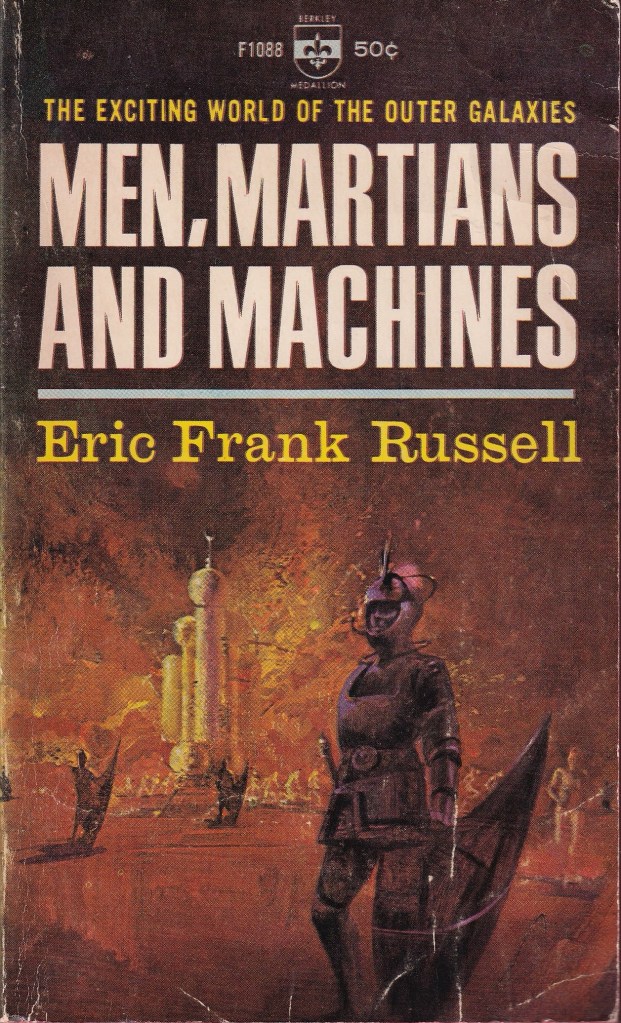
Paul Lehr’s–uncredited but certainly his style–cover for the 1965 edition
From the back cover: “VOYAGE OF THE MARATHON. Even at the time when space ships were making regular voyages across the universe, the MARATHON was a remarkable craft. Powered by the Flettner system, its speed was so great that for the first time exploration of the outer galaxies was made possible.
MEN, MARTIANS AND MACHINES describes some of the great voyages made by the MARATHON. There was, for example, the planet which was solely inhabited by machines–survivors, perhaps, from a civilization in which the first machine-makers had perished. On another planet, the inhabitants had developed the power of hypnotism to a fantastic degree, so that the observer saw only what he was willed to see.”
Contents: “Jay Score” (1941), “Mechanistria” (1942), “Symbiotica” (1943), “Mesmerica” (1955).
Initial Thoughts: I’ve only indirectly explored a few of Russell’s visions. I selected this one as the Jay Score / Marathon sequence stories contain examples of early genre magazine non-white characters.
2. Forbidden Area, Pat Frank (1956)
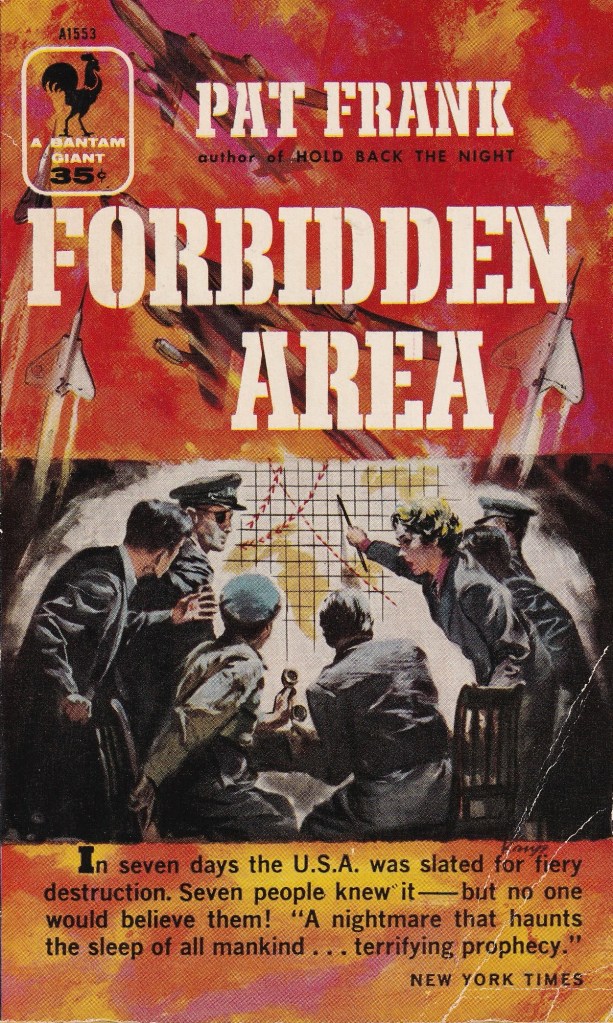
Barye Phillips’ cover for the 1957 edition
From the back cover: “ONLY SEVEN AMERICANS KNEW WHAT WAS COMING. The time of the enemy attack was cunningly chosen–Christmas Eve in a nation sleeping in peace.
Death would rain down from giant bombers–horror, fire and destruction.
Only seven Americans–six men and one girl in a secret room in the Pentagon–knew absolutely, factually, and without the shadow of a doubt that the United States was about to be destroyed.
They knew there wasn’t much time left. They told the brass; they reported to their general. But nobody would listen to them.
AND TOMORROW WAS CHRISTMAS EVE.”
Initial Thoughts: Yes, this might not be technically SF. However, it’s a nuclear-themed thriller that might be in Frank’s “near future.” I recently read Frank’s Alas, Babylon (1959) and wanted to read a bit more of his work. I also adore the cover!
3. The Exiles Trilogy, Ben Bova (1980)
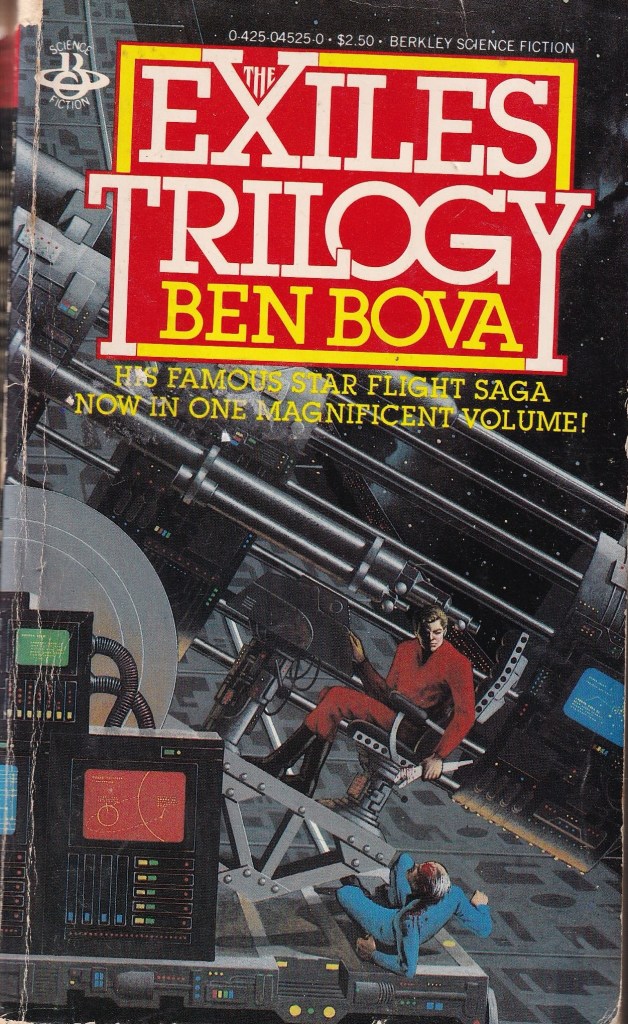
Uncredited cover for the 1st edition
From the back cover: “EXILED TO THE STARS! They were Earth’s best and brightest: the brilliant young generation of scientists who were the last hope of an overburdened planet.
But their breakthrough in genetic engineering threatened the despotic World Government, and they were rewarded for their success by the cruelest punishment ever devised.
Banned from Earth forever, they turned their exile into humankind’s greatest adventure. They left behind a million years of evolution and embarked on a one-way voyage across the Universe!”
Contents: Exiles from Earth (1971), Flight of Exiles (1972), End of Exile (1973)
Initial Thoughts: I am aware that these novels are most likely bottom-of-the-barrel generation ship stories. To add insult to injury, my cover is misprinted at an angle. However, I am on a (misguided?) quest to read all pre-1985 examples of the subgenre. If you’re new to the site, here’s my index on the topic. Also, here’s my most recent installment of my series: Mari Wolf’s “The First Day of Spring” (1954) and Francis G. Rayer’s “Continuity Man” (1959).
4. Tom’s A-Cold, John Collier (1933)
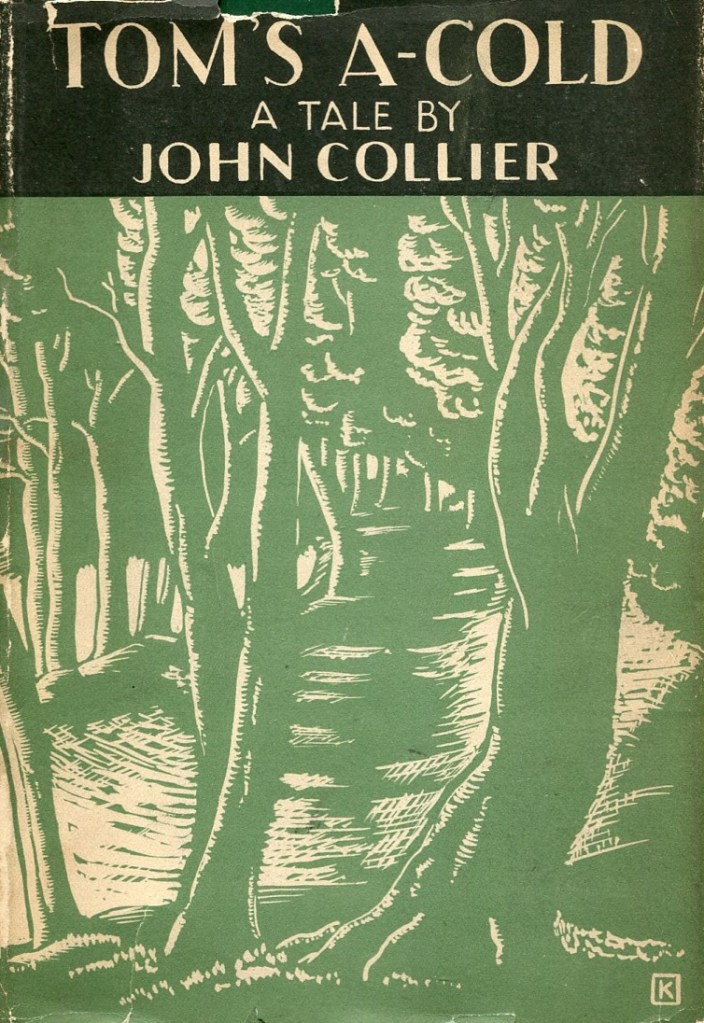
Uncredited (there’s a “K” initial) cover for the 1st edition
From the inside flap: My edition came sans dust jacket. Couldn’t find a pristine edition within my price range. Alas.
Initial Thoughts: All I know about this one are a few brief mentions in Andrew Hammond’s Cold War Stories: British Dystopian Fiction, 1945-1990 (2017) and the substantial SF Encyclopedia entry that I’ll reproduce for you:
“Radically dissimilar to his most familiar work is Tom’s A-Cold (1933; vt Full Circle 1933), a remarkably effective Scientific Romance set in a 1990s Ruined Earth, long after an unexplained Disaster has decimated England’s (and presumably the world’s) population and thrust mankind back into rural barbarism, a condition out of which the eldest survivors, who remember civilization, are trying to educate the young third generation. The simple plot plays no tricks on the reader: the young protagonist, a born leader, rises through raids and conflict to the chieftainship, undergoes a tragedy, and reconciles himself at the novel’s close to the burdens of a government which will improve the lot of his people. Throughout the novel, very movingly, Collier renders the reborn, circumambient natural world with a hallucinatory visual intensity found nowhere else in his work. Along with Alun Llewellyn’s The Strange Invaders (1934), Tom’s A-Cold can be seen, in its atmosphere of almost loving conviction, as a genuine successor to Richard Jefferies’s After London (1885).”
Sounds great!
For book reviews consult the INDEX
For cover art posts consult the INDEX
For TV and film reviews consult the INDEX
 Science Fiction and Other Suspect Ruminations
I love the cover of the Russell book. Feels pulpy yet sophisticated.
I’ve always held Lehr — the artist — in high regard.
And definitely look through his cover listing! (if you haven’t already)
https://www.isfdb.org/cgi-bin/ea.cgi?1391
Thank you for the recommendation. I recently bought an art book (I forget the name) full of SF covers from the golden age. Really fun to look through!
Adam Rowe’s Worlds Beyond Time: Sci-Fi Art of the 1970s (2023)? I interviewed him a while back about his book. And he contributed a post on 70s art books earlier this year.
No, it was Rayguns and Rocketships (2022). If I recall, most of the covers were from the 50s and 60s.
Ah.
I’ve read one of the Russell stories in that volume. It’s serving Star Trek TOS—not just because of the Black doctor—if maybe a little more militaristic. I seem to remember the villains in “Symbiotica” have some kind of space Zulu/jungle drums thing going on though.
It’s really good to hear from you!
Yup, the presence of a black doctor was the reason I tracked it down. I can’t remember where I read about the stories — maybe in some monograph in the last year or two. Did you review the Russell story on your site?
Joachim,
I read Frank’s Forbidden Area in 2019 and noted that it was “well done.” I’m not a fan of what I’ve read by Eric Frank Russell (mostly stories in old British SF magazines and the Hugo Award winning Allamagoosa) or Ben Bova. However, at the end of your post, you wrote, “Along with Alun Llewellyn’s The Strange Invaders (1934), Tom’s A-Cold can be seen, in its atmosphere of almost loving conviction, as a genuine successor to Richard Jefferies’s After London (1885).” I just finished The Strange Invaders at archive.org, where Aldiss laments in the introduction that the book has been forgotten. Maybe back in 1934 it rubbed people the wrong way because it was about Russians, with a heavy dose of Marx, Lenin & Stalin? I thought it was a little better than average, although throwing in the dinosaurs didn’t really complicate the love triangle. I’m now reading After London and finding Part 1 interesting, though dry. Amazon should be delivering Tom’s A-Cold today.
Andrew
Hello Andrew,
Yeah, I’m not a fan of what I’ve read of Russell or Bova either. The Bova, as I mentioned above, was only acquired due to my multi-year project to read all generation ship stories and novels written before 1985. I’m making substantial progress.
Of the bunch, I am most interested in Tom’s A-Cold. Due to that quoted reference to The Strange Invaders and its presence in a monograph on British dystopian post-WWII literature I just read, I went ahead and acquired it as well.
I am most interested in what you think of Tom’s A-Cold. It’ll probably encourage me to get to it faster!
Joachim
I finished After London and was amazed that something like this was published back in 1885. The first part could’ve been interwoven with the story to improve it, but by the end I was wishing it had gone on for another 100 pages. Having said that, Tom’s A-Cold was more enjoyable, not withstanding another unresolved ending. As stated in the 2020 Bruin preface, it is a novel with darkness and despair. Collier’s writing is solid, being lyrical at times with subtle wit and sharp perceptions about humanity. It was far ahead of its time, too, being published in 1933. I recommend both of them, and I’m glad that I first read After London followed by Tom’s A-Cold.
I downloaded the index to the British dystopian monograph you mentioned and have found other books of interest. I know your reasons for reading are different from mine, but I those titles you’ve mentioned and I have read, have been for the most part, very enjoyable!
Thanks very for much for your website!
Andrew
The Pat Frank book does look appealing. Pre-Sputnik worries about the US being behind enough in technology that a surprise attack could destroy it – wonder if he got a sales boost in 1957?
Joachim,
My reply was posted. And then it wasn’t. Even though I checked the “Save my name…” slider I had to do it again just now.
And then I got a notice, “Sorry, this comment can’t be posted.”
Suffice it to say, I recommended Tom’s A-Cold even though it, like After London, had unresolved ends.
Andrew.
Hello Andrew,
I see your reply from two days ago about Tom’s A-Cold (check earlier in the conversation in reply to one of your earlier points). I’m sorry I haven’t responded. Rough work week. Will have time later to respond to the bunch of recent comments I’ve received!