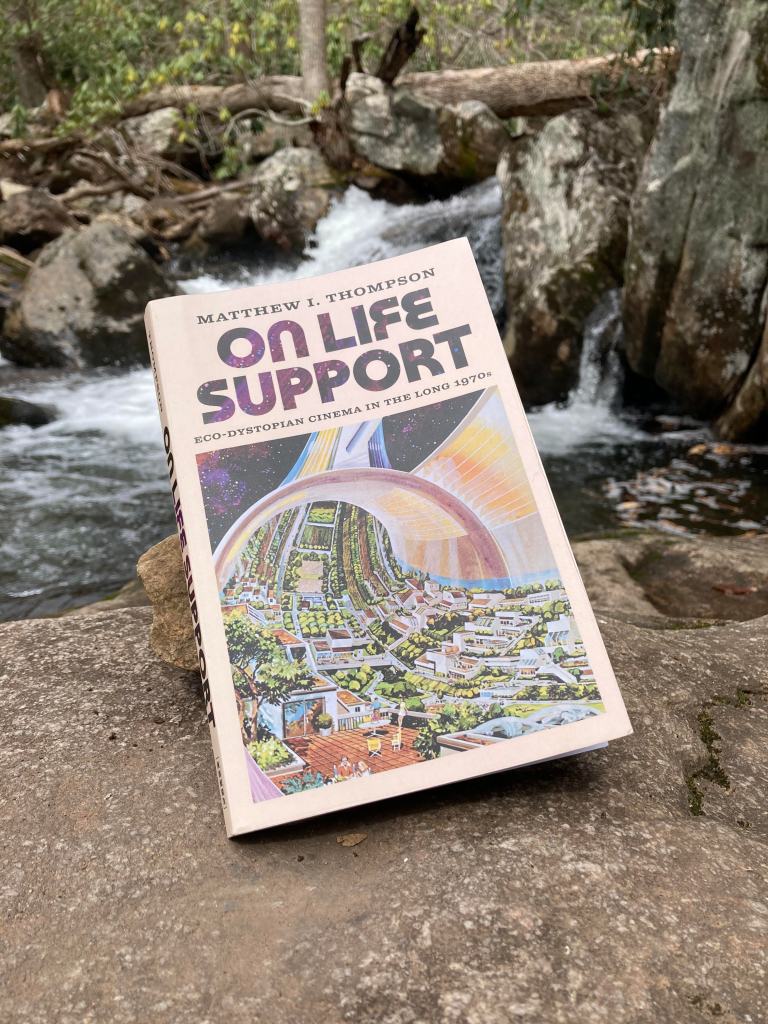
Matthew I. Thompson’s On Life Support: Eco-Dystopian Cinema in the Long 1970s (2026). Photographed by me on a hike in Pembroke, VA.
Over the last few years, I have highlighted a smattering of the vast range of spectacular scholarship on science fiction in my reviews and Exploration Log series that intrigue me.1 Today I have an interview with Matthew I. Thompson, author of the brand new book On Life Support: Eco-Dystopian Cinema in the Long 1970s (2026). Due to the focus of my site and research interests, I narrowed my questions primarily on the historical rather than theory-centric sections of his book.
You can buy a copy directly from University of Minnesota Press here or on Amazon. Paperbacks copies are relatively inexpensive ($28) for an academic press.
Let’s get to the interview and the intersections of the environmentalist movement and dystopian science fiction film!

Graphic created by my father
1. Thank you so much for agreeing to this interview. Can you introduce yourself and your interest in science fiction cinema?
Thanks so much for having me! My name is Matthew I. Thompson and I am an assistant professor of film studies at the University of Regina. My interest in science fiction began early, as my mom introduced me to the sf cannon. I remember watching the original Star Wars trilogy (1977, 80, 83) and Blade Runner (1982) on VHS and reading The Hitchhiker’s Guide to the Galaxy (1979) and The Left Hand of Darkness (1969). I’ve always loved how good sf establishes a world with its own internal rules and atmosphere. I’m especially into the terminology for as-yet un-invented technologies that are taken for granted in the world of the story.
Once I began studying science fiction academically, I became fascinated by how the genre renders the major social and political concerns of its moment into strange distant futures and other worlds. One can trace the major developments of the twentieth century in North America through a science fiction lens to reveal some of the hidden hopes and fears driving political thought. Film, even more than sf literature, makes this sort of analysis possible as it is a mass medium produced by hundreds and consumed by millions.
2. Before we dive into more specific arguments and positions you take in your recent book, On Life Support, is there a particular movie (or specific scene) that served as the genesis point for your research on 70s eco-dystopian cinema?
Yes, there is, actually. During my master’s I was working closely with Dr. Sheryl Vint who first pointed me towards the 70s cycle of eco-dystopian films that became the focus of my PhD dissertation and then my book. The first of these films that I watched was Soylent Green, and I remember it quite clearly because I saw it in an unusual setting. My friend and I were visiting another friend who lived deep in the north Ontario woods alone all winter. We had driven about five hours north from Toronto in February to a remote parking lot on the shore of Lake Temagami. Our friend then picked us up on his snowmobile and drove 45 minutes up the lake to his off-grid cabin. During the day we would cross-country ski and ice fish, and at night we would watch movies by the fire. One night I managed to convince my friends to watch Soylent Green, and it was then that I realized that my environmentalism and love of the wilderness and my passion for science fiction could overlap. Soylent Green begins with an environmentally nostalgic opening montage that sets the stage for an apocalyptic future, and I was just totally grabbed by it.
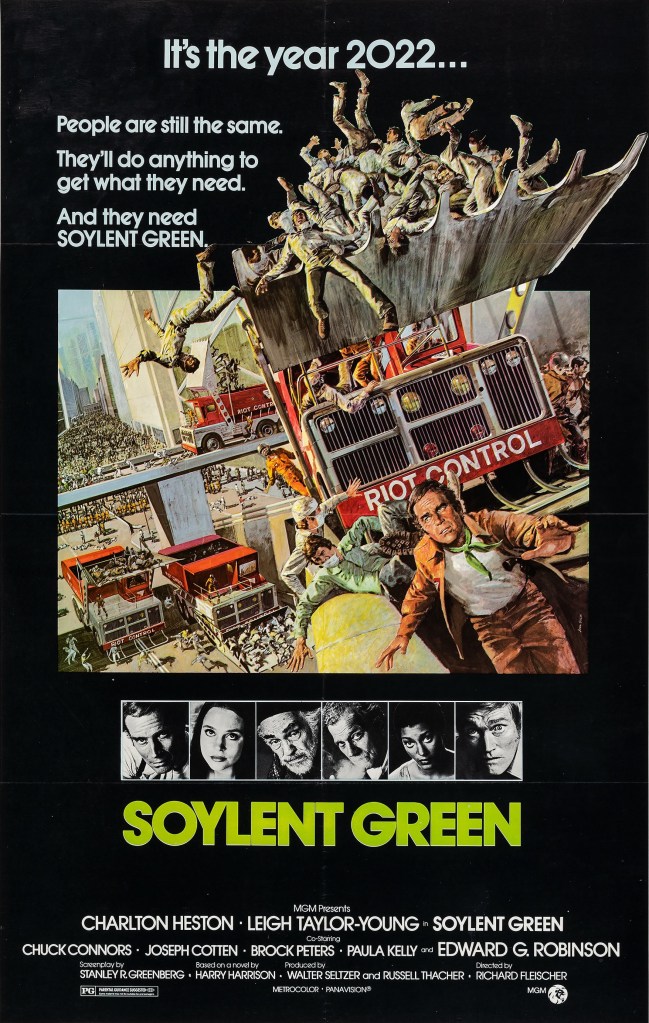
John Solie’s poster for Soylent Green (1973)
3. With a few exceptions, your analysis focuses on SF film between 1968-1977. Why this chronological range?
Joan Dean identifies this period of science fiction film history and labels it “from 2001 to Star Wars.” This is a distinct cycle of films because 2001: A Space Odyssey and The Planet of the Apes, both released in 1968, demonstrated that there was an appetite for relatively big-budget and thematically dark science fiction. Following these two films there was a spate of dystopian science fiction films produced like Silent Running (1972), Soylent Green (1973), Zardoz (1974), and Logan’s Run (1976). In 1977, however, Star Wars: A New Hope and Close Encounters of the Third Kind were released, and they paved the way for a less cynical science fiction landscape.
The films of the period between ‘68 and ‘77 are important because they took the concerns of the rapidly growing environmental movement and projected them into ecologically devastated futures. In so doing, I argue in On Life Support, they clarify some of the murky assumptions that inform the environmental politics of the era. These assumptions, that the environment benefits from human containment and control, for example, continue to plague the environmental movement into the present. That these films were made at all is thanks in part to the financial crisis of the major movie studios in the 1960s which led to the creative freedom and countercultural influence of the New Hollywood directors in the 1970s.
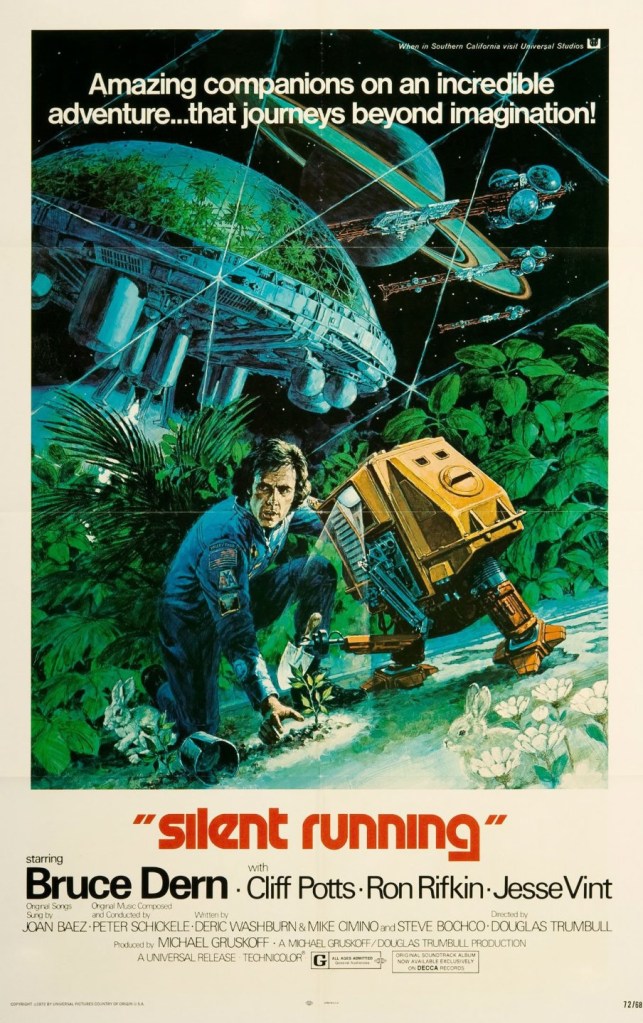
George Akimoto’s poster for Silent Running (1972)
4. Your book repeatedly returns to the relationship between containment and contamination. How is this a helpful lens to view filmic environmentalism? Can you provide an example?
I find that the tension between a desire for containment and a fear of contamination structures the environmental rhetoric of the 1970s. Environmentalists then and now often seek to preserve nonhuman nature by containing it within the confines of a greenhouse, a national park, or the cinematic frame. Conversely, environmentalists fear contamination and seek to avoid it at all costs. I argue for a politics of contamination, not to encourage pollution, but to demonstrate that we think more ecologically when we come to terms with the fact that human control and containment of nonhuman nature is a fiction: a fiction that has allowed us to harm the environment (including ourselves) to the extent that we have.
In the book I make a connection between the rhetorical figures used to represent environmental ideas and this spectrum that stretches from containment to contamination. In rhetoric metaphor and metonymy are often thought of as “super figures” which structure poetic language. Metaphor signifies by exchanging one signifier with another in order to draw our attention to how similar they are. The popular metaphor “Spaceship Earth” emphasizes the ways that our planet travels through space while supporting life like a spaceship. Metonymy, on the other hand, exchanges one signifier for another based on proximity and integration. Around the same time that Spaceship Earth was a popular metaphor, Rachel Carson was using metonymy to connect the human body to the global environment, showing that the same chemicals that contaminated the environment were found polluting human bodies. I argue that metaphor contains one signifier within another while metonymy contaminates the two. In this way the spectrum of containment-contamination maps onto the rhetorical spectrum that stretches between metaphor and metonymy.
The method of my book involves isolating environmental rhetoric like the metaphor of Spaceship Earth and then looking at how that rhetoric was visualized in eco-dystopian science fictions films.
5. How does Douglas Trumbull’s Silent Running (1972) manifest the contradictions of 70s environmentalism?
Silent Running takes place in a future where anthropogenic climate change has rendered Earth inhospitable to all nonhuman nature. Humans survive there synthetically, and appear to be thriving. The last remaining Earth ecosystems are preserved in biodomes on board spaceships like the Valley Forge. The film is set on the Valley Forge as an order comes through to jettison and destroy the biodomes so that the spaceships can return home. The Valley Forge’s ecologist, Freeman Lowell (Bruce Dern), is shocked at this development, and his crewmates indifference. He mutinies, killing his fellow crew and hijacking the spaceship to save the ecosystems.
I argue that this film takes the metaphor of Spaceship Earth, at that time a very influential environmental figure, and visualizes it. Once visualized in the form of the Valley Forge, the Spaceship Earth metaphor begins to reveal some of its problematic assumptions. Nonhuman nature is contained within a human-designed and controlled spaceship. Spaceship Earth is a technophilic metaphor that imagines that the planet could be contained and controlled by human technology. Ironically, the film itself was supported in part with brand placement from Dow Chemical, at that time a leading producer of DDT, Agent Orange, and Napalm. These are chemicals that seek to control nonhuman nature, and their unconstrained use could lead to a future very like that depicted in Silent Running.

Biodomes on the Valley Forge in Silent Running (1972)
6. I’m deeply fascinated by the generation ship subgenre. For more than a decade, I’ve added to Simon Caroti’s index of textual examples. I’m slowly working through all pre-1985 examples available in English. I recently covered Francis G. Rayer’s “Continuity Man” (1959), in which the contained “natural” world grows redolent with rot as the surviving crew approaches the target destination. And there’s of course iconic novels like Brian W. Aldiss’ Non-stop (1958), in which the generation ship’s interior, chocked with unchecked vegetal growth, parallels the crew’s isolation and ignorance about their world. However, I have not looked at them through an environmental lens. How do filmic examples like The Starlost (1973-1974) complicate the Starship Earth metaphor?
This is such a great question, I’m also fascinated by generational earth-ship stories. I recently finished reading Adrian Tchaikovsky’s Children of Time, so I have been thinking about the earth-ship ark trope in science fiction recently. The Starlost was a short-lived Canadian television series based on a concept by Harlan Ellison. The show takes place onboard “a giant ark, one thousand miles long, comprised of hundreds of self-contained biospheres.” In each of these biospheres (which were heavily inspired by Silent Running), a distinct human culture and ecosystem are preserved. Not only has the Earth been destroyed, but the ship has been damaged and the crew piloting the ark are all dead. The show takes place when one farmer from an Amish dome discovers that their world is in fact a ship, a ship that is on a collision course with a star. The Starlost production was an absolute disaster, and it is generally considered to be one of the worst science fiction TV shows, despite starring Keir Dullea from 2001 and having Ben Bova as a science advisor. The concept of an earthship where everyone has forgotten what Earth was is an important continuation of the Spaceship Earth metaphor. It pushes the metaphor to its logical limit, where there is no longer any distinction between spaceship and Earth.

Uncredited cover for the 1975 1st edition. Novelization of The Starlost (1973-1974)
7. As you point out, Rachel Carson’s Silent Spring (1962), and her characterization of the human body as ecosystem, transformed the environmentalist movement. How did it impact cinema?
Rachel Carson was the first person to collect scientific reports on the harms of pesticides like DDT into a compelling narrative legible to the public. It is hard to overstate the impact of Silent Spring on North American culture in the 1960s and 70s. In terms of cinema, Carson’s impact can be seen in all of the eco-dystopian films of the period, but I found the most methodological kinship between Carson and the Canadian filmmaker David Cronenberg.
Both Carson and Cronenberg, in their own way, helped transform the human body from an enclosed and impermeable system into a leaky and porous membrane. In Cronenberg’s first commercial feature, They Came from Within (AKA Shivers, 1975), a human-designed, sexually transmitted parasite passes from body to body within a condo development outside of Montreal (the condo is called “Starliner Towers” which can be read as a critique of the Spaceship Earth metaphor). The parasite turns its host into a sex-zombie before crawling out of the body in horrible ways. They Came from Within, like later Cronenberg films such as The Fly (1986) and Naked Lunch (1991), visually and viscerally represents Carson’s argument; namely, that the human body, the environment, and technology are all contaminated with one another.
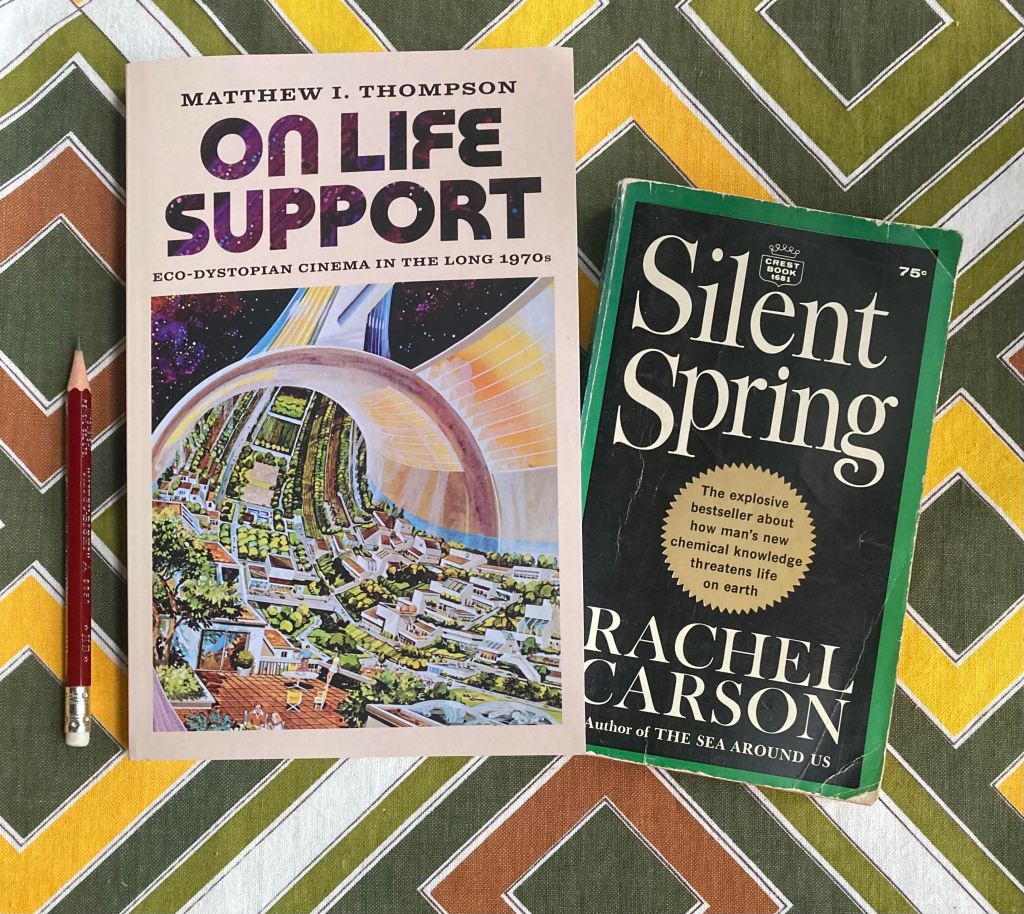
Photo of Matthew I. Thompson’s On Life Support: Eco-Dystopian Cinema in the Long 1970s (2026) and Rachel Carson’s Silent Spring (1962)
8. Both Rachel Carson in Silent Spring (1962) and Paul R. Ehrlich in The Population Bomb (1968) engage in dystopian science fiction extrapolation. What rhetorical and conceptual purpose does it serve?
What I realized while researching and writing this book is that science fiction and environmentalism actually share a lot of structural similarities. Both are deeply concerned with the future and what consequences our current actions will have on that future. Both often have a pessimistic outlook ranging from dystopian to apocalyptic. I also noticed that some of the most effective environmental authors of the 60s and 70s used the genre of science fiction within their nonfiction books to convince readers of the importance of their arguments. Carson’s book famously begins with a chapter titled “A Fable for Tomorrow” which takes real events involving pesticide use from around the country and amalgamates them into one fictional town. Ehrlich, who was a much less careful disseminator of scientific knowledge than Carson, also used science fiction in his fear-mongering population control book. In The Population Bomb, Ehrlich asks us to imagine that the world population has continued to grow at the rate it had been during the first half of the twentieth century. Ehrlich peers 900 years into the future where the population has swelled to sixty million billion people housed in a 2,000-story building covering the entire globe.
9. As you survey in your chapter on Cetacean Cinema, whales and dolphins shifted in the popular imagination from “profitable sources of fats and oils before the 1960s to the benevolent poster child of environmental campaigns in the 1970s” (84). Yet you characterized 70s film depictions, inspired by John C. Lilly’s influential publications, in their attempt to “plumb the inscrutable world of Cetacea” simultaneously “cause them harm” (106). Can you explain this apparent paradox?
Yes, the paradox is that scientists like Lilly needed to contain and control whales and dolphins by placing them within tanks, hammering electrodes into their brains, and trying to teach them English before they came to respect their right to be free. Once Lilly came to this realization (around the time that his scientific funding dried up) he released his dolphin test subjects back into the ocean. The sad irony is that once whales and dolphins have been in captivity for an extended period of time, they are no longer capable of surviving in the wild. Lilly’s books and the subsequent Save the Whales movement inspired films like The Day of the Dolphin (1973) and Orca (1977) which were critical of the keeping of captive cetaceans, despite needing captive cetacean actors to make their films. This paradox came to a head with the film Free Willy (1993) where a captive orca named Keiko played a freed whale named Willy. After the film was released, pressure mounted on the studio to free Keiko, and millions were spent trying to prepare him for reintegration into the wild ocean. Despite a massive effort, Keiko died of pneumonia in a Norwegian fjord 18 months after his release into the Atlantic.
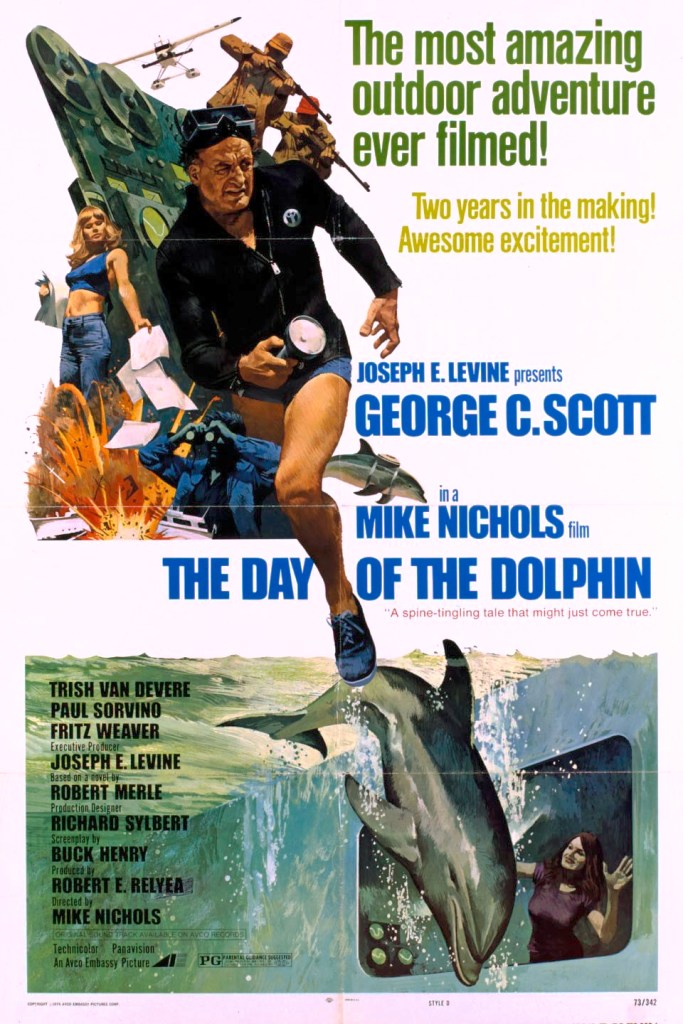
Poster for The Day of the Dolphin (1973)
10. In 1973, Peter Tompkins and Christopher Bird published the pseudoscientific The Secret Life of Plants (1973) that inspired multiple science fictional films. I cannot help but narrow in instead on the bizarre 1979 documentary with a score by Stevie Wonder! Can you explain a bit about how his lyrics and use of archival footage intertwine concerns of “environmental degradation and systematic racism” (137)?
Yes, somewhat improbably, after Innervisions (1973), Fulfillingness’ First Finale (1974), and Songs in the Key of Life (1976), each of which won a Grammy for album of the year, Wonder turned his talents to scoring an obscure documentary about plants. The Secret Life of Plants (1979) and Wonder’s score focus on the botanists Sir Jagadish Chandra Bose and George Washington Carver who were marginalized by the scientific community because of their race. I argue that the documentary and the score draw a metonymic connection between the marginalization of plants and people of color. The song “Same Old Story,” for example, plays in the documentary over archival footage of Bose and Carver. Wonder’s lyrics are displayed onscreen almost like title cards for a silent film. The song argues that Bose and Carver had to fight simultaneously for the legitimacy of themselves as scientists and for the amazing capacities of the plants they studied. Carver, a Black agriculturalist born to parents who were enslaved, is known for discovering that nitrogen-fixing crops like peanuts could replenish soil ravaged by years of cotton monoculture. Wonder draws a connection between the abuse of nonhuman nature and the abuse of nonwhite people, prefiguring, I argue, the central claim of the environmental justice movement.
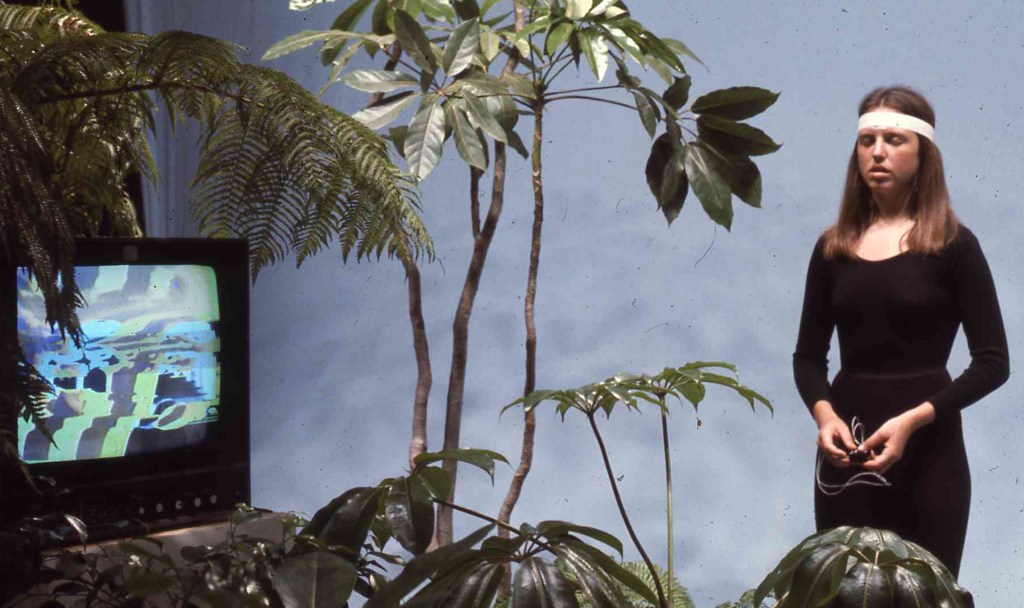
Still from The Secret Life of Plants (1978) with score by Stevie Wonder
11. You characterize Richard Fleischer’s Soylent Green (1973), inspired by Paul R. Ehrlich’s The Population Bomb (1968) and adapted from Harry Harrison’s novel Make Room! Make Room! (1966), as a distillation of the “white liberal fears and desires that plague both science fiction and environmentalism in the 1970s and today” (160). What fears? What desires?
Ok, so I have to begin with a spoiler. The film Soylent Green revolves around a mysterious ingredient in the titular popular food-replacement wafer. In the overpopulated future of the film (it is set in 2022!) everyone survives on Soylent wafers which are supposedly made out of plankton. What Charleton Heston’s detective discovers, however, is that the plankton have all died and Soylent Green is instead made out of people. Soylent Green was a part of a neo-Malthusian discourse popular in the 1970s and I argue that it uncovers a secret fear informing the overpopulation anxiety in books like The Population Bomb and Make Room! Make Room! Tracing all the way back to Malthus himself, I discovered marginal mentions of anthropophagy in overpopulation discourse. In other words, demographic dystopians often mention, as a throw away aside, the possibility that as the world’s population exceeds the planet’s carrying capacity humans will begin to eat each other. These off-hand remarks become the central premise of Soylent Green, which exposes that the Malthusians are secretly afraid of being eaten. More specifically, they are afraid of being overwhelmed and consumed by the marginalized nations of the globe which have higher birth rates. I argue that overpopulation discourse is typically informed by a desire to protect a way of life only available to a privileged few and a fear of being consumed by the Other.
Soylent Green prompts me to ask, however: is cannibalism such a bad solution to overpopulation? It simultaneously decreases the population and increases the food supply. If people voluntarily submit themselves to be eaten, perhaps it is the type of unconventionally elegant solution we need in our era of crisis?
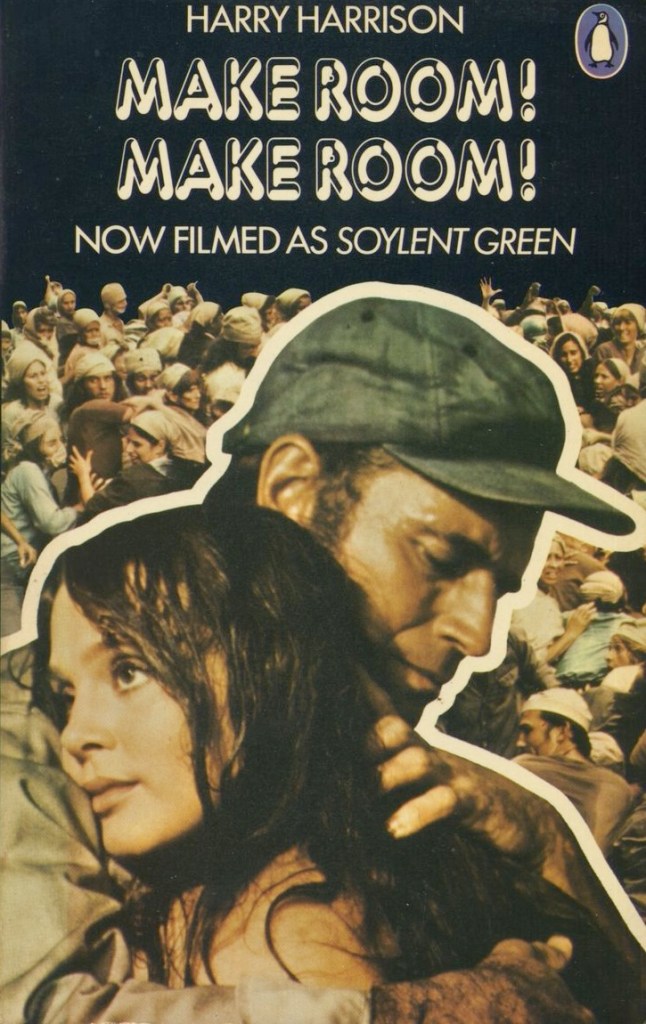
Film still cover for the 1973 edition of Harry Harrison’s Make Room! Make Room! (1966)
12. Despite its low budget and negative critical response, George McCowan’s Frogs (1972) emerges from your analysis as quite radical and forward thinking. How does it escape some of the pitfalls of Soylent Green and its source material?
Frogs, like Rachel Carson and the films of Cronenberg, eschews containment and purity and instead foregrounds contamination. It takes place in a plantation-era mansion in the American South, where the owner of a pulp and paper corporation named Jason Crockett (Ray Milland) is poisoning the noisy local frogs. Rather than focusing on ecological problems with global effects and universal blame, Frogs ties a local ecological crime to a specific person, namely, a racist industrial polluter. The local frogs build an ecological coalition of reptiles, amphibians, and insects who begin picking off members of the Crockett family. One unlucky Crockett is sent to the greenhouse to collect a bouquet of flowers for the elder Crockett’s birthday celebration (which happens to be on the Fourth of July). Throughout On Life Support, the greenhouse represents the fantasy of containment and control prevalent in environmental discourse. In Frogs, however, the greenhouse is transformed into a contaminated metonymy of our planet. While in the greenhouse, lizards knock over jugs of pesticide and Crockett’s son is poisoned with the same chemicals that were sprayed on the frogs at the outset of the film. In this way the film ties the poisoning of the environment to the poisoning of ourselves, and places blame on individual polluters who hold the corporate power to effect real ecological change.
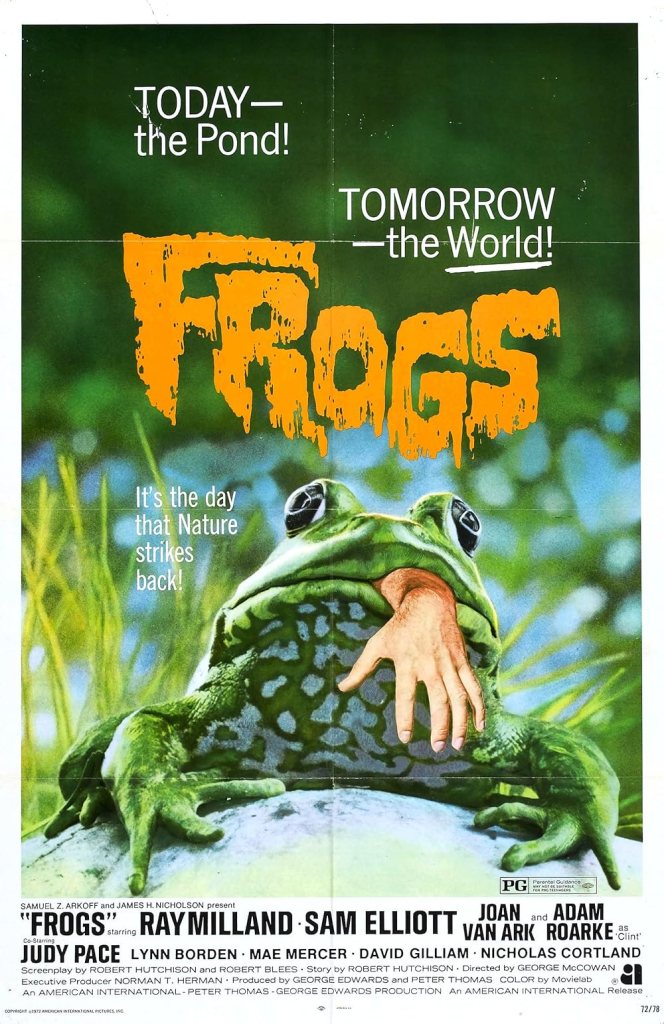
Poster for Frogs (1972)
13. What are your next projects?
Right now, I am working on an essay about artificial intelligence, science fiction, and environmentalism. In particular, I am looking at ecological robots in children’s science fiction films. I argue that robots like WALL-E and Roz from The Wild Robot (2024) are expressing a hope echoed by tech billionaires that artificial intelligence will take care of the environment for us. This hope allows us to plow trillions into AI exactly when that type of investment is needed to avert a climate disaster.
14. Thank you so much for your answers. Good luck with your future projects!
Thank you for your insightful questions!
Notes
- Relevant previous posts: Interview with Chukwunonso Ezeiyoke, author of Nigerian Speculative Fiction: The Evolution (2025); Interview with Jaroslav Olša, Jr., author of Dreaming of Autonomous Vehicles: Miles (Miroslav) J. Breuer: Czech-American Writer and the Birth of Science Fiction (2025); Interview with Jordan S. Carroll, author of Speculative Whiteness: Science Fiction and the Alt-Right (2024); Interview with Adam Rowe, author of Worlds Beyond Time: Sci-Fi Art of the 70s (2023); Al Thomas’ “Sex in Space: A Brief Survey of Gay Themes in Science Fiction” (1976); and Sonja Fritzsche’s “Publishing Ursula K. Le Guin in East Germany” (2006). ↩︎ ↩︎
For book reviews consult the INDEX
For cover art posts consult the INDEX
For TV and film reviews consult the INDEX


Pingback: Pixel Scroll 4/3/26 Hello Centaur, Give Me Doctor Scroll | File 770
Thank you Mike for linking the interview!
The nihilism in Silent Running is intense, vivid memories of seeing that as a kid and being sort of confused by the grim griminess of it. Never heard of Frogs before, sounds like a dry run for the better known Piranha.
I’m pretty sure I saw Silent Running as a young teenager. My memories revolve around his robotic “friends” and the visuals. Not so much its griminess or, as Thompson indicates, its technophilic dreams of ecological containment.
I’d never heard of Frogs either until I read the book.
Another interesting short film that doesn’t come up in the interview but features prominently in the monograph is Rolf Forsberg’s Ark (1970). It’s available to watch online. Might give that one a go! https://vimeo.com/415210481