Exploration Log 13: Interview with Matthew I. Thompson, author of On Life Support: Eco-Dystopian Cinema in the Long 1970s (2026)

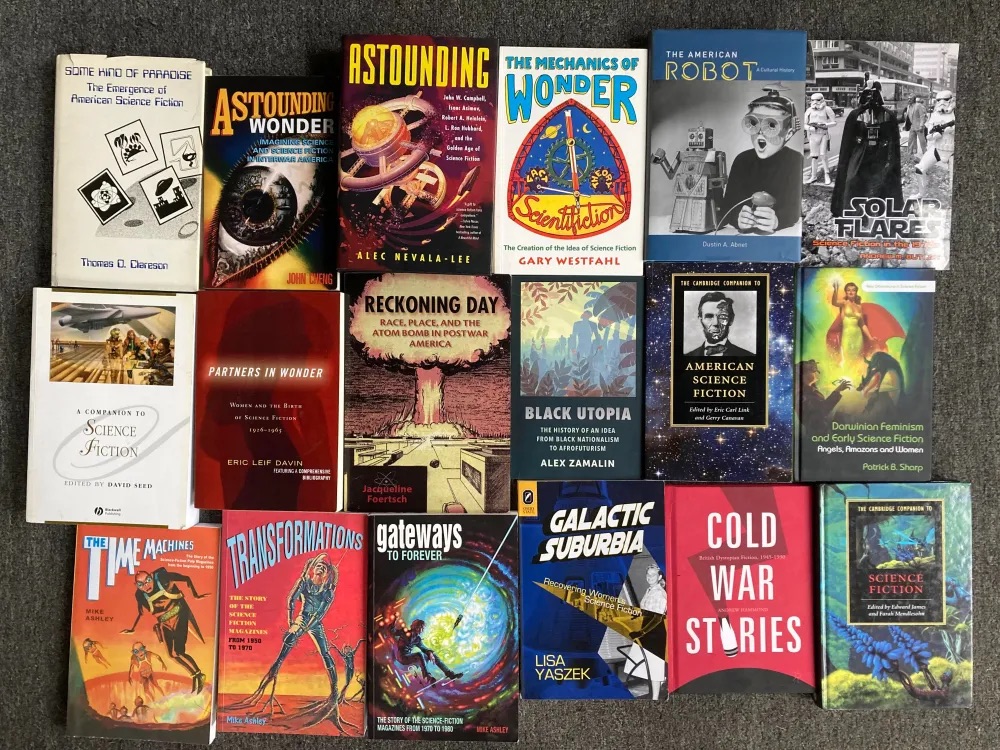
Over the last few years, I have highlighted a smattering of the vast range of spectacular scholarship on science fiction in my reviews and Exploration Log series that intrigue me.1 Today I have an interview with Matthew I. Thompson, author of the brand new book On Life Support: Eco-Dystopian Cinema in the Long 1970s (2026). Due to the focus of my site and research interests, I focused my questions primarily on the historical rather than theory-focused sections of his book.

You can buy a copy directly from University of Minnesota Press here or on Amazon. Paperbacks copies are relatively inexpensive ($28) for an academic press.

Let’s get to the interview and the intersections of the environmentalist movement and dystopian science fiction film!


1. Thank you so much for agreeing to this interview. Can you introduce yourself and your interest in science fiction cinema?

Thanks so much for having me! My name is Matthew I. Thompson and I am an assistant professor of film studies at the University of Regina. My interest in science fiction began early, as my mom introduced me to the sf cannon. I remember watching the original Star Wars trilogy (1977, 80, 83) and Blade Runner (1982) on VHS and reading The Hitchhiker’s Guide to the Galaxy (1979) and The Left Hand of Darkness (1969). I’ve always loved how good sf establishes a world with its own internal rules and atmosphere. I’m especially into the terminology for as-yet un-invented technologies that are taken for granted in the world of the story.

Continue reading

Short Book Reviews: Fritz Leiber, Jr.’s Gather, Darkness! (1943, novelized 1950) and Gillian Freeman’s The Leader (1965)

Note: My read but “waiting to be reviewed pile” is growing. Short rumination/tangents/impressions are a way to get through the stack before my memory and will fades. My website partially serves as a record of what I have read and a memory palace for future projects. Stay tuned for more detailed and analytical reviews.

1. Fritz Leiber’s Gather, Darkness! (1943, novelized 1950)

3.25/5 (Above Average)

Frtiz Leiber’s Gather, Darkness! first appeared across the May, June, and July 1943 issues of Astounding Science-Fiction, ed. John W. Campbell, Jr. It was novelized in 1950. Written in the midst of WWII, Gather, Darkness! is a product of an important moment in Leiber’s life. The previous year he abandoned his profession as a speech and drama instructor at Occidental College (1941-1942) and decided that “the struggle against fascism mattered more than his long-held pacifist convictions.” He joined Douglas Aircraft as a quality inspector and continued to publish science fiction.1

Continue reading

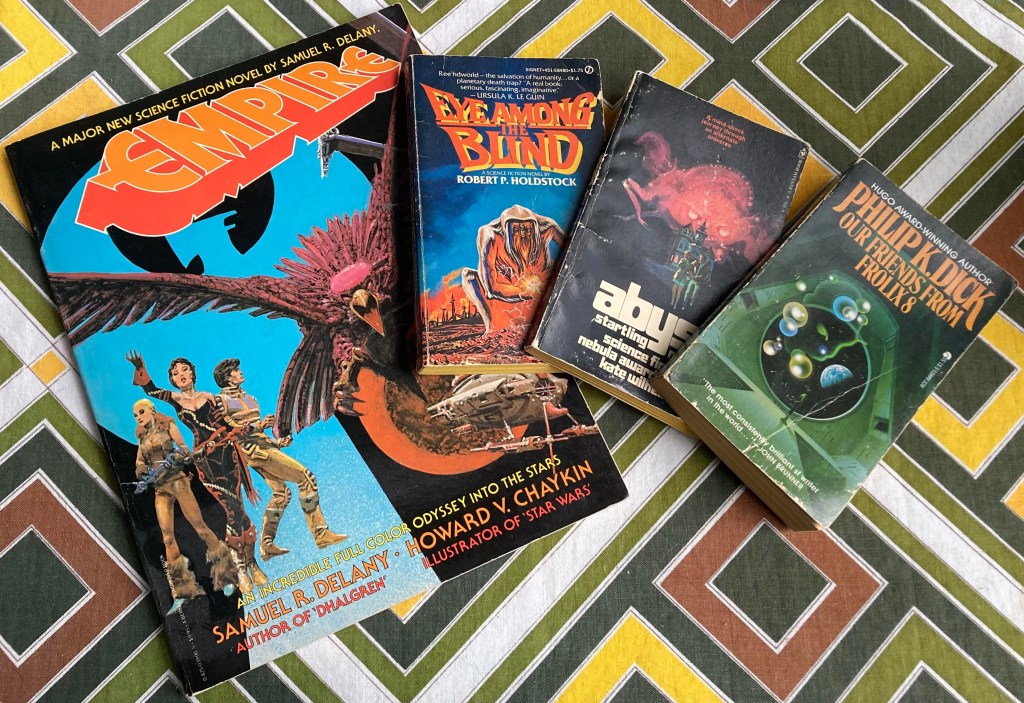
Updates: Recent Science Fiction Purchases No. CCCXLVIII (Eric Frank Russell, Ben Bova, Pat Frank, and John Collier)

Which books/covers/authors intrigue you? Which have you read? Disliked? Enjoyed?

1. Men, Martians, and Machines, Eric Frank Russell (1955)

From the back cover: “VOYAGE OF THE MARATHON. Even at the time when space ships were making regular voyages across the universe, the MARATHON was a remarkable craft. Powered by the Flettner system, its speed was so great that for the first time exploration of the outer galaxies was made possible.

Continue reading

My 2025 in Review (Best Science Fiction Novels and Short Fiction, Reading Initiatives, and Bonus Categories)

Here’s to happy reading in 2026! I hope you had a successful reading year. Whether you are a lurker, occasional visitor, a regular commenter, a follower on Bluesky or Mastodon, thank you for your continued support. As I say year after year, It’s hard to express how important (and encouraging) the discussions that occur in the comments, social media, and via email are to me. I’m so thankful for the lovely and supportive community of readers, writers, and discussion partners that stop by.

What were your favorite vintage SF reads–published pre-1985–of 2025? Let me know in the comments.

Throughout the later part of the year I’ve dropped hints about a research project. Perceptive readers might have parsed together the contours of the research: late 19th/early 20th century, utopian, African American, the American South, radical politics… It’s taking longer than expected. I’ve read a good ten monographs, five dissertations, countless articles. I’ve written twenty pages. I hoped to have it posted by early in this year. Alas. It’s coming together–slowly. Stay tuned.

Without further ado, here are my favorite novels (I only read a few) and short stories (I read a ton of those) I read in 2025 with bonus categories. I made sure to link my longer reviews where applicable if you want a deeper dive.

Check out my 202420232022, and 2021 rundowns if you haven’t already. I have archived all my annual rundowns on my article index page if you wanted to peruse earlier years.


My Top 5 Science Fiction Novels of 2025

1. Octavia E. Butler’s Clay’s Ark (1984), 4.5/5 (Very Good). Full review.

Continue reading

What pre-1985 science fiction are you reading? + Update No. XXVII

What pre-1985 science fiction are you reading or planning to read next month? Here’s the October installment of this column.

If I’m feeling a bit unmotivated to write about science fiction, I always end up on Fanac or another online repository of fanzines/newspapers exploring all the old historical fannish debates. I especially enjoy their reports on various conventions and the community (from accepting to reactionary) that emerges. For example, the details I uncovered about a lost Philip José Farmer speech titled “SF and the Kinsey Report at the 11th World Science Fiction Convention (Philcon 2) in Philadelphia (September 1953) and Pat M. Kuras and Rob Schmieder’s article “When It Changed: Lesbians, Gay Men, and Science Fiction Fandom” (1980) on the first Worldcon panel with an openly LGBTQ topic: “The Closed Open Mind: Homophobia in Science Fiction Fantasy Stories” moderated by Jerry Jacks, one of the “early openly gay fans.” I recently edited a friend’s article for academic publication on the role of conventions in forming feminist and political activism. Conventions sound like fascinating places, at least from my historically-minded vantage point and lens.

Continue reading

Updates: Recent Science Fiction Purchases No. CCCXLVI (Kim Stanley Robinson, Miriam Allen DeFord, Keith Laumer, and Jack Dann)

Which books/covers/authors intrigue you? Which have you read? Disliked? Enjoyed?

Finally acquired a new scanner!

1. The Memory of Whiteness, Kim Stanley Robinson (1985)

From the back cover: “In the 33rd century humanity is scattered among the planets of the Solar System. Millions of lives depend on the revolutionary physics of Arthur Holywelkin; millions of hears are moved by the music created by the strange, eerie instrument he built in the last years of his life: the Orchestra. Johannes Wright is the Ninth–and youngest–Master of the Orchestra. But as he sets out on his first Grand Tour of the Solar System, unseen foes are at his heel, ready to reveal all but the meaning of their enmity. In confronting them, Wright must redefine the Universe–for himself and all humanity.”

Continue reading

What pre-1985 science fiction are you reading? + Update No. XXVI

What pre-1985 science fiction are you reading or planning to read next month? Here’s the August installment of this column.

The Power of the List. I adore lists. I’ve compiled lists of science fiction stories on my site about generation ship stories, immortality (abandoned), overpopulation (abandoned), and sports and games (abandoned). I religiously update my SF Novel and Short Story Review index and the Best SF Novels I’ve reviewed index. In your exploration of genre, I imagine you’ve encountered a “Best Of” list that horrified you — they tend to generate controversy, argument, and all sorts of impulsive takes. Lists can be dangerous. Lists can suggest canon. Lists exclude. Lists can be incomplete. Lists can motivate. Ian Sales, a long-time critic, author, and visitor to my site, created the SF Mistressworks (unfortunately, also abandoned) website in response to an egregious list that demonstrate utter ignorance about the wonderful SF written by women.

Continue reading

Short Fiction Reviews: George H. Smith’s “The Last Days of L.A.” (1959) and “In the Imagicon” (1966)

Back in 2021, I reviewed and adored George H. Smith’s “The Last Crusade” (1955), a scathing take-down of modern war (replete with confused soldiers in mech suits). While a good portion of Smith’s science fictional output was comedic smut with titles like Those Sexy Saucer People (1967) and Flames of Desire (1963), he clearly could craft an effective short fiction in the best genre magazines of the day.

I appeared recently on a podcast about Philip K. Dick’s masterpiece “Foster, You’re Dead” (1955) and felt the urge to track down story about nuclear terror. Smith’s drunk whirlwind of a story “The Last Days of L. A.” (1959) fits the bill. In addition, I selected “In the Imagicon” (1966), an intriguing take on a personal virtual reality machine, as the 34th story in my series on media landscapes of the future.

Previously in my future media series: Russell Bates’ “Hello, Walls and Fences” (1973) and “Warning: The Surgeon General Has Determined…:” (1977)

Up Next: Izumi Suzuki’s “Terminal Boredom” (1984)

Let’s get to the stories!


4/5 (Good)

“The Last Days of L. A.” first appeared in If, ed. Damon Knight (February 1959). You can read it online here.

Continue reading

What pre-1985 science fiction are you reading? + Update No. XXV

What pre-1985 science fiction are you reading or planning to read next month? Here’s the July installment of this column.

One of my favorite forms of SF scholarship is careful identification of a intellectual genealogy–tracing what an author read and engaged in dialogue with. Authors are readers. They also can’t escape references and textual traces of what they’ve consumed (or, of course, engagement with the world in which they lived).

I’ve read two interesting examples recently. The first, Carol McGuirk’s “J. G. Ballard and American Science Fiction” in Science Fiction Studies, vol. 49 (2022), is the perfect example of this type of scholarship. She traces Ballard’s engagement with SF, his earliest stories, and the various parallels an interactions between his work and American SF that he read (Galaxy Magazine, Theodore Sturgeon, Fritz Leiber, Robert Heinlein, Frederik Pohl, C. M. Kornbluth, Ray Bradbury, Judith Merril, Federic Brown, Henry Kuttner, C. L. Moore, etc.). She argues that Ballard engaged in “retelling with a twist” (476). She writes that “early Ballard stories rework prior sf in moods ranging from measured homage to barbed repose to parodic photo-bomb” (483).

Continue reading