Which books/covers/authors intrigue you? Which have you read? Disliked? Enjoyed?
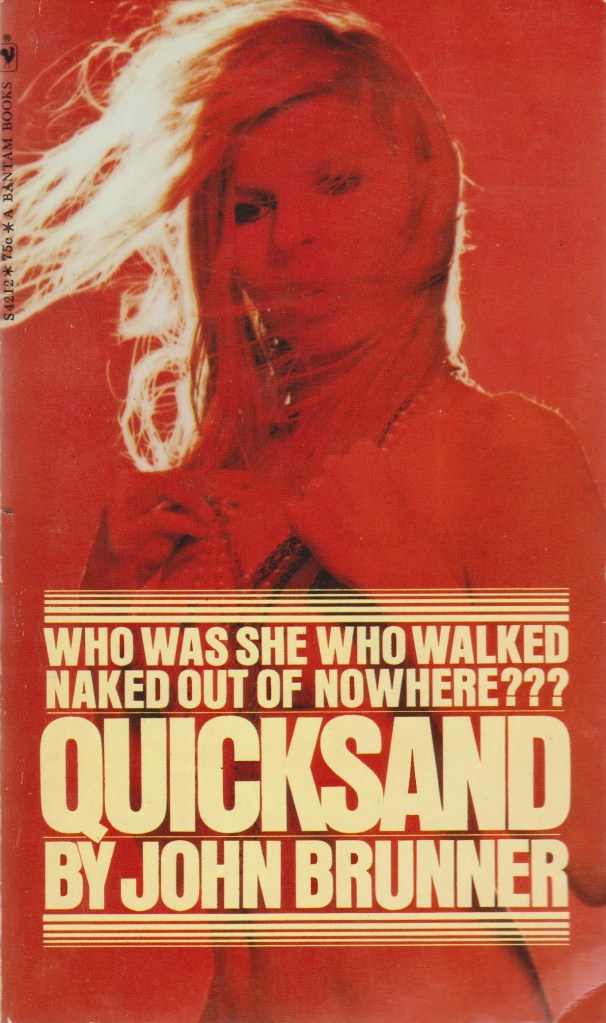
1. Quicksand, John Brunner (1967)
Uncredited cover for the 1969 edition
From the back cover: “She had nearly killed a man who tried to assault her. She spoke a language no one could understand. Commonplace objects like clothing and cars were a mystery to her.
Paul was haunted and entranced by her. He licked at the secrecy that surrounded her until, inevitably, his fate became linked to hers. And she gave him a vision of a world more beautiful than any he had ever known.
THEY LIVED IN A PARADISES OF SENSUAL ECSTACY… UNTIL IT WAS TOO LATE. BECAUSE HER LOVE WAS LIKE QUICKSAND.”
Initial Thoughts: My Brunner obsession in my early 20s generated a packed few years of reading as many novels–the good and the bad–that I could get my hands on. This one escaped my grasp.
Today I’ve reviewed the eighteenth and nineteenth stories in my series on the science fictional media landscape of the future. Alice Eleanor Jones and C. M. Kornbluth conjure a media-saturated world and cartoon characters that generate cultish adoration. Both authors respond to the rapid growth of television in the United States over the 1950s and multimedia conglomerates like Disney.
Previously: John Brunner’s “Fair” (March 1956) under the pseudonym Keith Woodcott.
C. M. Kornbluth’s “The Advent on Channel Twelve” first appeared in Star Science Fiction Stories No. 4, ed. Frederik Pohl (1958). You can read it online here if you have an Internet Archive account. Nominated for the 1959 Hugo for Best Short Story. Lost to Robert Bloch’s “That Hell-Bound Train” (1958).
In the short intro to the story in The Best of C. M. Kornbluth (1976), Frederik Pohl explains that Kornbluth’s two young sons (and their father) never missed an episode of theThe Mikey Mouse Club(1955-1958). The iconic Disney TV show generated a “national mania” with kids everywhere singing the Mouseketeer song and wearing mouse-ear hats. In 1955, the wider Disney craze would see the creation of their first theme park–Disneyland. Expanding on earlier ruminations on media and the masses in The Space Merchants (1953), “The Advent on Channel Twelve” imagines the dystopic elevation of cartoon character to an altogether new pedestal in the American consciousness.
Which books/covers/authors intrigue you? Which have you read? Disliked? Enjoyed?
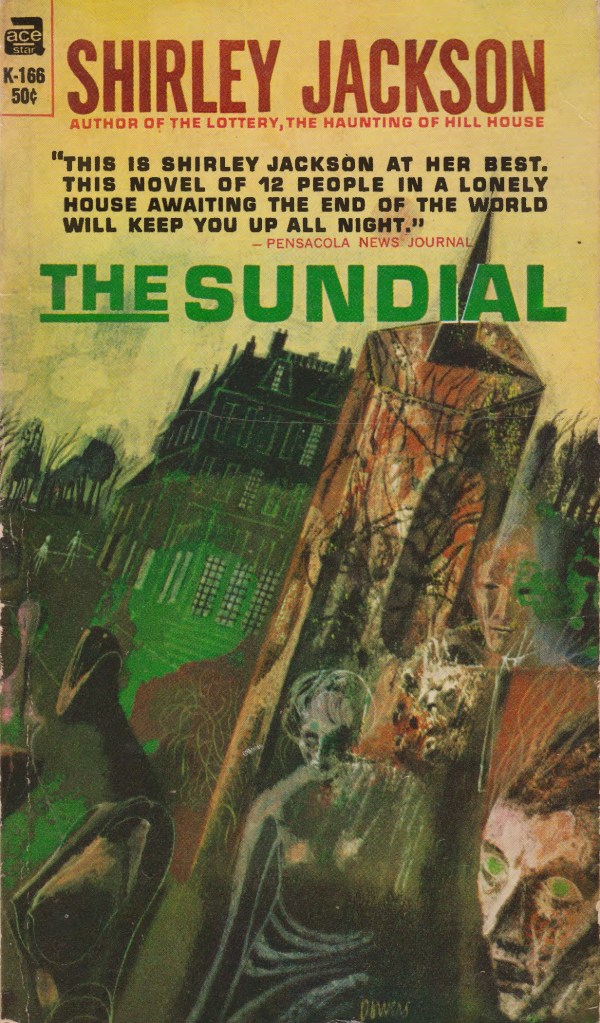
1. The Sundial, Shirley Jackson (1958)
Richard Powers’ cover for the 1963 edition
From the back cover: “THE SUNDIAL is a chilling, suspenseful, bloodcurdlingly macabre novel of twelve strange people awaiting the end of the world in a fantastical house like no other on earth.” SF Encyclopedia describesThe Sundial as “the closet to SF she came.”
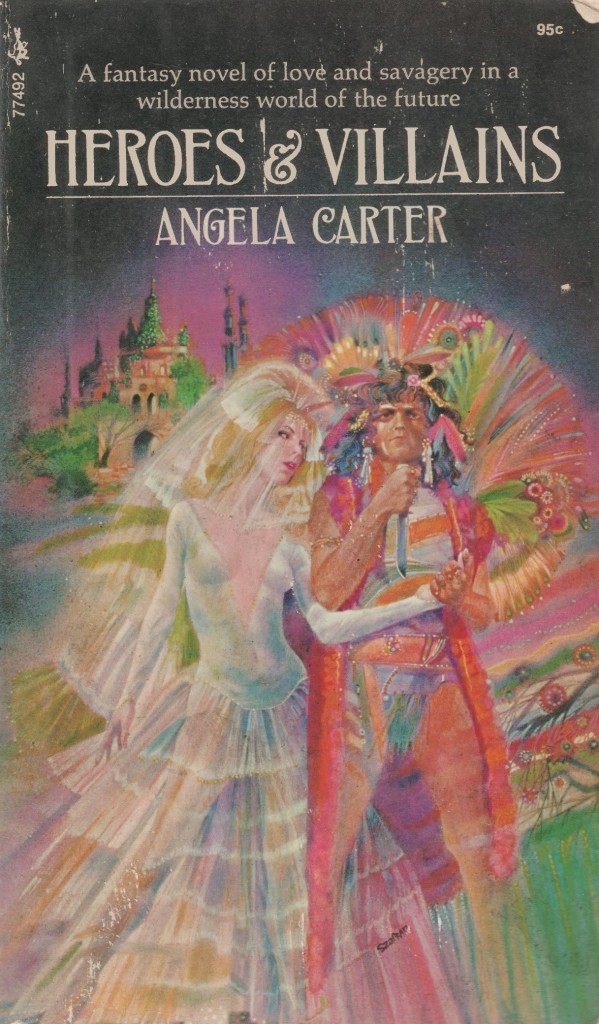
English author Angela Carter (1940-1992) spun postmodern fabulations of decadent futures and decaying urban expanses replete with incisive deconstruction of genre conventions [1]. Her dark, Freudian, and erotic masterpiece The Infernal Desire Machines of Doctor Hoffman (1972) ranks amongst my favorite SF 70s visions. From a young age Carter read John Wyndham and, like so many others in the 60s, felt the relentless pull of Michael Moorcock’s New Worlds magazine and the larger New Wave movement: “this lode, this seam of intensely imaginative and exciting fiction” [2]. And, as with her contemporary Emma Tennant, the work of J. G. Ballard–and/or his ability to fill the air with his entropic sadness–spurred her to write post-apocalyptic SF [3]. Heroes & Villains (1969) is the product of her inspiration and “her first tale to engage in a recognizably sf displacement of reality” [4].
Today I’ve selected two post-apocalyptic visions by female authors. I needed an antidote to the creepy last man/woman stories I’ve been reading recently. Alice Eleanor Jones spins a masterpiece about a housewife attempting to keep the entropy of a crumbling world and an abusive husband at bay. Katherine MacLean imagines a moment where the last representative of the American Empire, after all the rhetoric of progress and exceptionalism came crashing down in a nuclear war, interacts with a persistent and well-meaning native girl.
The links to the stories can be found in the reviews. Both are recommended reads for fans of 50s and 60s science fiction.
Uncredited cover for the 1968 edition of The Best from Fantasy and Science Fiction: Fifth Series, ed. Anthony Boucher (1956)
5/5 (Masterpiece)
Alice Eleanor Jones’ “Created He Them” first appeared in The Magazine of Fantasy and Science Fiction, ed. Anthony Boucher (June 1955). You can read it online here.
Sometimes there are stories that transcend their short length with lasting power. This story has resided within me as if freshly read for weeks. Like some corrosive lozenge of love and hate, “Created He Them” eats you up from the inside.
Rob Latham in his article “Sextrapolation in New Wave Science Fiction” (2008) argues that in the early 1950s “a handful of stories were published in the magazines that dealt explicitly with sexual topics” long absent from genre. Latham suggests that some of the notable New Wave takes on science fictional sex read as reconceptualized versions of these stories [2]. With few exceptions, the 50s trailblazing tales were ignored by the major digests of the day and instead appeared in the failing pulps–Startling Stories and Thrilling Wonder Stories–or in “second- and third-tier digests just struggling to establish themselves” such as Howard Browne’s Fantastic Adventures. For example, my two previous posts in this series covered Sherwood Springer’s “No Land of Nod” (1952), which appeared in Thrilling Wonder Stories, and Philip José Farmer’s “The Lovers” (1952) in Startling Stories. The later was rejected by H. L. Gold, according to John Brunner, at Galaxy with the note: “I’ll publish this if you can get rid of the sex–I run a family magazine” [3].
Let’s get to the stories! Both Fritz Leiber’s “The Ship Sails at Midnight” (1950) and Theodore Sturgeon’s “The Sex Opposite” (1952) explore polyamorous relationships between humans and aliens. In Leiber’s case, a group of bohemians fall in love with a bisexual alien. In Sturgeon’s tale, a heterosexual couple both fall for a parthenogenetically female “alien” symbiote that appears male to women and female to men.
Henry Sharp’s interior art for Fritz Leiber’s “The Ship Sails at Midnight” in Fantastic Adventures, ed. Howard Browne (September 1950)
3/5 (Average)
Fritz Leiber’s “The Ship Sails at Midnight” first appeared in Fantastic Adventures, ed. Howard Browne (September 1950). You can read it online here.
Four self-proclaimed “‘wild’-young people, bohemians” (61), fresh out of college but still “sponging” off their parents “doing academic odd-jobs” (57), encounter the enigmatic and stunningly gorgeous Helen serving food at Benny’s, an all-night diner. Soon after meeting Helen, Es, “something of an artist,” starts to push the boundaries of her previously staid art (56). The narrator, Larry, who calls himself a writer but spends more time “reading magazines and detective stories, lazing around, getting drunk, and conducting […] endless intellectual palavers” (58) suddenly has something to actually write about–a carnal and intellectual love for Helen that they keep hidden from the rest. Louis, a philosopher, slowly encounters new avenues to explore rather than “merely cultivat[ing] a series of intellectual enthusiasms [..] and fruitless-excitement over the thoughts of other men” (57). And the gruff exterior of Gene, an atomic scientist, begins to mellow. All four view Helen as a “Great Books discussion leader” who serves as an intellectual midwife–who fosters, encourages, and inspires the expansion of their minds.
Which books/covers/authors intrigue you? Which have you read? Disliked? Enjoyed?
I planned to have a review up today. Unfortunately, August is always my least productive month writing as it marks the return to work after a much needed summer break. It’s been a rough few weeks! Stay tuned.
1. The Squares of the City, John Brunner (1965)
Murray Tinkelman’s cover for the 1978 edition
From the back cover: CHECHMATE IN PARADISE. Ciudad de Vados was a Latin-American showplace, a paradise…a flourishing supercity designed and run nearly to perfection.
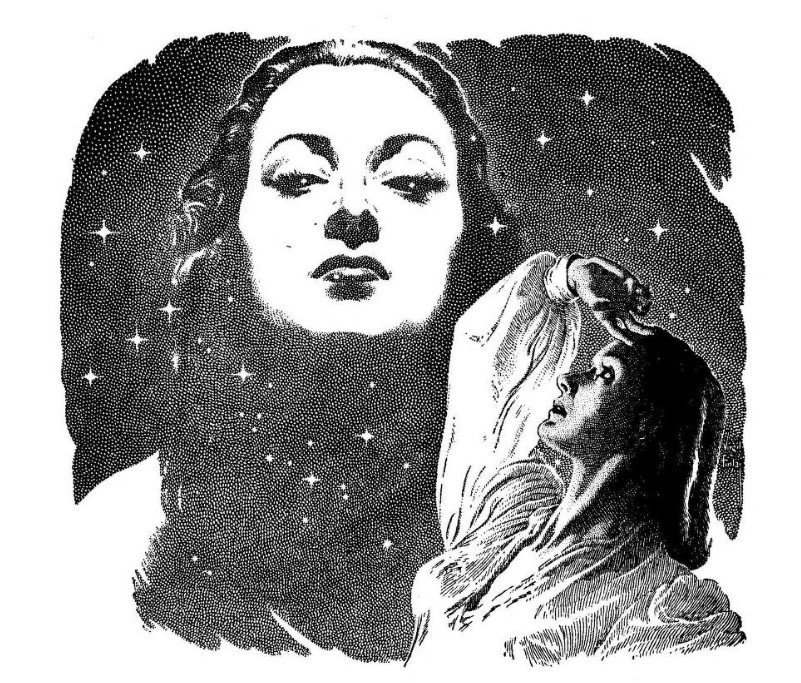
Virgil Finlay’s interior art for Sherwood Springer’s “No Land of Nod” in Thrilling Wonder Stories, ed. Samuel Mines (December 1952)
In the March 1955 issue of John Brunner’s fanzine Noise Level, the young author listed a handful of “thematically edgy stories”–including Sherwood Springer’s “No Land of Nod” (1952), Theodore Sturgeon’s “The World Well Lost” (1953), and Lester del Rey’s “For I am A Jealous People (1954)–that he considered a “step forward” in the field [1]. The previous year he had praised elements of Philip José Farmer’s “The Lovers” (1952) in a fan letter to Startling Stories. According to Jad Smith, the stories feature “lived-in, morally ambiguous backgrounds much noisier and dynamic than the two-dimensional backdrops of more conventional fare” that appealed to Brunner’s embryonic views on genre [2]. Brunner viewed social change as a “messy and unpredictable process riddled with moral complexities” [3].



 Science Fiction and Other Suspect Ruminations