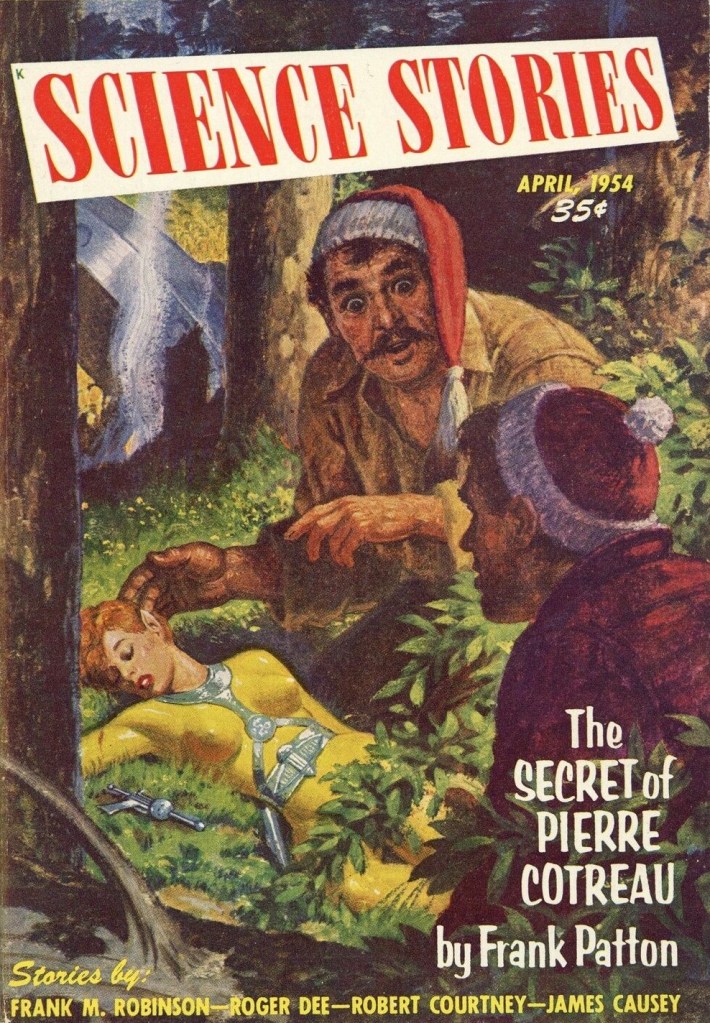
(SF Comic) Book Review: Future Day, Gene Day (1979)

Comic book author and artist Gene Day (1951-1982) is best known for his SF work on Marvel Comics’ Star Wars series and as an editor and artist for Dark Fantasy (1973-1980). He also created art for Chaosium games including Nomad Gods (1977). My brief bibliographic blurb is based on Wikipedia. Here is a wonderful gallery of his work including images from his various Star Wars publications.

Future Day (1979), a “graphic album,” contains seven “graphic stories” on themes of galactic conflict. It might be worth comparing Day’s rather nihilistic formulations of war and galactic expansion/conquest with the positivist depiction of heroic liberation in Star Wars. I would suggest that Day is deliberately responding to the phenomenon of Star Wars: Episode IV – A New Hope (1977). The art and storylines are filled with indirect correlates to the Star Wars universe (“cute” R2D2-esque robots, hulking spaceships with similar details to imperial cruisers and X-wings, etc.)

Continue reading

Generation Ship Short Story Review: Leigh Brackett’s “The Ark of Mars” (1953)

This is the 9th post in my newly resurrected series of vintage generation ship short fiction reviews. Not every short story I read for this series fits my definition of a generation ship. If you choose to read the story before my review, know that I disagree with its inclusion in SF Encyclopedia’s entry and understand why it was excluded from Simone Caroti’s original list. And that’s okay! I enjoy mapping the territory with all its swampy bayous, hidden coves, and dead ends.

As a reminder for anyone stopping by, all of the stories I’ll review in the series are available online via the link below in the review.

You are welcome to read and discuss along with me as I explore humanity’s visions of generational voyage. And thanks go out to all who have joined already. I also have compiled an extensive index of generation ship SF if you wish to track down my earlier reviews on the topic and any that you might want to read on your own.

Previously: Otto Binder’s “Son of the Stars” (1940)

Next Up: Frank M. Robinson’s “The Oceans Are Wide” (1954).


Leigh Brackett’s “The Ark of Mars” first appeared in Planet Stories (September 1953), ed. Jack O’Sullivan. 2.5/5 (Bad). You can read it online here. “Ark” was combined with an expanded “Teleportress of Alpha C” (1954) and released as the fix-up Alpha Centauri or Die! (1963).

Let’s get the obvious out of the way. As I mentioned above, this is not a generation ship story despite its inclusion in the SF Encyclopedia’s entry on the theme. While mothers and children are brought on board a massive vessel secretly constructed on Mars for a journey to an Earth-like planet orbiting Alpha Centauri, the voyage lasts a mere five years. Children might be born on the ship but will only spend a short portion of their lives on board. All of the action of the plot revolves around launching the vessel and Mars’ last attempt to stop the trip immediately as it sets off. Few of the distinctive hallmarks of generation ship stories are present — there’s no generational strife between those born on the ship and their elders, no conceptual breakthrough as the “true” nature of the world is revealed, etc. Instead, the ship is a glorified covered wagon, symbolic of Brackett’s identification of a primitivist masculine drive (with adjacent spouses) to trek West rather than a new social system to explore.

Continue reading

Generation Ship Short Story Review: Otto Binder’s “Son of the Stars” (1940)

This is the 8th post in my newly resurrected series of vintage generation ship short fiction reviews. As this series has a real chance to cover every pre-1985 generation ship short story available in English, I’ve bitten the bullet and stepped back to the pre-WWII SF landscape to track down a generation ship story by Otto Binder. I tend to be far more interested in post-WWII US and European SF history and have geared most of my site towards those decades.

As a reminder for anyone stopping by, all of the stories I’ll review in the series are available online via the link below in the review.

You are welcome to read and discuss along with me as I explore humanity’s visions of generational voyage. And thanks go out to all who have joined already. I also have compiled an extensive index of generation ship SF if you wish to track down my earlier reviews on the topic and any that you might want to read on your own.

Previously: Chad Oliver’s “Stardust” (1952) 

Next Up: Leigh Brackett’s “The Ark of Mars” (1953) 

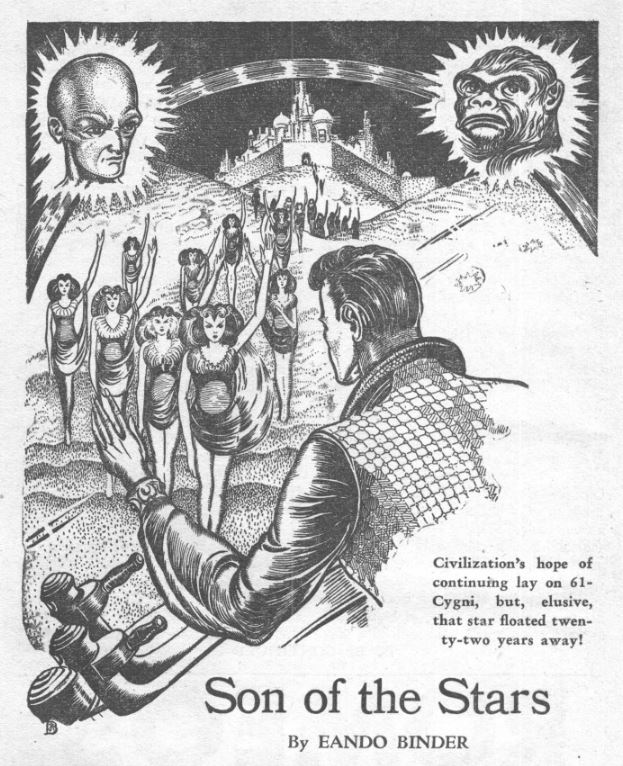
Otto Binder’s “Son of the Stars” first appeared in the February 1940 issue of  Famous Fantastic Mysteries, ed. Mary Gnaedinger. 2.75/5 (Vaguely Average). You can read the story online here. As always, I will have spoilers.

First, a note about authorship and pseudonyms: According to The Internet Speculative Fiction Database, Otto Binder is the sole author of “Son of the Stars.” “Eando Binder” was a joint pseudonym used by American brothers Earl Andrew Binder (1904-1966) and Otto Oscar Binder (1911-1975). After 1934, the elder brother Earl stopped writing SF and Otto continued to sign his work under the shared name. For more on their SF, check out their SF Encyclopedia entry.

Continue reading

Updates: Recent Science Fiction Purchases No. CCLXXVIII (Tanith Lee, Michael Bishop, Ian Watson, Greg Bear, Ferenc Karinthy)

As always, which books/covers/authors intrigue you? Which have you read? Disliked? Enjoyed?

1. Strength of Stones, Greg Bear (1981)

From the back cover: “Ages ago this world was named God-Does-Battle. No one remembers wh. It was colonized in the most up-to-date way possible, supplied with the best Cities ever built by Robert Kahn. Huge laboratories labored for decades to produce the right combinations of plant, animal, and machine, and to fit them into the right design. The result was magnificent; living Cities, able to regenerate broken parts, to produce food on demand, and medicine, and clothing. so careful, so advanced was Robert Kahn that he even built into his Cities the ability to protect their inhabitants; to sense the presence of the occasional person whose potential for violence or cruelty made him a threat to society, to remove him from the City, and to erect walls of needle-sharp crystal to be sure he did not return.

Continue reading

Generation Ship Short Story Review: Chad Oliver’s “Stardust” (1952)

This is the seventh post in my newly resurrected series of vintage generation ship short fiction reviews. I have returned to the author and anthropologist Chad Oliver (1928-1993) whose “The Wind Blows Free” (1957) inspired me to start the series. All of the stories I’ll review in the series are available online and linked.

You are welcome to read and discuss along with me as I explore humanity’s visions of generational voyage. And thanks go out to all who have joined already. I also have compiled an extensive index of generation ship SF if you wish to track down my earlier reviews on the topic and any that you might want to read on your own.

Previously: A. E. van Vogt’s “Centaurus II” (1947)

Next Up: Otto Binder’s “Son of the Stars” (1940).

As the last post was way back in January 2020, here’s a reminder of what I’ve covered so far:

I’ve also reviewed five additional generation ship works (two novels and one short story) since I started the series that I didn’t include:


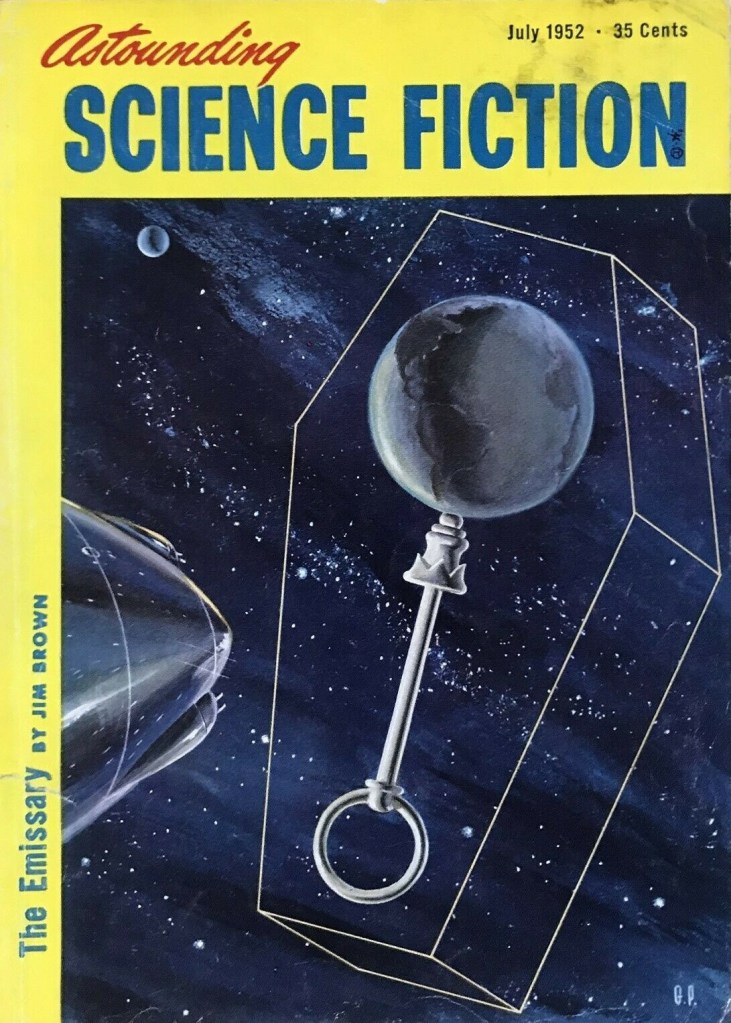
Chad Oliver’s “Stardust” first appeared in the July 1952 issue of Astounding Science Fiction, ed. John W. Campbell, Jr. 3.5/5 (Good). You can read it online here.

In the 1974 paper “Two Horizons of Man” for the American Anthropological Association, Chad Oliver identified the “larger theoretical and social contexts” in which his two professions (SF and anthropology) were subsumed: “The problems of cultural contact and culture conflict, the discussions of cultural relativism, the idea of cultural evolution, the whole emphasis on looking at things from different perspectives, the questions about what it meant to be human–all of these were as characteristics if science fiction as they were of anthropology” (note). “Stardust” (1952) exemplifies this intersection of concerns. The new generation of explorers encounter the first generation, trapped for hundreds of years on sabotaged generation ship on their way to colonize Capella.

Continue reading

Short Story Reviews: Carol Emshwiller’s “Day at the Beach” (1959), “Puritan Planet” (1960), and “Adapted” (1961)

It’s time for the fifth post in my series exploring Carol Emshwiller’s science fiction and fantasy–published between 1955-1979 in genre magazines–in chronological order. And if you missed earlier installments, check out Part IIIIII, and IV.

We have a beach vacation in the post-apocalypse, a gorgeous fable of a housewife struggling to chart her path, and the travails of a crashed astronaut and his cat on a planet of religious fanatics. In this installment, I wrap up her stories published in the 1950s and move into the 1960s. Emshwiller published only 12 stories in the 1960s with a publication gap between 1961-1966 while she managed 13 between 1955-1959. In the previous post, Rich Horton and Expendable Mudge speculated that it was due to the birth of her son in 1959.

I’ve listed by rating all of her 50s stories. If you’d like me to write up my thoughts overall on her 50s visions in a more analytical manner (a short essay?), let me know in the comments.

1. “Pelt” (1958), 5/5 (Masterpiece)

2. “Day at the Beach” (1959), 4.5/5 (Very Good) [this post]

3. “Baby” (1958), 4/5 (Good)

4. “Nightmare Call” (1957), 3.75/5 (Good)

5. “Bingo and Bongo” (1956), 3.5/5 (Good)

6. “The Piece Thing” (1956), 3.5/5 (Good)

7. “This Thing Called Love” (1955), 3.5/5 (Good)

8. “The Coming” (1957), 3.5/5 (Good)

9. “Love Me Again” (1956), 3.25/5 (Good)

10. Hunting Machine” (1957), 3/5 (Average)

11. “You’ll Feel Better…” (1957), 3/5 (Average)

12. “Two-Step for Six Legs” (1957), 2.75/5 (Vaguely Average)

13. “Idol’s Eye” (1958), 2.5/5 (Bad)

As always, feel free to join the conversation!


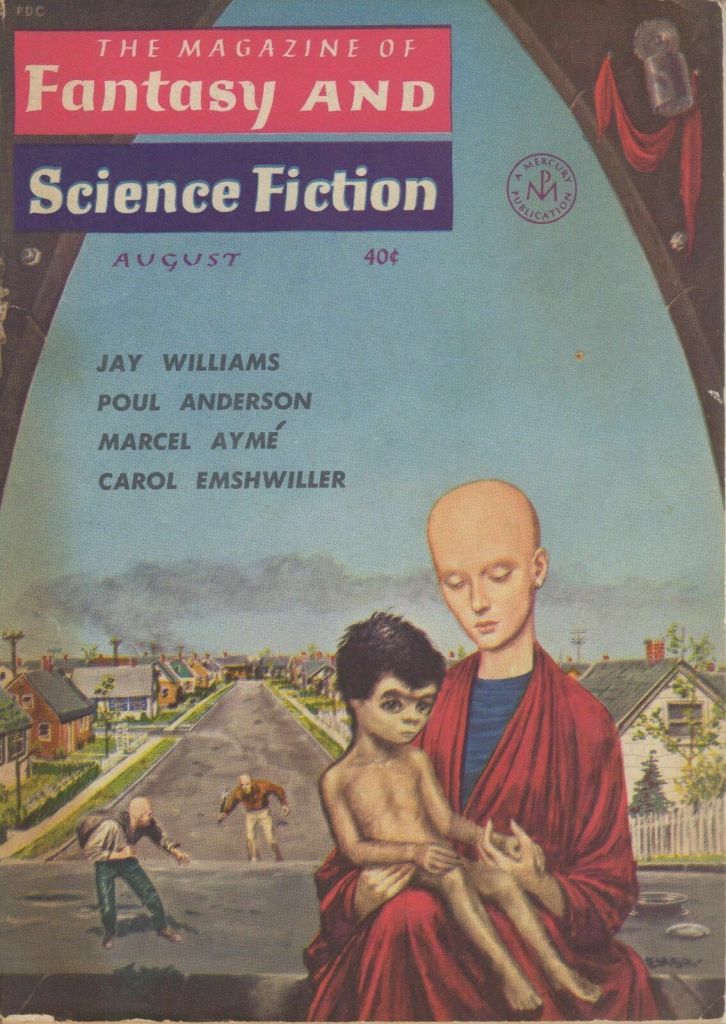
“Day at the Beach” in The Magazine of Fantasy and Science Fiction (August 1959), ed. Robert P. Mills. 4.5/5 (Very Good). You can read it online here. Like “Pelt” (1958), this wonderful story has been frequently anthologized. I read it in The Year’s Best S-F: 5th Annual edition (1960), ed. Judith Merril. At first glance “Day at the Beach” reaffirms the power of family in the face of a cataclysmic event as a mother and father slowly accept changes brought on by atomic mutation. Or, there’s a more sinister reading where the family unit creates a delusional bubble that obfuscates the real horror outside (and inside) their home.

Continue reading

Short Story Review: Raymond F. Jones’ “The Memory of Mars” (1961)

3.5/5 (Good)

Before Philip K. Dick’s “We Can Remember It for You Wholesale” (1966), Raymond F. Jones wrote the far lesser known “The Memory of Mars” (1961)–his own paranoid thriller about a vacation to Mars that might not have happened exactly as remembered. This is a plot-driven story. There are multiple twists and delusional layers that unfold at lightning speed–some more satisfying than others. You might want to read the story in the December 1961 issue of Amazing Stories, ed. Cele Goldsmith first.

“The Memory of Mars” has all the pieces of a paranoid masterpiece. A journalist named Mel Hastings, trained to be objective, waits for his wife Alice to be released from surgery. As he waits anxiously for news knowing that something has gone wrong, he recalls his wife’s persistent claim that they had gone on a vacation to Mars the first year of their marriage. The simmering terror of his own phobia of space and recurrent nightmares of being chased across the black void suggest there’s more than he remembers. Mel’s called into the surgery room with disturbing news. His wife is dead and something is terribly wrong with her viscera. Vigil Finlay’s top-notch interior art (above) hints at the terror that unfolds as Alice’s inhuman interior is laid bare….

Continue reading

Updates: Recent Science Fiction Purchases No. CCLXXVII (Octavia E. Butler, Harlan Ellison, James White, Poul Anderson)

As always, which books/covers/authors intrigue you? Which have you read? Disliked? Enjoyed?

1. Dawn, Octavia E. Butler (1987)

From the back cover: “XENOGENESIS: The birth of something new—and foreign.

Lilith Iyapo awoke from a centuries-long sleep—and found herself aboard the vast living spaceship of the Oankali. Alien creatures covered in writhing tentacles, the Oankali had saved every surviving human from a dying, ruined Earth. They healed the planet, cured cancer, increased human strength and disease resistance, and were now ready to help Lilith lead her people back to Earth.

Continue reading

Book Review: This Side of Infinity, ed. Terry Carr (1972) (Zelazny, Silverberg, Aldiss, Lafferty, et al.)

3.25/5 (Collated rating: Vaguely Good)

Soldiers in mech armor plagued by existential crisis. Asexual insectoid aliens pretending to be human. Children wielding pet apes as weapons. This Side of Infinity, ed. Terry Carr (1972) gathers eight kaleidoscopic visions from stalwarts (Roger Zelazny and Robert Silverberg) to lesser known authors (David Redd and George H. Smith). As a collated whole, this is a solid collection without a defining standout masterpiece but worth acquiring for the sheer variety and hallucinatory power of it all.

Continue reading