Book Review: Herovit’s World, Barry N. Malzberg (1973)

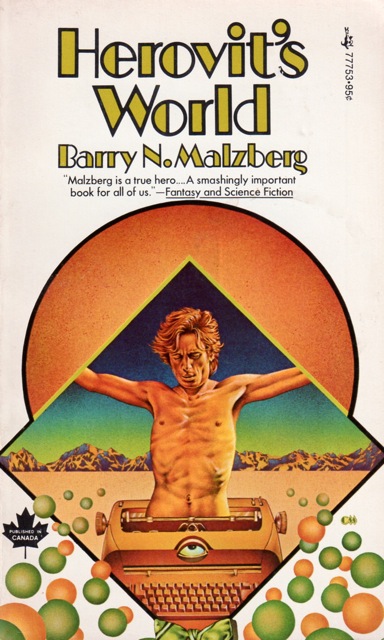
(Charles Moll’s cover for the 1974 edition)

3.5/5 (Good)

Note: Today is Barry N. Malzberg’s birthday!

Upon reading In the Enclosure (1973) I was immediately seduced by Barry N. Malzberg’s metafictional brand of science fiction — best illustrated by his masterpieces Beyond Apollo (1972) and Revelations (1972).  Although Herovit’s World (1973) contains many of the same metafictional trademarks of Malzberg’s best work, it should be noted that the novel is not science fiction and more a work about writing (pulp) science fiction.  In this case, the mental collapse of a pulp writer whose life may or may not contain “true” autobiographical kernels from Malzberg’s own experience Continue reading

Adventures in Science Fiction Cover Art: Domed Cities (and Outposts) of the Future, Part IV

Screen shot 2013-01-25 at 9.47.21 PM

(Ley Kenyon’s cover for the 1953 edition of Adventures in Tomorrow (1951), ed. Kendell F. Crossen)

Since the release of the TV series Under the Dome (2013-), based on Stephen King’s 2009 novel by the same name, there has been a resurgence of interest in domed cities.  And for good reason — the trope is one of the most popular of science fiction artists and authors since the 30s (and probably earlier).  Not only do the societal implications and visual allure of the trope of a domed outpost on a harsh planet or a domed city amidst the ruins of Earth arouse the creative authorial juices but also generate some fantastically Continue reading

Book Review: Why Call Them Back From Heaven?, Clifford D. Simak (1967)

(Leo and Diane Dillon’s cover for the 1970 edition)

4.5/5 (Very Good)

I have found that the most successful science fiction novels on the theme of immortality are not about the immortals themselves or the state of “being immortal.”  Novels like Raymond Z. Gallun’s The Eden Cycle (1974) might attempt to convey, at moments effectively, the ennui of an endless existence with endless possibilities but, as with mind of the immortal in question, the reader too feels the effects of endless, repetitive inundation.  Rather, the most successful and evocative novels — for example James Gunn’s The Immortals (1962) — explore the social space that is created by the presence of immortals although they might be only peripheral characters.  Simak’s Why Call Them Back From Heaven? (1967) takes Gunn’s premise a step further: What would happen to our society if almost everyone bought into the idea that immortality would be a real possibility sometime in the future? Continue reading

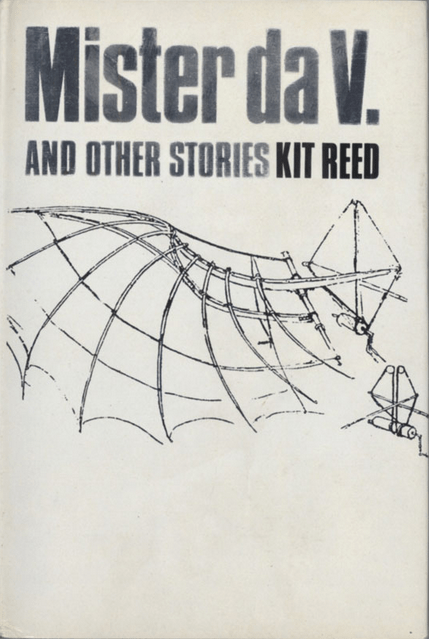
Book Review: Mister Da V. and Other Stories, Kit Reed (1967)

Screen shot 2013-07-16 at 10.06.04 AM

(Uncredited cover for the 1967 edition)

4.25/5 (collated rating: Good)

Kit Reed has been publishing literary, thought-provoking, and darkly satirical sci-fi + speculative fiction + non-genre fiction since the late 50s… And she is still going strong — her most recent novel Son of Destruction (2012) came out last year.  Reed’s collection Mister Da V. and Other Stories (1967) contains three stories from the late 50s including her first published work, ‘The Wait’ (variant title: ‘To be Taken to a Strange Country’) (1958) and ten others from the 60s.  A few of the stories in the collection are not overtly science fiction — regardless, one could argue that all but ‘I am Through with Bus Trips’ (1967) contain speculative and/or sci-fi elements.

There are superficial differences between the 1967 Faber and Faber edition and the 1973 Berkley Medallion edition.  Because I own the Berkley paperback I’ve gone ahead and followed its chronological story order and page numbers.

A few of the themes/topics of the volume:  Paranoia.  Post-apocalyptic Landscapes.  Youth  Continue reading

Book Review: Big Planet, Jack Vance (magazine publication 1952)

Screen shot 2013-06-01 at 6.18.27 PM

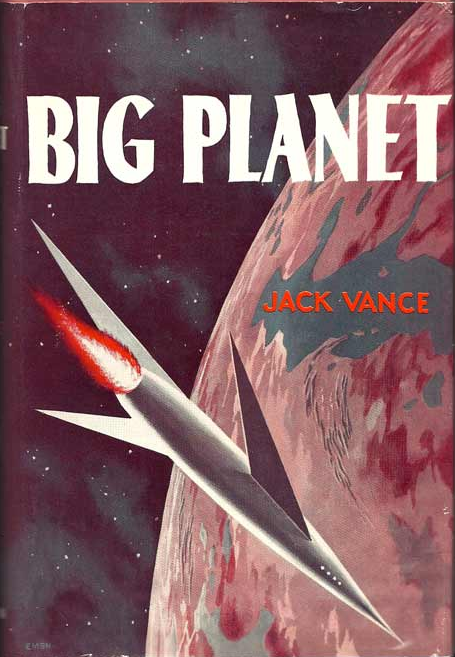
(Ed Emshwiller’s cover for the 1952 edition)

3.25/5 (Good)

After Jack Vance’s recent passing I decided that as an informal remembrance I’d review one of his novels.  However Big Planet (1952), the only unread novel of his I had on my shelf, is from early in his career and far from the level of his best works.  Of his novels I’ve read, Wyst: Alastor, 1716 (1978) and the loose sequel to Big Planet, Showboard World (1975) were the most satisfying.  The Blue World (1966), Marune: Alastor, 933 (1975), and City of the Chasch (1968) were all enjoyable adventure tales set in fantastic worlds.  I recommend those — along with his more famous novels — before picking up a copy of Big Planet.

Over the course of its publication history Big Planet was cut and modified multiple times from its original magazine form.  A restored text was published in 1978…  Unfortunately, I read the 1957 Ace Continue reading

Adventures in Science Fiction Cover Art: The Space Station, Part III

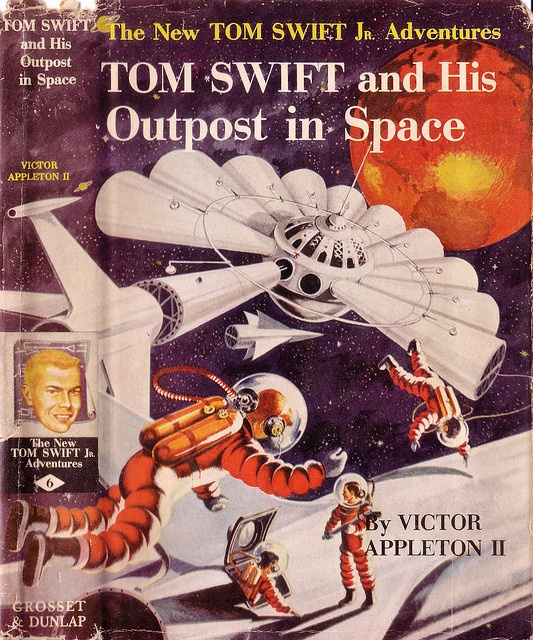
8fb71adc43d8c6f43977b5522a534504(Graham Kaye’s cover for the 1955 edition of Tom Swift and his Outpost in Space (1955), Victor Appleton II)

This is Part III of my series on space stations (Part I + Part II).  Ever since I watched 2001: A Space Odyssey (1968) as a teen I’ve been fascinated by space stations — platforms for further space exploration!  I can only imagine how exciting it was for fans of science fiction who read about stations before they existed to see them finally constructed. The fact that they became reality — well, perhaps not (yet) as a launching point for space going exploration vessels — almost vindicates the scientific extrapolation of some of these early visions.  Also, Arthur C. Clarke’s Islands in the Sky (1952) happened to be one of my first science fiction novels…..  And C. J. Cherryh’s Downbelow Station (1981) Continue reading

Book Review: Mortals and Monsters, Lester del Rey (1965)

(Richard Powers’ cover for the 1965 edition)

3.25/5 (collated rating: Average)

Lester del Rey’s collection Mortals and Monsters (1965) — first editions are adorned with a gorgeous collage by the superb Richard Powers — is comprised of eight short stories from the 50s and four from the early 60s.  The collection, as with all but the best collections, is a mixed bag.  ‘The Years Draw Nigh’ (1951) is almost a masterpiece while ‘Recessional’ (1965) is an upsetting exercise in 60s sexism despite the fascinating premise.

I found that a few of the del Rey’s shorts are some of the more blatantly sexist 50s works Continue reading

Updates: Recent Science Fiction Acquisitions No. LXVII (Simak, Clement, Bradley, White)

I just came back from more than a month in Paris where I was rather sci-fi deprived so I headed immediately (well, not literally) to the local used bookstore.  A nice collection of novels from some of the genre’s greats — Hal Clement, James White, Clifford D. Simak, and Marion Zimmer Bradley.  I’ve not read any of Bradley’s novels and I’ve heard that Darkover Landfall (1972) is probably the place to start.

And I’ve enjoyed James White’s work so far.  Clement isn’t exactly my cup of tea but it might be good to read another one of his novels before I come to a conclusion.

And some fun Paul Lehr covers…

1. Lifeboat (variant title: Inferno), James White (1972)

(John Berkey’s cover for the 1972 edition) Continue reading

Book Review: Mission of Gravity, Hal Clement (serialized, 1953)

(Joe Mugnaini’s cover for the 1954 edition)

3.5/5 (Good)

Hal Clement’s Mission of Gravity (1953) is generally considered one of the early classic (and most influential) novels of the hard science fiction subgenre.  The care in which Clement lavishes on the fascinating world of Mesklin is manifest on virtually every page.  The inherent logic of the unusual scientific properties of the planet Mesklin provides the superstructure for Clement’s development of the intelligent species that inhabits it and generates the majority of the plot.  Clement, a Harvard educated astronomer, applies the (remorseless) logic of the world to almost every situation and every paragraph creating a convincing, if rather laborious Continue reading