Generation Ship Short Story Review: Julian May’s “Star of Wonder” (1953)

This is the 16th post in my series of vintage generation ship short fiction reviews. Today I have an interesting formulation of the generation ship–its component parts dispersed across multiple vessels–that did not appear on Simone Caroti’s list that spurred this project.

As a reminder for anyone stopping by, all of the stories I’ll review in the series are available online via the link below in the review.

You are welcome to read and discuss along with me as I explore humanity’s visions of generational voyage. And thanks go out to all who have joined already. I also have compiled an extensive index of generation ship SF if you wish to track down my earlier reviews on the topic and any that you might want to read on your own.

Previously: Fred Saberhagen’s “The Long Way Home” (1961).

Next Up: Barrington J. Bayley’s “Exit from City 5” (1971)

2/5 (Bad)

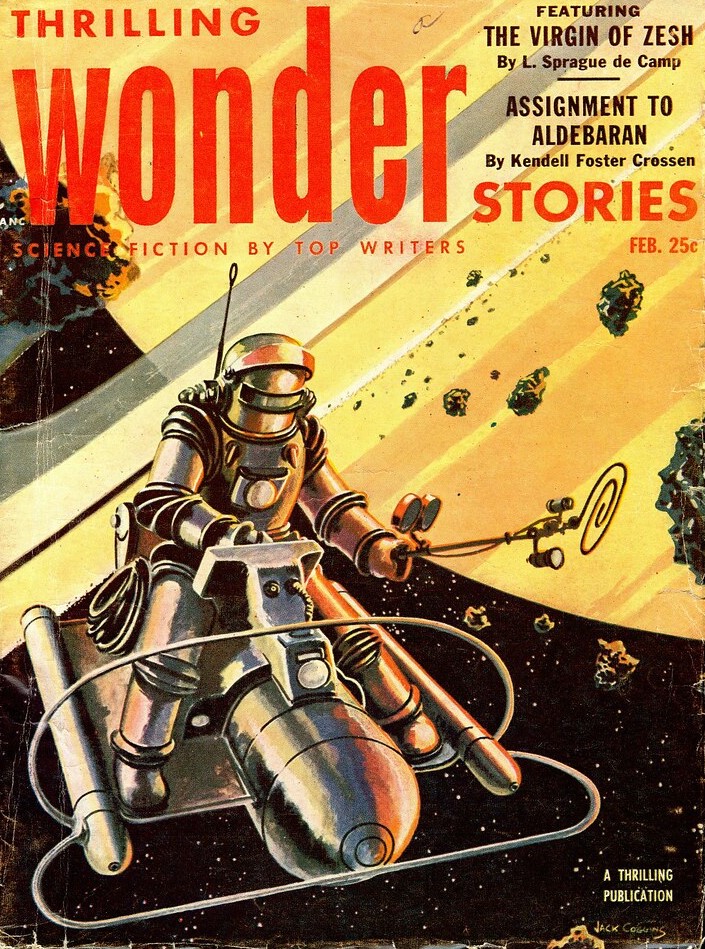
Julian May’s “Star of Wonder” first appeared in the February 1953 issue of Thrilling Wonder Stories, ed. Samuel Mines. You can read it online here.

After getting involved with SF fandom in her teens, Julian May (1931-2017) published two short stories in the 1950s before returning in the 1980s with the multi-volume Saga of the Pliocene Exile sequence (1981-1984). In between, according to Wikipedia, May worked with her husband T. E. Dikty in publishing, wrote children’s fiction and nonfiction, Buck Rogers comic strips, and even Catholic catechism for publishers affiliated with the Franciscans. Of her two 50s SF tales, “Dune Roller” in the December 1951 issue of Astounding Science Fiction remains by the best known (I suspect for good reason). It received both a TV adaptation for Tales of Tomorrow and film version.

Continue reading
Short Story Reviews: Ward Moore’s “Lot” (1953) and Langdon Jones’ “I Remember, Anita…” (1964)

My series on 1950s stories on sex and sexuality finds itself relentlessly drawn back to the well-trodden post-apocalyptic wasteland. New moralities are inscribed and ritualized in the wreckage. As Paul Brians points out in Nuclear Holocaust: Atomic War in Fiction, 1895-1984 (1987), authors in the 1950s and 60s demonstrate an obsession with the sex in the post-holocaust landscape as if they are “feverishly battling atomic thanatos with eros” [note 1]. Here I have paired two moments that dance around either side of the nuclear nightmare. Langdon Jones’ “I Remember, Anita…” (1964), the most controversial story from the early issues of Michael Moorcock’s New Worlds, explores an intense love affair in the moments before and after impact. Ward Moore’s shocker “Lot” (1953) charts the moments after impact as the masses flee from the city.

Previously: Fritz Leiber’s “The Ship Sails at Midnight” (1950) and Theodore Sturgeon’s “The Sex Opposite” (1952)

Up next: Damon Knight’s “Not With a Bang” (1950)

If any stories on 1950s stories on sex and sexuality come to mind that I haven’t read yet let me know in the comments. I have a substantial list waiting to be covered but I suspect it’s far from comprehensive.


4.5/5 (Very Good)

Ward Moore’s “Lot” first appeared in The Magazine of Fantasy and Science Fiction, ed. Anthony Boucher and J. Francis McComas (May 1953). You can read it online here.

Continue reading

Short Fiction Reviews: Phyllis Gotlieb’s “A Grain of Manhood” (1959), “Phantom Foot” (1959), and “No End of Time” (1960)

Since 2021, I’ve put together a series on the first three published short fictions by female authors who are new(ish) to me and/or whose most famous SF novels fall mostly outside the post-WWII to mid-1980s focus of my reading adventures. So far I’ve featured Josephine Saxton (1935-), Carol Emshwiller (1921-2019), Wilmar H. Shiras (1908-1990), Nancy Kress (1948-), Melisa Michaels (1946-2019), Lee Killough (1942-), Betsy Curtis (1917-2002), and Eleanor Arnason (1942-).

I do not expect transformative or brilliant things from first stories. Rather, it’s a way to get a sense of subject matter and concerns that first motivated authors to put pen to paper and to further map the territories that fascinate me.

Phyllis Gotlieb (1926-2009) was one of a legion of authors who received a debut under the influential editorship of Cele Goldsmith (1933-2002). Goldsmith fostered the early careers of Ursula K. Le Guin, Keith Laumer, Thomas M. Disch, David R. Bunch, Roger Zelazny, among many others. For a fascinating look at her years at Amazing Stories, check this later reflection article. Goldsmith writes: “My greatest pleasure was developing and publishing new, talented writers. I was not a writer and never aspired to be. But I was an editor who loved to help writers adapt their ideas and copy for the audience. My requirements: credible (or incredible), well-plotted, care- fully developed stories. My criteria for acceptance: ‘goose flesh’ while reading a submission.” For more on her contribution to the field, check out “Friend of the Site” John Boston and Cora Buhlert’s article over on Galactic Journey. Barry N. Malzberg also interviewed her in 2003.

Gotlieb, also known for her poetry, was born in Canada and received an M. A. in English from the University of Toronto. Her first novel–which I acquired recentlySunburst appeared in 1964. Her novella “Son of the Morning” (1972) received a Nebula Award nomination. Here’s her complete bibliography. I have read none of her work until now!


Continue reading

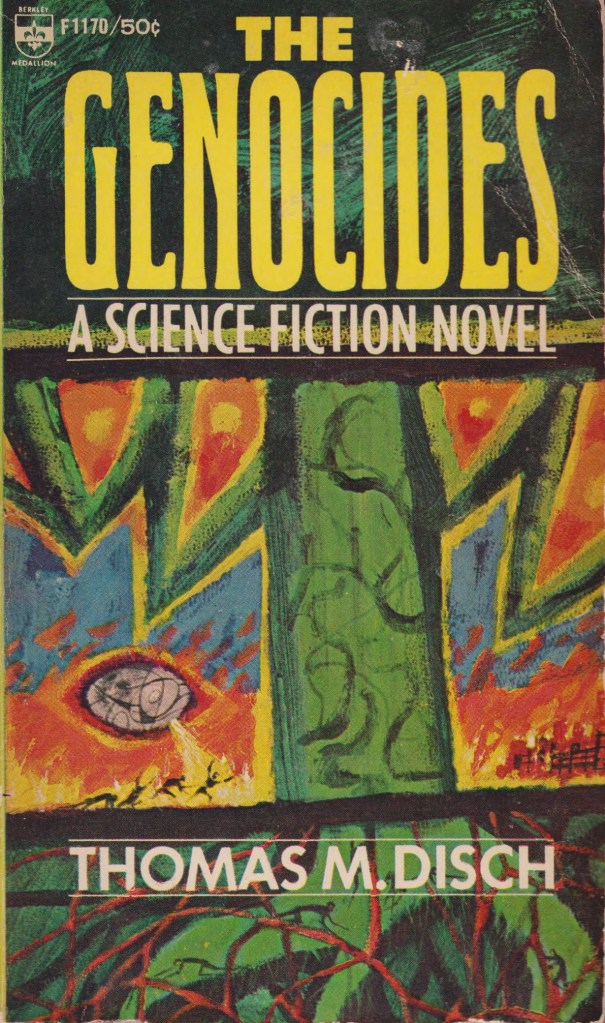
Book Review: The Genocides, Thomas M. Disch (1965)

5/5 (Masterpiece)

Thomas M. Disch’s The Genocides (1965) is an incendiary assault on our senses and expectations of trope and genre. In the face of apocalyptic annihilation at the hands of a vast alien Plant spread across the Earth, biblical stories of redemption and (re)birth are subversively recast as either delusions or decrepit meaningless patterns. Disch conjures a frontier landscapes inhabited by the sinful. Apocalypse cannot lead to rebirth.

Nominated for the 1966 Nebula Award for Best Novel.

The New Land of Milk and Honey

A billion spores, “invisible to all but the most powerful microscopes,” sown by an invisible sower over the entire Earth create a veritable carpet of greenery across even the most inhospitable geographies (15). Within seven years the alien trees or Plants, six-hundred feet tall with leaves the size of billboards, threaten to annihilate the last bastions of humanity. The narrative follows the inhabitants of a small town named Tassel–under the dictatorial sway of the preacher/mayor Anderson and his “Colt Python .357” (17)–and their attempts to survive on the new frontier.

Continue reading

Updates: Recent Science Fiction Purchases No. CCCXIV (Harlan Ellison, Gillian Freeman, Mick Farren, Fritz Leiber)

A new year and new books!

Which books/covers/authors intrigue you? Which have you read? Disliked? Enjoyed?

1. From the Land of Fear, Harlan Ellison (1967)

From the back cover: “SCIENCE FICTION STORIES by Award Winning Author

WHERE DID HARLAN ELLISON COME FROM?

At 13 he ran away from home in Ohio and joined a carnival. At 15 he was driving a dynamite truck in North Carolina. At 19 he was thrown out of college and at 21 had sold his first novel. Today he is 33 and is considered one of the top screenwriters in Hollywood. Fairly ordinary background? True.

But somewhere along the way, Harlan Ellison made a strange detour. He vanished into a country of the mind where time and space ceased to exist, where strange ideas and wild adventures were commonplace. He came back from that dark world, carrying away with him its richest treasures: stories unlike any ever told before. In this unusual book you will sample these “stray dreams.”

FROM THE LAND OF FEAR!”

Continue reading

Short Story Reviews: Fritz Leiber’s “The Moon Is Green” (1952) and Sonya Dorman’s “Go, Go, Go, Said the Bird” (1967)

Today I have selected two radical post-apocalyptic visions to review. Fritz Leiber (1910-1992) writes a conscientious attempt to understand the plight of a housewife trapped in a fallout shelter with an abusive husband and a mysterious man outside who whispers her deepest fantasies. I am fascinated by subversive 50s stories–especially on sex, masculinity, colonization, suburbia–and Leiber’s tale ticks many of my favorite boxes. Sonya Dorman (1924-2005), a skilled American representative of the New Wave movement, recounts a highly metaphoric flight of a woman attempting to maintain independent thought and experience in a world hurtling towards disaster.


4.5/5 (Very Good)

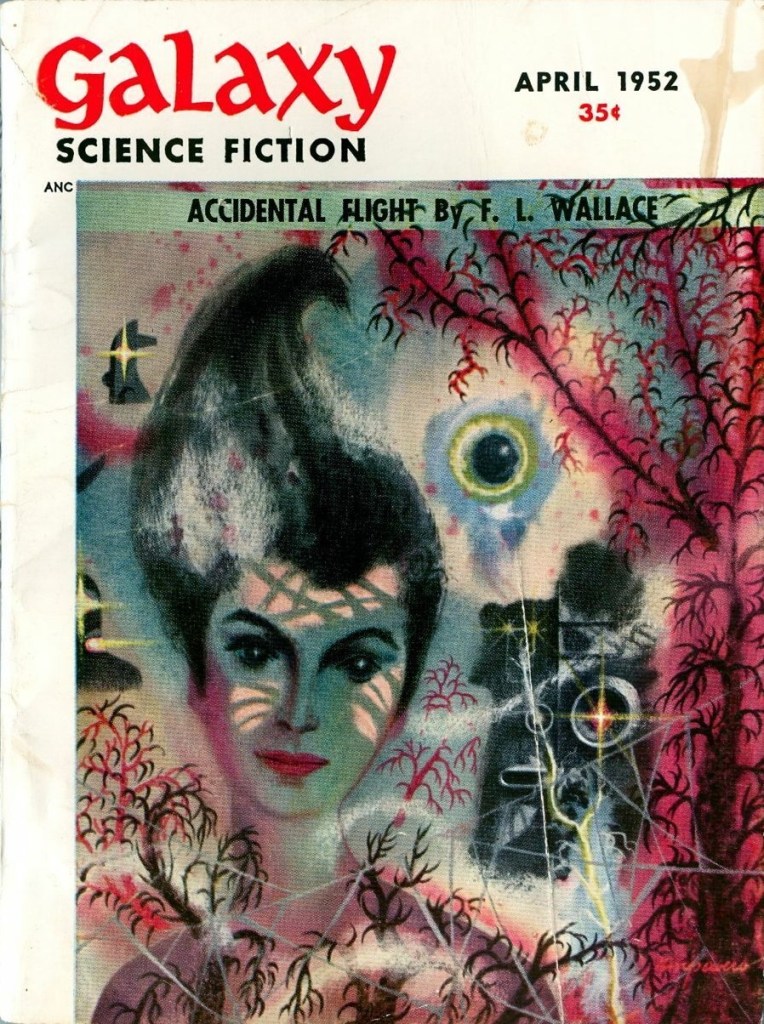
Fritz Leiber’s “The Moon Is Green” first appeared in Galaxy Science Fiction, ed. H. L. Gold (April 1952). You can read it online here.  

On January 3rd, 1950, in response to the successful 1949 Soviet test of atomic weapons, President Truman announced a crash program to develop the hydrogen bomb. It is within this moment of escalating terror after Truman’s announcement that Leiber wrote “The Moon is Green” (1952). While Leiber references hydrogen weapons, the story was published before the “Ivy Mike” Hydrogen bomb test (November 1st, 1952)–known to the public after a media blackout on January 7th, 1953–that revealed the devastating presence of fallout. The Soviets conducted their own test of a thermonuclear device–Joe-4–on August 12, 1953 (source).

Continue reading

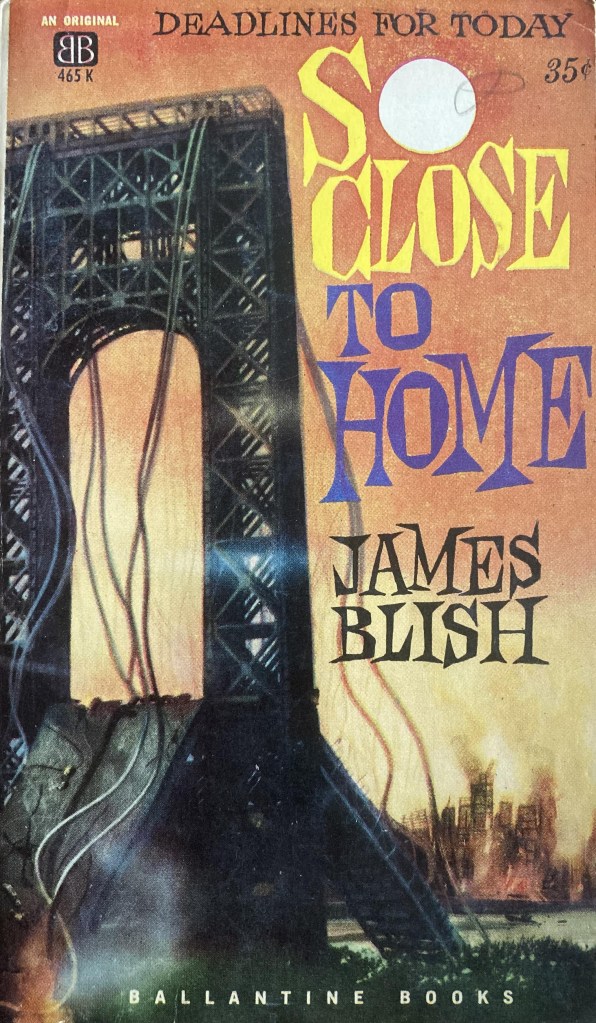
Book Review: So Close to Home, James Blish (1961)

3/5 (collated rating: Average)

It’s been more than a decade since I’ve read James Blish. I’ve long been a fan of his Hugo-winning novel A Case of Conscience (1958) and individual stories in collections like The Seedling Stars (1957) and Galactic Cluster (1959). Unfortunately, So Close to Home (1961) is an uneven collection with more duds than hits. The three worthwhile stories–“The Oath” (1960), “Testament of Andros” (1953), and “The Masks” (1959)–can be found online at the links below. Almost all the stories in the collection are set in the near future and chart humanity’s fear of the end and how one might navigate the strange new worlds that emerge.

Continue reading

Short Fiction Reviews: Norman Spinrad’s “The Weed of Time” (1970) and William Morrison’s “The Addicts” (1952)

Today I’ve decided to do something a bit different. Over the past year or so I’ve been compiling short stories on various themes and I put three of the themes to vote on the hellscape that is Twitter (I’m @SFRuminations). And science fictional drugs won out!

If this topic is interesting, let me know. My notebook contains a substantial list of stories I haven’t yet read on the topic. If you know of other short stories from the decades of my interest (1945-1985), leave a note in the comments.


4/5 (Good)

Norman Spinrad’s “The Weed of Time” first appeared in Alchemy and Academe, ed. Anne McCaffrey (1970). You can read it online here. I read it in his collection No Direction Home (1975) above with its striking Charles Moll cover.

As I’ve mentioned in the past, I’m relentlessly drawn to New Wave movement because there was a serious and conscience attempt to tell stories in artful ways replete with “literary” prose, radical structure/politics, non-standard SF characters/perspectives. Sometimes it’s beautiful. Sometimes it doesn’t work. But it’s all fascinating. This one works.

Now let’s enter the landscape of a transformed mind… At birth, the nameless narrator emerges “an infant-child-youth-man-ancient, in a government cell in a mental hospital dying in clean white sheets” (1979). He sees immediately the “gestalt painting of [his] lifespan, a pattern of immutable events painted on the stationary and external canvas of time….” (78). He experiences all the actions of his life simultaneously (79). No knowledge can effect any “action performed in any particular time-locus” (79). He babbles incessantly about the effects of consuming tempis ceti, an alien plant accidentally released on earth before the astronauts had even returned from their journeys. Of course, all prophesized occurs… and all businesses want to exploit prophesy even if the oracle already knows the irrelevancy of it all.

Continue reading

Short Story Reviews: Harlan Ellison’s “Psycho at Mid-Point” (1956) and “The Discarded” (variant title: “The Abnormals”) (1959)

The following review is the 20th installment of my series searching for “SF short stories that are critical in some capacity of space agencies, astronauts, and the culture which produced them.” Some stories I’ll review in this series might not fit. Many are far from the best. And that is okay. I relish the act of literary archaeology.

I turn now to an author, Harlan Ellison (1934-2018), whom I’ve only marginally explored considering his prodigious output. I am completely ignorant of his 50s visions. I’d previously read and reviewed his collection Approaching Oblivion (1974) and a handful of other stories including “A Boy and His Dog” (1969). The first story in this post–“Psycho at Mid-Point” (1956)–exemplifies the theme at its most brutal and nihilistic. As a bonus, I’ve paired it with one of Ellison’s better known 50s tales of mutants and prison ships–“The Discarded” (variant title: “The Abnormals”) (1959). If you know of any other Ellison stories that might fit the theme, let me know.

As always, feel free to join the conversation and read along with me on the search for the depressed astronaut.

Previously: Alfred Coppel’s “The Hunters” (1952, “The Dreamer” (1952), and “Double Standard” (1952).

Up Next: George R. R. Martin’s “The Second Kind of Loneliness” (1972) and Tom Godwin’s “The Nothing Equation” (1957)

3.25/5 (Above Average)

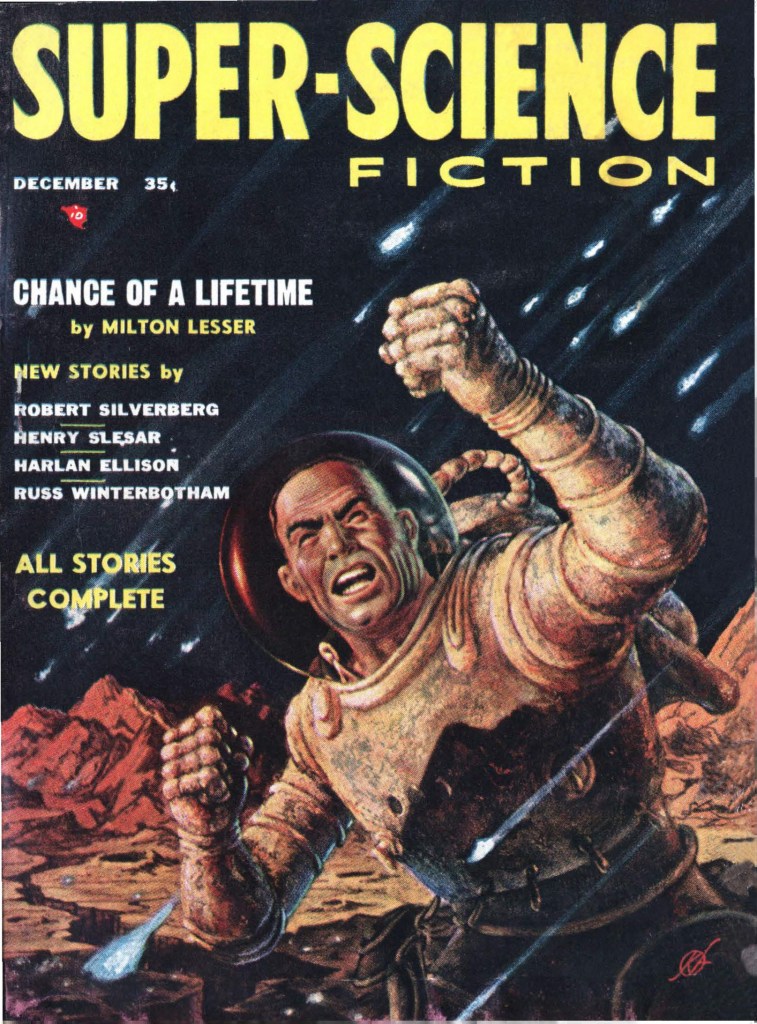
Harlan Ellison’s “Psycho at Mid-Point” first appeared in Super-Science Fiction, ed. W. W. Scott (December 1956). You can read it online here. It was not collected or anthologized.

Mike Ashley in Transformations: The Story of the Science Fiction Magazines from 1950 to 1970 (2005) does not have kind words for the three-year run of the magazine Super-Science Fiction (1956-1959). He describes the editor W. W. Scott as utterly out of his depth with a misguided reliance on “instant impact” without substance or cohesion or knowledge of the field. That said, Scott accidentally published a few solid short stories before the magazine’s demise in the market collapse in the late 50s even if the overall issues tended to be poor (168-169) and pandered to whatever craze filled the air (187). I’d classify Harlan Ellison’s “Psycho at Mid-Point” as a solid early work that fits the theme of this series perfectly!

“After fifteen months, Wallace went mad” (54).

Continue reading