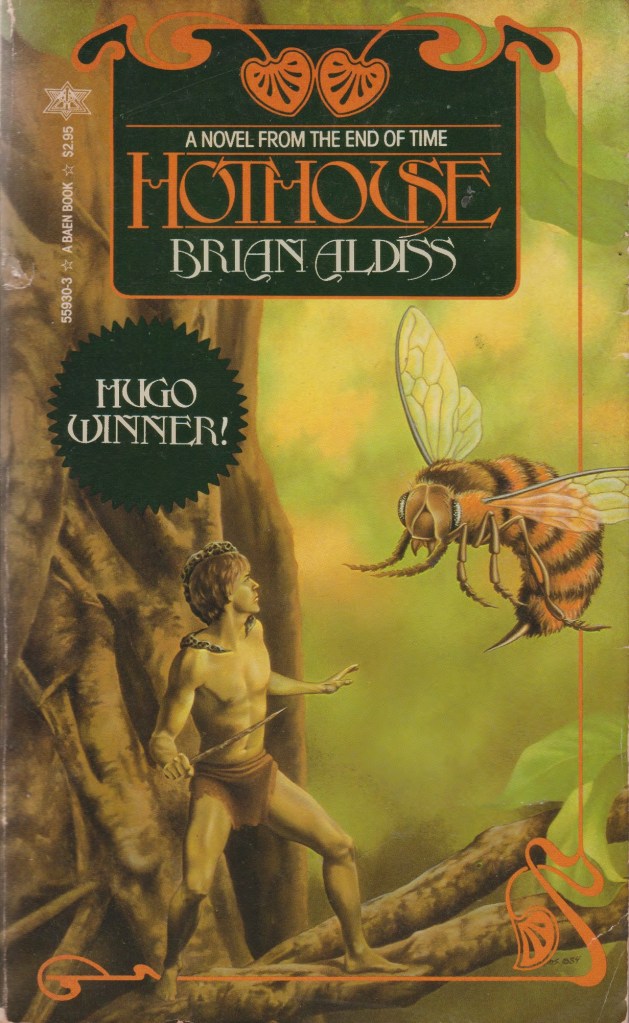
Brian W. Aldiss’ Hugo-winning Hothouse (1962) imagines an oppressive, violent, and alien Earth transformed by “the long age of the vegetable” (187). The surviving humans live–“more by instinct than intelligence” (54)– in a continent-encompassing banyan tree in constant fear of killer flora and fauna. Aldiss succeeds in constructing a profoundly unsettling worldscape encyclopedic in its details with unusual rituals of survival. There’s the existential sense throughout that the humans, detached from any memory of their past, who attempt to survive are but frantic movements of an apocalyptic paroxysm. Inventive, relentless, hallucinogenic.
The following review is the 16th installment of my series searching for “SF short stories that are critical in some capacity of space agencies, astronauts, and the culture which produced them.” Some stories I’ll review in this series might not fit. And that is okay. I relish the act of literary archaeology.
I decided to return to this all-but-defunct series after I was inspired by a conversation in the comment section of my recent review of John D. MacDonald’s “Spectator Sport” (1950). A friend of the site listed a fascinating range of MacDonald’s short stories and multiple appeared to fit my series on subversive accounts of astronauts and space travel. MacDonald’s “Flaw” (1949) charts the end of the dream of the conquest of space.
As always, feel free to join the conversation and read along with me on the search for the depressed astronaut.
Previously: Walter M. Miller, Jr.’s “The Hoofer” (1955)
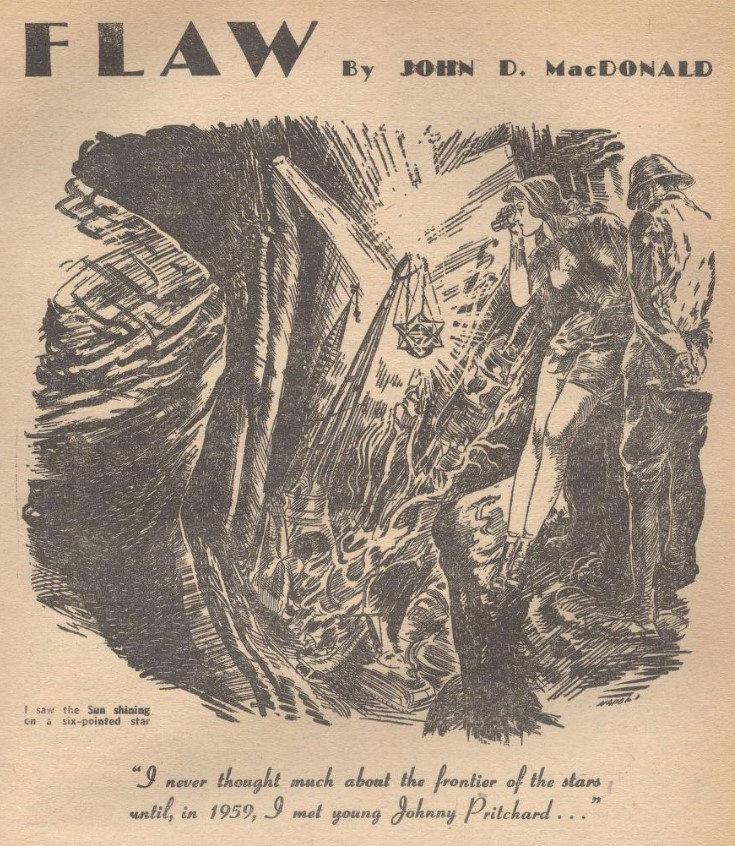
Vincent Napoli’s interior art for John D. MacDonald’s “The Flaw” in Startling Stories, ed. Sam Merwin, Jr. (January 1949)
3.75/5 (Good)
John D. MacDonald’s “The Flaw” first appeared in the January 1949 issue of Startling Stories, ed. Sam Merwin, Jr. You can read it online here.
The Dream Sold to the Legions
Carol Adlar, a government clerk at a rocket station in Arizona, falls in love with both the young astronaut Johnny Pritchard and his dream. Johnny believes the moment that humanity can travel to the stars will be the opportunity to create a new “world with no wars, no disease, no starvation” (84). The scars of the ruined Earth offer lessons to create a better future where the sinful will be able to transcend their timeless tendencies. Carol recounts, after Johnny’s tragic death, that “within a week I had caught his fervor, his sense of dedication” (84). They share the dream. They imagine that they will become “one of the first couples to become colonists for the new world” (84). And against her better judgement, she gives her “heart to a man who soars up at the top of a comet plume” (84).
This is the 15th post in my series of vintage generation ship short fiction reviews. Today I have an unusual take on the subgenre–a young scavenger couple encounter a mysterious blip on their radar!
As a reminder for anyone stopping by, all of the stories I’ll review in the series are available online via the link below in the review.
You are welcome to read and discuss along with me as I explore humanity’s visions of generational voyage. And thanks go out to all who have joined already. I also have compiled an extensive index of generation ship SF if you wish to track down my earlier reviews on the topic and any that you might want to read on your own.
Paul E. Wenzel’s cover for Galaxy Magazine, ed. H. L. Gold (June 1961)
3/5 (Average)
Fred Saberhagen’s “The Long Way Home” first appeared in the June 1961 issue of Galaxy Magazine, ed. H. L. Gold. You can read it online here.
Among the Asteroids out Near Pluto
Marty and Laura–recently married and very much in love–form the crew of the Clementine, a robotic mining, ore refining, and hauling vessel. They spend their isolated existence identifying prospective asteroids out near Pluto. Laura, on her very first space voyage, remains his liaison in the control room when Marty scoots off in his space bike to investigate a blip on the radar. If it’s a wrecked hull of “a ship dead for decade, or a century, or a thousand years” if theirs by right of salvage if they could tow it into a port (181). The robotic librarian indicates that no such vessel has ever existed! Marty’s investigation reveals that the thirty-mile long hull is part of a two-thousand-year-old larger vessel that has suffered a possibly cataclysmic disaster.
Wallace Wood’s interior art for Frederik Pohl’s “The Wizards of Pung’s Corners” in Galaxy Magazine, ed. H. L. Gold (October 1958).
Today I’ve reviewed the twentieth story in my series on the science fictional media landscape of the future. Frederik Pohl satirizes a post-apocalyptic world where advertising gets right to work after the bomb!
Dember’s cover for Galaxy Magazine, ed. H. L. Gold (October 1958)
3/5 (Average)
Frederik Pohl’s “The Wizards of Pung’s Corners” first appeared in Galaxy Magazine, ed. H. L. Gold (October 1958). You can read it online here.
The year 1957 flashed subliminal messaging directly into the popular imagination. Vance Packard published The Hidden Persuaders (1957), that quickly became a best seller, and articlesincluding “The Growing Power of Admen” in the Atlantic [1]. In addition, research findings were released and publicized demonstrations occurred over the course of the year appeared to substantiate Packard’s primary claims. In September 1957 James Vicary, a pioneer in subliminal advertising, conducted his infamous “breakthrough media event” to gathered reporters [2]–he intermixed a nature documentary with the subliminal message “Drink Coca-Cola” 169 times! –that built on his earlier studies [3].
Today I’ve reviewed the eighteenth and nineteenth stories in my series on the science fictional media landscape of the future. Alice Eleanor Jones and C. M. Kornbluth conjure a media-saturated world and cartoon characters that generate cultish adoration. Both authors respond to the rapid growth of television in the United States over the 1950s and multimedia conglomerates like Disney.
Previously: John Brunner’s “Fair” (March 1956) under the pseudonym Keith Woodcott.
C. M. Kornbluth’s “The Advent on Channel Twelve” first appeared in Star Science Fiction Stories No. 4, ed. Frederik Pohl (1958). You can read it online here if you have an Internet Archive account. Nominated for the 1959 Hugo for Best Short Story. Lost to Robert Bloch’s “That Hell-Bound Train” (1958).
In the short intro to the story in The Best of C. M. Kornbluth (1976), Frederik Pohl explains that Kornbluth’s two young sons (and their father) never missed an episode of theThe Mikey Mouse Club(1955-1958). The iconic Disney TV show generated a “national mania” with kids everywhere singing the Mouseketeer song and wearing mouse-ear hats. In 1955, the wider Disney craze would see the creation of their first theme park–Disneyland. Expanding on earlier ruminations on media and the masses in The Space Merchants (1953), “The Advent on Channel Twelve” imagines the dystopic elevation of cartoon character to an altogether new pedestal in the American consciousness.
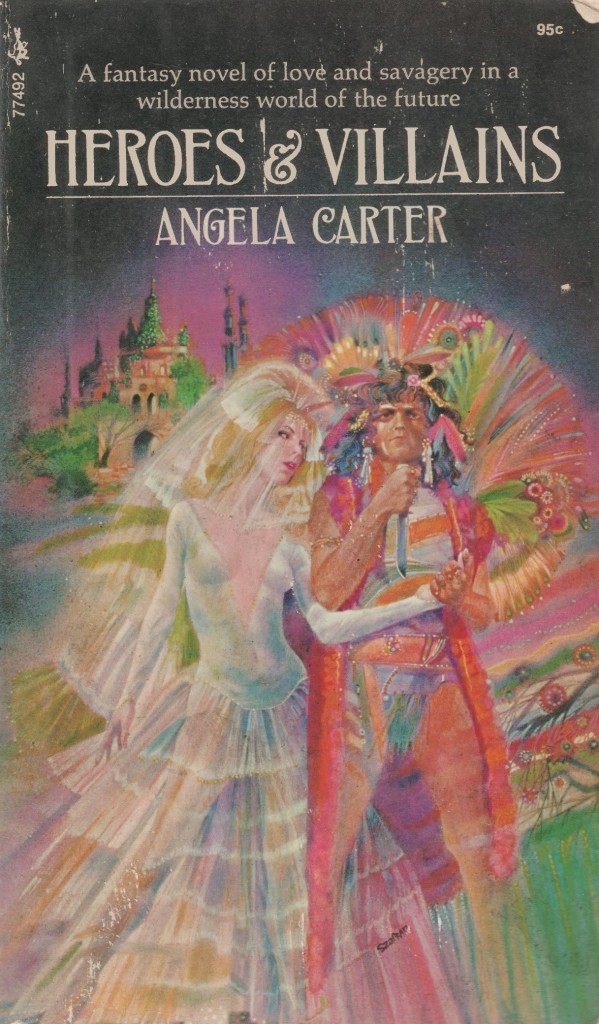
English author Angela Carter (1940-1992) spun postmodern fabulations of decadent futures and decaying urban expanses replete with incisive deconstruction of genre conventions [1]. Her dark, Freudian, and erotic masterpiece The Infernal Desire Machines of Doctor Hoffman (1972) ranks amongst my favorite SF 70s visions. From a young age Carter read John Wyndham and, like so many others in the 60s, felt the relentless pull of Michael Moorcock’s New Worlds magazine and the larger New Wave movement: “this lode, this seam of intensely imaginative and exciting fiction” [2]. And, as with her contemporary Emma Tennant, the work of J. G. Ballard–and/or his ability to fill the air with his entropic sadness–spurred her to write post-apocalyptic SF [3]. Heroes & Villains (1969) is the product of her inspiration and “her first tale to engage in a recognizably sf displacement of reality” [4].
Today I’ve selected two post-apocalyptic visions by female authors. I needed an antidote to the creepy last man/woman stories I’ve been reading recently. Alice Eleanor Jones spins a masterpiece about a housewife attempting to keep the entropy of a crumbling world and an abusive husband at bay. Katherine MacLean imagines a moment where the last representative of the American Empire, after all the rhetoric of progress and exceptionalism came crashing down in a nuclear war, interacts with a persistent and well-meaning native girl.
The links to the stories can be found in the reviews. Both are recommended reads for fans of 50s and 60s science fiction.
Uncredited cover for the 1968 edition of The Best from Fantasy and Science Fiction: Fifth Series, ed. Anthony Boucher (1956)
5/5 (Masterpiece)
Alice Eleanor Jones’ “Created He Them” first appeared in The Magazine of Fantasy and Science Fiction, ed. Anthony Boucher (June 1955). You can read it online here.
Sometimes there are stories that transcend their short length with lasting power. This story has resided within me as if freshly read for weeks. Like some corrosive lozenge of love and hate, “Created He Them” eats you up from the inside.
Rob Latham in his article “Sextrapolation in New Wave Science Fiction” (2008) argues that in the early 1950s “a handful of stories were published in the magazines that dealt explicitly with sexual topics” long absent from genre. Latham suggests that some of the notable New Wave takes on science fictional sex read as reconceptualized versions of these stories [2]. With few exceptions, the 50s trailblazing tales were ignored by the major digests of the day and instead appeared in the failing pulps–Startling Stories and Thrilling Wonder Stories–or in “second- and third-tier digests just struggling to establish themselves” such as Howard Browne’s Fantastic Adventures. For example, my two previous posts in this series covered Sherwood Springer’s “No Land of Nod” (1952), which appeared in Thrilling Wonder Stories, and Philip José Farmer’s “The Lovers” (1952) in Startling Stories. The later was rejected by H. L. Gold, according to John Brunner, at Galaxy with the note: “I’ll publish this if you can get rid of the sex–I run a family magazine” [3].
Let’s get to the stories! Both Fritz Leiber’s “The Ship Sails at Midnight” (1950) and Theodore Sturgeon’s “The Sex Opposite” (1952) explore polyamorous relationships between humans and aliens. In Leiber’s case, a group of bohemians fall in love with a bisexual alien. In Sturgeon’s tale, a heterosexual couple both fall for a parthenogenetically female “alien” symbiote that appears male to women and female to men.
Henry Sharp’s interior art for Fritz Leiber’s “The Ship Sails at Midnight” in Fantastic Adventures, ed. Howard Browne (September 1950)
3/5 (Average)
Fritz Leiber’s “The Ship Sails at Midnight” first appeared in Fantastic Adventures, ed. Howard Browne (September 1950). You can read it online here.
Four self-proclaimed “‘wild’-young people, bohemians” (61), fresh out of college but still “sponging” off their parents “doing academic odd-jobs” (57), encounter the enigmatic and stunningly gorgeous Helen serving food at Benny’s, an all-night diner. Soon after meeting Helen, Es, “something of an artist,” starts to push the boundaries of her previously staid art (56). The narrator, Larry, who calls himself a writer but spends more time “reading magazines and detective stories, lazing around, getting drunk, and conducting […] endless intellectual palavers” (58) suddenly has something to actually write about–a carnal and intellectual love for Helen that they keep hidden from the rest. Louis, a philosopher, slowly encounters new avenues to explore rather than “merely cultivat[ing] a series of intellectual enthusiasms [..] and fruitless-excitement over the thoughts of other men” (57). And the gruff exterior of Gene, an atomic scientist, begins to mellow. All four view Helen as a “Great Books discussion leader” who serves as an intellectual midwife–who fosters, encourages, and inspires the expansion of their minds.
Which books/covers/authors intrigue you? Which have you read? Disliked? Enjoyed?
I planned to have a review up today. Unfortunately, August is always my least productive month writing as it marks the return to work after a much needed summer break. It’s been a rough few weeks! Stay tuned.
1. The Squares of the City, John Brunner (1965)
Murray Tinkelman’s cover for the 1978 edition
From the back cover: CHECHMATE IN PARADISE. Ciudad de Vados was a Latin-American showplace, a paradise…a flourishing supercity designed and run nearly to perfection.




 Science Fiction and Other Suspect Ruminations