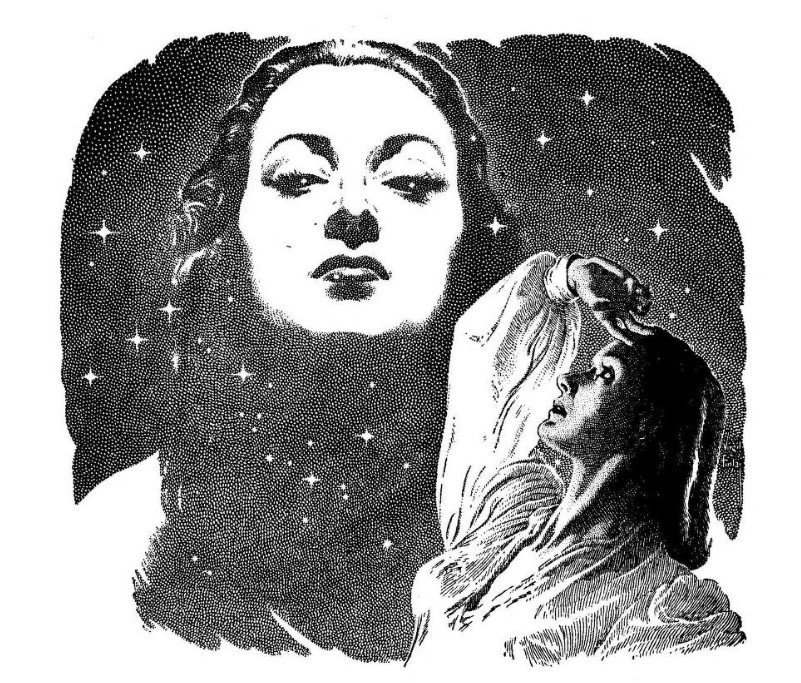
Virgil Finlay’s interior art for Sherwood Springer’s “No Land of Nod” in Thrilling Wonder Stories, ed. Samuel Mines (December 1952)
In the March 1955 issue of John Brunner’s fanzine Noise Level, the young author listed a handful of “thematically edgy stories”–including Sherwood Springer’s “No Land of Nod” (1952), Theodore Sturgeon’s “The World Well Lost” (1953), and Lester del Rey’s “For I am A Jealous People (1954)–that he considered a “step forward” in the field [1]. The previous year he had praised elements of Philip José Farmer’s “The Lovers” (1952) in a fan letter to Startling Stories. According to Jad Smith, the stories feature “lived-in, morally ambiguous backgrounds much noisier and dynamic than the two-dimensional backdrops of more conventional fare” that appealed to Brunner’s embryonic views on genre [2]. Brunner viewed social change as a “messy and unpredictable process riddled with moral complexities” [3].
Today I’ve reviewed the seventeenth story in my series on the science fictional media landscape of the future. John Brunner explores how total immersion media, one organ in a vast futuristic fair designed to satiate the masses, can transform fear within the broken.
Terry Maloney’s cover for New Worlds Science Fiction, ed. John Carnell (March 1956)
4.5/5 (Very Good)
John Brunner’s “Fair” first appeared in New Worlds Science Fiction, ed. John Carnell (March 1956) under the pseudonym Keith Woodcott. You can read it online here. It also appeared in his first collection No Future In It (1962).
I recently devoured Jad Smith’s short monograph John Brunner(2012) in the Modern Masters of Science Fiction series for Illinois University Press. Not only did the book rekindle my desire to tackle more of Brunner’s short fiction but I also bought copies of The Squares of the City (1965) and Quicksand (1967). I might even reread The Shockwave Rider (1975) in the near future. If you are at all interested in John Brunner’s science fiction I recommend acquiring a copy.
Smith identifies “Fair” (1956) as Brunner’s “finest achievement during this [early] period” (Smith 28). I’d rank it right under his spectacular generation ship short story “Lungfish” (1957). As with many of Brunner’s best works, “Fair” had a contested publication history–in this instance John Carnell only accepted it under the pseudonym “Keith Woodcott” to “fill out an issue” (Smith 29). The identity of the consummate wordsmith didn’t last long as Carnell accidentally revealed his identity in next issue when the story came in second in the reader’s poll!
Earle Bergey’s cover for Startling Stories, ed. Samuel Mines (August 1952)
3.5/5 (Good)
Preliminary note: This is a review of the original 1952 novella. You can read it online here. Philip José Farmer published a novelization in 1961. While the novel was frequently republished, the original novella was not anthologized until 2003 (bibliography). I am in half a mind to read the 1961 version and analyze the changes!
This is a review that I wish I didn’t have to provide a rating as my lukewarm response to the story might obfuscate my fascination with its thematic contents and larger historical context. Philip José Farmer’s novella “The Lovers” (1952) is, without doubt, historically important for the development of the SF genre as it introduced a transgressive mix of sex (mostly implied), unusual xenobiology, and colonial critique. It shocked and fascinated readers at the time. In a letter published in the September issue of Startling Stories, Farmer himself predicted the “Reverberations from THE LOVERS should be really bouncing” later in the year (136). And he was right!
In the past year or so I’ve put together an informal series on the first three published short fictions by female authors who are new(ish) to me and/or whose most famous SF novels fall mostly outside the post-WWII to mid-1980s focus of my reading adventures. So far I’ve featured Carol Emshwiller (1921-2019), Nancy Kress (1948-), Melisa Michaels (1946-2019), Lee Killough (1942-), and Eleanor Arnason (1942). I do not expect transformative or brilliant things from first stories. Rather, it’s a way to get a sense of subject matter and concerns that first motivated authors to put pen to paper.
Today I’ve selected Josephine Saxton (1935-), an author whom I’ve long known about–I reviewed The Hieros Gamos of Sam and An Smith (1969) back in 2012–but never read any more of her work. Due to Rich Horton’s review of Saxton’s Vector for Seven (1970), my interest in an important voice of the English New Wave movement suddenly rekindled. Her 60s and 70s stories appeared in many of the influential New Wave (and adjacent) anthologies–including Judith Merril’s England Swings SF (1969), Harlan Ellison’s Again, Dangerous Visions (1972), Robert Silverberg’s New Dimensions 1 (1971), Samuel R. Delany and Marilyn Hacker’s Quark/3 (1971), and Damon Knight’s Orbit 9 (1971).
In her first three stories, Saxton deploys sculpted landscapes as metaphysical traps that allegorize the internal struggles of her characters. In the language of the New Wave, inner space manifests as a nightmarish landscape that one must try to traverse. Her prose, even in her weakest tales, is measured and poetic. See SF Encyclopedia for discussion of her later fiction.
Let me know which Josephine Saxton fictions–perhaps from much later in her career–resonate with you.
Keith Roberts’ cover for Science Fantasy, ed. Kyril Bonfiglioli (November 1965)
4/5 (Good)
“The Wall” first appeared Science Fantasy, ed. Kyril Bonfiglioli (November 1965). You can read it online here. It also appeared in Saxton’s collection The Power of Time (1985), which is where I read it.
Which books/covers/authors intrigue you? Which have you read? Disliked? Enjoyed?
1. Courtship Rite, Donald Kingsbury (1982)
Rowena Morrill’s cover art for the 1st edition
From the inside flap: “Gaet, Hoemei and Joesai are three clone brothers, survivors of the rigorous and deadly process of nurture and weeding that produces people of high kalothi, people worthy of surviving on the inhospitable planet of Geta. Geta was settled many thousands of years ago by human starships, but only legends of the people’s origins remain, memories that have become myths.
Stephen Goldin gathers together twelve original short stories–including six by women authors and two co-written with women–on the theme of the alien condition [1]. Despite the “Average” overall rating, The Alien Condition gathers a fascinating range of science fiction with three spectacular visions by Vonda N. McIntyre, Kathleen Sky, and James Tiptree, Jr. I was also pleasantly surprised by Alan Dean Foster’s take on the theme considering my previous exposure to his fiction.
Today I’ve reviewed the sixteenth story in my series on the science fictional media landscape of the future. John D. MacDonald tortures a time-traveler with an immersive TV experience!
Thank you “Friend of the Site” John Boston for suggesting I track this one down for my media series. “Friend of the Site” Antyphayes also brought up the story in a discussion way back in 2018…
Up Next: John Brunner’s “Fair” (March 1956) (as Keith Woodcutt).
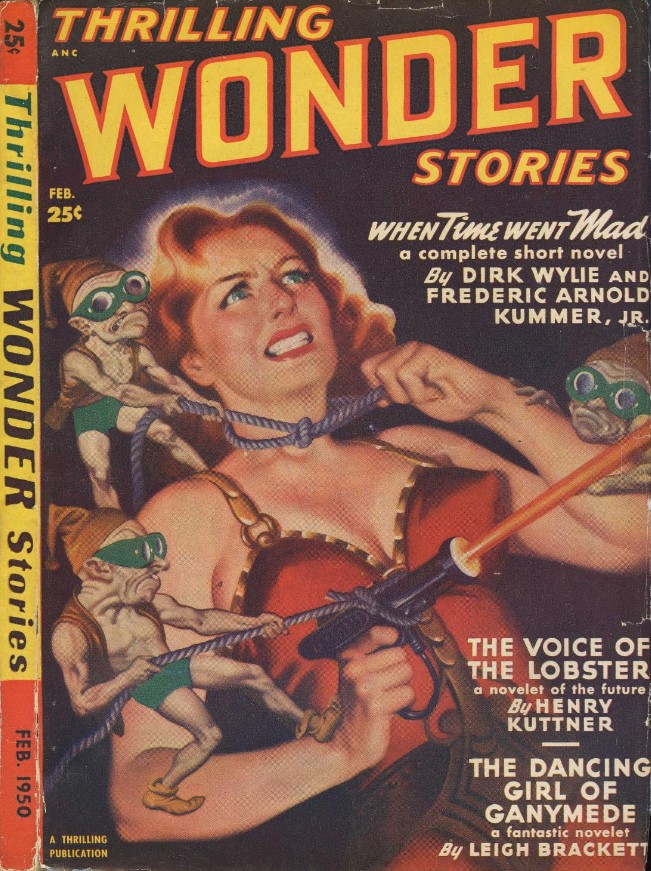
Earle Bergey’s cover for Thrilling Wonder Stories, ed. Sam Merwin, Jr. (February 1950)
4/5 (Good)
John D. MacDonald’s “Spectator Sport” first appeared in the February 1950 issue of Thrilling Wonder Stories, ed. Sam Merwin, Jr. You can read it online here. Note: this is a very short story and my review will contain unavoidable spoilers.
John D. MacDonald (1916-1986), best known for his massive Travis McGee series (1964-1985) and the twice-adapted psychological thriller The Executioners (1957), wrote three SF novels and was a regular in SF magazines in the 40s and 50s (with a handful appearing later). SF Encyclopedia claims erroneously that none of his later “ebullient pessimism” is present in his early SF. “Spectator Sport” embodies “ebullient pessimism” by creating a future where everyone is excited about slipping into delusion.
Today I’ve reviewed the fifteenth story in my series on the science fictional media landscape of the future. Theodore Sturgeon explores the effects of information overload in a chilling study of the making of a terrorist.
Dick Shelton’s cover for The Best from Fantasy and Science Fiction, Sixth Series, ed. Anthony Boucher (1957)
4.5/5 (Very Good)
Theodore Sturgeon’s “And Now the News…” first appeared in the December 1956 issue of The Magazine of Fantasy and Science Fiction, ed. Anthony Boucher. You can read it online here. I read it in TV: 2000, ed. Isaac Asimov, Martin H. Greenberg, Charles G. Waugh (1982). I highly recommend the anthology for all readers interested in this theme.
Written during the boom in TV sales and consumption in the United States–from 7k sold in 1944 to 5 million in 1950 (and by 1960 90% of homes contained a TV) (source)–“And Now the News…” describes a world saturated by all forms of media [1]. From the morning newspapers that wait at his door consumed at breakfast, the “three [radio] stations in town with hourly broadcasts” (262), and the TV news programs in the evening, MacLyle’s waking hours are completely inundated with the news [1].
Richard Matheson’s I Am Legend (1954) is an influential SF vampire/zombie novel that spawned three film adaptations (I’ve watched the first two) and inspired directors such as George A. Romero and Danny Boyle, game designers such as Tim Cain (Fallout), and countless authors. The subject of the novel–man attempts to survive an onslaught of vampires, caused by bacterial infection, that act like smart(er) zombies in a post-apocalyptic wasteland–normally isn’t my cup of tea. I’m the first to admit that I picked up the novel entirely due to its historical importance. And I’m somewhat glad I did! While the physical onslaught of vampiric zombies didn’t interest me, the main thrust of the narrative concerns the mechanisms of grief and sexual frustration in the burning wreckage of one-time domestic bliss.