Book Review: The Eclipse of Dawn, Gordon Eklund (1971)

THCLPSFDWN1971

(Diane and Leo Dillon’s cover for the 1971 edition)

3.25/5 (Vaguely Good)

“I hadn’t even voted in the last election.  I knew nothing about it, except Robert Colonby, how he wanted to make America strong again, how he said we ought to exert ourselves” (15).

Gordon Eklund’s first novel Eclipse of Dawn (1971) tells of a future dystopic America (the year 1988) chaffing under foreign quarantine and suffering from a major race war which results in African-Americans creating an autonomous political entity in the American South.  The effects of limited nuclear war spawns a poisonous urban environment and microclimates across the state of California. A return to “Victorian morality” presents but a facade of “purity laid across a morass of fear and guilt” (94).

Robert F. Colonby sets out from his residence amidst the bombed-out remains of Disneyland, where he dines on exotic cuts of meat and “wines dated back to the glory days” Continue reading
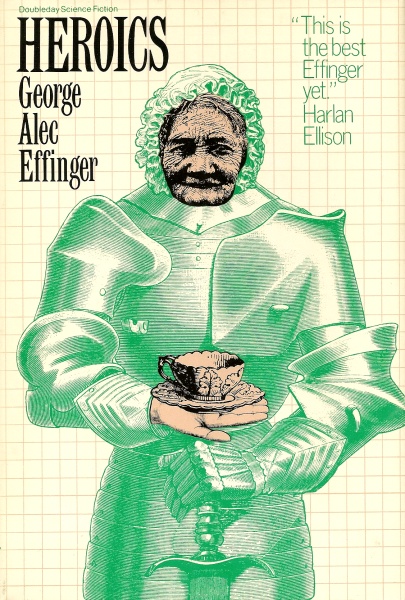
Book Review: Heroics, George Alec Effinger (1979)

HEROICS1979

(Gary Friedman’s cover for the 1979 edition)

4.25/5 (Good)

George Alec Effinger’s What Entropy Means to Me (1972), a complex and intense homage to the act of literary creation, ranks among my favorite SF novels.  Heroics (1979), a deconstruction of myth and heroic quest,  treads similar ground but in a more light-hearted manner.  The sheer intensity elevates the former while the latter’s sincere examination of old age and loneliness still strikes with elegiac power.  Both are highly recommended but What Entropy Means to Me or his short story collection Irrational Numbers (1976) might be the place to Continue reading

Short Book Reviews: Theodore Sturgeon’s Venus Plus X (1960), Christopher Priest’s The Affirmation (1981), and Barry N. Malzberg’s Screen (1968)

Cycle: read a book, place it in the review pile, the immediacy of the novel fades slightly or the novel fights every moment of the review writing process (–> Priest’s masterpiece The Affirmation), never review it, feel bad that I never reviewed the novel, read less in order to catch up…

Result: less reading and more pouting.

Remedy: In order to catch up, here are short/less intensive reviews with links to in-depth analysis (if it exists).  Part I + II (books by Budrys, Strete, White, Bishop, etc).

1. Venus Plus X, Theodore Sturgeon (1960)

VNSPLSX1960

(Victor Kalin’s cover for the 1960 edition) Continue reading

Book Review: Blind Voices, Tom Reamy (1978)

BLNDVCS1978

(David Plourde’s cover for the 1978 edition)

4.25/5 (Very Good)

Tom Reamy’s Blind Voices (1978) was nominated for the Nebula, Hugo, and BFSA awards and came in second in Locus voting for best novel in 1979.  Posthumously released, Reamy died of a heart attack while writing in the fall of 1977 at 42.  His take on small town America transformed by the arrival of a traveling circus and its array of wonders will stay with you for years to come.  The science fiction elements (revealed more than halfway through the novel) interlace and add to the elegiac and constrained fantasy feel.  The specter of sexuality and violence Continue reading

Book Review: An Exercise for Madmen, Barbara Paul (1978)

Screen Shot 2016-06-06 at 6.43.29 PM

(Jack Gaughan’s cover for the 1978 edition)

2.5/5 (Bad)

Barbara Paul’s An Exercise for Madmen (1978), a retelling of Euripides’ The Bacchae, follows an established narrative pattern: Stranger enters community with dangerous knowledge.  Community reacts with suspicion but soon the stranger, despite claims of goodwill, begins to wield greater and greater influence.

In this case, a priapic-Romance cover-“ideal” alien man named Zalmox (masculine to women, feminine to men) gets an entire community to have great sex with him and everyone else….  And he brings magical alien apples, apples that cure madness Continue reading

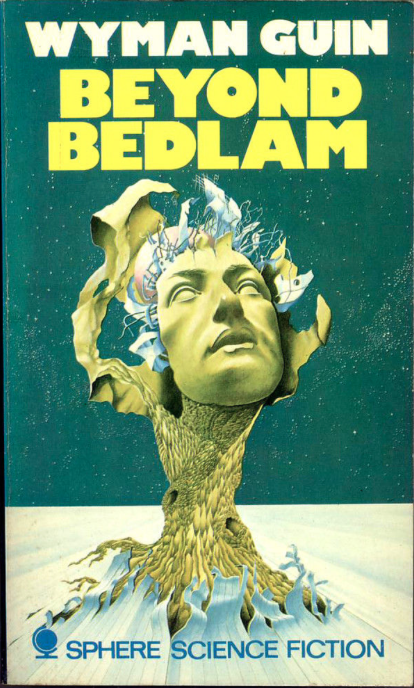
Book Review: Living Way Out (variant title: Beyond Bedlam), Wyman Guin (1967)

Screen Shot 2016-06-05 at 8.57.04 AM

(Jim Burns’ cover for the 1973 edition)

3.75/5 (collated rating: Good)

Wyman Guin produced eight short stories and one novel between 1950 and 1973 [see his entry on SF encyclopedia].  A pharmacologist/advertising executive by profession, his SF output demonstrates a mature satirical bent touching on topics of sociology, psychology, and psychiatry.  Best known for the often anthologized “Beyond Bedlam” (1951), the collection is worth tracking down for   “A Man of the Renaissance” (1964), “Volpla” (1956), “The Delegate from Guapanga” (1964), and “Trigger Tide” (1950) as well.  It is a shame that he did not write more.

Highly recommended for fans of social Continue reading

Book Review: The Best SF Stories From New Worlds, ed. Michael Moorcock (1967)

lehr

(Paul Lehr’s cover for the 1968 edition)

4/5 (collated rating: Good)

Fresh off of Langdon Jones’ wonderful New Wave collection The Eye of the Lens (1972) I decided to see if any of my unread anthologies contained his work—queue The Best SF Stories From New Worlds (1967).  Unfortunately, Jones’ contribution is far from the best in this absolutely stellar collection.

This 1967 volume was the first in a series of eight Best Of New Worlds anthologies edited by Michael Moorcock between 1967-1974.  I reviewed The Best SF Stories From New Worlds 3 (1968)—i.e. the one with Pamela Zoline’s must-read “The Heat Death of the Universe” (1967)—a while back.

The takeaway: The majority of stories in are required reading for fans of New Wave SF and New Worlds magazine.  Find a copy of the anthology with its fantastic Paul Lehr cover or track down Continue reading

Book Review: The Eye of the Lens, Langdon Jones (1972)

Richard Jones1972

(Richard Jones’ cover for the 1972 edition)

4/5 (collated rating: Good) (*see note below)

Langdon Jones is best known for his involvement in New Worlds Magazine: he contributed stories (published 16 in various New Worlds venues), cover art, and edited the April-July 1969 issues.  One of his stories, “To Have and To Hold,” was slated to appear in the never published Last Dangerous Visions, and languishes unread and unknown.  Why Ellison doesn’t relinquish control of the copyright is beyond me…  Sadly, Jones’ output had all but dried up by 1969.  If anyone knows why, please let me know.

Three of the seven stories in the collection—“The Hall of Machines” (1968), “The Coming of the Sun” (1968), and “The Eye of the Lens” (1968)—form a loose triptych (the religious connotations of the term is purposeful).

*NOTE: Recommended only for fans of the most radical New Wave SF that graced the pages of New Worlds magazine.  Experimental, allegorical, and occasionally Borgesian, all the stories revolve around our perception of time and memory.  Even in the collection’s weakest moments—the Continue reading

Book Review: Starship and Haiku, Somtow Sucharitkul (S. P. Somtow) (1981)

STRSHPHKJJ1981

(Gerry Daly’s cover for the 1981 edition)

3.25/5 (Vaguely Good)

“Nature does not write haiku.  Men write haiku.  The world cannot end in chaos, with things running wild, with gangs running rampant, with cannibals, with dog eating dog and plague-deaths and the abominable mutations.  O, I know it is so in some other countries, but we are Japanese.  We are the children of the whale, who have committed the original sin of patricide… but we have pride, and we must die in beauty” (131).

Somtow Sucharitkul (S. P. Somtow after 1985) is a fascinating individual.  He’s a Thai-American SFF author/composer who moved back and forth between Thailand and the UK (English was his first language and he received his education at the University of Cambridge).  Perhaps best known for his Mallworld sequence of stories (1979-2000), Somtow’s output is immense and ranges from horror to mainstream fiction (in addition to numerous symphonies and operas).

His first novel Starship & Haiku (1981), which won the 1982 Locus Best First Novel Award, joins the ranks of a veritable subgenre of SF about whales and pseudo-whales—including (off the top of my head, there are bound to be more!): Star Trek IV: The Voyage Home (1986), Ian Watson’s The Jonah Kit (1975), T. J. Bass’ The Godwhale (1974), Philip José Farmer’s The Wind Whales of Ishmael (1971), John Varley’s Gaean series (1979-1984), Alan Dean Foster’s Cachalot (1980), and  Robert F. Young’s Spacewhale sequence of short stories (1962-1980) which includes “Starscape with Frieze of Dreams” (1970).  And yes, a whale makes a fateful appearance in Adams’ The Hitchhiker’s Guide to the Galaxy (1979)… The interest in whale SF was probably rooted to the increasing scientific research on whale song in the 1970s.  And whales do hold a certain allure as the largest mammals on our planet! Continue reading