Book Review: To Open the Sky, Robert Silverberg (1967)

(Richard Powers’ cover for the 1967 edition)

3.5/5 (Good)

“And there is light, before and beyond our vision, for which we give thanks.  And there is heat, for which we are humble.  And there is power, for which we count ourselves blessed.  Blessed be Balmer, who gave us wavelengths.  Blessed be Bohr, who brought us understanding.  Blessed be Lyman, who saw beyond sight.  Tell us now the stations of the spectrum […]” (3).

Robert Silverberg’s To Open the Sky (1967) is an enjoyable pulp future history with a somewhat “different” premise–religion will be the main force that facilitates mankind’s exploration of the stars.  In his intro of 1978 edition he discusses how the project came about.  In the early 60s Frederik Pohl became his editor and allowed him to published, for the first time, SF “for love rather than money” (II).  Up to this point Silverberg had never attempted, other than in the briefest sketch form,  to extrapolate an entire future history à la Olaf Stapleton or Isaac Asimov.  Silverberg’s vision is nowhere as complex Continue reading
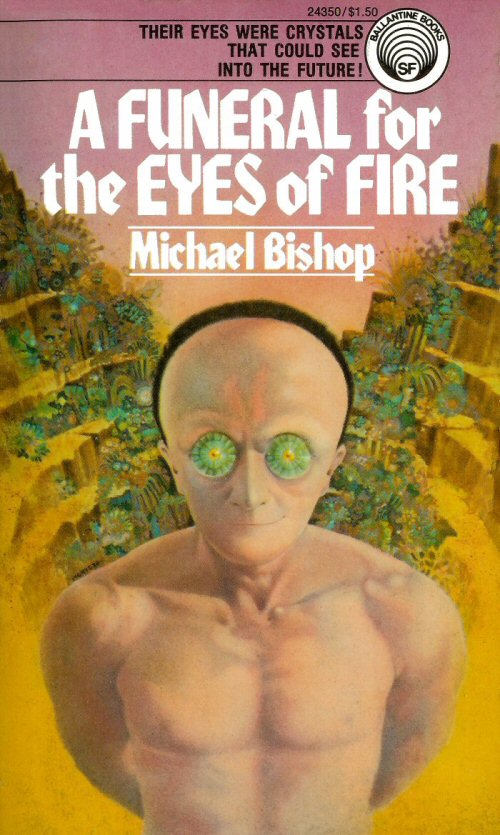
Book Review: A Funeral for the Eyes of Fire, Michael Bishop (1975*)

funeral

(Gene Szafran’s cover for the 1975 edition)

Nominated for the 1976 Nebula Award for Best Novel

5/5  (Masterpiece)

*First, a preliminary note on the publication history:  I read the original, unabridged 1975 edition.  However, Michael Bishop “completely rewrote” the novel in 1980 (according to ISFDB and his introduction to the later edition).  The 1980 rewrite—initially titled Eyes of Fire but later confusingly released under the original title, A Funeral For the Eyes of Fire-–was the one republished and recently available as an eBook through SF Gateway according to Bishop’s wishes.  I would prefer my readers, if they are interested in the volume, to not hesitate in snatching up the original.  I suspect both are worth reading.


Fresh off Michael Bishop’s strangely wonderful And Strange at Ecbatan the Trees (variant title: Beneath the Shattered Moons) (1976) I eagerly devoured his first published novel, A Funeral for the Eyes of Fire (1975)—and with this work, bluntly put, he enters my pantheon of favorite SF authors.  Bishop, completely in command of his narrative, weaves together a literary and anthropological tapestry filled with stories within stories and delicate interplay between these layers.

The deceptively simple premise unfurls into a complex and moving meditation on culture clash and the power of ritual, threatening at every moment to explode into violence.  This is perhaps the most sophisticated rumination I  Continue reading

Book Review: Yesterday’s Children (variant title: Starhunt*), David Gerrold (1972)

(Paul Lehr’s cover for the 1972 edition)

3/5 (Average)

*The 1980 edition, still under the title Yesterday’s Children, was substantially rewritten.  In 1985 David Gerrold released it under a new title, Starhunt.  This is a review for the original 1972 edition.  I have not read the later rewrite so I am unsure how much was modified.

David Gerrold, best known for writing the famous Star Trek: The Original Series episode “The Trouble With Tribbles” (1967), has continuously produced SF novels since the early 70s.  I had previously read the disappointing Space Skimmer (1972) which combined a fascinating premise with puff-puppies, annoying princes, and bad poetry.  Yesterday’s Children (1972) (variant title: Starhunt) likewise combines a fascinating premise with a less than satisfactory delivery, numerous narrative hiccups, and uneven tone and characterization.  I am not surprised that the novel was rewritten due to the slightly rough Continue reading

Book Review: Cloned Lives, Pamela Sargent (1976)

(Walter Rane’s cover for the 1976 edition)

2.5/5 (Bad)

There is a reason that Pamela Sargent’s Cloned Lives (1976) has been overshadowed by Kate Wilhelm’s clone-themed Where Late the Sweet Birds Sang (1976), which garnered a Hugo award and a Nebula nomination, released the same year. While Sargent’s vision is painfully melodramatic and descriptive to a fault where pages and pages and pages pass without a single metaphor or simile, Wilhelm’s was psychologically taut and beautiful.  Cloned Lives is comprised of three previously published works, the short story “A Sense of Difference” (1972), the novella “Father” (1974), and the novelette “Clone Sister” (1973).  Each section shifts perspective between each of the clones and their father (with a culminating “Interface” section).    

Despite Cloned Lives’ manifold flaws there are a few moments of interest, notably amongst descriptive postulations about the nature of her futuristic society, that are prescient and thought-provoking.  Likewise, Sargent’s conscious effort to integrate a vast assortment of races (Indians, Arabs, Africans, etc) and gender roles (homosexual couples who use cloning to have children, female scientists, etc) is admirable and appealing.  However,  these brief (yet intriguing) interludes and observations do not redeem the banal melodrama Continue reading

Book Review: The Men Inside, Barry N. Malzberg (1973)

(Ron Walotsky’s cover for the 1973 edition)

4.5/5 (Very Good)

Caveat: If a perverse (and Freudian) metafictional (and literary) retelling of Otto Klement and Jerome Bixby’s Fantastic Voyage replete with filmic flashbacks does not intrigue you then stay away….

There are few SF authors who utilize metafictional elements as gleefully and effectively as Barry N. Malzberg.  Beyond Apollo (1972), his masterpiece, is a labyrinthine sequence of 67 short chapters of a novel written by the main character who may or may not be recounting real (imagined?) events.  While in In the Enclosure (1973) the excruciating paranoia that permeates the pages and the impossible escapes that transpire, recounted as if they were entries in a diary, could indeed be generated by an external force—the exact nature of which is unknowable—implanting memories.  Revelations (1972) was entirely comprised of a sequence of documents (interview transcripts, diary fragments, epistolary fragments) Continue reading

Book Review: Fireship (variant title: Fireship / Mother and Child), Joan D. Vinge (1978)

(Stephen Hickman’s cover for the 1978 edition)

3.5/5 (collated rating: Good)

Like so many SF fans, my first exposure to Joan D. Vinge’s work was via her wonderful Hugo-winning novel The Snow Queen (1980).  Eventually I found a copy of her first published novel, The Outcasts of Heaven Belt (1978), which had an intriguing premise but a less than satisfactory delivery (poor characterizations, pacing, etc).  The collection Fireship (1978) is comprised of two novellas: the Hugo- and Nebula-nominated “Fireship” (1978) and one of her earlier works, “Mother and Child” (1975).

The title story is the lesser of the two despite its (dare I say dubious) award nominations.  It’s a light-hearted and unchallenging proto-cyperpunk Continue reading

Book Review: The Downstairs Room and Other Speculative Fiction, Kate Wilhelm (1968)

(Ron Walotsky’s cover for the 1968 edition)

4/5 (collated rating: Good)

By the late 60s Kate Wilhelm’s SF moved from generally uninspiring pulp (à la the collection The Mile-Long Spaceship) to psychologically taught and emotive mood pieces exploring the almost existential malaise of daily existence and the disturbing effects of “programmed” lives (especially the housewife).  The fourteen short-stories in The Downstairs Room and Other Speculative Fiction (1968) (the term “speculative fiction” was coined by Judith Merril in the 60s) comprise a snapshot of Wilhelm’s best New Wave work.  It should be noted that not all are SF.

Although some are less engaging than others, her harrowing portrayal of starlets subjected to endless psychological torments at the whims of their viewers in “Baby, You Were Great” (1967) (Nebula nominated) and the evocative tapestry of daydreams Continue reading

Book Review: The Shores of Another Sea, Chad Oliver (1971)

(Michael Booth’s cover for the 1984 edition)

3.25/5 (Vaguely Good)

Suppose that one day man landed on some distant planet.  Why would he have come, what impulse would have driven him across the darkness and the light-years?  Could he explain, and would he even try?  If he set out to explore that fearful world, if he trapped some specimens, what would he do if he were attacked by monstrous beings he could not understand? (135)

Chad Oliver is a well-known proponent of anthropological science fiction.  John Clute (of SF encyclopedia) proclaims him “pioneer in the application of competent anthropological thought to sf themes.”  Despite being relatively prolific between the 50s-70s (a handful of short stories appeared in the 80s), The Shores of Another Sea (1971) retains a distinctly 50s tone, Continue reading

Book Review: Immortality, Inc. (variant title: Time Killer), Robert Sheckley (1958)

(Uncredited cover for the 1959 edition)

3.75/5 (Good)

Nominated for the 1959 Hugo Award for Best Novel

Robert Sheckley’s first novel Immortality, Inc. (variant title: Time Killer) (1958) has a somewhat checkered publication history.  It was originally published by Avalon books under the title Immortality Delivered (1958) where it was abridged against Sheckley’s wishes.  Unless you are a collector of the Avalon publication series I recommend procuring the complete 1959 Bantam Book edition with its gorgeous (and alas, uncredited) cover.  Later editions were decked with rather unfortunate covers linking the book to the atrocious film Freejack (1992) (replete with Mick Jagger) which was supposedly influenced by Sheckley’s novel.

Thematically, Immortality, Inc concerns the societal ramifications of the important discovery that death is not the end of existence and nor does the Christian conception of the afterlife Continue reading