Book Review: Costigan’s Needle, Jerry Sohl (1953)

(Richard Powers’ cover for the 1954 edition)

2/5 (Bad)

In countless Star Trek episodes a shattered piece of technology is miraculously resurrected (or a non-related piece of technology is transformed into an inter-dimensional portal) rescuing stranded one-time antagonists who learn, through their shared struggles, to finally get along.  Jerry Sohl’s Costigan’s Needle (1953) takes this classic scenario to an even more preposterous level.

Related Tangent

As a kid I adored Jules Verne’s Mysterious Island (1874), disliked Robinson Crusoe (1719), and despised Perseverance Island; or, The Robinson Crusoe Continue reading

Book Review: The Second Trip, Robert Silverberg (serialized: 1971)

(Uncredited cover for the 1973 edition)

4.5/5 (Very Good)

Robert Silverberg’s late 60s and early 70s science fiction novels were often well-wrought ruminations on acute social alienation.   For example, in Dying Inside (1972) a man slowly loses his telepathic abilities and thus, a core component of his identity.  In  The Man in the Maze (1969), a man rendered incapable of interacting with other humans, goes into self-imposed exile.  In Thorns (1967), two manipulated/modified souls (a man surgically altered by aliens and a young girl who’s the virgin mother of hundreds of children), find strange solace in each other’s company.  In The World Inside (1971), our heroes feel disconnected from the unusual world they’ve grown up in — and rebel in their own ways.

The Second Trip (1971) subverts this theme.  Instead, our hero desperately attempts to re-integrate himself into society (as his persona has been designed to do), to come to grips with his laboratory Continue reading

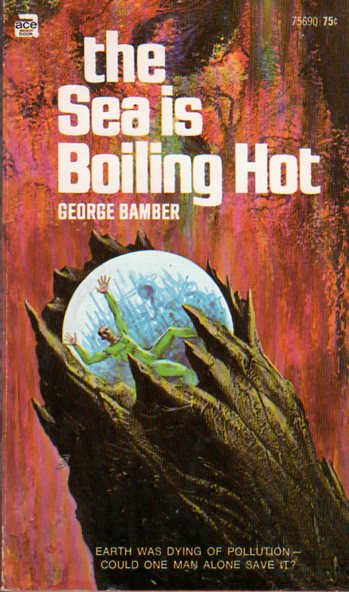
Book Review: The Sea is Boiling Hot, George Bamber (1971)

(Jack Gaughan’s cover for the 1971 edition)

2/5 (Bad)

The Sea is Boiling Hot (1971), George Bamber’s sole novel length contribution to the genre (thankfully), is the unabashedly pornographic version of the ecological disaster, humanity cooped-up in massive domed cities, let’s all get lobotomies to escape the horrors of the world science fiction.  As in, large portions of the narrative are endless sex scenes all gussied up with the accouterments of ecological “message” science fiction.

Unfortunately the sex scenes are there, in all their endless variation, simply to titillate to the reader rather than a necessary part of world building/character analysis — I’m thinking of Silverberg’s Continue reading

Book Review: A Martian Odyssey and Other Classics of Science Fiction, Stanley G. Weinbaum (1962)

(Robert E. Schulz’s cover for the 1966 edition)

3/5 (collated rating: Average)

After reading Joanna Russ’ nihilistic downer (but brilliant nevertheless) We Who Are About To… (1976) I needed to decompress with some 30s pulp.  I’m generally not a fan of pulp unless it attempts to integrate social science fiction elements or creates a vibrant/otherworldly sense of wonder.  Thankfully, this collection of Stanley G. Wienbaum’s stories contains one of the most influential pulp science fiction shorts due to its descriptions of aliens — ‘A Martian Odyssey’ (1934).

For anyone interested in the history of the genre and 30s pulp, Continue reading

Book Review: We Who Are About To…, Joanna Russ (1976)

(The hideous uncredited cover for the 1977 edition)

5/5 (Masterpiece: *caveats below*)

We Who Are About To… (1976) is the third of Joanna Russ’ science fiction novels I’ve read over the past few years. For some reason I was unable gather the courage to review The Female Man (1975) and might have been too enthusiastic about And Chaos Died (1970).  We Who Are About To… is superior to both (although, not as historically important for the genre as The Female Man).  This is in part because Russ refines her prose — it is vivid, scathing, and rather minimalist in comparison to her previous compositions — and creates the perfect hellish microcosm for her ruminations on the nature of history, societal expectation, memory,  and death.

Highly recommended for fans of feminist + literary Continue reading

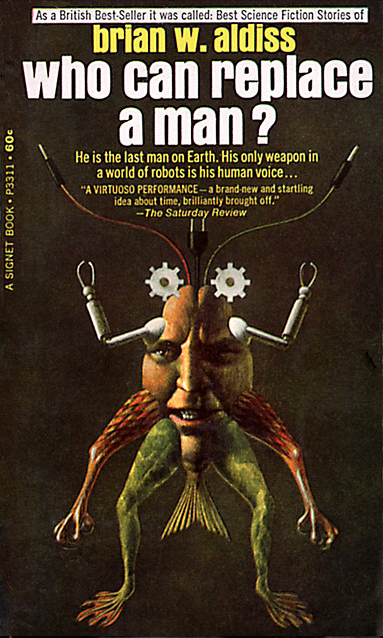
Book Review: Who Can Replace a Man? (variant title: Best Science Fiction Stories of Brian W. Aldiss), Brian W. Aldiss (1965)

Screen shot 2013-02-10 at 11.42.53 AM

(Don Puchatz’s cover for the 1967 edition)

4/5 (collated rating: Good)

Seven of the 1950s short stories in Brian W. Aldiss’ best of collection Who Can Replace a Man? (1965) I’ve reviewed before in No Time Like Tomorrow (1959) and Galaxies Like Grains of Sand (1960).  However, the collection contains seven additional 50s and 60s novellas/short stories that make up the majority of pages.  I’ve indicated the old material in the review with an asterisk Continue reading

Book Review: Beyond This Horizon, Robert A. Heinlein (magazine publication 1942, novelized 1948)

(Sandy Kossin’s cover for the 1960 edition)

2.5/5 (Bad)

Beyond This Horizon (magazine publication 1942, novelized 1948) was Robert A. Heinlein’s second published novel and one of the few non-juvenile works he published until the late 50s and early 60s.  Interesting tangent: Starship Troopers (1959) was originally conceived as a juvenile but rejected by his normal publisher due to its more serious content.

Unfortunately, Beyond this Horizon is plagued by an utterly contrived Continue reading

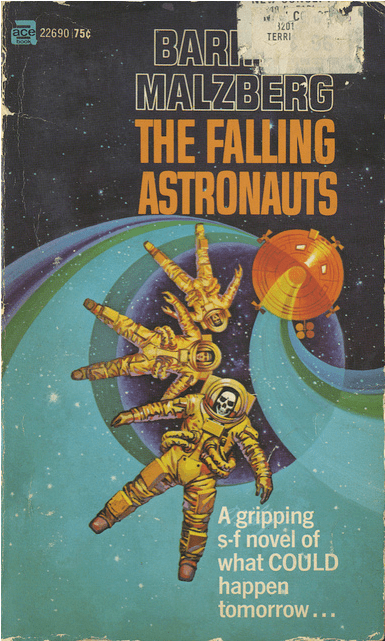
Book Review: The Falling Astronauts, Barry N. Malzberg (1971)


(Davis Meltzer’s cover for the 1971 edition)

4.25/5 (Good)

The Falling Astronauts (1971) (from now on FA) is the first in Barry N. Malzberg’s thematic trilogy on the American space program.  Although not as engaging or experimental as the other two masterpieces in the sequence — Beyond Apollo (1972) and Revelations (1972), FA is highly readable and a notable work in Malzberg’s extensive corpus.  FA attempts to debunk the so-called cult (in part propagated by the media) of the astronaut (and his ideal family) and in so doing questions the ultimate purpose of the space Continue reading

Book Review: The Eyes of Heisenberg, Frank Herbert (1966)

(Paul Lehr’s cover for the 1970 edition)

4/5 (Good)

Frank Herbert, known to most science fiction fans for his classic six book Dune sequence, published an extensive catalogue of other novels and short story collections.  A trademark of so many works of Herbert’s corpus is his near immaculate world-building skills.  As in Dune, the true extent of the world and all its hidden powerplays are slowly uncovered over the course of the narrative.  Although the basic premise is standard for the genre, Herbert’s multi-faceted world combined with his ability to develop characters and the pure hysteria/sheer hopelessness that permeates every page makes Continue reading