Book Review: Time and Stars, Poul Anderson (1964)

TMNDSTRSQZ1965

(Richard Powers’ cover for the 1965 edition)

3.75/5 (collated rating: Good)

Time and Stars (1964) is a wonderful collection of short works by one of the greats, Poul Anderson.  Anderson is best known for hard science fiction novels such as Tau Zero (1970) as well as fast paced pulp adventures exemplified by his Dominic Flandry (à la James Bond in space) sequence which he started in the 50s.

Only one of the six shorts in the collection was subpar — ‘Escape from Orbit’ (1962) — which did not rise above the traditional we need to rescue some stranded astronauts plot.  All the others — for example, Hugo winning novella and well-told tale of a balkanized American Pacific coast ‘No Truce of Kings’ (1963), the fantastic evolved mechanical life forms in ‘Epilogue’ (1962), and the wit of ‘The Critique of Impure Reason’ (1962) — make the collection worthwhile for fans of classic science fiction (and obviously, fans of Poul Anderson).  The novella ‘Epilogue’ is the best of Anderson’s works Continue reading

Book Review: Profundis, Richard Cowper (1979)

PRFNDS1981

(Don Maitz’s cover for the 1981 edition)

3.75/5 (Good)

Richard Cowper’s science fiction (and fantasy) was recommended to me by 2theD over at Potpourri of Science Fiction Literature (be sure to follow him!).  But ever since I procured a copy of Profundis (1979) more than a year ago, I’ve passed over it when searching for my next read — perhaps due to the silly “Three Kinky Kittens, talented sexboats with uninhibiting charms” blurb on the back cover (“uninhibiting” isn’t even a word) in addition to Don Maitz’s uninteresting 80s cover art…  Tangent: Maitz drew the pirate for the Captain Morgan Rum brand.

However, Profundis proved to be a highly involving science fiction parable set in a post-apocalyptical Continue reading

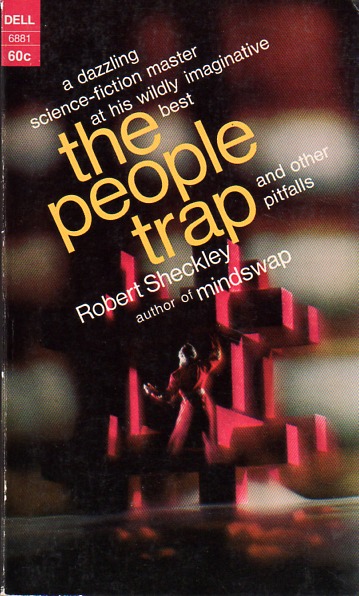
Book Review: The People Trap (full title: The People Trap and other Pitfalls, Snares, Devices, Delusions, as Well as Two Sniggles and a Contrivance), Robert Sheckley (1968)

TPPLTRP19XX

(Photo Media’s cover for the 1968 edition)

4/5 (collated rating: Good)

Although Robert Sheckley’s collection The People Trap (1968) does not approach the heights of Store of Infinity (1960), there are plenty of gems and the overall quality should compel any fan of satirical 50s/60s science fiction to find a copy.   Sheckley’s stories are characterized by delightful wit (despite serious themes such as the effects of colonization, technology, and nuclear disaster), surprising twist-endings, a penchant for intellectual mind-games (especially his 60s stories), and often hilariously hapless Continue reading

Book Review: A Scourge of Screamers (variant title: The Lost Perception), Daniel F. Galouye (1966)

SCRGSCRM1968

(Paul Lehr’s cover for the 1968 edition)

2.75/5 (Vaguely Average)

Recently I procured a handful of Daniel F. Galouye’s novels (here) for a few dollars on ebay because I enjoyed his first novel Dark Universe (1961), which is an underread/underrated classic of the early 60s.  In an effort to rekindle public interest in Galouye’s small ouvre (he died at 54 due to war injuries and was unable to write much in the last ten years of his life), he received the Cordwainer Smith Rediscovery Award in 2007.  Unfortunately, Galouye’s fast-paced sci-fi thriller A Scourge of Screamers (variant title: The Lost Perception) does not measure up to the claustrophobic and well-plotted social rumination (with a good dose of action) that is Dark Universe.

The most redeeming feature is Paul Lehr’s harrowing depiction of mental anguish Continue reading

Book Review: The Iron Dream, Norman Spinrad (1972)

(Uncredited cover for the 1972 edition)

4.75/5 (Very Good)

Nominated for the 1973 Nebula Award

Simply put, Norman Spinrad’s The Iron Dream (1972) is a fantastic alternate history novel.  However, unlike a standard “what if this happened instead and now let’s write a traditional narrative” alternate history, The Iron Dream is organized around a powerful metafictional conceit which explicitly serves to satirize pulp science fiction and fantasy and condemn its lurid nature and Spinrad would argue, racist inclinations.

The premise is straightforward: after the Great War (WWI) Hitler comes to the United States (and thus WWII never happens) and becomes a science fiction illustrator.  Eventually he starts writing science fiction and articles in fanzines.  However, he’s considered by the establishment to be little more than a hack writer and lives the rest of his life in squalor.  It is only after he dies (from symptoms related to syphilis) that he receives any critical success. What you read is Hitler’s 1954 posthumous Hugo-winning novel (which he wrote in six weeks), The Lord of the Swastika,  along with a short pseudo-scholarly “afterward to the Continue reading

Book Review: Beasts, John Crowley (1976)

s-l1600-2.jpg

(John Cayea’s cover for the 1976 edition)

4.5/5 (Very Good)

“‘They want to kill us all, you know.  They’re trying […].  The government.  Men.  You.’  Still his eyes searched hers. ‘We’re no use to them.  Worse than useless.  Poachers.  Thieves.  Polygamists.  We won’t be sterilized.  There’s no good in us.  We’re their creation, and they’re phasing us out.  When they can catch us'” (33).

While reading John Crowley’s Beasts (1976) I was reminded of the life of Stephan Bibrowski (1891-1932) à la Lionel the Lion-faced Man.  Stephan was afflicted with hypertrichosis (most likely) which caused his entire body to be covered with hair.  His mother was so horrified at his appearance  — which she believed was caused because she saw her husband mauled by a lion while she was pregnant Continue reading

Book Review: The Burning, James E. Gunn (1972)

TBRNNG1972

(Robert Foster’s evocative cover for the 1972 edition)

3.25/5 (collated rating: Above Average)

James E. Gunn’s The Burning (1972) is a fix-up novel containing three previously published but linked novelettes: ‘Witches Must Burn’ (1956), ‘Trial By Fire’ (1969), and ‘Witch Hunt’ (1969).  The first two are contiguous while the third section is more loosely related.  I will rate each separately as I did with the superior The Immortals (1962).

As someone who has lived in areas of the United States plagued by virulent strains of anti-intellectualism, massive higher education funding cuts (especially in the liberal arts), and an increasing emphasis on “practical” fields of study, James E. Gunn’s The Burning (1972) is a profoundly unsettling read.  Of course Gunn’s dystopic future is much more one of doom and gloom: The universities lie in smoldering ruins, the professors (“eggheads”) Continue reading

Book Review: The Immortals, James E. Gunn (1962)

THMMRTLSNS1962(Mitchell Hooks’ cover for the 1962 edition)

4.25/5 (collated rating: Good)

James E. Gunn’s The Immortals (1962) is less about the lives and mental state of the eponymous humans “blessed” with immortality (a fascinating topic in itself) and more about the ramifications of their existence on the rest of society not “blessed” with such genetic structures.  Their presence exacerbates the problems of an already dystopically tinged world where medical care is increasingly the domain of the ultra wealthy.  With the knowledge that a random genetic mutation has created a bloodline whose members are immortal, society is all too eager to root them out and (literally) bleed them dry.  Living longer — achieved by whatever means — becomes the single-minded desire of all.  Most of humanity is oblivious to the festering (and carcinogenic) Continue reading

Book Review: The Status Civilization, Robert Sheckley (1960)

THSTTSCVLZ1960

(Richard Powers (?) cover for the 1960 edition)

4/5 (Good)

Robert Sheckley deftly manipulates — in a mere (but dense) 127 pages — a plot straight from the pulps involving prison planets and gladiatorial fights against terrifying robots into a scathing and artfully constructed work of satire.  Similar skills were apparent in his masterful collection Store of Infinity (1960) where traditional sci-fi situations such as colonization of alien worlds, robot rebellions, post-apocalyptical wastelands, and time-travel (among other tropes) are imbued with witty wordplay and biting social Continue reading