Book Review: We Who Are About To…, Joanna Russ (1976)

(The hideous uncredited cover for the 1977 edition)

5/5 (Masterpiece: *caveats below*)

We Who Are About To… (1976) is the third of Joanna Russ’ science fiction novels I’ve read over the past few years. For some reason I was unable gather the courage to review The Female Man (1975) and might have been too enthusiastic about And Chaos Died (1970).  We Who Are About To… is superior to both (although, not as historically important for the genre as The Female Man).  This is in part because Russ refines her prose — it is vivid, scathing, and rather minimalist in comparison to her previous compositions — and creates the perfect hellish microcosm for her ruminations on the nature of history, societal expectation, memory,  and death.

Highly recommended for fans of feminist + literary Continue reading

Book Review: Who Can Replace a Man? (variant title: Best Science Fiction Stories of Brian W. Aldiss), Brian W. Aldiss (1965)

Screen shot 2013-02-10 at 11.42.53 AM

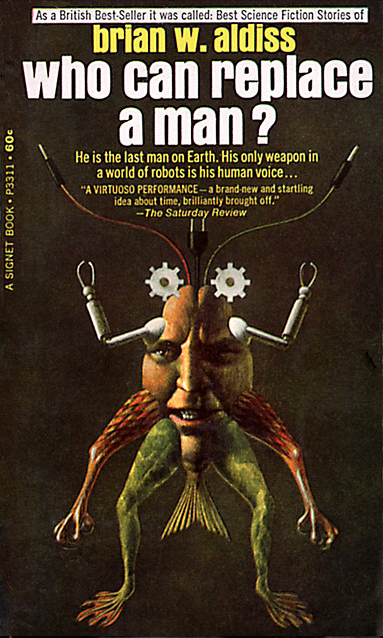
(Don Puchatz’s cover for the 1967 edition)

4/5 (collated rating: Good)

Seven of the 1950s short stories in Brian W. Aldiss’ best of collection Who Can Replace a Man? (1965) I’ve reviewed before in No Time Like Tomorrow (1959) and Galaxies Like Grains of Sand (1960).  However, the collection contains seven additional 50s and 60s novellas/short stories that make up the majority of pages.  I’ve indicated the old material in the review with an asterisk Continue reading

Book Review: Beyond This Horizon, Robert A. Heinlein (magazine publication 1942, novelized 1948)

(Sandy Kossin’s cover for the 1960 edition)

2.5/5 (Bad)

Beyond This Horizon (magazine publication 1942, novelized 1948) was Robert A. Heinlein’s second published novel and one of the few non-juvenile works he published until the late 50s and early 60s.  Interesting tangent: Starship Troopers (1959) was originally conceived as a juvenile but rejected by his normal publisher due to its more serious content.

Unfortunately, Beyond this Horizon is plagued by an utterly contrived Continue reading

Book Review: The Falling Astronauts, Barry N. Malzberg (1971)


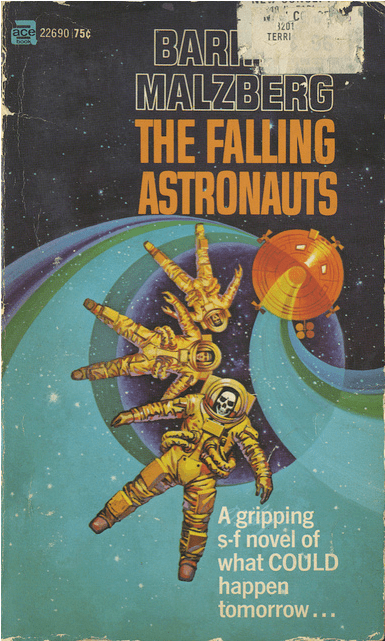
(Davis Meltzer’s cover for the 1971 edition)

4.25/5 (Good)

The Falling Astronauts (1971) (from now on FA) is the first in Barry N. Malzberg’s thematic trilogy on the American space program.  Although not as engaging or experimental as the other two masterpieces in the sequence — Beyond Apollo (1972) and Revelations (1972), FA is highly readable and a notable work in Malzberg’s extensive corpus.  FA attempts to debunk the so-called cult (in part propagated by the media) of the astronaut (and his ideal family) and in so doing questions the ultimate purpose of the space Continue reading

Book Review: The Eyes of Heisenberg, Frank Herbert (1966)

(Paul Lehr’s cover for the 1970 edition)

4/5 (Good)

Frank Herbert, known to most science fiction fans for his classic six book Dune sequence, published an extensive catalogue of other novels and short story collections.  A trademark of so many works of Herbert’s corpus is his near immaculate world-building skills.  As in Dune, the true extent of the world and all its hidden powerplays are slowly uncovered over the course of the narrative.  Although the basic premise is standard for the genre, Herbert’s multi-faceted world combined with his ability to develop characters and the pure hysteria/sheer hopelessness that permeates every page makes Continue reading

SF Article: Barry N. Malzberg (b.1939): Metafiction and the Demystification of the Cult of the Astronaut

This was my recent guest post on Little Red Reviewer.

For those who didn’t see it I decided to post it here….

——-

 Barry N. Malzberg (b. 1939): Metafiction and the Demystification of the Cult of the Astronaut

Screen shot 2013-01-14 at 1.55.20 PM

In the World Book Encyclopedia Science Service publication The United States Astronauts and their Families: A Pictorial Presentation (1965), each astronaut is allotted a two-page spread replete with staged photos of their family life and hobbies.  Otis L. Wiese, the editor of the volume, proclaims grandiosely “Man’s reach for the world of space is born of his insatiable curiosity about the unknown… his indomitable drive for accomplishment… his instinctive response to a challenge. Astronauts-Husbands-Fathers: these men are the men featured here but it’s essentially as family men that we portray them” (i).

The photographs are fascinating.  Roger B. Chaffee’s wife Martha teaches him lunar geography (22), L. Gordon Cooper, Jr. sits at the helm of his speedboat Bluebonnet which is capable of reaching 80 knots (28), in another photo him and his family spend time with their German shepherd (29), Donn F. Eisele teaches his daughter “the finer points of marksmanship” (35), while Alan B. Shepard, Jr. plays piano tunes for his daughters (61) and in the facing image shakes hands with John F. Kennedy (61).

Their families illustrate the epitome of the American family: the ultra-masculine man with his cars and boats, the supportive wife facilitating Continue reading

Book Review: No Time Like Tomorrow, Brian Aldiss (1959)

Screen shot 2013-01-10 at 11.21.02 PM

(Richard Powers’ cover for the 1959 edition)

3.75/5 (collated rating: Good)

This collection of Brian Aldiss short stories from the mid-to-late 50s is a notch above the middling Galaxies Like Grains of Sand (1960), collated from the same period, which I reviewed a few months back.  Aldiss is definitely one of the more bizarre and original (along with Philip K. Dick) sci-fi voices of the 50s (and beyond).

Most collections are purposely comprised of a mixture of good and bad stories hence the generally low collated ratings I hand out.  Unlike Galaxies, most of the stories in this collection are worth reading and none are egregiously bad.  ‘Not for an Age,’ ‘Judas Danced’, ‘The Failed Men’, and ‘Outside’ are all highly Continue reading

Book Review: Level 7, Mordecai Roshwald (1959)

(Sanden’s cover for the 1960 edition)

4.75/5 (Very Good)

I recently received a copy of Modecai Roshwald’s Level 7 (1959) from 2thD at Potpourri of Science Fiction Literature (his enthusiastic review of the novel here).  Roshwald’s novel should be considered along with Walter Miller, Jr.’s A Canticle for Leibowitz (1959, published 1960) as one the best nuclear disaster sci-fi novels of the late 50s (and all time).  Unlike Nevil Shute’s On the Beach (1957) or Pat Frank’s Alas, Babylon (1959) the allegiance (Soviet or American) of the protagonists of Level 7 remains Continue reading

Book Review: Dark Dominion, David Duncan (1954)

Screen shot 2012-12-22 at 9.06.53 PM(Richard Powers’ cover for the 1954 edition)

2.5/5 (Bad)

David Duncan, most famous for writing the screenplay to George Pal’s film The Time Machine (1960), produced a handful of genre and non-genre novels in the 1950s.  Bluntly put, the Dark Dominion (1954) was one of the more disappointing novels I’ve read this year.  It is worthwhile for one thing alone, Richard Powers’ gorgeous cover.  Duncan’s novel is characterized by an incredibly painful strain of melodrama even for the 50s, downright preposterous science Continue reading