Book Review: The Wall Around the World, Theodore R. Cogswell (1962)

(John Schoenherr’s cover for the 1962 edition)

collated rating: 2.25/5 (Bad)

In my quest to bring to light the esoteric, the worthwhile yet forgotten, and to re-examine unjustly maligned works of science fiction I’m unfortunately more likely find incredibly average works than if I were to stick to the more well-trod path.  Theodore Cogswell’s short stories attempt unsuccessfully to wed clichéd fantasy + horror elements — à la vampires, werewolves, broomsticks and all that drek — with science fiction staples, including alien invasions and alien visitations.  I suspect there was, and still is, a market for such hybridity.  I don’t have to mention the conveyor belt chunking out vampire/zombie excreta all over our modern bookstore shelves… (I apologize to anyone who’s offended or implicated by that statement).  Almost all of Cogswell’s stories are lighthearted (besides ‘The Burning’), replete with heavy doses of whimsy, and in the few readable stories, some vibrancy.

Not my type of science fiction or fantasy.
Continue reading

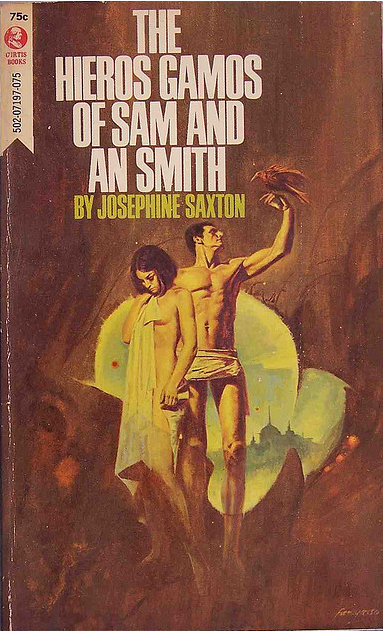
Book Review: The Hieros Gamos of Sam and An Smith, Josephine Saxton (1969)

(Jack Faragasso’s cover for the 1970 edition)

4.5/5 (Very Good)

The Hieros Gamos of Sam and An Smith (1969) is an experimental (but approachable) science fiction fable set in a world which, at least on the surface, is very much like our own.  The buildings remain, food dispensers still dispense food, and undisturbed store shelves are fully stocked.  However, the majority of the animals have disappeared and people are almost all gone. Cannibalism is hinted at.  A few other individuals flit on the outskirts of the narrative, phantom-like, unsubstantial in their physicality.  Are they hallucinations, or external viewers of the spectacle who intrude when needed before vanishing with no evidence of their arrival?

Josephine Saxton deftly utilizes the coming of age narrative, Continue reading

Book Review: The Eleventh Commandment, Lester del Rey (1962, revised: 1970)

(Dean Ellis’ cover for the 1970 edition)

3.5/5 (Good)

Lester del Rey’s The Eleventh Commandment, originally published in 1962, was revised by the author in 1970. I’ve reviewed the 1970 edition — I do not know to what extent the original was changed.

My first exposure to Lester del Rey’s sci-fi bucks the impression of general averageness conveyed by my fellow reviewers.  This work strikes me as a product of the more mature side of del Rey, a move away from his normal space opera YA fare.  In The Eleventh Commandment del Rey explores the religious ramification of overpopulation (see list) concerns of the 50s/60s.  Due to the fact that overpopulation fears gained a lot of currency after the publication of the 1968 bestselling non-fiction work The Population Bomb,  I suspect it provided the impulse for del Rey to rewrite the novel.  Despite the involving premise, the plot is often a Continue reading

Book Review: Galaxies Like Grains of Sand, Brian Aldiss (1960)

(Paul Lehr’s cover for the 1960 edition)

3/5 (collated rating: Average)

The concept behind Brian Aldiss’ short story collection Galaxies Like Grains of Sand (1960) is intriguing.  Take previously published stories (in this case from magazines in the late 50s), graft them together by means of mini-introductions, and arrange them so they fit into a future history framework à la Olaf Stapledon’s Last and First Men (1930) or Isaac Asimov’s Foundation Trilogy (1951-1953).

The quality of the stories makes the format less than successful.   Only three stories are worth reading — ‘Secret of a Mighty City’ (1958), ‘Out of Reach’ (1957), and ‘All Continue reading

Book Review: Total Eclipse, John Brunner (1974)

(John Cayea’s cover for the 1974 edition)

3/5 (Average)

Over the years I’ve deluded myself into becoming a John Brunner completest — around twenty-five of his novels line my shelves and I’ve read most of them over the years.  At his best he’s without question one of the great masters of the genre — Stand on Zanzibar (1968), The Sheep Look Up (1972), etc. are evidence of this.  However, in-between his social science fiction masterpieces are a plethora of unsatisfying attempts at traditionalist space opera.  In these works Brunner never fully leaves his pulp roots although he occasionally tries to inject a dose of hard science, (pseudo) intellectualism, and social commentary.

Total Eclipse (1974) fits this mold.  A group of scientists attempt to figure out the mystery of a highly advanced race which has apparently, died out. Character interactions are painfully silly along the “Oh heroic main character, you’re a genius let me jump into your bed” sort of Continue reading

Book Review: The Joy Makers, James Gunn (1961, magazine publication 1955)

(William Hofmann’s cover for the 1961 edition)

4.25/5 (collated rating: Good)

The three parts of James Gunn’s fix-up novel The Joy Makers (1961) were originally published in magazine form in 1955 as ‘Name Your Pleasure,’ ‘The Naked Sky’, and ‘The Unhappy Man.’  I have not read the originals so I’m unsure of how much was added or subtracted or completely re-conceptualized.  Largely a satire — Gunn pushes his point to the logical, and terrifying extreme — each part is a further chronological progression of a society whose chief aim is to make people happy.  It is hard not to read Part I as a satirical take on some aspects of Scientology,  a movement that was gaining force in the early 1950s.

Because each part is only linked thematically to the others

Continue reading

Book Review: The Eden Cycle, Raymond Z. Gallun (1974)

(Kelly Freas’ cover for the 1974 edition)

4/5 (Good)

Raymond Z. Gallun is best known for his pulp sci-fi from the 1930s-50s.  From the 50s onward he wrote a handful of novels of varying quality.  The Eden Cycle (1974), probably his single best science fiction work, is a successful integration of pulp ideas and lush environments with a poignant and often haunting depiction of the social ramifications of a future world where everyone, “blessed” with immortality, can “live” in any virtual reality of their choice, shift  from simulation to simulation at will, and spontaneously conjure new ones.

Brief Plot Summary/Analysis

In the near future mankind receives mysterious signals from space.  Gallun is careful to slowly reveal the main backstory over the course of the first third of the novel.  After Continue reading

Book Review: Farewell, Earth’s Bliss, D. G. Compton (1966)

(Karel Thole’s cover for the 1971 edition)

4.5/5 (Very Good)

(*some spoilers due to the limited nature of the plot*)

Another D. G. Compton novel, another wonderful (and terrifying) experience…  The only one of his novels so far that has failed to hold my interest was The Missionaries (1971), a lackluster satire on religion.  The Continuous Katherine Mortenhoe (variant title: The Unsleeping Eye) (1973) is a masterpiece and Farewell, Earth’s Bliss (1966) and Synthajoy (1968) are close behind.

Farewell, Earth’s Bliss is best described as a character study of a group of convicts sent to Mars and their attempts to integrate into an incredibly repressive and conservative society (derived in part to to the extreme dangers of the Martian environment) — in short, a piece of race and religion themed social science fiction.  Be warned, there  is little to no action.  As with most of Compton’s works, near future environments are the perfect vehicle for societal ruminations Continue reading

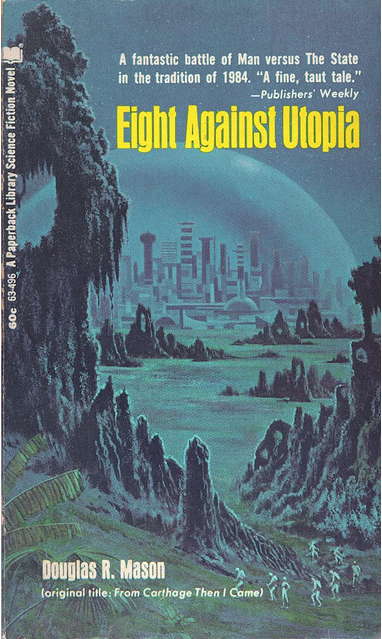
Book Review: Eight Against Utopia (variant title: From Carthage Then I Came), Douglas R. Mason (1966)

(Dean Ellis’ cover for the 1970 edition)

2.25/5 (Bad) 

Eight Against Utopia (1966) is the second escape from a domed city novel published by Paperback Library I’ve read — the first, Rena Vale’s Beyond the Sealed World (1965) was a truly dismal “adventure.”  Mason’s take on the theme is only marginally better.  The first half, life and escape from the domed city of Carthage, is more intriguing and engaging than the second half, an endless unexciting chase sequence along the coast of North Africa.  Mason’s novel is painfully flawed in its social theory and mechanics of delivery.  Even on the level of a future adventure tale, most of Eight Against Continue reading