Book Review: Total Eclipse, John Brunner (1974)

(John Cayea’s cover for the 1974 edition)

3/5 (Average)

Over the years I’ve deluded myself into becoming a John Brunner completest — around twenty-five of his novels line my shelves and I’ve read most of them over the years.  At his best he’s without question one of the great masters of the genre — Stand on Zanzibar (1968), The Sheep Look Up (1972), etc. are evidence of this.  However, in-between his social science fiction masterpieces are a plethora of unsatisfying attempts at traditionalist space opera.  In these works Brunner never fully leaves his pulp roots although he occasionally tries to inject a dose of hard science, (pseudo) intellectualism, and social commentary.

Total Eclipse (1974) fits this mold.  A group of scientists attempt to figure out the mystery of a highly advanced race which has apparently, died out. Character interactions are painfully silly along the “Oh heroic main character, you’re a genius let me jump into your bed” sort of Continue reading

Book Review: The Joy Makers, James Gunn (1961, magazine publication 1955)

(William Hofmann’s cover for the 1961 edition)

4.25/5 (collated rating: Good)

The three parts of James Gunn’s fix-up novel The Joy Makers (1961) were originally published in magazine form in 1955 as ‘Name Your Pleasure,’ ‘The Naked Sky’, and ‘The Unhappy Man.’  I have not read the originals so I’m unsure of how much was added or subtracted or completely re-conceptualized.  Largely a satire — Gunn pushes his point to the logical, and terrifying extreme — each part is a further chronological progression of a society whose chief aim is to make people happy.  It is hard not to read Part I as a satirical take on some aspects of Scientology,  a movement that was gaining force in the early 1950s.

Because each part is only linked thematically to the others

Continue reading

Book Review: The Eden Cycle, Raymond Z. Gallun (1974)

(Kelly Freas’ cover for the 1974 edition)

4/5 (Good)

Raymond Z. Gallun is best known for his pulp sci-fi from the 1930s-50s.  From the 50s onward he wrote a handful of novels of varying quality.  The Eden Cycle (1974), probably his single best science fiction work, is a successful integration of pulp ideas and lush environments with a poignant and often haunting depiction of the social ramifications of a future world where everyone, “blessed” with immortality, can “live” in any virtual reality of their choice, shift  from simulation to simulation at will, and spontaneously conjure new ones.

Brief Plot Summary/Analysis

In the near future mankind receives mysterious signals from space.  Gallun is careful to slowly reveal the main backstory over the course of the first third of the novel.  After Continue reading

Book Review: Farewell, Earth’s Bliss, D. G. Compton (1966)

(Karel Thole’s cover for the 1971 edition)

4.5/5 (Very Good)

(*some spoilers due to the limited nature of the plot*)

Another D. G. Compton novel, another wonderful (and terrifying) experience…  The only one of his novels so far that has failed to hold my interest was The Missionaries (1971), a lackluster satire on religion.  The Continuous Katherine Mortenhoe (variant title: The Unsleeping Eye) (1973) is a masterpiece and Farewell, Earth’s Bliss (1966) and Synthajoy (1968) are close behind.

Farewell, Earth’s Bliss is best described as a character study of a group of convicts sent to Mars and their attempts to integrate into an incredibly repressive and conservative society (derived in part to to the extreme dangers of the Martian environment) — in short, a piece of race and religion themed social science fiction.  Be warned, there  is little to no action.  As with most of Compton’s works, near future environments are the perfect vehicle for societal ruminations Continue reading

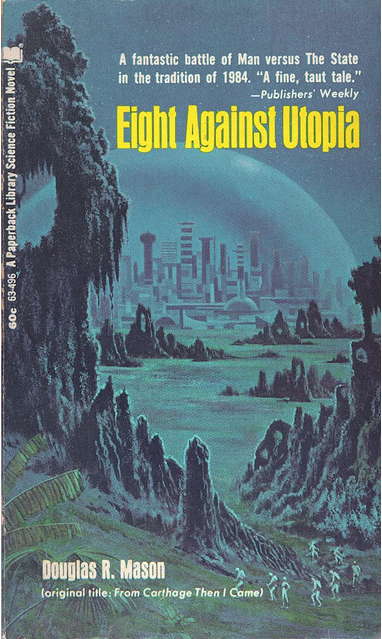
Book Review: Eight Against Utopia (variant title: From Carthage Then I Came), Douglas R. Mason (1966)

(Dean Ellis’ cover for the 1970 edition)

2.25/5 (Bad) 

Eight Against Utopia (1966) is the second escape from a domed city novel published by Paperback Library I’ve read — the first, Rena Vale’s Beyond the Sealed World (1965) was a truly dismal “adventure.”  Mason’s take on the theme is only marginally better.  The first half, life and escape from the domed city of Carthage, is more intriguing and engaging than the second half, an endless unexciting chase sequence along the coast of North Africa.  Mason’s novel is painfully flawed in its social theory and mechanics of delivery.  Even on the level of a future adventure tale, most of Eight Against Continue reading

Book Review: Three for Tomorrow, novellas by Robert Silverberg, Roger Zelazny, and James Blish, (1969)

(Uncredited cover for the 1970 edition)

3.5/5 (collated rating: Good)

Three for Tomorrow (1969) contains three novellas written specially for the volume on the following theme selected by Arthur C. Clarke: “with increasing technology goes increasing vulnerability: the more man conquers Nature, the more prone he becomes to artificial catastrophe” (foreword, 8).  In my continuing quest for Robert Silverberg’s work from his Glory Period (proclaimed by me) 1967-1976, I was delighted to come across one of his shorter works paired with two other great authors, James Blish and Roger Zelazny.  If you want to read Silverberg’s novella but not the others, it appeared in many of his later collections — Earth’s Other Shadow (1973) for example.

As with most collections, Three for Tomorrow is uneven.  Silverberg’s installment is the best due to its intriguing social analysis of a city suddenly whose inhabitants are suddenly missing Continue reading

Book Review: Revelations, Barry N. Malzberg (1972)

(Michael Presley’s cover for the 1977 edition)

5/5 (Masterpiece)

Revelations (1972) is the second in a thematically linked group of Malzberg’s novels — published in-between its siblings, The Falling Astronauts (1971) and Beyond Apollo (1972) (from now on BA).  Each deals with insane astronauts, and in Malzberg’s own words, “sexual dysfunction as representing the necessary loss of energy of the machine age,” and each contains a character desperately attempting to speak out.  But, as with most of Malzberg’s novels, it is unclear whether there is truth in these cries.

Revelations is less rigorously structured than BA, which was characterized by 67 short tellings/retellings/scenes/dream moments all from the perspective of a single insane character.  As with BA, our anti-hero is an unreliable narrator, but due to the variety of diaristic, epistolary, and interrogatory fragments that comprise  Continue reading

Book Review: Dr. Futurity, Philip K. Dick (1960)

(Ed Valigursky’s cover for the 1960 edition)

2.75/5 (Average)

Over the years I’ve found Philip K. Dick’s early novels hit or miss.  Along with The World Jones Made (1956), Dr. Futurity (1960) (expanded from the 1954 short story “Time Pawn”) is the least satisfying of his novels I’ve read so far.  My total PKD consumption is extensive — around 20 novels and at least 60 short stories.

Time travel is by far my least favorite major science fiction trope.  However, in many of Philip K. Dick’s novels and short stories time travel is transformed into something surreal and often, downright fascinating.  But unlike his later novels, the trope in Dr. Futurity is an endlessly laborious plot device.  Our hero doctor, Jim Parsons, is constantly whisked back and forth in time with hardly a moment of rest or discussion. Continue reading

Book Review: Seed of Light, Edmund Cooper (1959)

(Uncredited cover for the 1959 edition — I suspect it might be David Davies)

3.25/5 (Average)

Edmund Cooper’s Seed of Light (1959) is less of a traditional narrative of the voyage of a generation ship as are its fellow generation ship novels of the 40s/50s. The best examples are Brian Aldiss’ Non-Stop (1958) and Robert Heinlein’s Orphans of the Sky (1941).  Seed of Light is more like a piece of pseudo-history interlaced with fragments of narrative of varying effectiveness.  The work is best described as a thematically-linked series of novellas tracking the future development of man in broad strokes à la Brian Aldiss’ Galaxies Like Grains of Sand (1960).  Unfortunately, Cooper’s original splicing of the generation ship theme onto a Future History template (made popular but Olaf Stapleton and Isaac Asimov among others) is extremely uneven.  Some portions are involving while others are plagued by laborious epoch-spanning pseudo-historical lectures.

Because each part is a separate novella (the last two are more closely Continue reading