As always, which books/covers/authors intrigue you? Which have you read? Disliked? Enjoyed?
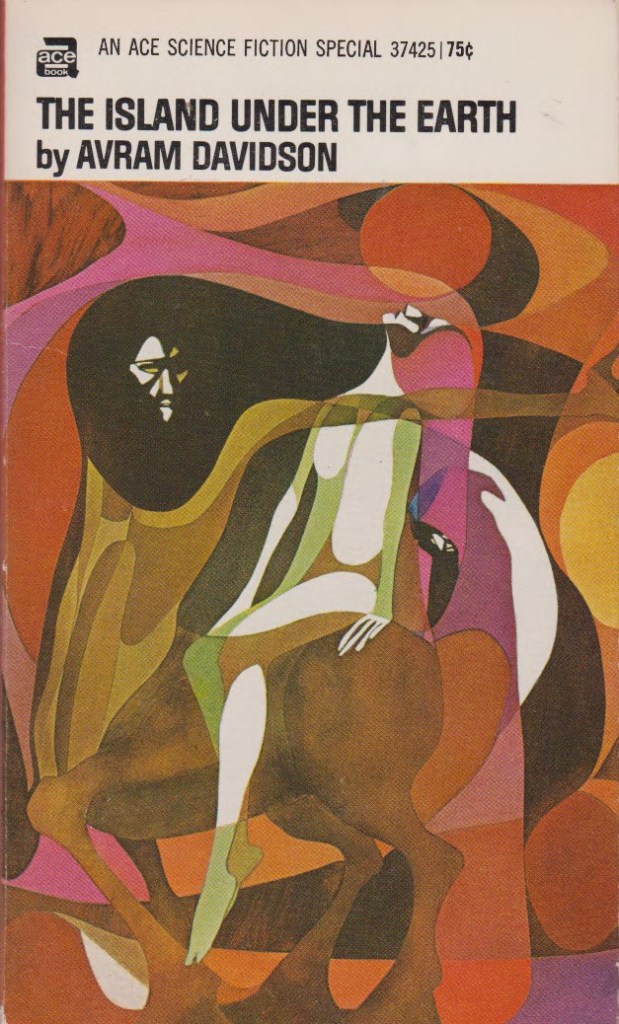
1. The Island Under the Earth, Avram Davidson (1969)
Diane and Leo Dillon’s cover for the 1st edition
From the inside page: “In THE ISLAND UNDER THE EARTH, a master fantasist has created his most fabulous land of imagination, peopled with humans and not-humans who speak with characteristically different voices and pursue goals and philosophies that set them inevitably against one another.
As always, which books/covers/authors intrigue you? Which have you read? Disliked? Enjoyed?
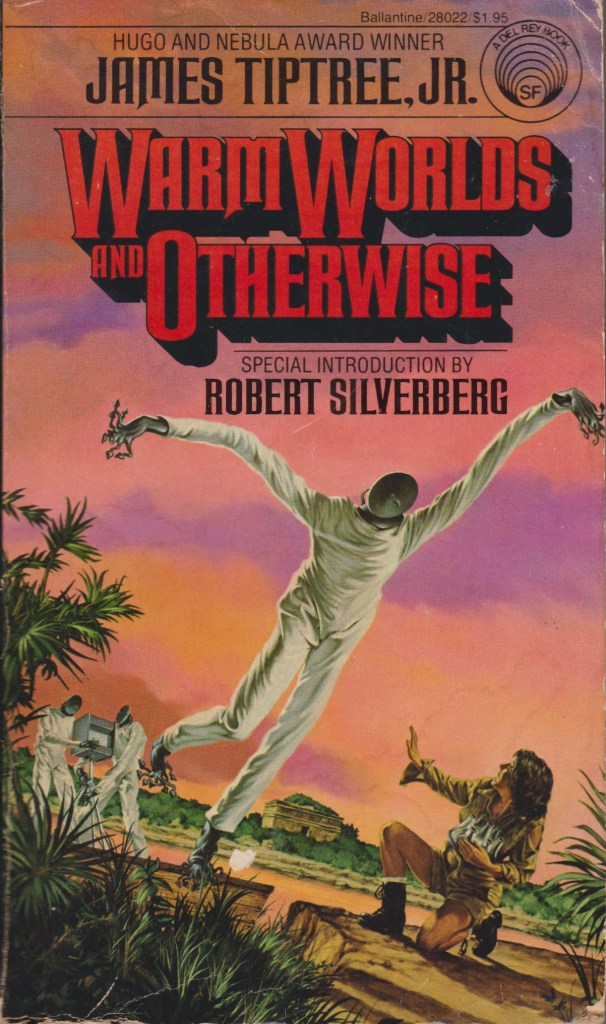
1. Warm Worlds and Otherwise, James Tiptree, Jr. (1975)
Michael Herrin’s cover for the 1979 edition
From the back cover: “A DOZEN FABULOUS TALES OF INNER VISIONS AND OUTER SPACE…
LOVE IS THE PLAN, THE PLAN IS DEATH (Nebula-Award Winner—Best Short Story 1973)
Courtship rites can easily run amok, especially when that’s what’s supposed to happen… especially when the creatures are color-coded for passion as well as for death!
As always, which books/covers/authors intrigue you? Which have you read? Disliked? Enjoyed?
1. Worlds Without End, Clifford D. Simak (1964)
Richard Powers’ cover for the 1st edition
From the back cover: “A link between yesterday and the tomorrow that was here already…. Dreams constructed and maintained by society…. A world-to-world search for an elusive secret…. The bizarre, weird, strange creations of things and worlds only Clifford D. Simak could have written… and make believable.”
Contents: “Worlds Without End” (1956), “The Spaceman’s Van Gogh” (1956), “Full Cycle” (1955)
As always, which books/covers/authors intrigue you? Which have you read? Disliked? Enjoyed?
1. Empire, H. Beam Piper (1981)
Michael Whelan’s cover for the 1st edition
From the back cover: “”H. BEAM PIPER beloved author of LITTLE FUZZY, SPACE VIKING, and other classics, has left behind a veritable treasure trove of short fiction in his passing. Collected here for the first time anywhere are four of the best stories by one of the Grand Old Masters of science fiction.”
Contents: “The Edge of the Knife” (1957), “A Slave is a Slave” (1962), “Ministry of Disturbance” (1958), “The Return” (1954) with John J. McGuire, “The Keeper” (1957).
Initial Thoughts: Years back I read, but never reviewed, H. Beam Piper’s pulp extravagance Space Viking (1963) and detested it. I get the sense Space Viking might not be representative of his work? Piper has a devoted following and I want to know why.
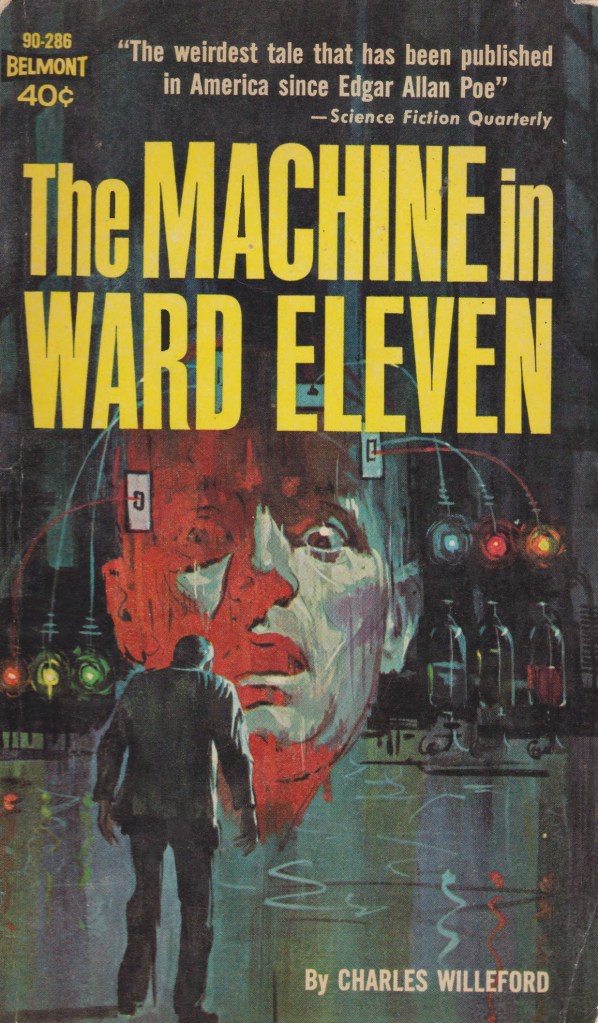
1. The Machine in Ward Eleven, Charles Willeford (1963)
Robert Maguire’s cover for the 1st edition
From the back cover: “‘I tied his body to the treatment table and stuffed his mouth with wadded paper towels. Dr. Fellerman’s big brown eyes were expressive indeed, particularly when my fingers adjusted the elastic harness over his head and centered the shiny electrodes to his temples.
A simple, impersonal, uncomplicated machine. I plugged the long cord into the wall outlet, turned the two plastic knobs as far to the right as they would go and left them there…’
For some time now, Charles Willeford’s writing has been emanating from the deep South like a series of electric shocks. Millions of readers around the world delight over each new item, whether a feature in Playboy or one of his rare novels. He is ranked as an author of distinction in the Burnett-Foley Best Short Stories of 1962.
As always, which books/covers/authors intrigue you? Which have you read? Disliked? Enjoyed?
1. Low-Flying Aircraft and Other Stories, J. G. Ballard (1976)
Larry Rostant’s cover for the 1992 edition
There’s not a back cover or inside cover blurb on my edition
Contents: “The Ultimate City” (1976), “Low-Flying Aircraft” (1975), “The Dead Astronaut” (1968), “My Dream of Flying to Wake Island” (1974), “The Life and Death of God” (1976), “The Greatest Television Show on Earth” (1972), “A Place and a Time to Die” (1969), “The Comsat Angels” (1968), “The Beach Murders” (1966)
Initial Thoughts: I’ve been on a weird (for me) music kick as of late. I’ve been listening to a lot of 80s post-punk/new wave/goth music (Bauhaus, The Cure, Echo & the Bunnymen, The Psychedelic Furs, The Sisters of Mercy, Siouxsie and the Banshees, etc.) and I came across the British band The Comsat Angels. And they’re named after a J. G. Ballard story! If you don’t know of the band but enjoy any of the bands in the above list, check out Sleep No More(1981) (cold, paranoid, hypnotic). This led me back to Ballard’s catalog to track down the remaining anthologies of his I don’t own.
As always, which books/covers/authors intrigue you? Which have you read? Disliked? Enjoyed?
1. Worlds Apart (variant title: Born Leader), J. T. McIntosh (1954)
Richard Powers’ cover for the 1958 edition
From the back cover: “ROG FOLEY had never seen Earth—and he never would. For all that was left of Earth was an atomic funeral pyre in the sky.
ROG FOLEY was a leader of the new generation of humans who were born and raised on Mundis, the distant planet circling Brinsen’s Star and to which the last survivors of Earth had escaped in a 17-year journey through space.
Detail from Darrel K. Sweet’s cover for the 1st paperback edition of The Best from Cordwainer Smith (1975)
Today’s installment of my occasional Monday Maps and Diagrams series is a self-reminder that I must get over the poor taste left in my mouth by two forgettable Cordwainer Smith short stories and dive into the meat of his Instrumentality of Mankind sequence. Which should I have read?
I’m a sucker for future history timelines (Olaf Stapledon, Robert A. Heinlein, and Isaac Asimov come to mind). They add a sense of time and scope to what, at first glance, might seem like disparate pieces. I often wonder how much an author plans out a timeline. This one, scanned from The Best of Cordwainer Smith (1975), places each of the Instrumentality of Mankind stories into a functional timeline. I’m assuming it adds to the series’ sense of historical development and societal evolution?
Let me know what you think of the series and the timeline in the comments!
John J. Pierce’s timeline (he wrote the intro article) in the 1975 Ballantine Paperback edition
Isfdb.org note on the timeline’s publication history: “There are (at least) 2 variants of this timeline. A table version titled The Instrumentality of Mankind appears in the original July 1975 Nelson Doubleday hardcover. A reformatted graphical version titled Timeline from THE INSTRUMENTALITY OF MANKIND appears in Continue reading →
As always, which books/covers/authors intrigue you? Which have you read? Disliked? Enjoyed?
1. Windhaven, George R. R. Martin and Lisa Tuttle (1981)
Vincent Di Fate’s cover for the 1st edition
From the inside flap: “The planet Windhaven was settled by humans after the crash of a colony starship. Survivors discovered that people could actually fly on this world, aided by the light gravity and dense atmosphere, and using wings made from a virtually indestructible metal fabric that had once been part of the starship. On this planet of small islands, monster-infected seas Continue reading →