Which books/covers/authors intrigue you? Which have you read? Disliked? Enjoyed?
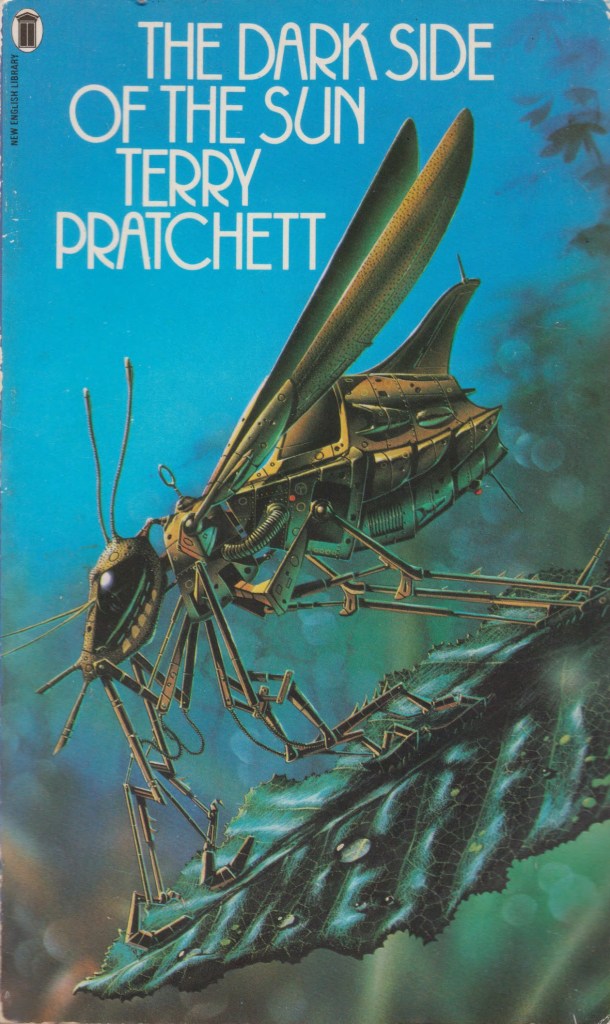
1. The Dark Side of the Sun, Terry Pratchett (1976)
Tim White’s cover for the 1978 edition
From the back cover: “Dom Sabalos, the young heir to the Sabalos dynasty, has a strangely uncertain future. Probability math, the infallible science of foretelling the future, has predicted his assassination in twenty-four hours. But, by an extraordinary paradox, it has also predicted that he will go on to discover the fabulous, almost mythical world of the Jokers–the gods of the universe.
Which books/covers/authors intrigue you? Which have you read? Disliked? Enjoyed?
1. Where is the Bird of Fire?, Thomas Burnett Swann (1970)
John Schoenherr’s cover for the 1st edition
From the back cover: “Were the mythical monsters our ancestors spoke of so often more than fantasy? Is it not probable that these semi-human races existed–and that only human vanity has blurred their memory?
2021 was the best year in the history of my site for visits and unique viewers! I suspect this increasingly has to do with my twitter account where I actively promote my site vs. a growing interest in vintage SF. I also hit my 1000th post–on Melisa Michaels’ first three published SF short stories–in December.
As I mention year after year, I find reading and writing for the site—and participating in all the SF discussions it’s generated over the year—a necessary and greatly appreciated salve. Thank you everyone!
I read very few novels this year. Instead, I devoted my attention to various science short story reviews series and anthologies. Without further ado, here are my favorite novels and short stories I read in 2021 (with bonus categories).
Tempted to track any of them down?
And feel free to list your favorite vintage (or non-vintage) SF reads of the year. I look forward to reading your comments.
My Top 7 Science Fiction Novels of 2021 (click titles for my review)
Uncredited cover for the 1988 edition
1. Where Time Winds Blow (1981), Robert Holdstock, 5/5 (Masterpiece): Holdstock’s vision is a well-wrought cavalcade of my favorite SF themes–the shifting sands of time, the pernicious maw of trauma that threatens to bite down, unreliable narrators trying to trek their own paths, a profoundly alien planet that compels humanity to construct an entirely distinct society… It’s a slow novel that initially masquerades as something entirely different. Just like the planet itself.
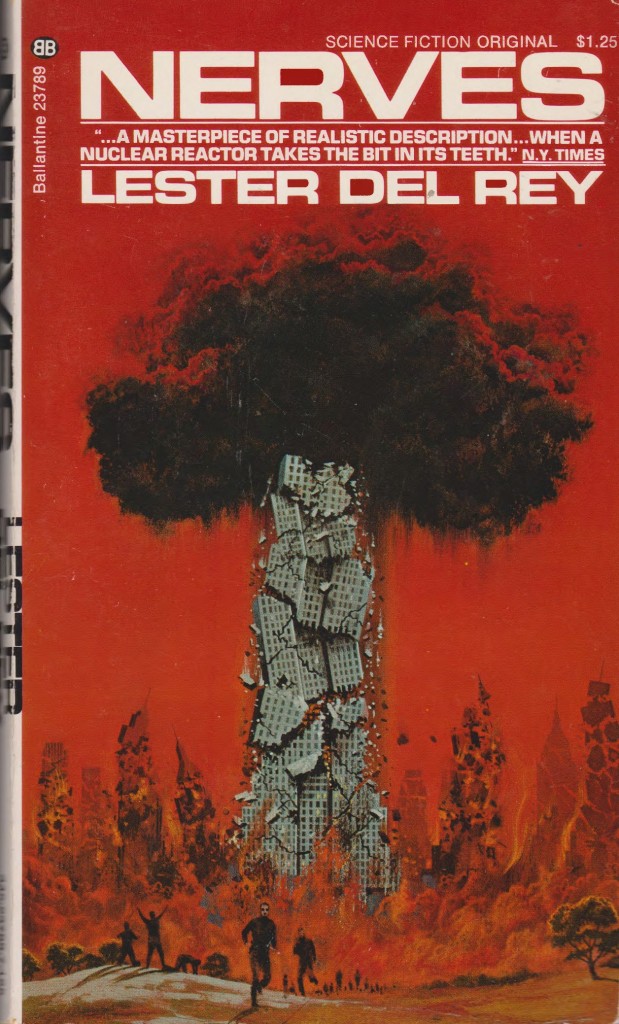
From the back cover: “THIS IS NO STORY OF SPACE SHIPS AND MARTIANS. THIS IS A STORY ABOUT OUR WORLD RIGHT NOW.
‘In 1942, three years before the general public had ever heard of nuclear fission. Lester del Rey wrote a brilliantly detailed novella of disaster in an atomics plant, which now appears, skillfully expanded to book length, as NERVES. A wholly admirable blend of prophetic thinking (in medicine as well as atomics), warm human values and powerful narrative suspense, this novel is strongly recommended…’ –N.Y. Herald Tribune.”
Which books/covers/authors intrigue you? Which have you read? Disliked? Enjoyed?
1. The Martian Chronicles, Ray Bradbury (1950)
Ian Miller’s cover for the 1979 edition
From the back cover: “A MAGNIFICANCTLY ILLUSTRATED EDITION OF THE MARTIAN CHRONICLES WHICH MASTERFULLY ENHANCES THE CLASSIC WONDER AND TERROR BY THE WORLD-RENOWNED AUTHOR OF THE ILLUSTRATED MAN RAY BRADBURY.
I’ve recently conducted a binge read of my ARC of Dangerous Visions and New Worlds: Radical Science Fiction, 1950-1985, ed. Andrew Nette and Iain McIntyre (2021). It is a must buy for any SF fan of the era interested in exploring the larger world behind the texts. Considering the focus of my website and most of my reading adventures over the last decade, I can unabashedly proclaim myself a fan of the New Wave SF movement–and this edited volume is the perfect compliment to my collection and interests.
The editors and PM Press have graciously provided me with the introduction to the volume. Perhaps it’ll convince you to purchase your own copy!
The “long sixties,” an era which began in the late 1950s and extended into the 1970s, has become shorthand for a period of trenchant social change, most explicitly demonstrated through a host of liberatory and resistance movements focused on class, racial, gender, sexual, and other inequalities. These were as much about cultural expression and social recognition as economic redistribution and formal politics. While the degree to which often youthful insurgents achieved their goals varied greatly, the global challenge they presented was a major shock to the status quo.
Which books/covers/authors intrigue you? Which have you read? Disliked? Enjoyed?
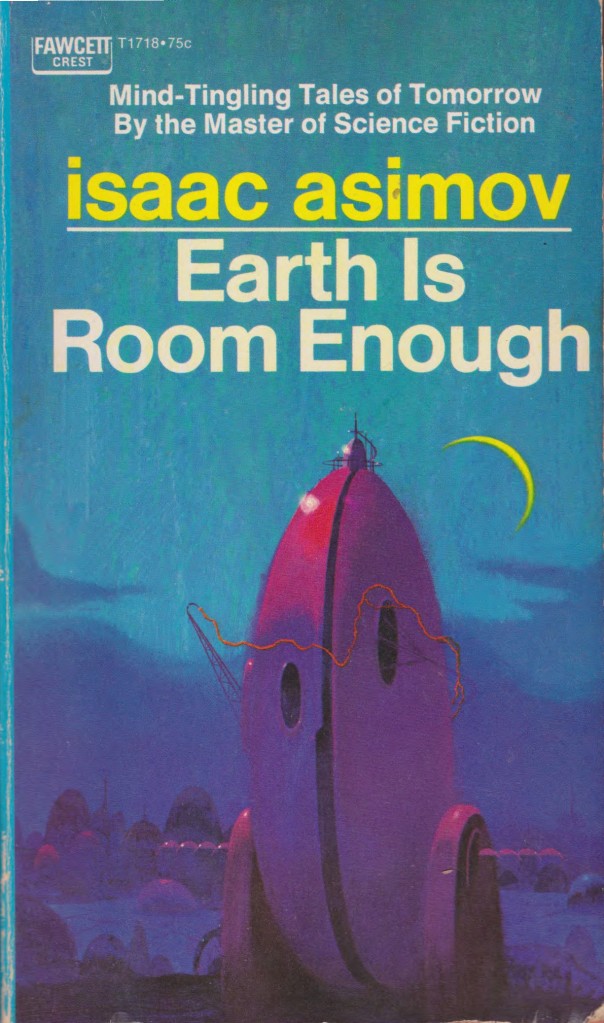
1. Earth Is Room Enough, Isaac Asimov (1957)
Paul Lehr’s cover for the 1970 edition
From the back cover: “ANYTHING CAN HAPPEN and probably will RIGHT HERE ON EARTH.
You don’t have to rent a spaceship or sign up for a singles cruise to Saturn or spend your weekends star-hopping along the Milky Way because EARTH IS ROOM ENOUGH.
Earth is where the action is and each tomorrow unleashes new discoveries.
Here are brilliant, witty, frightening, and fascinating stories of the future by the greatest science fiction master of them all. Just hitch your mind to these weird and wonderful tales for a spin around the world of tomorrow that will take you right to the center of your wildest dreams.”
Contents: “The Dead Past” (1956), “Franchise” (1955), “Gimmicks Three” (1956), “Kid Stuff” (1953), “The Watery Place” (1956), “Living Space” (1956), “The Message” (1956), “Satisfaction Guaranteed” (1951), “Hell-Fire” (1956), “The Last Trump” (1955), “The Fun They Had” (1951), “Jokester” (1956), “The Immortal Bard” (1954), “Someday” (1956), “The Author’s Ordeal” (1957), “Dreaming Is a Private Thing” (1955)
Which books/covers/authors intrigue you? Which have you read? Disliked? Enjoyed?
1. In the Drift, Michael Swanwick (1985)
Ron Lieberman’s cover for the 1st edition
From the back cover: “The meltdown at Three Mile Island created the death zone known as the Drift, where the sky burned dark blue and pink and where boneseekers destroyed bodies within.
Which books/covers/authors intrigue you? Which have you read? Disliked? Enjoyed?
1. Macrolife, George Zebrowski (1979)
Rich Sternbach’s cover for the 1st edition
From the inside flap: “A novel of epic scope, Macrolife opens in the year 2021. The Bulero family owns one of Earth’s richest corporations. As the Buleros gather for a reunion at the family mansion, an industrial accident plunges the corporation into a crisis, which eventually brings the world around them to the brink of disaster. Vilified, the Buleros flee to a space colony where the young Richard Bulero gradually realizes that the only hope for humanity lies in macrolife—mobile, self-reproducing space habitats.






 Science Fiction and Other Suspect Ruminations