Book Review: Profundis, Richard Cowper (1979)

PRFNDS1981

(Don Maitz’s cover for the 1981 edition)

3.75/5 (Good)

Richard Cowper’s science fiction (and fantasy) was recommended to me by 2theD over at Potpourri of Science Fiction Literature (be sure to follow him!).  But ever since I procured a copy of Profundis (1979) more than a year ago, I’ve passed over it when searching for my next read — perhaps due to the silly “Three Kinky Kittens, talented sexboats with uninhibiting charms” blurb on the back cover (“uninhibiting” isn’t even a word) in addition to Don Maitz’s uninteresting 80s cover art…  Tangent: Maitz drew the pirate for the Captain Morgan Rum brand.

However, Profundis proved to be a highly involving science fiction parable set in a post-apocalyptical Continue reading

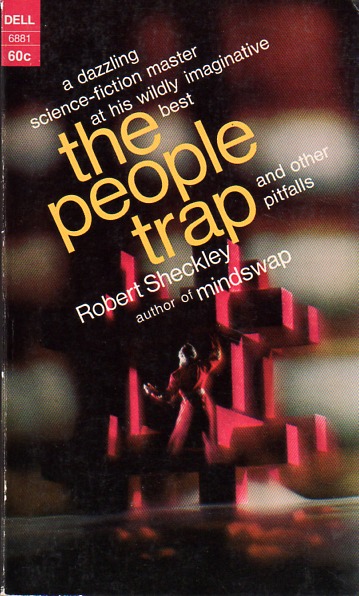
Book Review: The People Trap (full title: The People Trap and other Pitfalls, Snares, Devices, Delusions, as Well as Two Sniggles and a Contrivance), Robert Sheckley (1968)

TPPLTRP19XX

(Photo Media’s cover for the 1968 edition)

4/5 (collated rating: Good)

Although Robert Sheckley’s collection The People Trap (1968) does not approach the heights of Store of Infinity (1960), there are plenty of gems and the overall quality should compel any fan of satirical 50s/60s science fiction to find a copy.   Sheckley’s stories are characterized by delightful wit (despite serious themes such as the effects of colonization, technology, and nuclear disaster), surprising twist-endings, a penchant for intellectual mind-games (especially his 60s stories), and often hilariously hapless Continue reading

Updates: Recent Acquisitions No. LXV (Spinrad + Coney + Cummings + an anthology containing short stories by Pohl, Knight, Aldiss, et al.)

My first book from the 80s in many a year!  But, I’m on a Norman Spinrad kick so when I saw it for one dollar at the store I had to snatch it up his post-apocalyptical vision Songs from the Stars (180)….  The premise is rather hokey but perhaps a quality writer like Spinrad can imbue it with some vigor.

I’m most excited about The Ninth Galaxy Reader, ed. Frederik Pohl (1966) (twelve short stories from the Galaxy Magazine) due the top-quality author line-up — Brian W. Aldiss, John Brunner, Richard Wilson, Damon Knight, Philip Kose farmer, Harry Harrison, Frederik Pohl, Lester Del Rey, Roger Zelazny, C. C. MacApp, Larry Niven, and R. A. Lafferty….

1.  Songs from the Stars, Norman Spinrad (1980)

SNGSFRMTHS1982

(Uncredited cover for the 1982 Continue reading

Book Review: A Scourge of Screamers (variant title: The Lost Perception), Daniel F. Galouye (1966)

SCRGSCRM1968

(Paul Lehr’s cover for the 1968 edition)

2.75/5 (Vaguely Average)

Recently I procured a handful of Daniel F. Galouye’s novels (here) for a few dollars on ebay because I enjoyed his first novel Dark Universe (1961), which is an underread/underrated classic of the early 60s.  In an effort to rekindle public interest in Galouye’s small ouvre (he died at 54 due to war injuries and was unable to write much in the last ten years of his life), he received the Cordwainer Smith Rediscovery Award in 2007.  Unfortunately, Galouye’s fast-paced sci-fi thriller A Scourge of Screamers (variant title: The Lost Perception) does not measure up to the claustrophobic and well-plotted social rumination (with a good dose of action) that is Dark Universe.

The most redeeming feature is Paul Lehr’s harrowing depiction of mental anguish Continue reading

Updates: My 7 Favorite Metafictional Science Fiction Novels

Here are my seven favorite metafictional science fiction novels. By metafiction I’m referring to devices such as breaking the fourth wall (characters addressing the audience), the author addressing the reader, a story about a writer writing a story, a story containing another work of fiction within it, a work where the narrator reveals himself or herself as the author of the story, narrative footnotes, etc….

I’d love to hear your favorites (they don’t have to be novels)!

Obviously, these types of experimental works only appeal to some readers (especially fans of the sci-fi New Wave movement of the late 60s and early 70s) but I personally love seeing experimentation in an often — dare I say — stylistically stale genre.  Often, the metafictional aspects do not prevent authors from deploying traditional narratives.

 71nOA-QfpuL NSTNINT1967 RVLTNSXKSK1977

 THIRNDRM1972 MNINTHCST1974

My top seven (and an honorable mention):

1. Beyond Apollo, Brian N. Malzberg (1972) (REVIEW) — what you read is most likely the novel written by the main character. However, he’s most likely insane so attempting to get AT the true nature of his voyage to Venus is purposefully layered… Complicating the matter is how unreliable of a narrator he is and the fact that he’s tells many versions of the same story. Malzberg pokes fun at pulp science fiction throughout — which he clearly enjoyed as a child.

2. Stand on Zanzibar, John Brunner (1968) — the metafictional aspects are rather hidden in this New Wave masterpiece (my single favorite sci-fi novel).  Brunner’s vast (in scope and depth) mosaic of invented book fragments, advertising jingles, and narrative portions are interspersed with news articles taken from his own day — including the school shooting at the University of Texas in 1966.  Of course, as readers we’re geared to imagining that everything Continue reading

Book Review: The Iron Dream, Norman Spinrad (1972)

(Uncredited cover for the 1972 edition)

4.75/5 (Very Good)

Nominated for the 1973 Nebula Award

Simply put, Norman Spinrad’s The Iron Dream (1972) is a fantastic alternate history novel.  However, unlike a standard “what if this happened instead and now let’s write a traditional narrative” alternate history, The Iron Dream is organized around a powerful metafictional conceit which explicitly serves to satirize pulp science fiction and fantasy and condemn its lurid nature and Spinrad would argue, racist inclinations.

The premise is straightforward: after the Great War (WWI) Hitler comes to the United States (and thus WWII never happens) and becomes a science fiction illustrator.  Eventually he starts writing science fiction and articles in fanzines.  However, he’s considered by the establishment to be little more than a hack writer and lives the rest of his life in squalor.  It is only after he dies (from symptoms related to syphilis) that he receives any critical success. What you read is Hitler’s 1954 posthumous Hugo-winning novel (which he wrote in six weeks), The Lord of the Swastika,  along with a short pseudo-scholarly “afterward to the Continue reading

Adventures in Science Fiction Cover Art: Nostalgic Visions — Plastic Toy Spacemen

6186728691_d76e9c6c89_z

(Uncredited cover for the 1970 edition of When Two Worlds Meet (1970), Robert Moore Williams)

A while ago I put together a post on the theme of Models, Dolls, and Mannequins in cover art.  Little did I know that Curtis Books (a rather minor publisher of generally minor authors) and Born, a Dutch imprint, used a substantial number of cover compositions comprised of manipulated photographs/collages etc of plastic toy spacemen in unusual alien environments.  Also, a few more major publishers/magazines — Four Square Science Fiction and Analog Science Fiction Science Fact — had their own take on the theme.

I find these covers very charming and fun (sort of like a science fiction B-film from the 50s) — not necessarily artistic masterpieces.  They certainly evoke childhood games with toy figurines — perhaps placed in the lawn or sandbox or amongst the grass. I’ve included a few from my previous post and another can be found in my post Continue reading

Updates: Recent Science Fiction Acquisitions No. LXIV (Herbert + Tenn + Geston + Cummings)

More from my local dirt cheap book store…

By far most interested in William Tenn’s lone novel (he was predominately a short story writer) Of Men and Monsters (1968) — humans living in the walls, like mice, in the homes of the alien invaders of Earth.  Geston’s novelette The Day Star (1972) should be a fast and fun read — hopefully despite the comment by previous owner of the book who inscribed “TEDIOUS” on the back cover with a ballpoint pen…

Some fun covers.

1. Hellstrom’s Hive, Frank Herbert (1972)

HLLSTRMSHV1974

(R. Shore’s cover for the 1975 edition)

Excerpt from the inside flap of the first edition hardback: “In the summer of 1971, Doctor Nils Hellstrom appeared in his own film production, The Hellstrom Chronicle.  The motion picture Continue reading

Book Review: Beasts, John Crowley (1976)

s-l1600-2.jpg

(John Cayea’s cover for the 1976 edition)

4.5/5 (Very Good)

“‘They want to kill us all, you know.  They’re trying […].  The government.  Men.  You.’  Still his eyes searched hers. ‘We’re no use to them.  Worse than useless.  Poachers.  Thieves.  Polygamists.  We won’t be sterilized.  There’s no good in us.  We’re their creation, and they’re phasing us out.  When they can catch us'” (33).

While reading John Crowley’s Beasts (1976) I was reminded of the life of Stephan Bibrowski (1891-1932) à la Lionel the Lion-faced Man.  Stephan was afflicted with hypertrichosis (most likely) which caused his entire body to be covered with hair.  His mother was so horrified at his appearance  — which she believed was caused because she saw her husband mauled by a lion while she was pregnant Continue reading