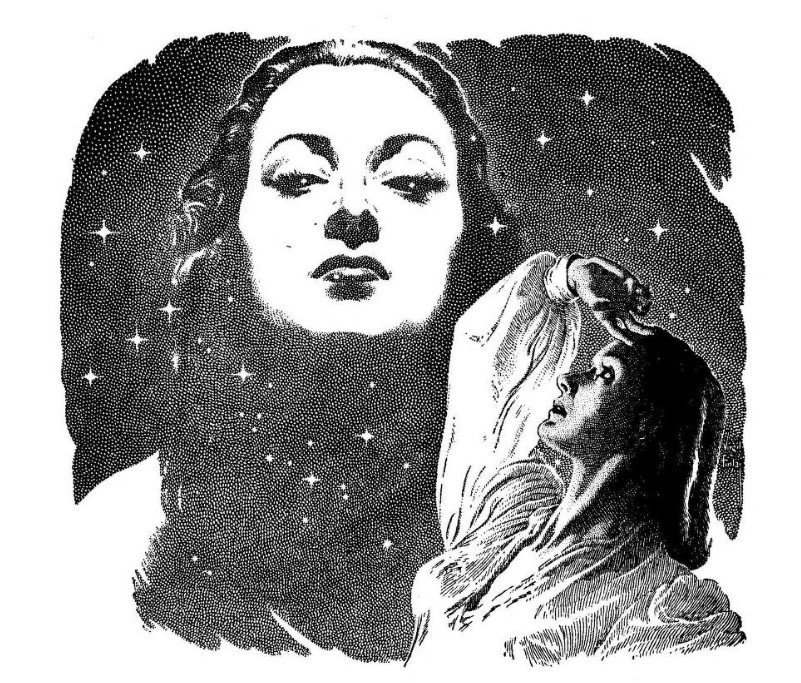
Today I’ve selected two post-apocalyptic visions by female authors. I needed an antidote to the creepy last man/woman stories I’ve been reading recently. Alice Eleanor Jones spins a masterpiece about a housewife attempting to keep the entropy of a crumbling world and an abusive husband at bay. Katherine MacLean imagines a moment where the last representative of the American Empire, after all the rhetoric of progress and exceptionalism came crashing down in a nuclear war, interacts with a persistent and well-meaning native girl.
The links to the stories can be found in the reviews. Both are recommended reads for fans of 50s and 60s science fiction.
Uncredited cover for the 1968 edition of The Best from Fantasy and Science Fiction: Fifth Series, ed. Anthony Boucher (1956)
5/5 (Masterpiece)
Alice Eleanor Jones’ “Created He Them” first appeared in The Magazine of Fantasy and Science Fiction, ed. Anthony Boucher (June 1955). You can read it online here.
Sometimes there are stories that transcend their short length with lasting power. This story has resided within me as if freshly read for weeks. Like some corrosive lozenge of love and hate, “Created He Them” eats you up from the inside.
Rob Latham in his article “Sextrapolation in New Wave Science Fiction” (2008) argues that in the early 1950s “a handful of stories were published in the magazines that dealt explicitly with sexual topics” long absent from genre. Latham suggests that some of the notable New Wave takes on science fictional sex read as reconceptualized versions of these stories [2]. With few exceptions, the 50s trailblazing tales were ignored by the major digests of the day and instead appeared in the failing pulps–Startling Stories and Thrilling Wonder Stories–or in “second- and third-tier digests just struggling to establish themselves” such as Howard Browne’s Fantastic Adventures. For example, my two previous posts in this series covered Sherwood Springer’s “No Land of Nod” (1952), which appeared in Thrilling Wonder Stories, and Philip José Farmer’s “The Lovers” (1952) in Startling Stories. The later was rejected by H. L. Gold, according to John Brunner, at Galaxy with the note: “I’ll publish this if you can get rid of the sex–I run a family magazine” [3].
Let’s get to the stories! Both Fritz Leiber’s “The Ship Sails at Midnight” (1950) and Theodore Sturgeon’s “The Sex Opposite” (1952) explore polyamorous relationships between humans and aliens. In Leiber’s case, a group of bohemians fall in love with a bisexual alien. In Sturgeon’s tale, a heterosexual couple both fall for a parthenogenetically female “alien” symbiote that appears male to women and female to men.
Henry Sharp’s interior art for Fritz Leiber’s “The Ship Sails at Midnight” in Fantastic Adventures, ed. Howard Browne (September 1950)
3/5 (Average)
Fritz Leiber’s “The Ship Sails at Midnight” first appeared in Fantastic Adventures, ed. Howard Browne (September 1950). You can read it online here.
Four self-proclaimed “‘wild’-young people, bohemians” (61), fresh out of college but still “sponging” off their parents “doing academic odd-jobs” (57), encounter the enigmatic and stunningly gorgeous Helen serving food at Benny’s, an all-night diner. Soon after meeting Helen, Es, “something of an artist,” starts to push the boundaries of her previously staid art (56). The narrator, Larry, who calls himself a writer but spends more time “reading magazines and detective stories, lazing around, getting drunk, and conducting […] endless intellectual palavers” (58) suddenly has something to actually write about–a carnal and intellectual love for Helen that they keep hidden from the rest. Louis, a philosopher, slowly encounters new avenues to explore rather than “merely cultivat[ing] a series of intellectual enthusiasms [..] and fruitless-excitement over the thoughts of other men” (57). And the gruff exterior of Gene, an atomic scientist, begins to mellow. All four view Helen as a “Great Books discussion leader” who serves as an intellectual midwife–who fosters, encourages, and inspires the expansion of their minds.
Which books/covers/authors intrigue you? Which have you read? Disliked? Enjoyed?
I planned to have a review up today. Unfortunately, August is always my least productive month writing as it marks the return to work after a much needed summer break. It’s been a rough few weeks! Stay tuned.
1. The Squares of the City, John Brunner (1965)
Murray Tinkelman’s cover for the 1978 edition
From the back cover: CHECHMATE IN PARADISE. Ciudad de Vados was a Latin-American showplace, a paradise…a flourishing supercity designed and run nearly to perfection.
Virgil Finlay’s interior art for Sherwood Springer’s “No Land of Nod” in Thrilling Wonder Stories, ed. Samuel Mines (December 1952)
In the March 1955 issue of John Brunner’s fanzine Noise Level, the young author listed a handful of “thematically edgy stories”–including Sherwood Springer’s “No Land of Nod” (1952), Theodore Sturgeon’s “The World Well Lost” (1953), and Lester del Rey’s “For I am A Jealous People (1954)–that he considered a “step forward” in the field [1]. The previous year he had praised elements of Philip José Farmer’s “The Lovers” (1952) in a fan letter to Startling Stories. According to Jad Smith, the stories feature “lived-in, morally ambiguous backgrounds much noisier and dynamic than the two-dimensional backdrops of more conventional fare” that appealed to Brunner’s embryonic views on genre [2]. Brunner viewed social change as a “messy and unpredictable process riddled with moral complexities” [3].
Which books/covers/authors intrigue you? Which have you read? Disliked? Enjoyed?
1. 5 Tales From Tomorrow, ed. T. E. Dikty (1957)
Richard Powers’ cover for the 1st edition
From the back cover: “THE TIME: TOMORROW… when
…space travel is as simple as suburban commuting
…robots do everything from washing dishes to waging wars
…do-it-yourself surgery kits are as common as Band-aids
…giant electronic brains mastermind all human activity
THE PLACE: SPACE SPACE SPACE
where the cold, dark islands of abandoned planets drift in a fabulous universe flooded with blazing energy, the dust of old suns and the heat of smoldering new stars.
Space–the promise of new life to a crowded earth–the new frontier–the hope of tomorrow!”
Contents: Bud Foote’s “Push-Button Passion” (1954), Tom Godwin’s “The Cold Equations” (1954), Clifford D. Simak’s “How-2” (1954), Robert Abernathy’s “Deep Space” (1954), Everett B. Cole’s “Exile” (1954)
Today I’ve reviewed the seventeenth story in my series on the science fictional media landscape of the future. John Brunner explores how total immersion media, one organ in a vast futuristic fair designed to satiate the masses, can transform fear within the broken.
Terry Maloney’s cover for New Worlds Science Fiction, ed. John Carnell (March 1956)
4.5/5 (Very Good)
John Brunner’s “Fair” first appeared in New Worlds Science Fiction, ed. John Carnell (March 1956) under the pseudonym Keith Woodcott. You can read it online here. It also appeared in his first collection No Future In It (1962).
I recently devoured Jad Smith’s short monograph John Brunner(2012) in the Modern Masters of Science Fiction series for Illinois University Press. Not only did the book rekindle my desire to tackle more of Brunner’s short fiction but I also bought copies of The Squares of the City (1965) and Quicksand (1967). I might even reread The Shockwave Rider (1975) in the near future. If you are at all interested in John Brunner’s science fiction I recommend acquiring a copy.
Smith identifies “Fair” (1956) as Brunner’s “finest achievement during this [early] period” (Smith 28). I’d rank it right under his spectacular generation ship short story “Lungfish” (1957). As with many of Brunner’s best works, “Fair” had a contested publication history–in this instance John Carnell only accepted it under the pseudonym “Keith Woodcott” to “fill out an issue” (Smith 29). The identity of the consummate wordsmith didn’t last long as Carnell accidentally revealed his identity in next issue when the story came in second in the reader’s poll!
Earle Bergey’s cover for Startling Stories, ed. Samuel Mines (August 1952)
3.5/5 (Good)
Preliminary note: This is a review of the original 1952 novella. You can read it online here. Philip José Farmer published a novelization in 1961. While the novel was frequently republished, the original novella was not anthologized until 2003 (bibliography). I am in half a mind to read the 1961 version and analyze the changes!
This is a review that I wish I didn’t have to provide a rating as my lukewarm response to the story might obfuscate my fascination with its thematic contents and larger historical context. Philip José Farmer’s novella “The Lovers” (1952) is, without doubt, historically important for the development of the SF genre as it introduced a transgressive mix of sex (mostly implied), unusual xenobiology, and colonial critique. It shocked and fascinated readers at the time. In a letter published in the September issue of Startling Stories, Farmer himself predicted the “Reverberations from THE LOVERS should be really bouncing” later in the year (136). And he was right!
Which books/covers/authors intrigue you? Which have you read? Disliked? Enjoyed?
1. The Lovers, Philip José Farmer (1961)
Mati Klarwein’s cover for the 1972 edition
From the back cover: “In 1952, Philip José Farmer excited instant acclaim in the science fiction field with the publication of a short story, THE LOVERS.
In 1961, he wrote and published the full-length novel based on that short story.
And in 1972, Ballantine Books is proud to bring this classic work back into print.
Mr. Farmer, who is known for his explorations into the psychological byways of odd relationships, here postulates a love affair which might well have surprised even Haverlock Ellis. but words such as ‘normal’ or ‘abnormal’ simply have no application in the original concepts to which Mr. Farmer’s imagination gives rise. The book remains unique and fascinating.”




 Science Fiction and Other Suspect Ruminations