Short Fiction Reviews: Josephine Saxton’s “The Wall” (1965), “Ne Déjà Vu Pas” (1967), and “Nothing Much to Relate” (1967)

In the past year or so I’ve put together an informal series on the first three published short fictions by female authors who are new(ish) to me and/or whose most famous SF novels fall mostly outside the post-WWII to mid-1980s focus of my reading adventures. So far I’ve featured Carol Emshwiller (1921-2019), Nancy Kress (1948-), Melisa Michaels (1946-2019), Lee Killough (1942-), and Eleanor Arnason (1942). I do not expect transformative or brilliant things from first stories. Rather, it’s a way to get a sense of subject matter and concerns that first motivated authors to put pen to paper.

Today I’ve selected Josephine Saxton (1935-), an author whom I’ve long known about–I reviewed The Hieros Gamos of Sam and An Smith (1969) back in 2012–but never read any more of her work. Due to Rich Horton’s review of Saxton’s Vector for Seven (1970), my interest in an important voice of the English New Wave movement suddenly rekindled. Her 60s and 70s stories appeared in many of the influential New Wave (and adjacent) anthologies–including Judith Merril’s England Swings SF (1969), Harlan Ellison’s Again, Dangerous Visions (1972), Robert Silverberg’s New Dimensions 1 (1971), Samuel R. Delany and Marilyn Hacker’s Quark/3 (1971), and Damon Knight’s Orbit 9 (1971).

In her first three stories, Saxton deploys sculpted landscapes as metaphysical traps that allegorize the internal struggles of her characters. In the language of the New Wave, inner space manifests as a nightmarish landscape that one must try to traverse. Her prose, even in her weakest tales, is measured and poetic. See SF Encyclopedia for discussion of her later fiction.

Let me know which Josephine Saxton fictions–perhaps from much later in her career–resonate with you.


4/5 (Good)

“The Wall” first appeared Science Fantasy, ed. Kyril Bonfiglioli (November 1965). You can read it online here. It also appeared in Saxton’s collection The Power of Time (1985), which is where I read it.

Continue reading

Updates: Recent Science Fiction Purchases No. CCCIII (William S. Burroughs, Chester Anderson, Pat Cadigan, Donald Kingsbury)

Which books/covers/authors intrigue you? Which have you read? Disliked? Enjoyed?

1. Courtship Rite, Donald Kingsbury (1982)

From the inside flap: “Gaet, Hoemei and Joesai are three clone brothers, survivors of the rigorous and deadly process of nurture and weeding that produces people of high kalothi, people worthy of surviving on the inhospitable planet of Geta. Geta was settled many thousands of years ago by human starships, but only legends of the people’s origins remain, memories that have become myths.

Continue reading

Book Review: The Alien Condition, ed. Stephen Goldin (1973)

3/5 (collated rating: Average)

Stephen Goldin gathers together twelve original short stories–including six by women authors and two co-written with women–on the theme of the alien condition [1]. Despite the “Average” overall rating, The Alien Condition gathers a fascinating range of science fiction with three spectacular visions by Vonda N. McIntyre, Kathleen Sky, and James Tiptree, Jr. I was also pleasantly surprised by Alan Dean Foster’s take on the theme considering my previous exposure to his fiction.

Continue reading

Future Media Short Story Review: John D. MacDonald’s “Spectator Sport” (1950)

Today I’ve reviewed the sixteenth story in my series on the science fictional media landscape of the future. John D. MacDonald tortures a time-traveler with an immersive TV experience!

Thank you “Friend of the Site” John Boston for suggesting I track this one down for my media series. “Friend of the Site” Antyphayes also brought up the story in a discussion way back in 2018

Previously: Theodore Sturgeon’s “And Now the News…” (December 1956).

Up Next: John Brunner’s “Fair” (March 1956) (as Keith Woodcutt).

4/5 (Good)

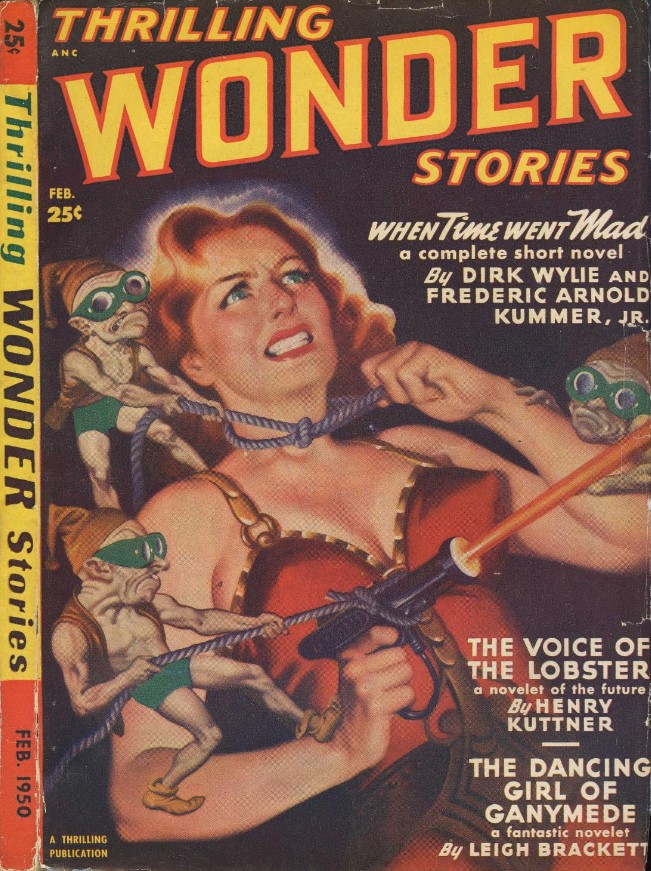
John D. MacDonald’s “Spectator Sport” first appeared in the February 1950 issue of Thrilling Wonder Stories, ed. Sam Merwin, Jr. You can read it online here. Note: this is a very short story and my review will contain unavoidable spoilers.

John D. MacDonald (1916-1986), best known for his massive Travis McGee series (1964-1985) and the twice-adapted psychological thriller The Executioners (1957), wrote three SF novels and was a regular in SF magazines in the 40s and 50s (with a handful appearing later). SF Encyclopedia claims erroneously that none of his later “ebullient pessimism” is present in his early SF. “Spectator Sport” embodies “ebullient pessimism” by creating a future where everyone is excited about slipping into delusion.

Continue reading

Adventures in Science Fiction Cover Art: Mariella Anderlini’s Covers for Roger Zelazny’s Chronicles of Amber (Corwin) sequence

On twitter, I recently learned from Jay O’Connell (cover artist and author) that all of Roger Zelazny’s work will be back in print. What exactly “everything back in print” means in reality I’m not entirely sure–will it include only the best known novels? All the short stories? Are works Zelazny wanted to “kill off” like To Die in Italbar (1973) really going to get reprints? Regardless, I was inspired to look back at the non-English language covers his work has received over the years. Naturally, as I moved to the fantastic Italian presses, I re-encountered and fell in love (again) with Allison’s evocative take on Zelazny’s Chronicles of Amber (Corwin) five-novel sequence.

What are your favorites?

Continue reading

Updates: Podcast Interview and Vintage Science Fiction Discussion Extravaganza

I appeared in my first ever podcast–Postcards from a Dying World with David Agranoff–last week. Organized around a series of interview questions, David and I ended up discussing vintage SF for a good hour. I cover how studying history has inspired my project, reasons for my focus on SF from post-WWII to the mid-1980s, favorite authors and themes, etc. Please check out his twitter and website as well. I have gathered together a list of the SF works I mention in the interview with links to my reviews when applicable.

I hate listening to myself as I am far too excited about vintage SF! (but is that a surprise?)

Continue reading

Updates: Recent Science Fiction and Fantasy Purchases No. CCCII (C. L. Moore, Marc Laidlaw, Fredric Brown, Mack Reynolds)

Which books/covers/authors intrigue you? Which have you read? Disliked? Enjoyed?

1. Dad’s Nuke, Marc Laidlaw (1986)

From the back cover: “BARBECUE THE NEIGHBOURS. In post-collapse suburban America, keeping up with the Joneses has got a little out of hand. Fallout shelters used to be the ultimate status symbol–until Mr. Johnson had his baby daughter’s digestive system adapted to consume radioactive waste.

Now Jock Smith has the edge on his neighbours–he has installed his very own tactical nuclear missile in the back yard.

After all, these are dangerous times..”

Continue reading

Future Media Short Story Review: Theodore Sturgeon’s “And Now the News…” (1956)

Today I’ve reviewed the fifteenth story in my series on the science fictional media landscape of the future. Theodore Sturgeon explores the effects of information overload in a chilling study of the making of a terrorist.

Previously: Walter F. Moudy’s “The Survivor” (May 1965).

Up Next: John D. MacDonald’s “Spectator Sport” (February 1950).

4.5/5 (Very Good)

Theodore Sturgeon’s “And Now the News…” first appeared in the December 1956 issue of The Magazine of Fantasy and Science Fiction, ed. Anthony Boucher. You can read it online here. I read it in TV: 2000, ed. Isaac Asimov, Martin H. Greenberg, Charles G. Waugh (1982). I highly recommend the anthology for all readers interested in this theme.

Written during the boom in TV sales and consumption in the United States–from 7k sold in 1944 to 5 million in 1950 (and by 1960 90% of homes contained a TV) (source)–“And Now the News…” describes a world saturated by all forms of media [1]. From the morning newspapers that wait at his door consumed at breakfast, the “three [radio] stations in town with hourly broadcasts” (262), and the TV news programs in the evening, MacLyle’s waking hours are completely inundated with the news [1].

Continue reading

Book Review: I Am Legend, Richard Matheson (1954)

4/5 (Good)

Richard Matheson’s I Am Legend (1954) is an influential SF vampire/zombie novel that spawned three film adaptations (I’ve watched the first two) and inspired directors such as George A. Romero and Danny Boyle, game designers such as Tim Cain (Fallout), and countless authors. The subject of the novel–man attempts to survive an onslaught of vampires, caused by bacterial infection, that act like smart(er) zombies in a post-apocalyptic wasteland–normally isn’t my cup of tea. I’m the first to admit that I picked up the novel entirely due to its historical importance. And I’m somewhat glad I did! While the physical onslaught of vampiric zombies didn’t interest me, the main thrust of the narrative concerns the mechanisms of grief and sexual frustration in the burning wreckage of one-time domestic bliss.

Continue reading