Atelier Heinrichs & Bachmann’s cover for the 1970 edition of J. T. McIntosh’s One in Three Hundred (1954)
In 2021, I posted Part I of my Adventures in Science Fiction Cover Art series on the Atelier Heinrichs & Bachmann. Between 1966 and 1971, they created a kaleidoscopic array of psychedelic visions for the German press Heyne Bücher. I described their art as follows: “Pop surrealism? Lowbrow art? The Andy Warhol effect? However you classify Atelier Heinrichs & Bachmann’s covers […] they’re gleeful and sarcastic.” And despite a few readers who disliked their exuberant/chaotic hilarity (someone described them as the “very nadir in SF cover art”), I stand by my positive assessment. And I bring you Part II of my series!
Hello everyone! Thank you for the immense support over the last twelve years (!) of my website. I keep doing what I do in part due to all the wonderful comments you leave, discussions you participate in, and suggestions you make. I can’t emphasize how much I appreciate it. I was recently interviewed by Cora Buhlert over on her website. She’s a three-time Hugo-nominated fan writer and a wonderful reviewer of vintage SF (often at Galactic Journey). Check out the interview here.
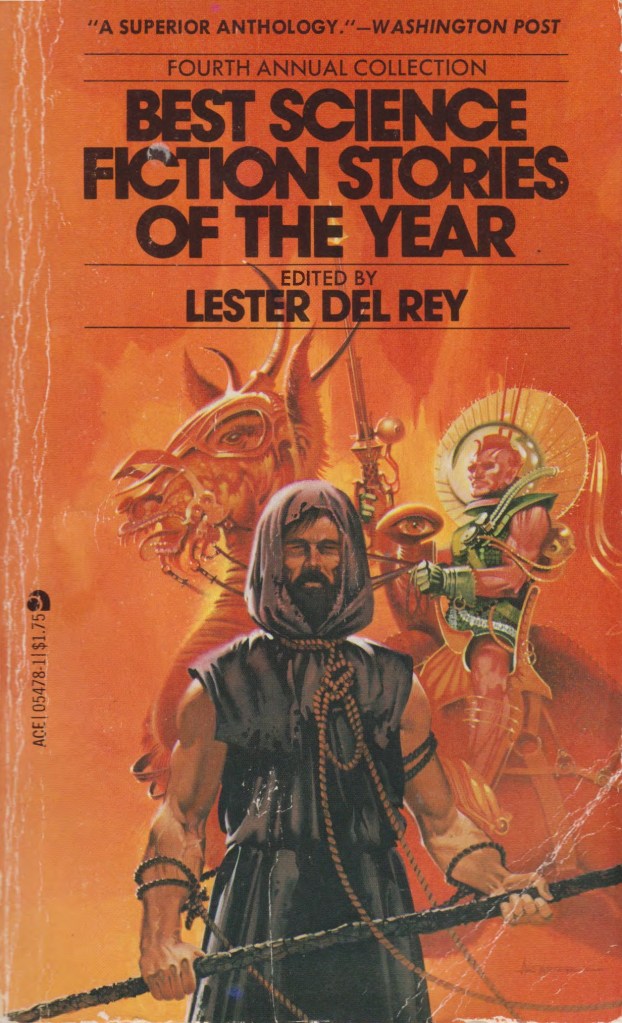
Lester del Rey’s Best Science Fiction Stories of the Year: Fourth Annual Collection (1975) is a mystifying read. For an anthology series claiming to contain the best stories of 1974, del Rey completely misidentifies all the hard-hitters of the year. For example, it does not include a single Hugo– or Nebula-nominated story.
My advice: Ignore the title. Instead, if you have an unnatural obsession with anthologies like myself, then contemplate picking up a copy for the Vonda N. McIntyre, F. M. Busby, John Brunner, and Gordon R. Dickson stories. The rest are average to poor.
Brief Plot Summary/Analysis
“If This Is Winnetka, You Must Be Judy” (1974), F. M. Busby, 4/5 (Good): Until I read this story, I assumed F. M. Busby’s SF from the 70s was as blunt and imprecise as Cage a Man(1973) and “Tell Me All About Yourself” (1973). With the emotional strokes reminiscent of Silverberg’s masterpiece Dying Inside(1972), Busby spins an ingenious time-travel tale about a man who lives his life in non-sequential sections.
Today I’ve reviewed the twelfth story in my series on the science fictional media landscape of the future–and the first from the early 1980s. Pat Cadigan howls a ghastly punk scream into the vastness of the night.
Up Next: Barry N. Malzberg’s “The Idea” (1971) (as K. M. O’Donnell).
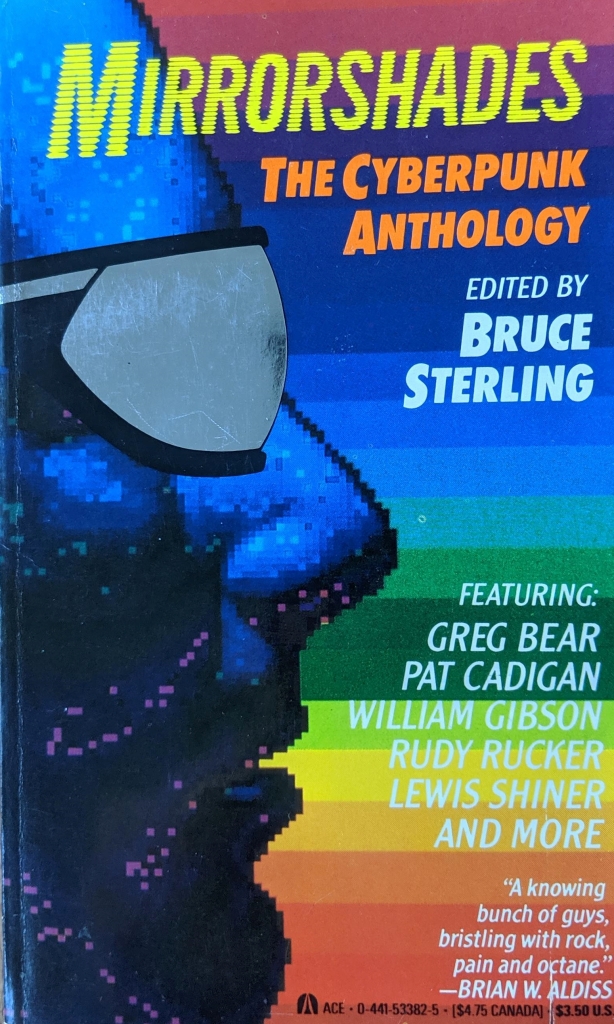
Uncredited cover for the 1988 edition of Mirrorshades: The Cyberpunk Anthology, ed. Bruce Sterling (1986)
3.75/5 (Good)
Pat Cadigan’s “Rock On” first appeared in Light Years and Dark: Science Fiction and Fantasy of and for Our Time, ed. Michael Bishop (1984). You can read it online here.
Whenever I delve into the nihilistic streets of cyberpunk, I enter the mental soundscape and acute estrangement imbued by the seminal 80s goth/post punk band The Cure: “scarred, your back was turned / Curled like an embryo” (“Cold” from Pornography, 1982). Robert Smith’s incantation of “a shallow grave / A monument to the ruined age” almost personifies cyberpunk’s fleeting but terrible power and apocalyptic conceptions of dark streets and conglomerates stamping out the last individuals finding their way across the net.
Which books/covers/authors intrigue you? Which have you read? Disliked? Enjoyed?
1. The Escape Orbit (variant title: Open Prison), James White (1964)
Jack Gaughan’s cover for the 1965 edition
From the back cover: “STRANDED ON A PLANET OF MONSTERS. When the survivors of the his starship were taken prisoner by the insec-creatures against whom Earth had fought a bitter war for nearly a century, Sector Marshal Warren expected to be impounded in a prison camp like those the Earthmen maintained. But the “Bugs” had a simpler method of dealing with prisoners–they dumped them on an uninhabited planet, without weapons or tools, and left them to fend for themselves against the planet’s environment and strange monsters. A “Bug” spaceship orbited above, guarding them.
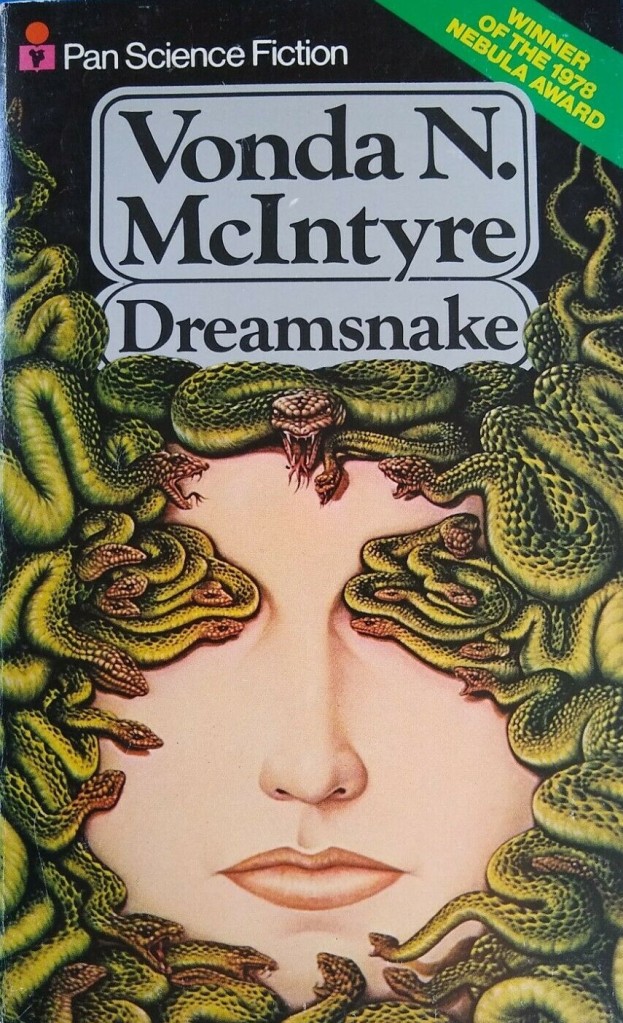
Won the 1979 Hugo, Locus, and Nebula Award for Best Novel.
I’ve now tackled the only pre-1990 Hugo Award-winning novel I had yet to read. And I was not disappointed. Fresh off Vonda N. McIntyre’s ingenious generation ship short story “The Mountains of Sunset, The Mountains of Dawn” (1974) with its winged-alien voyagers, I savored Dreamsnake‘s original blend of feminist science fiction and post-apocalyptic quest tale.
In the past few months, I’ve put together an informal series on the first three published short fictions by female authors who are completely new to me or whose most famous SF novels fall mostly outside the post-WWII to mid-1980s focus of my reading adventures. So far I’ve featured Carol Emshwiller (1921-2019), Nancy Kress (1948-), Melisa Michaels (1946-2019), and Lee Killough (1942-). To be clear, I do not expect transformative or brilliant things from first stories. Rather, it’s a way to get a sense of subject matter and concerns that first motivated authors to put pen to paper.
Today I’ve selected an author I’ve never read–Eleanor Arnason (1942-). According to SF Encyclopedia, most of her best-known science fiction appeared from the mid-1980s onward with To the Resurrection Station (1986) (which I own), A Woman of the Iron People (1991), Changing Women (1992), and the Hwarhath sequence (1993-2012). Unfortunately, I did not encounter her work in my late teens and early 20s when I read science fiction more widely.
I’d rank Eleanor Arnason’s first three published short fictions as the most auspicious start of the those I’ve covered so far. Her stories–often self-consciously in dialogue with pulp worlds and plots–demonstrate a fascination with ritualized landscapes and behaviors and feature female narrators attempting to find their place in strange new worlds.
Let me know which Arnason fictions–perhaps from much later in her career–resonate with you.
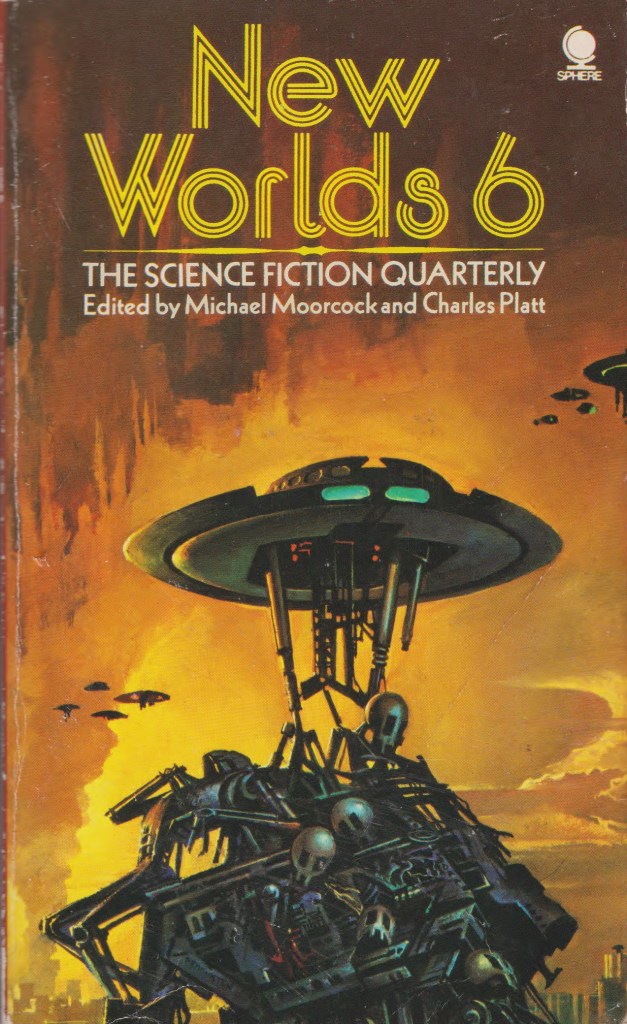
Bruce Pennington’s cover for New Worlds 6, ed. Michael Moorcock and Charles Platt (1973)
4/5 (Good)
“A Clear Day in the Motor City” first appeared in New Worlds 6, ed. Michael Moorcock and Charles Platt (1973). This does not seem to be available online. If you find it, let me know.
Like a cryptic quilt, a strange ritualized landscape drapes across the polluted industrial expanse of Detroit and Windsor. On clear air holidays, when “the Seven Sisters” were visible from the roof of a nearby office building, CEOs adorn “wreaths of plastic oak leaves” and release pigeons to “whoever’s responsible for the weather, to bear our thanks to him, her, it or them” (187).
Which books/covers/authors intrigue you? Which have you read? Disliked? Enjoyed?
1. The Darfsteller and Other Stories, Walter M. Miller, Jr. (1982)
Peter Jones’ cover for the 1st edition
From the back cover: “Walter M. Miller, Jr., wrote A CANTICLE FOR LEIBOWITZ, and changed the nature of science fiction, forever. Now, collected together for the first time are some of his most gripping masterpieces, including the Hugo Award-winning ‘The Darfsteller’ and ‘Crucifixius Etiam.'”
Today I’ve reviewed the eleventh story in my series on the science fictional media landscape of the future! Ann Warren Griffith spins a nightmarish dystopia where advertisements are illegal to block out.
Ed Emswhiller’s cover for the 1960 edition of The Best from Fantasy and Science Fiction, Third Series, ed. Anthony Boucher and J. Francis McComas (1954)
4/5 (Good)
Ann Warren Griffith’s “Captive Audience” (1953) first appeared in The Magazine of Fantasy and Science Fiction, ed. Anthony Boucher and J. Francis McComas (August 1953). You can read it online here.
In the 1950s, Americans depicted Communism as denying inherent human freedoms of choice and enslaving the mind. Over the course of the decade, the terror of Communist brainwashing collided with fears of the detrimental effects of consumer culture and advertising. Perhaps the evil Communist was so successful due to a new softness within the American family (Dunne, 123). Anne Warren Griffith’s “Captive Audience” imagines a dystopic future in which the American mind is turned into malleable putty by an entropic (and sonic) inundation of advertisements. According to the story’s relentless logic, the last bastions of independent thought will cease to exist in a capitalist world where the right of every product to receive “its share of the consumer dollar” is the only right that matters (57).





 Science Fiction and Other Suspect Ruminations