It’s time for the fifth post in my series exploring Carol Emshwiller’s science fiction and fantasy–published between 1955-1979 in genre magazines–in chronological order. And if you missed earlier installments, check out Part I, II, III, and IV.
We have a beach vacation in the post-apocalypse, a gorgeous fable of a housewife struggling to chart her path, and the travails of a crashed astronaut and his cat on a planet of religious fanatics. In this installment, I wrap up her stories published in the 1950s and move into the 1960s. Emshwiller published only 12 stories in the 1960s with a publication gap between 1961-1966 while she managed 13 between 1955-1959. In the previous post, Rich Horton and Expendable Mudge speculated that it was due to the birth of her son in 1959.
I’ve listed by rating all of her 50s stories. If you’d like me to write up my thoughts overall on her 50s visions in a more analytical manner (a short essay?), let me know in the comments.
1. “Pelt” (1958), 5/5 (Masterpiece)
2. “Day at the Beach” (1959), 4.5/5 (Very Good) [this post]
3. “Baby” (1958), 4/5 (Good)
4. “Nightmare Call” (1957), 3.75/5 (Good)
5. “Bingo and Bongo” (1956), 3.5/5 (Good)
6. “The Piece Thing” (1956), 3.5/5 (Good)
7. “This Thing Called Love” (1955), 3.5/5 (Good)
8. “The Coming” (1957), 3.5/5 (Good)
9. “Love Me Again” (1956), 3.25/5 (Good)
10. “Hunting Machine” (1957), 3/5 (Average)
11. “You’ll Feel Better…” (1957), 3/5 (Average)
12. “Two-Step for Six Legs” (1957), 2.75/5 (Vaguely Average)
13. “Idol’s Eye” (1958), 2.5/5 (Bad)
As always, feel free to join the conversation!
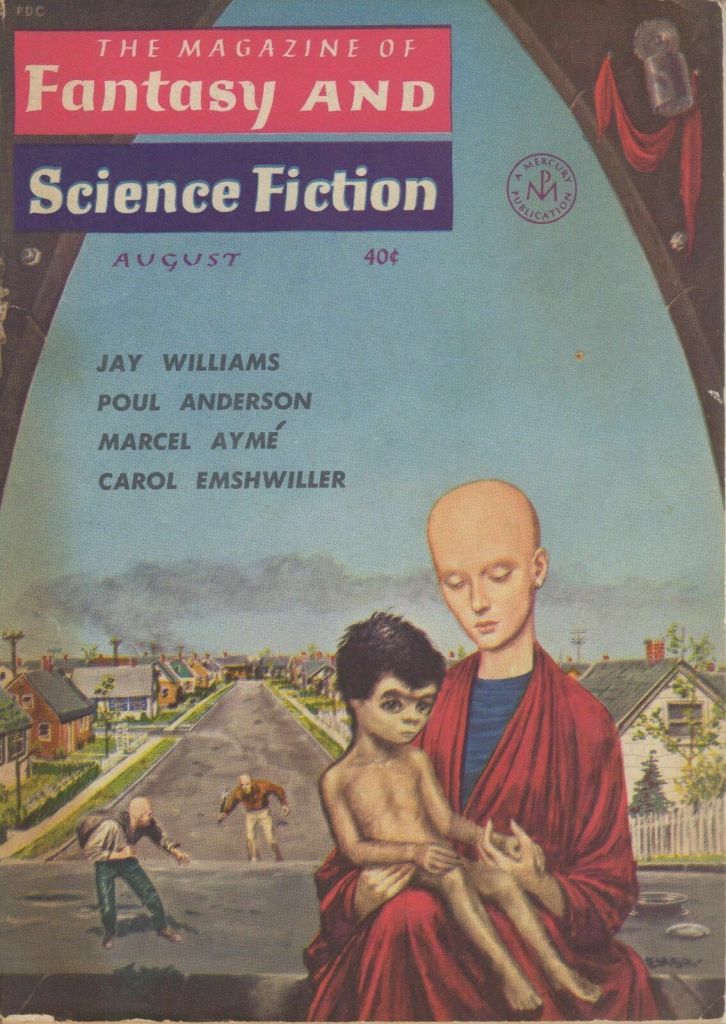
Ed Emshwiller’s cover depicting his wife’s story in The Magazine of Fantasy and Science Fiction (August 1959)
“Day at the Beach” in The Magazine of Fantasy and Science Fiction (August 1959), ed. Robert P. Mills. 4.5/5 (Very Good). You can read it online here. Like “Pelt” (1958), this wonderful story has been frequently anthologized. I read it in The Year’s Best S-F: 5th Annual edition (1960), ed. Judith Merril. At first glance “Day at the Beach” reaffirms the power of family in the face of a cataclysmic event as a mother and father slowly accept changes brought on by atomic mutation. Or, there’s a more sinister reading where the family unit creates a delusional bubble that obfuscates the real horror outside (and inside) their home.
Continue reading




 Science Fiction and Other Suspect Ruminations