Adventures in Science Fiction Cover Art: A Handful of SF Inspired Album Covers

space-art

(Jean-Auguste Ringard’s cover for the 1979 album Trip in the Center of Head by Space Art)

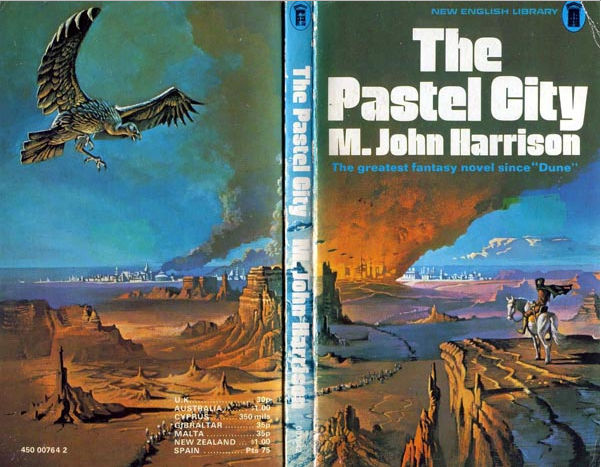
Due to a continuous and growing state of panic as election day (November 8th) approaches in the US, I have postponed completing my review of M. John Harrison’s The Pastel City (1971) (the first volume of the Viriconium sequence) in order to do something fun and lighthearted. Harrison’s entropic visions of decay and despair are not sitting well as the xenophobic orange monster looms spewing sexism and unbridled hate…. My The Pastel City review will appear after the election.

Instead, I want all my wonderful readers to pick their favorite SF-esque album cover from any era and Continue reading

Updates: Recent Science Fiction Acquisitions No. CLXIII (Simak + Moore + Universe Anthology + Lewin)

I had a choice, one of the worst SF covers I have ever seen vs. a standard Richard Powers cover. Despite my undying Powers love, I chose the worst (weird white face bathed in purple/pink strangeness)…. you know…. a conversation starter? As I have read little of Simak’s non-novel SF, I was quite happy to I come across one of his collections at the local bookstore.

Ward Moore’s 1953 alt-history classic fetches quite the price online. Perhaps due to a renewed interest as it was recently published in the Gollancz Masterwork series. Regardless, I found a 70s edition (alas, a bland cover) for a few dollars. I’ve been listening to his humorous satire of salesmen Greener Than You Think (1947) as an ebook while at the gym and thought I’d give his most famous novel a go…

My Universe anthology series grows and grows–and, this one contains authors new to me, including Howard Waldrop, F. M. Busby, and Lee Killough.

Thoughts/comments welcome!  I doubt many will support my choice of picking the hideous cover over Powers, but, I can submit a picture of it to our esteemed purveyor of trash covers, Good Show, Sir!

1. Bring the Jubilee, Ward Moore (1953)

screen-shot-2016-11-02-at-7-47-47-am

(Jeff Jones’ cover for the 1972 edition) Continue reading

Book Review: Cirque, Terry Carr (1977)

screen-shot-2016-10-26-at-8-04-06-am

(Stanislaw Fernandes’ cover for the 1978 edition)

3/5 (Average)

Nominated for the 1978 Nebula

Terry Carr’s third novel Cirque (1977) takes the form of a religious allegory filled with a mosaic of characters that each represent a different psychological profile. These allegorical representations of the populace inhabit the city of Cirque, that surrounds the Abyss, a vast and seemingly bottomless chasm into which the River Fundament pours its fertile waters.  Each character must confront their own failings, spurned by a tentacled Beast which crawls from the depths of the Abyss…

Allegory. Yes! Strange (urban) landscapes. Yes! These elements succeed in the hands of the adept. John Crowley’s masterful The Deep (1975) took SF-tinged fantasy tropes, inserted them game-like into a stylized world on top of a pillar, and with icy detachment Continue reading

Updates: Recent Science Fiction Acquisitions No. CLXII (Vance + Rucker + Kaye + Godwin + Orbit Anthology)

More SF joins the ranks that cover my shelves, from a Jack Vance Demon Princes sequence novel to a promising Orbit anthology with early Vernor Vinge, Carol Emshwiller, Harlan Ellison, etc.

And the covers!  Powers and Lehr at their best…

And what happened to SF art the 80s? (the Rudy Rucker novel cover terrifies — in a bad way).

As always, thoughts/comments are appreciated!

1.The Palace of Love, Jack Vance (serialized 1966)

thplcflvgw1967

(Richard Powers’ cover for the 1967 edition) Continue reading

Book Review: Involution Ocean, Bruce Sterling (1977)

nvltncnhsp1980

(Tim White’s cover for the 1980 edition)

3.25/5 (Vaguely Good)

“Turn and look behind you, reader. Can you see the crater now? It is wide, round, magnificent; within it shimmers a sea of air above a sea of dust. Almost a million human beings live within this titanic hole, this incredible crater, this single staring eye in the face of an empty planet” (119).

In my youth naval history and fiction transfixed: from the capture of the Spanish Xebec El Gamo by Lord Thomas Cochrane, 10th Earl of Dundonald to C. S. Forester’s Horatio Hornblower sequence, inspired in part by Lord Cochrane’s career.  I assessed each novel and memoir on whether or not I felt like I was on a sea-going vessel, holding the ropes in calloused hands, trapped belowdeck in a storm, yanking the lanyard on a cannon’s gunlock… With a dictionary of naval terms on my desk, I looked up each and every reference, memorized the cross-sections of frigates and the intricacies of the chain of command.  I recoiled with grim fascination as Hornblower–fresh off the harrowing loss of the HMS Sutherland and desperate to escape the French countryside–peers at Lieutenant Bush’s amputated leg and checks the inserted cloth wads that soak up the leaking puss.

Bruce Sterling’s Involution Ocean (1977) draws on the naval tradition, transposed into a SF future, although it is more exploration à la Darwin and the HMS Beagle than combat à la Horatio Hornblower and the HMS Hotspur.  Inspired by Melville’s Moby-Dick; or, The Whale (1851), Involution Ocean tells the tale of John Newhouse’s search for Nullaquan dustwales, the “only source of the drug syncophine” (23), across a vast Continue reading

Adventures in Science Fiction Cover Art: Art mysteries! Help Identify the SF Cover Artist (Novels by Clarke + Silverberg + Wilhelm, et al.)

Below are a group of uncredited covers whose artists I have not been able to firmly identify.  Some were brought to my attention by Adam who runs a collectible SF store (link).   I’d love to hear your input — make sure to read the guidelines.

Guidelines: If you think a cover is the work of a particular artist, please please please provide some evidence for your claim: for example, a comparison cover, a citation from a book/resource, or, perhaps a link to a canvas or artist webpage.  This makes identifying the artist more authoritative than a vague claim and readers can follow along more easily.  If you think you’ve identified the author, I recommend peeking at their other credited covers at The Internet Speculative Fiction Database.

Pocket Books was notoriously bad at citing their artists.  If we are able to identify a few of those below (Margaret and I and Journey), we might be able to nail down tens more covers missing citations in their catalogue.

The three covers below for Fred Saberhagen’s Empire in the East sequence are clearly by the same artist—the style seems so familiar!  And, the 1974 Signet edition of Cage a Man (1973), F. M. Busby is credited as FMA only.  I wonder if it’s possible to identify who FMA was.

In some cases, I have a pretty good idea who the artist might be but don’t have enough evidence….  I am convinced that Stanislaw Fernandes created the 1974 Signet edition of New Dimensions IV (1974) , ed. Robert Silverberg.  Although, it would be very early in his career and love to have some firm evidence.

I look forward to your ideas!

EDIT: I’ve gone ahead and indicated which ones have been solved by inserting the artist into the citation.

For more Adventures in SF Cover Art consult the INDEX

thmnnthmzj1977

(Bob Haberfield’s cover for the 1971 Tandem edition of The Man in the Maze (1968), Robert Silverberg) Continue reading

Updates: Recent Science Fiction Acquisitions No. CLXI (Ellison + Sterling + Fast + Paul)

As is my wont, a wide range of authors, SF styles, and covers…. From Harlan Ellison’s collection with the first expanded and non-magazine publication of his famous  1970 Nebula Award-winning and Hugo-nominated novella “A Boy and His Dog” (1969) to Barbara Paul’s best-known SF novel.

And, how can you resist the gorgeous Karel Thole cover for Fast’s collection?  I know little about the author….

And finally, in my youth I was a cyberpunk fanatic and I adored (perhaps I was misguided, hah) Bruce Sterling’s Islands in the Net (1988).  At last I have his first novel in my hands!

As always, thoughts and comments are welcome!

1. The General Zapped an Angel, Howard Fast (1970)

thgnrlzppd1970

(Karel Thole’s cover for the 1970 edition) Continue reading

Book Review: Abyss, Kate Wilhelm (1971)

bsshvspmdn1973

(Lou Feck’s cover for the 1973 edition)

4/5 (collated rating: Good)

Kate Wilhem’s SF forms one of the foundational pillars propping up my fascination with the genre.  Her writing, sometimes oblique and interior, cuts to the very heart of things, exposing the hidden societal and psychological sinews that suppress and restrict.  Her 60s/70s women characters, from linguists and mathematicians to discontented housewives, subtly subvert our expectations of how genre characters should behave.  And for a few years in the early 70s, she dominated the award lists (four Nebula nominations in 1971, two in 1970, a win in 1968, and of course, her double Hugo and Nebula win in 1976 for her novel Where Late our Sweet Birds Sang).  Totals: 14 Nebula nominations Continue reading

Updates: Recent Science Fiction Acquisitions No. CLX (Delany + Disch + Sladek + Zelazny + Edmondson + Bryant + Sucharitkul)

It’s been too long since I’ve read anything by Delany.  I polished off Triton (1976), Nova (1968), The Einstein Intersection (1967), and Babel-17 (1966) long before I started my site.  For a SF reading group I reread Nova a few years back but never wrote a review.  One of the few SF novels I’ve reread.  And yes, I do not own a copy nor have I tackled the behemoth that is Dhalgren (1975).

As a teen I was obsessed with Delany’s first collection Driftglass (1971), although I probably did not understand the important of the stories.  It is hard to forget the images in “Aye, and Gomorrah…” (1967) or “We, in Some Strange Power’s Employ, Move on a Rigorous Line” (1968) even if the message was lost on my younger self.  Now I have an excuse to reread one of Delany’s best known stories, originally collected in Driftglass (1971) — “Time Considered as a Helix of Semi-Precious Stones” (1968) — in a fascinating anthology with other luminaries of the field, Disch, Sladek, and Zelazny.

I confess, I was seduced by Powers’ gorgeous cover for G. C. Edmondson’s novel despite the terrifying back cover blurb: “Good, Old-fashioned Science Fiction Adventure at its best!”

A few months ago I read and reviewed Somtow Sucharitkul’s Starship and Haiku (1981).  Although I did not care for the novel, I need more strikes against before I give up on an author completely.  And, why not a fix-up comprised of his best known stories?

Same thing with Edward Bryant…  His attempts at channeling extreme decadence, fascinating cityscapes, and odd hybrids come off as inarticulate and forced.  Albeit I have only read “Jade Blue” (1971) and “The Human Side of the Village Monster” (1971).  As with Somtow Sucharitkul, I need to read more of his stories to come to a firm stance on his abilities.

As always, thoughts and comments are welcome.

  1. The Shores Beneath, ed. James Sallis (1971)

the-shores-beneath_page_2

(Ron Walotsky’s cover for the 1971 edition) Continue reading