Updates: Year in Review (Top Ten SF Novels + Top Ten Short Stories/Novelettes/Novellas + other categories)

Everyone likes lists!  And I do too….  This is an opportunity to collate some of my favorite (and least favorite) novels and shorter SF works I read this year.  Last year I discovered Barry N. Malzberg and this year I was seduced by…. Well, read and find out.


Top Ten Novels

1. We Who Are About To…, Joanna Russ (1976): A scathing, and underread, literary SF novel by one of the more important feminist SF writers of the 70s (of The Female Man fame).

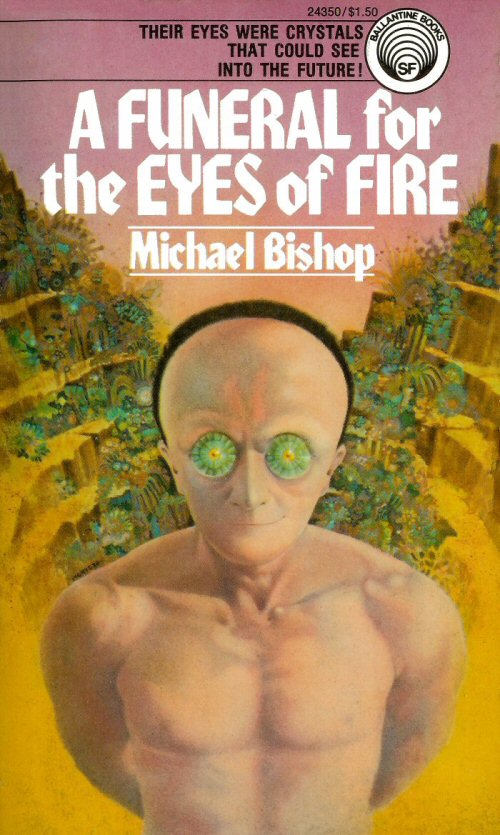
2. A Funeral for the Eyes of Fire, Michael Bishop (1975): A well-written anthropological clash of cultures novel.  Slow, gorgeous, emotionally engaging….

3. Level 7, Mordecai Roshwald (1959): A strange satire of the bomb shelter…  Everyday surrealism. Continue reading

Book Review: Cloned Lives, Pamela Sargent (1976)

(Walter Rane’s cover for the 1976 edition)

2.5/5 (Bad)

There is a reason that Pamela Sargent’s Cloned Lives (1976) has been overshadowed by Kate Wilhelm’s clone-themed Where Late the Sweet Birds Sang (1976), which garnered a Hugo award and a Nebula nomination, released the same year. While Sargent’s vision is painfully melodramatic and descriptive to a fault where pages and pages and pages pass without a single metaphor or simile, Wilhelm’s was psychologically taut and beautiful.  Cloned Lives is comprised of three previously published works, the short story “A Sense of Difference” (1972), the novella “Father” (1974), and the novelette “Clone Sister” (1973).  Each section shifts perspective between each of the clones and their father (with a culminating “Interface” section).    

Despite Cloned Lives’ manifold flaws there are a few moments of interest, notably amongst descriptive postulations about the nature of her futuristic society, that are prescient and thought-provoking.  Likewise, Sargent’s conscious effort to integrate a vast assortment of races (Indians, Arabs, Africans, etc) and gender roles (homosexual couples who use cloning to have children, female scientists, etc) is admirable and appealing.  However,  these brief (yet intriguing) interludes and observations do not redeem the banal melodrama Continue reading

Updates: Recent Science Fiction Acquisitions No. LXXXIII (Randall + Brunner + Shaw + Jones)

Dallas Half Price Book Store Part III (Part I, Part II)!

A short story collection by an author I have termed Mr. Perpetually Average But Readable, Bob Shaw.  I am interested in whether or not his visions are more concise/poignant in short story form.  I suspect a book like One Million Tomorrows (1971) would have been amazing in short form, especially the disturbing portions that take place in Africa (the UN forcefully administering immortality treatment on people who do not want them)….

A Nebula award nominated novel by Marta Randall, Islands (1976)—immortality themed, seems (at first glance) to be on the allegorical side = I have high hopes.

More Brunner! (Despite his warning, I was influenced by a review over at Speculiction…. here)  But then again, I am a Brunner completest…. And finally, a relatively unknown British SF novel, Implosion (1967) about a decreasing population.  Despite words of warning from reviews like Ian Sales’ (here) I couldn’t resist the Vincent Di Fate cover.

Thoughts?

1. Tomorrow Lies in Ambush, Bob Shaw (1973)

(Uncredited cover for the 1975 edition) Continue reading

Book Review: The Men Inside, Barry N. Malzberg (1973)

(Ron Walotsky’s cover for the 1973 edition)

4.5/5 (Very Good)

Caveat: If a perverse (and Freudian) metafictional (and literary) retelling of Otto Klement and Jerome Bixby’s Fantastic Voyage replete with filmic flashbacks does not intrigue you then stay away….

There are few SF authors who utilize metafictional elements as gleefully and effectively as Barry N. Malzberg.  Beyond Apollo (1972), his masterpiece, is a labyrinthine sequence of 67 short chapters of a novel written by the main character who may or may not be recounting real (imagined?) events.  While in In the Enclosure (1973) the excruciating paranoia that permeates the pages and the impossible escapes that transpire, recounted as if they were entries in a diary, could indeed be generated by an external force—the exact nature of which is unknowable—implanting memories.  Revelations (1972) was entirely comprised of a sequence of documents (interview transcripts, diary fragments, epistolary fragments) Continue reading

Updates: Recent Science Fiction Acquisitions No. LXXXII (Brunner + Sargent + Simak + Harrison)

Dallas, TX Half Price Books haul Part II [Part I].

Only 2thD at Potpourri of Science Fiction Literature has read more John Brunner novels than me (an overstatement of course).  At last count I have read somewhere near eighteen of his novels (as diligent readers of my site know, I consider the 1968 masterpiece Stand on Zanzibar my single favorite SF novel).  So, when I encounter any of the legions of his novels/short story collections that I have not yet read I snatch them up without a second thought.  The most appealing thing about Double, Double (1969) might be the delightful name Brunner came up with for a band that somehow features in the plot–Bruno and the Hermetic Tradition.

Pamela Sargent’s Cloned Lives (1976) is the “other” SF novel about cloning released that year — the more famous is Kate Wilhelm’s stunning (and moody) Where Late the Sweet Birds Sang (1976).  I had high hopes for Sargent’s vision but considering I have already read more than half the novel I think they have been dashed to small bits — alas (review forthcoming).

And there is nothing wrong with more Clifford D. Simak and Harry Harrison.

As always, some intriguing covers….

1. Double, Double, John Brunner (1969) (MY REVIEW)

(Uncredited cover for the 1969 edition) Continue reading

Book Review: Fireship (variant title: Fireship / Mother and Child), Joan D. Vinge (1978)

(Stephen Hickman’s cover for the 1978 edition)

3.5/5 (collated rating: Good)

Like so many SF fans, my first exposure to Joan D. Vinge’s work was via her wonderful Hugo-winning novel The Snow Queen (1980).  Eventually I found a copy of her first published novel, The Outcasts of Heaven Belt (1978), which had an intriguing premise but a less than satisfactory delivery (poor characterizations, pacing, etc).  The collection Fireship (1978) is comprised of two novellas: the Hugo- and Nebula-nominated “Fireship” (1978) and one of her earlier works, “Mother and Child” (1975).

The title story is the lesser of the two despite its (dare I say dubious) award nominations.  It’s a light-hearted and unchallenging proto-cyperpunk Continue reading

Updates: Recent Science Fiction Acquisitions No. LXXXI (Vinge + Gerrold + Zelazny + White)

Part 1 of many: Half Price Books in Dallas, TX (the second best bookstore, after Dawn Treader Books in Ann Arbor, MI for SF I have ever come across).  Gift card courtesy of fiancé’s mother = LOTS OF SCIENCE FICTION.  There could not be a better gift….

Everyone reads Robert Zelazny’s This Immortal (1966) and Lord of Light (1967), but who has read Isle of the Dead (1969)?  Thematically it seems similar to Lord of Light…  I have high hopes.  James White’s SF is always above average — and a fund cover from Dean Ellis makes that an auto-buy.  Although I disliked David Gerrold’s Space Skimmer (1972) my father swears Yesterday’s Children (1972) is somewhat readable.

I enjoyed Joan D. Vinge’s The Summer Queen (1980), tolerated her first novel The Outcasts of Heaven Belt (1978), so I suspect her two novella collection Fireship (1978) will be worthwhile…

Thoughts?

1. Isle of the Dead, Robert Zelazny (1969)

(Leo and Dianne Dillon’s cover for the 1969 edition) Continue reading

Book Review: The Downstairs Room and Other Speculative Fiction, Kate Wilhelm (1968)

(Ron Walotsky’s cover for the 1968 edition)

4/5 (collated rating: Good)

By the late 60s Kate Wilhelm’s SF moved from generally uninspiring pulp (à la the collection The Mile-Long Spaceship) to psychologically taught and emotive mood pieces exploring the almost existential malaise of daily existence and the disturbing effects of “programmed” lives (especially the housewife).  The fourteen short-stories in The Downstairs Room and Other Speculative Fiction (1968) (the term “speculative fiction” was coined by Judith Merril in the 60s) comprise a snapshot of Wilhelm’s best New Wave work.  It should be noted that not all are SF.

Although some are less engaging than others, her harrowing portrayal of starlets subjected to endless psychological torments at the whims of their viewers in “Baby, You Were Great” (1967) (Nebula nominated) and the evocative tapestry of daydreams Continue reading

Updates: Recent Science Fiction Acquisitions N. LXXX (Bishop + Herbert + Malzberg + Offutt)

Stopped briefly in St. Louis to peruse a used book store and came across these…  Another work by one of my new favorite SF authors, Michael Bishop.  Short stories by Frank Herbert, and an intriguing post-apocalyptical vision by Andrew J. Offutt (with a fantastic Powers cover).

Unfortunately, Malzberg’s lesser novel Tactics of Conquest (1974) — according to later admission expanded from a short story in only four days! — tempted me, but it was only one dollar…

Thoughts?

1. Stolen Faces, Michael Bishop (1977)

(Steve Hickman’s cover for the 1978 edition) Continue reading