Book Review: Doomsday Morning, C. L. Moore (1957)

powers_doomsday-morning

(Richard Powers’ cover for the 1958 edition)

4.25/5 (Good)

C. L. Moore’s Doomsday Morning (1957) — she’s best known for her revolutionary 1930s works including “Shambleau” (1934) and the “Jirel of Joiry” sequence — is perhaps her most ruminative and traditional SF novel (she tended to write more fantastical SF and fantasy).  Unfortunately, she quit writing around the time of the death of her husband and frequent collaborator Henry Kuttner (they often published under the pseudonym Lewis Padgett).  And her second husband forbid her to write altogether…

Moore creates a finely wrought dystopic vision where an oppressive future government utilizes communication networks to spread its tentacles across the United States.  Against this backdrop intriguing characters come to life.  Her descriptions of the political backdrop remain minimalistic which is surprising for SF of the 50s which often resorts to lengthy descriptive lectures.  Instead, the true extent of the government’s Continue reading

Adventures in Science Fiction Cover Art: The City as Canvas, Part I

Screen shot 2013-04-25 at 9.00.06 PM

(Richard Powers’ cover for the 1969 edition of Cosmic Engineers (1939), Clifford D. Simak)

The theme of this post is the future metropolis as canvas where the entire surface of the cover is arrayed and ordered by the forms and forces of the city.    The city as a matrix that holds the scene unfolding amongst its spires…  Richard Powers’ masterful cover for the 1969 edition of Cosmic Engineers is the perfect example.  The mass of the buildings arch, indistinct, upward — causeways and platforms amongst the cityscape hold faceless humanoid forms that “look” Continue reading

Book Review: The Human Angle, William Tenn (1956)

(Richard Powers’ cover for the 1964 edition)

3.75/5 (collated rating: Good)

I’ve been in a 50s SF short story craze of late, devouring collections by Robert Silverberg (Godling, Go Home!), Walter M. Miller, Jr. (The View From the Stars), Fritz Leiber (A Pail of Air), Lester Del Rey (Mortals and Monsters), and a few Robert Sheckley volumes a few months before. Fresh off of William Tenn’s solid novel Of Men and Monsters (1968) I went into The Human Angle (1956) (containing three novelettes and five short stories predominately from the 50s) with high expectations.  Despite the handful of duds — “The Human Angle” (1948), “Project Hush” (1954) and “The Discovery of Morniel Mathaway” (1955) —  that tend to creep into most collections of shorts, the majority were characterized by sardonic brilliance.

Although not as biting as his august contemporaries Robert Sheckley and C. M. Kornbluth, Tenn’s visions are delightfully humorous and ironic.  It’s worth getting your Continue reading

Adventures in Science Fiction Cover Art: The Vaguely Defined Looming Man Shape

stewart01

(John Richards’ cover for the 1961 edition of Earth Abides (1949), George R. Stewart)

Note: if anyone can identify the artist for the first three downright spectacular covers I’d be very very happy.  I’m positive that they match stylistically (the vague human shape, the cityscape, the brush strokes, the textures).  Two of the three covers were made for Signet press and all three are from the early 1960s.  I suspect if I perused the covers from the Signet catalogue from that era I’d find even more….  Perhaps it’s the work of Sanford Kossin?  He was producing covers for Signet around the same time.  Solved: The cover artist is John Richard.

And now The Vaguely Defined Looming Man Shape Continue reading

Book Review: The Bridge, D. Keith Mano (1973)

(Uncredited — but looks like Jerome Podwil’s work — cover for the 1974 edition)

3.25/5 (Good)

The Bridge (1973) is D. Keith Mano’s only “full-fledged” SF work (Clute on SF encyclopedia).  Mano’s profoundly unsettling dystopic New York circa 2035 is characterized by an unusual mix of radical environmentalism gone amok and Christianity misinterpreted beyond recognition.  In our current day of overwhelming evidence of Global warming and other types of environmental devastation caused by mankind, Mano’s near future will come off as unnecessarily alarmist.

Clearly Mano means his work to be a satire of the most draconian rhetorical flourishes of the environmentalist Continue reading

Updates: Recent Science Fiction Acquisitions No. LXXIV (Malzberg + Geston + Anthony + Barjavel)

Part 5 of 5 acquisitions posts covering my haul from Dawn Treader Books in Ann Arbor, Michigan.  I’ve saved some good ones for the end — namely, Mark S. Geston’s Out of the Mouth of the Dragon (1969).  I’ve previously reviewed his first novel — Lords of the Starship (1967) — which was a relentlessly dark vision that showed great promise.  Besides the work of Stanislaw Lem, I know very little about non-English language SF so I snatched up a copy of Rene Barjavel’s Future Times Three (1944).  According to some critics, his treatment of time travel proved profoundly influential.

The other two novels are somewhat bigger risks.  Brian N. Malzberg’s The Empty People (1969), written under his pseudonym K. M. O’Donnell, is one of his first SF novels and supposedly quite average.  And, Piers Anthony’s Macroscope (1969) strikes me as a rather bloated, pseudo-spiritual, New Wave extravaganza (but not in a good way) — we’ll just have to see.

Thoughts?

1. Out of the Mouth of the Dragon, Mark S. Geston (1969)

(John Schoenherr’s cover for the 1969 edition) Continue reading

Updates: Recent Science Fiction Acquisitions No. LXXIII (Aldiss + Nourse + Biggle, Jr. + Levy + Coleman)

Part 4 of 5 acquisition posts covering my haul from the marvelous SF bookstore Dawn Treader Books in Ann Arbor, Michigan (Part I, Part II, Part III).

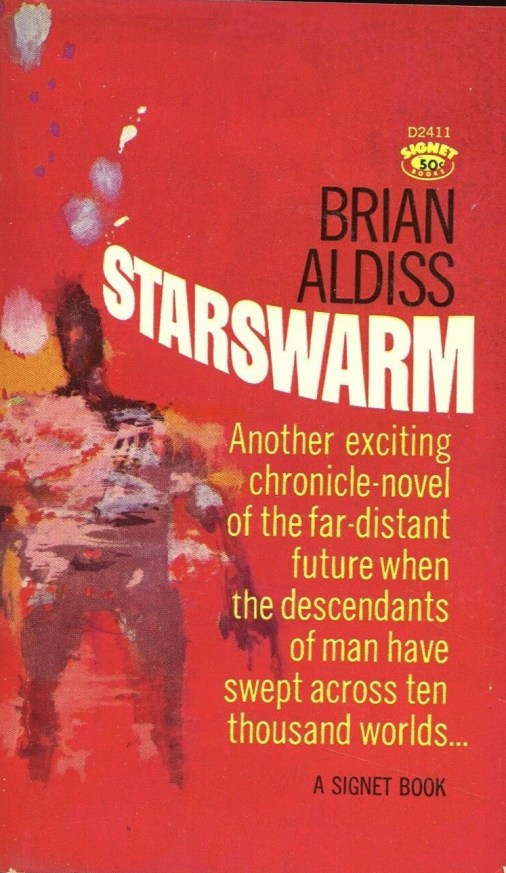
Three of the five books have been on my to acquire list for long time.  I adore Brian Aldiss’ early work (Non-Stop is one of my favorite SF novels) so I snatched up Starswarm (1964) without a moment’s hesitation.  Lloyd Biggle, Jr. writes very unusual (not sure if it’s good) SF — The Light That Never Was (1972) certainly had potential despite its flaws.  Regardless, The World Menders (1971) is supposedly his best work (despite the egregious Freas cover it was “graced” with).  After reading some good reviews of some of Alan E. Nourse’s 1950s medical themed stories, I’ve been looking for a copy of the fix-up novel The Mercy Men (1955).  The remaining two novels in this post were in the 50 cent clearance section — both have stunning covers (Powers + Lehr) and are probably absolutely atrocious reads.

1. Starswarm, Brian Aldiss (1964) (MY REVIEW)

starswarm

(Uncredited cover for the 1964 edition) Continue reading

Book Review: The View from the Stars, Walter M. Miller, Jr. (1965)

(Richard Powers’ cover for the 1965 edition)

3.75/5 (Collated rating: Good)

Almost all SF fans have read Walter M. Miller, Jr.’s masterpiece A Canticle for Leibowitz (1959) but few indulge in his shorter works.  By 1957 Miller had virtually quit publishing new SF (A Canticle is comprised of novellas published between 1955-1957).  His only work published later was Saint Leibowitz and the Wild Horse Woman (1997) completed by Terry Bisson and released posthumously.

The View From the Stars (1965) — containing five short stories, two novelettes, and one novella — is a cross section of his most productive decade.  Although I found that none of the works included should be considered masterpieces, “I, Dreamer” (1953), “Dumb Waiter” (1952),  “Big Joe and the Nth Generation” (1952), and “The Big Hunger” (1952) were wonderful.  All the others are readable Continue reading

Updates: Recent Science Fiction Acquisitions No. LXXII (Sturgeon, Harness, Sheckley, Duke)

Part 3 of 5 acquisition posts covering my haul from Dawn Treader books in Ann Arbor, Michigan…. The only Sturgeon novel I’ve read was the masterpiece (and rightly so) More Than Human (1953) so I was thrilled when I found not one but three copies of Venus Plus X (1960).  Unfortunately, I was not able to scour the shelves closely enough to find a first edition and thus am stuck with Gray Marrow’s cover for the 1968 Pyramid Science Fiction edition.  But, I went ahead and posted the first edition art instead because it’s without doubt Victor Kalin’s best cover…..

Sheckley is brilliant so I snatched up another collection of his short stories without hesitation.

The two other authors are ones I have heard about but never read — Charles L. Harness and Madelaine Duke.  Duke’s novel was a complete risk due to the ridiculous sounding premise but I love reading works by unknown authors.  Harness is claimed by some to be one of the great authors whose neglect, in the words of John Clute in the SF encyclopedia entry on Harness, “is difficult to understand.”  His work sounds like my cup of tea….

Thoughts?  Has anyone read Charles L. Harness?

1. Venus Plus X, Theodore Sturgeon (1960) (MY REVIEW)

(Victor Kalin’s cover for the 1960 edition) Continue reading