Short Story Reviews: Carol Emshwiller’s “Baby” (1958), “Idol’s Eye” (1958), and “Pelt” (1958)

I’ve hit gold! Robotic nurses with adult “children.” A blind girl possessed by second sight. And a dog who cannot understand freedom. Here’s the fourth post in my series exploring Carol Emshwiller’s science fiction and fantasy–published between 1955-1979 in genre magazines–in chronological order. And if you missed earlier installments, check out Part III, and III.

In this installment, I have the first that I can confidently declare a 1950s masterpiece–“Pelt” (1958). If you want to participate in my explorations, links to the stories can be found below.

As always, feel free to join the conversation!
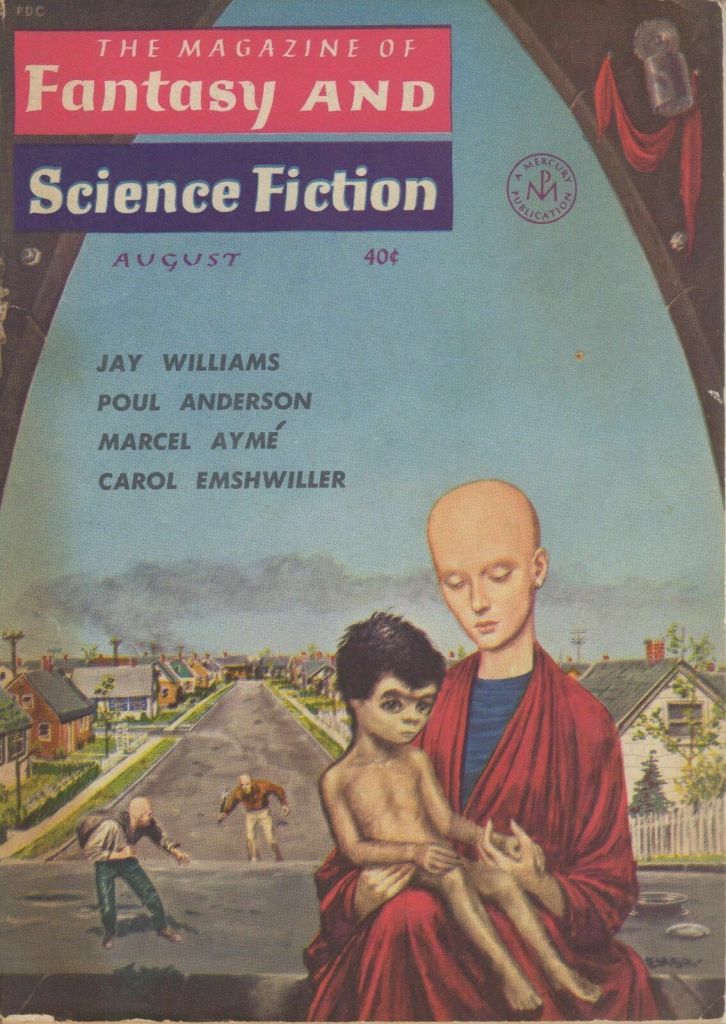
Her next three stories are covered in Part V.


“Baby” in The Magazine of Fantasy and Science Fiction (February 1958), ed. Anthony Boucher. 4/5 (Good). You can read it online here.

Raised by a robotic nurse, Baby, “six feet tall, lean, [with] the look of a hungry hunting animal,” encounters a slowly decaying world unable to provide his needs (115). Baby’s simulacra parent, and to a lesser degree Rob the repair robot, parrot the language, actions, and intentions of humans. He detects an emptiness to the space behind their words and increasing inability to explain the mechanical breakdowns that are never fixed. Saying “please” no longer works (116) but rather makes him angry. Nurse, with her “soft mother-arms” and “specially built place at her breast,” continues to follow her programming and treat Baby as if he were a child (118).

Continue reading

Updates: Recent Science Fiction Purchases No. CCLXXVI (Philip José Farmer, Barbara Paul, Knut Faldbakken, and Ward Moore)

Which books/covers/authors intrigue you? Which have you read? Disliked? Enjoyed?

1. Father to the Stars, Philip José Farmer (1981)

From the back cover: “John Carmody has no ethics, no morals and no conscience. Until he takes the Chance on Dante’s Joy, living through seven nights of wildest fantasies come true, he can’t even imagine why anyone would want a conscience. But Dante’s Joy is a truly strange place–and the phone calls from his murdered wife are only the beginning of his strange experiences.

Continue reading

Short Story Reviews: Carol Emshwiller’s “The Coming” (1957), “You’ll Feel Better…” (1957), and “Two-Step for Six Legs” (1957)

Here is another post in my series exploring Carol Emshwiller’s science fiction and fantasy–published between 1955-1979 in genre magazines–in chronological order. And if you missed earlier installments, check out Part I and II.

I found Emshwiller’s next three science fiction stories, including the first in her new long-term home The Magazine of Fantasy and Science Fiction, polished fables utilizing standard genre tropes (alien mating rituals, a mysterious stranger, etc.) to highlight humanity’s encounter with itself in idiosyncratic and grim ways.

However, this batch presents a bit of a lull in overall quality. These are probably only recommended for Emshwiller completists like myself or fans of off-kilter 50s parables. The next post will contain one of her best known works of the 50s–“Pelt” (1958). I look forward to Part IV.

For those curious why I am conducting this series, check out my review of the intense power that is “Animal” (1968) (the best story of hers I’ve read so far).

As always, feel free to join the conversation!

Her next three stories are covered in Part IV.


“The Coming” in The Magazine of Fantasy and Science Fiction (May 1957), ed. Anthony Boucher. 3.5/5 (Good). You can read it online here.

A mysterious stranger, “stick thin, and he walked as as scarecrow might walk” (102), comes into town like someone in a trance, his “lips parted, eyes half closed, head thrown back” (102). On cue, a young girl named Nina with her homework spread before her, slips into the same trance-like state. Her mom threatens “if you don’t keep your mind on your work you’ll be set back again this year” (103). But something about the stranger, the unknown, and the other world in which he seems to inhabit free from all care or obligation beckons.

Continue reading

Updates: Recent Science Fiction Purchases No. CCLXXIV (Suzette Haden Elgin, Paul Cook, Herbert W. Franke, Charles Eric Maine)

As always, which books/covers/authors intrigue you? Which have you read? Disliked? Enjoyed?

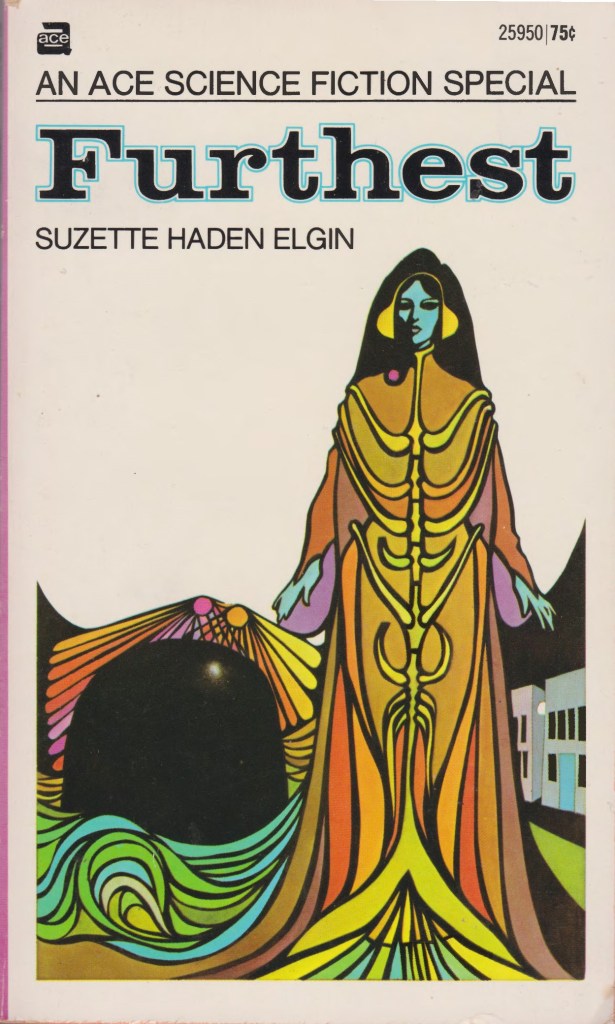
1. Furthest, Suzette Haden Elgin (1971) (MY REVIEW)

From the back cover: “Coyote Jones, agent for the Tri-Galactic Intelligence Service, had been sent to a planet so unimaginably distant from the rest of the Federation that it bore the descriptive name Furthest. His mission: to find out why the total body of data about Furthest showed the world’s inhabitants to be absolutely average down to the last decimal place. That data had to be false.

Jones was permitted to live on the planet, but the natives were so wary of him that he could uncover nothing—until he chanced into a personal crisis faced by his young Furthest assistant. The boy’s sister had been sentenced to Erasure, and he wanted Coyote Jones to take the fugitive girl in and hide her.

Continue reading

Short Story Review: Anthony Boucher’s “Star Bride” (1951)

The following review is the 13th installment of my series searching for “SF short stories that are critical in some capacity of space agencies, astronauts, and the culture which produced them.” Some stories I’ll review in this series might not fit. And that is okay. I relish the act of literary archaeology.

As always, feel free to join the conversation.

Previously: J. G. Ballard’s “The Cage of Sand” (1962)

Up Next: Poul Anderson’s “Third Stage” (1962)

2/5 (Bad)

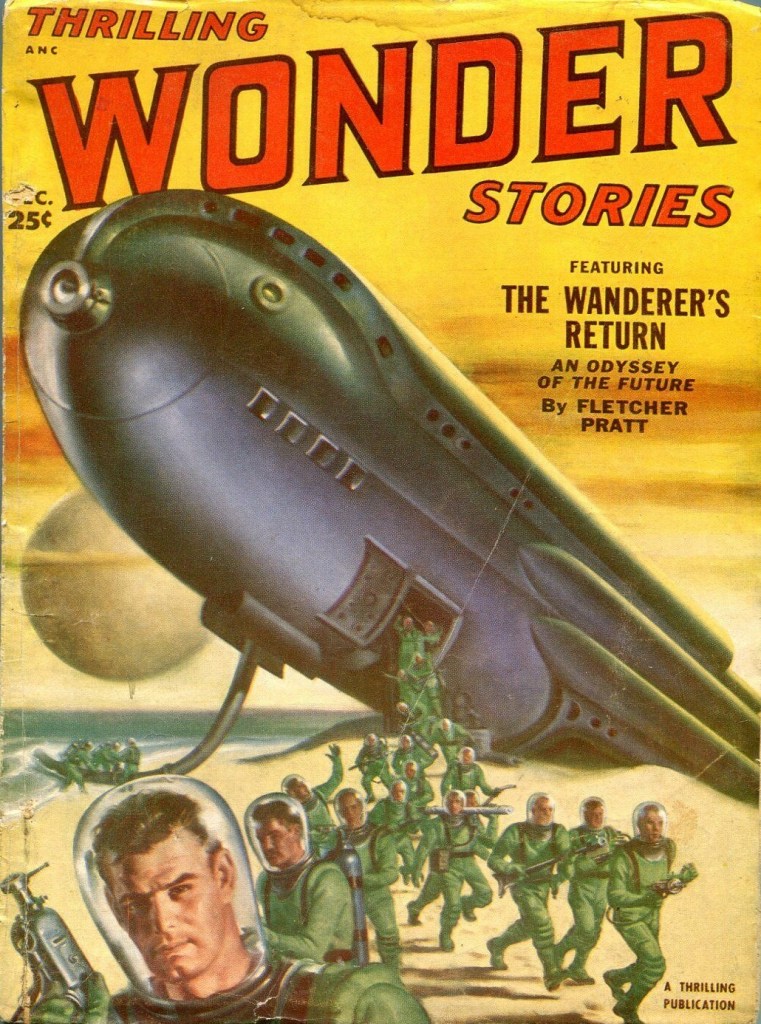
“Star Bride” (1951) first appeared in the December 1951 issue of Thrilling Wonder Stories, ed. Samuel Mines. You can read it online here.

Anthony Boucher’s short “Star Bride” is a tepid condemnation of colonialism written in the immediate post-WWII stages of decolonization (the Philippines gained its independence from the United States in 1946 and India from the British Empire in 1947). While a deeply problematic and forgettable story, a handful of Boucher’s themes and observations are worth teasing out due to later SF formulations I’ll be exploring in this series.

Continue reading

Updates: Recent SFF Purchases No. CCLXXIII (Avram Davidson, Joan D. Vinge, William Tenn, and Michael Kurland)

As always, which books/covers/authors intrigue you? Which have you read? Disliked? Enjoyed?

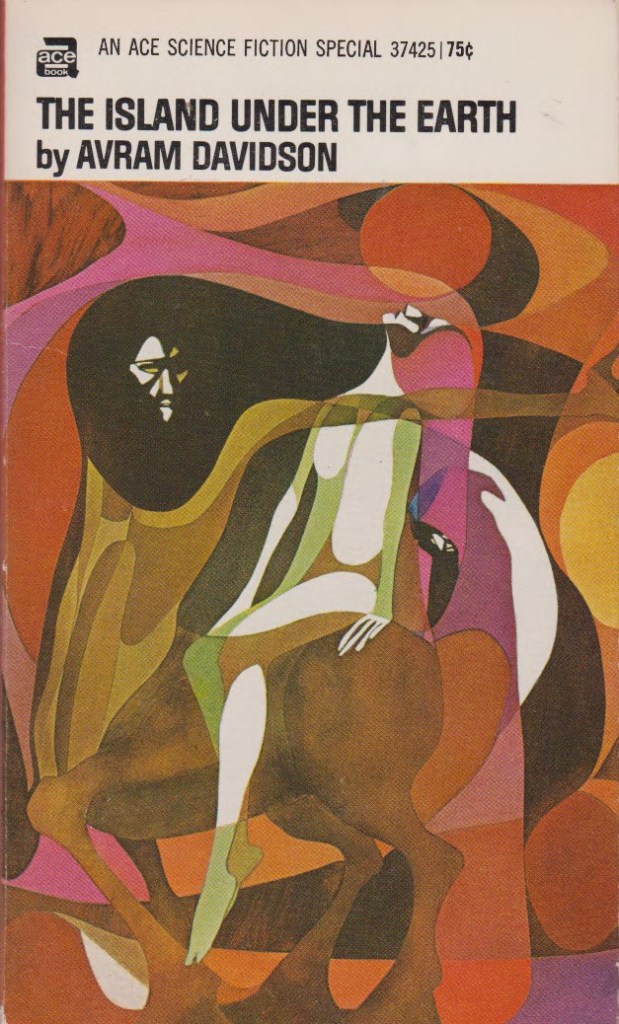
1. The Island Under the Earth, Avram Davidson (1969)

From the inside page: “In THE ISLAND UNDER THE EARTH, a master fantasist has created his most fabulous land of imagination, peopled with humans and not-humans who speak with characteristically different voices and pursue goals and philosophies that set them inevitably against one another.

Continue reading

Short Book Reviews: John Wyndham’s The Chrysalids (variant title: Re-Birth) (1955), John A. Williams’ Captain Blackman (1972), and Gina Berriault’s The Descent (1960)

Note: My read but “waiting to be reviewed pile” is growing. Short rumination/tangents are a way to get through the stack before my memory and will fades. Stay tuned for more detailed and analytical reviews.


1. The Chrysalids (variant title: Re-Birth), John Wyndham (1955)

3/5 (Average)

John Wyndham’s The Chrysalids (1955), my first exposure to his science fiction, transpires in a standard post-apocalyptic cozy catastrophe scenario with a deeply emotional core. The narrative follows David’s childhood in the backwater territories of Labrador, Canada hundreds of years after a nuclear war. The Church, inspired by Nicholson’s Repentances—which along with the Bible are only surviving books–imposes a draconian theology that “only God produces perfection” (51). Mutations, a visual sign of diabolical influence, must be destroyed. David, the son of the local strongman and preacher, discovers a young girl with a terrifying secret–she has six toes. David starts to accumulate secrets including his own mysterious telepathic abilities and recurrent dreams of a city in a world without cities. He shares them with his sympathetic Uncle Axel, who attempts to protect him from the forces narrowing in.

There are some nice touches throughout. Uncle Axel recounts his travels and knowledge of the world as a seaman and the effects is that of a medieval map, filled with pseudo-legendary beings, historical fragments, and “real” flora and fauna that, at first glance, seems too fantastic to exist (54-57).

Continue reading

Short Story Review: Charles W. Runyon’s “First Man in a Satellite” (1958)

The following review is the 11th installment of my series searching for “SF short stories that are critical in some capacity of space agencies, astronauts, and the culture which produced them.” Some stories I’ll review in this series might not fit. And that is okay. I relish the act of literary archaeology.

Preliminary Note: I am getting a bit carried away by this project. The historian in me rears its obsessive head. I experience intense enjoyment reading any and all stories on the theme regardless of their quality. I know my readers might want me to feature some higher quality stories. Right? While I have a few average to solid stories in the docket read and waiting for reviews, I plan on tackling some harder-hitters in the near future (more Malzberg, Ballard, Sturgeon, etc.).

I had fun writing about this one! As always, feel free to join the conversation.

Previously: Roger Zelazny’s “Halfjack” (1979)

Up Next: J. G. Ballard’s “The Cage of Sand” (1962)

2.75/5 (Vaguely Average)

Charles W. Runyon’s “First Man in a Satellite” appeared in Super-Science Fiction (December 1958), ed. W. W. Scott. You can read it online here.

For two years of my youth in the early 1990s, I lived in Washington, D.C with the National Air and Space Museum a few blocks away from our tiny home in Dupont Circle. While I could not yet read, I knew how long it should take for my parents to read each and every exhibit label to me. And, agape at Able the monkey’s space couch and preserved body, I asked the predictable question: “did she survive the voyage into space?” “She did,” my mother would said, “she died soon after.” “And the monkeys before her?”

Continue reading

Short Story Review: Frederik Pohl’s “The Hated” (1958)

The following review is the 9th post in my series searching for “SF short stories that are critical in some capacity of space agencies, astronauts, and the culture which produced them.” Some stories I’ll review in this series might not fit. And that is okay. I relish the act of literary archaeology.

As always, feel free to join the conversation!

Previously: Philip K. Dick’s “A Little Something For Us Tempunauts” (1974)

Up next: Roger Zelazny’s “Halfjack” (1979)

3.75/5 (Good)

Frederik Pohl’s “The Hated” (1958) first appeared in the January 1958 issue of Galaxy Science Fiction, ed. H. L. Gold. He wrote it under the pseudonym Paul Flehr. You can read it online here.

“The Hated” (1958) postulates that astronauts will require psychological conditioning to survive the confines of space travel to Mars. In Pohl’s future, the Mars-craft crams six men in a space the size of a Buick (51). The continuous sounds of machine and crew, the fetid taste of the air filled with sweat, the omniscient fear of crushing your oxygen line while sleeping, the free fall, the dreams of drowning, generates an intense drive to kill your crewmates. Byron, the narrator, wants a knife for Sam, to strangle Gilvey with his bear hands, gun Chowderhead with one bullet to the belly, turn a tommy gun on Wally, and cage the captain with hungry lions. The conditioning is “like a straightjacket”–Byron elaborates: “You know how to make a baby cry? Hold his hands […] What they did to us so we couldn’t kill each other, it was like being tied up, like having out hands held so we couldn’t get free” (50).

Continue reading