The following review is the 13th installment of my series searching for “SF short stories that are critical in some capacity of space agencies, astronauts, and the culture which produced them.” Some stories I’ll review in this series might not fit. And that is okay. I relish the act of literary archaeology.
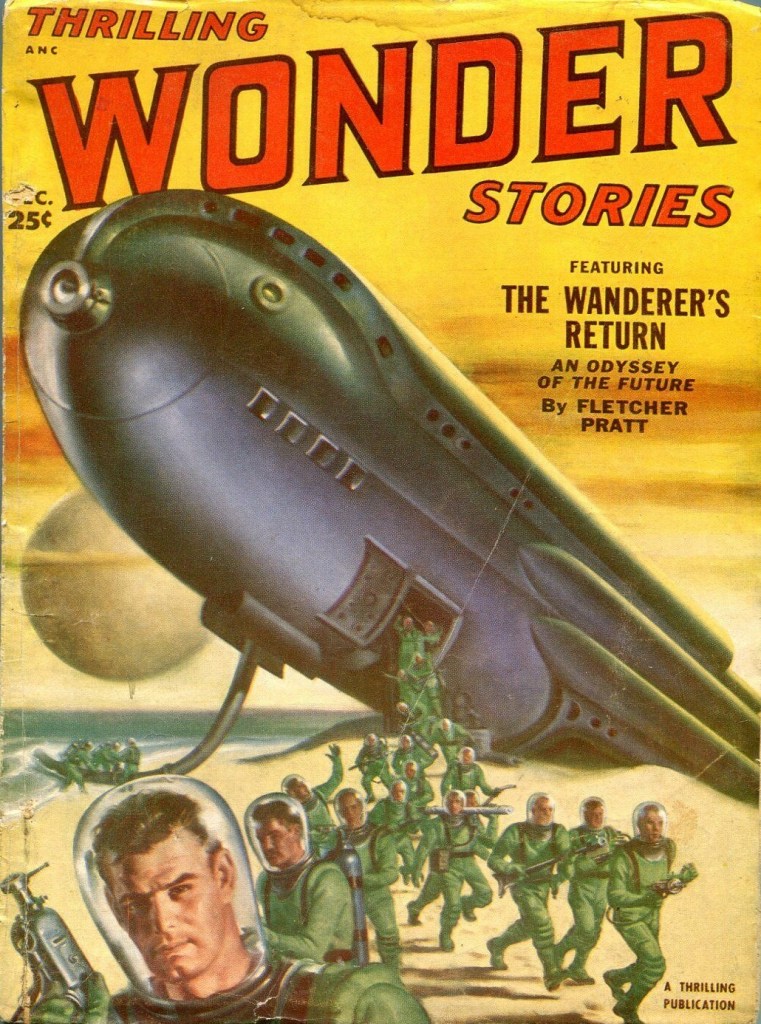
Uncredited cover for the December 1951 issue of Thrilling Wonder Stories
2/5 (Bad)
“Star Bride” (1951) first appeared in the December 1951 issue of Thrilling Wonder Stories, ed. Samuel Mines. You can read it online here.
Anthony Boucher’s short “Star Bride” is a tepid condemnation of colonialism written in the immediate post-WWII stages of decolonization (the Philippines gained its independence from the United States in 1946 and India from the British Empire in 1947). While a deeply problematic and forgettable story, a handful of Boucher’s themes and observations are worth teasing out due to later SF formulations I’ll be exploring in this series.
As always, which books/covers/authors intrigue you? Which have you read? Disliked? Enjoyed?
1. The Island Under the Earth, Avram Davidson (1969)
Diane and Leo Dillon’s cover for the 1st edition
From the inside page: “In THE ISLAND UNDER THE EARTH, a master fantasist has created his most fabulous land of imagination, peopled with humans and not-humans who speak with characteristically different voices and pursue goals and philosophies that set them inevitably against one another.
Note: My read but “waiting to be reviewed pile” is growing. Short rumination/tangents are a way to get through the stack before my memory and will fades. Stay tuned for more detailed and analytical reviews.
1. The Chrysalids (variant title: Re-Birth), John Wyndham (1955)
Richard Powers’ cover for the 1st edition
3/5 (Average)
John Wyndham’s The Chrysalids (1955), my first exposure to his science fiction, transpires in a standard post-apocalyptic cozy catastrophe scenario with a deeply emotional core. The narrative follows David’s childhood in the backwater territories of Labrador, Canada hundreds of years after a nuclear war. The Church, inspired by Nicholson’s Repentances—which along with the Bible are only surviving books–imposes a draconian theology that “only God produces perfection” (51). Mutations, a visual sign of diabolical influence, must be destroyed. David, the son of the local strongman and preacher, discovers a young girl with a terrifying secret–she has six toes. David starts to accumulate secrets including his own mysterious telepathic abilities and recurrent dreams of a city in a world without cities. He shares them with his sympathetic Uncle Axel, who attempts to protect him from the forces narrowing in.
There are some nice touches throughout. Uncle Axel recounts his travels and knowledge of the world as a seaman and the effects is that of a medieval map, filled with pseudo-legendary beings, historical fragments, and “real” flora and fauna that, at first glance, seems too fantastic to exist (54-57).
The following review is the 11th installment of my series searching for “SF short stories that are critical in some capacity of space agencies, astronauts, and the culture which produced them.” Some stories I’ll review in this series might not fit. And that is okay. I relish the act of literary archaeology.
Preliminary Note: I am getting a bit carried away by this project. The historian in me rears its obsessive head. I experience intense enjoyment reading any and all stories on the theme regardless of their quality. I know my readers might want me to feature some higher quality stories. Right? While I have a few average to solid stories in the docket read and waiting for reviews, I plan on tackling some harder-hitters in the near future (more Malzberg, Ballard, Sturgeon, etc.).
I had fun writing about this one! As always, feel free to join the conversation.
Frank Kelly Freas’ cover for the December 1958 issue of Super-Science Fiction, ed. W. W. Scott
2.75/5 (Vaguely Average)
Charles W. Runyon’s “First Man in a Satellite” appeared in Super-Science Fiction (December 1958), ed. W. W. Scott. You can read it online here.
For two years of my youth in the early 1990s, I lived in Washington, D.C with the National Air and Space Museum a few blocks away from our tiny home in Dupont Circle. While I could not yet read, I knew how long it shouldtake for my parents to read each and every exhibit label to me. And, agape at Able the monkey’s space couch and preserved body, I asked the predictable question: “did she survive the voyage into space?” “She did,” my mother would said, “she died soon after.” “And the monkeys before her?”
The following review is the 9th post in my series searching for “SF short stories that are critical in some capacity of space agencies, astronauts, and the culture which produced them.” Some stories I’ll review in this series might not fit. And that is okay. I relish the act of literary archaeology.
Robert Foster’s cover for the 1969 edition of Turn Left at Thursday (1961)
3.75/5 (Good)
Frederik Pohl’s “The Hated” (1958) first appeared in the January 1958 issue of Galaxy Science Fiction, ed. H. L. Gold. He wrote it under the pseudonym Paul Flehr. You can read it online here.
“The Hated” (1958) postulates that astronauts will require psychological conditioning to survive the confines of space travel to Mars. In Pohl’s future, the Mars-craft crams six men in a space the size of a Buick (51). The continuous sounds of machine and crew, the fetid taste of the air filled with sweat, the omniscient fear of crushing your oxygen line while sleeping, the free fall, the dreams of drowning, generates an intense drive to kill your crewmates. Byron, the narrator, wants a knife for Sam, to strangle Gilvey with his bear hands, gun Chowderhead with one bullet to the belly, turn a tommy gun on Wally, and cage the captain with hungry lions. The conditioning is “like a straightjacket”–Byron elaborates: “You know how to make a baby cry? Hold his hands […] What they did to us so we couldn’t kill each other, it was like being tied up, like having out hands held so we couldn’t get free” (50).
Ed Emshwiller’s interior art for Carol Emshwiller’s “The Piece Thing” in Science Fiction Quarterly (May 1956)
I have decided to do something I have never done before–read a contiguous chunk of an author’s work in chronological order. “Philip K. Dick? Robert A. Heinlein?” you might ask. “No! You know me….” I respond [in jest]. I have chosen to chart Carol Emshwiller’s short stories published in genre magazines and anthologies between 1955 and 1979. SF Encyclopedia conveys my fascination best: “In her hands, sf conventions became models of our deep estrangement from ourselves.” Of the two short stories of hers I’ve read–“Animal” (1968) and “Lib” (1968)–the former, an unnerving fable of the sexualized “Other” whose exclusion reinforces a community’s self-identity and cohesion, resides in my mind like a luminescent beacon. And I have finally latched on to its ever-present light.
If you are interested in all of Emshwiller’s short stories, check out Nonstop Press’ 2011 (vol. 1) and 2016 (vol. 2) omnibus release which includes those in non-SFF genre magazines. Here’s an example of what I am cutting: while her first published short story “Built for Pleasure” was SF, it only appeared in Long Island Suburban (November 1954) before the omnibus. Instead, I will start with 1955’s “This Thing Called Love” in Future Science Fiction,#28, ed. Robert A. W. Lowndes.
As I’ve only scratched the surface of Emshwiller’s output and can’t adequately summarize her work (I hope to by the end of this project), here’s the blurb from the Nonstop edition:
“Crossing the boundaries between fabulist literature, science fiction, and magical realism, the stories in this collection offer a valuable glimpse into the evolution of Carol Emshwiller’s ideas and style during her more than 50-year career. Influenced by J. G. Ballard, Steven Millhauser, Philip K. Dick, and Lydia Davis, Emshwiller has a range of works that is impressive and demonstrates her refusal to be labeled or to stick to one genre. This exhilarating new collection marks the first time many of the early stories have been published in book form and is evidence of the genius of Emshwiller, one of America’s most versatile and imaginative authors.”
This series will happen concurrently with the other short story reading exploration I am conducting and other reviews I have planned. Caveat: like my attempt to watch and reviewSurvivors (1975-1977), this series could stop after three posts or take five years. I am a reader of whim.
Her next three published short stories can be found in Part II.
Rudolph Belarski’s cover for Future Science Fiction,#28 (1955)
“This Thing Called Love” (1955), 3.5/5 (Good). First appeared in Future Science Fiction,#28 (1955), ed. Robert A. W. Lowndes. You can read the story online here.
Bill Botton’s cover for the 1970 edition of Project Barrier (1968)
3/5 (collated rating: Average)
In the early days of my site, I reviewed Daniel F. Galouye’s best-known novel Dark Universe (1961) and A Scourge of Screamers(1966). Since then I’ve attempted to read Simulacron-3 (1964), adapted into a fantastic German mini-series World on a Wire (1973) and The Thirteenth Floor (1999), three times without success. What can I say, I’m a reader of whim and in each instance I wasn’t in the mood. Maybe it was Bill Botton’s compelling/bizarre psychedelic cover for Project Barrier (1968) or perhaps Rich Horton’s comments on twitter about the title story but I decided to give Galouye’s short fiction a go.
Project Barrier (1968) contains four uneven tales with one notable standout–“Rub-a-Dub” (variant title: “Descent Into the Maestrom”) (1961)–which I highly recommend if disturbing psychological SF is up your alley. The others in the collection exude a more run-of-the-mill feel. I found it refreshing that Galouye, a veteran greatly impacted by war injuries, tends to eschew violent conflict for peaceful resolution.
Ever since I read Judith Merril’s “Daughters of Earth” (1952), I’ve been fascinated by her subversive takes 1950s-60s gender roles and classic SF tropes. Survival Ship and Other Stories (1974) contains twelve short stories and a never-before-published poem selected by the author.
In addition to the merits of the tales within, I found Merril’s brief reflections on her early work fascinating. For example, she ruminates on the failure of her planned novel based on the generation ship launched by The Matriarchy in “Survival Ship” (1951), “Wish Upon a Star” (1958), and “The Lonely” (1963). She also describes a magazine “cover story” commission. The author would be provided with the cover art and asked to write a story containing its elements! The following three in this Continue reading →
Detail from Darrel K. Sweet’s cover for the 1st paperback edition of The Best from Cordwainer Smith (1975)
Today’s installment of my occasional Monday Maps and Diagrams series is a self-reminder that I must get over the poor taste left in my mouth by two forgettable Cordwainer Smith short stories and dive into the meat of his Instrumentality of Mankind sequence. Which should I have read?
I’m a sucker for future history timelines (Olaf Stapledon, Robert A. Heinlein, and Isaac Asimov come to mind). They add a sense of time and scope to what, at first glance, might seem like disparate pieces. I often wonder how much an author plans out a timeline. This one, scanned from The Best of Cordwainer Smith (1975), places each of the Instrumentality of Mankind stories into a functional timeline. I’m assuming it adds to the series’ sense of historical development and societal evolution?
Let me know what you think of the series and the timeline in the comments!
John J. Pierce’s timeline (he wrote the intro article) in the 1975 Ballantine Paperback edition
Isfdb.org note on the timeline’s publication history: “There are (at least) 2 variants of this timeline. A table version titled The Instrumentality of Mankind appears in the original July 1975 Nelson Doubleday hardcover. A reformatted graphical version titled Timeline from THE INSTRUMENTALITY OF MANKIND appears in Continue reading →