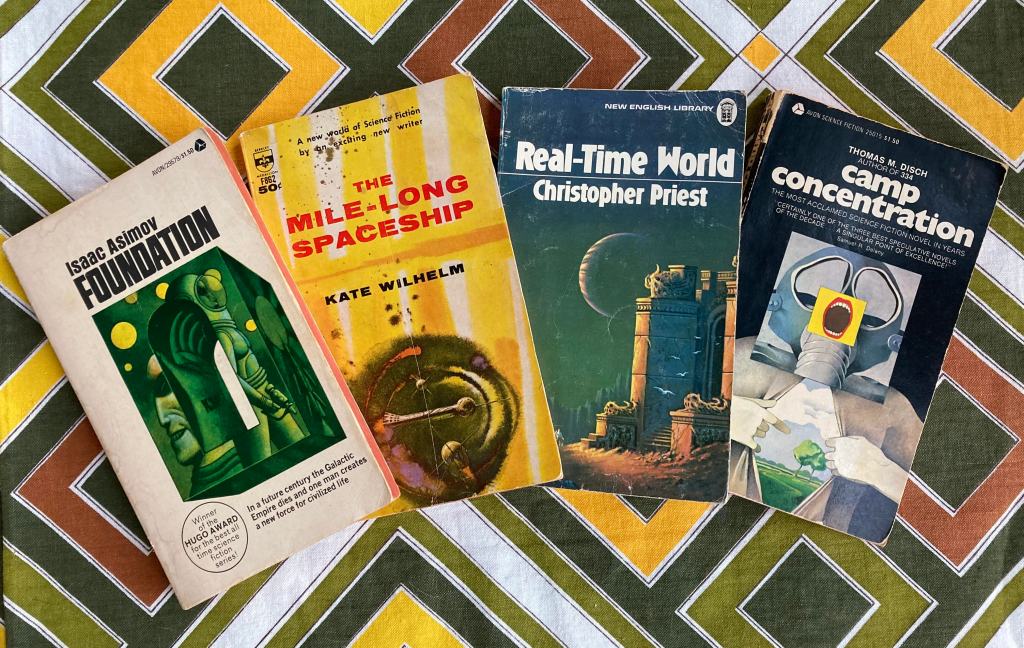
First, a bit about Isaac Asimov’s Foundation (1951) from M. Keith Booker’s Monsters, Mushroom Clouds, and the Cold War: American Science Fiction and the Roots of Postmodernism, 1946-1964 (2001), my current history of science fiction read:
After watching the first episode of the new Fallout (2024) adaptation a few nights ago (I like it!), I impulsively decided to push aside all my unfinished reviews and write about two more nuclear gloom tales. I selected two by Robert Bloch (1917-1994), best known as the author of Psycho (1959), whose SF output I’ve only recently started to explore. Both stories are slick satires that use the nuclear scenario to poke holes in the stories we weave about American exceptionalism and progress.
Let’s get to the nightmares!
Richard Powers’ cover for Star, ed. Frederik Pohl (1958)
3.25/5 (Above Average)
“Daybroke” first appeared in the only issue of Star, ed. Frederik Pohl (1958). You can read it online here.
Robert Bloch’s “Daybroke” attempts to convey an encyclopedic glimpse of post-apocalyptic destruction in order to satirize an America that allowed the usage of a nuclear weapon. Despite its appealing structure, the story lacks the prose necessary to sear and burn–the last sentence, well, that you’ll remember.
Which books/covers/authors in the post intrigue you? Which have you read? Disliked? Enjoyed?
1. The Witling, Vernor Vinge (1976)
George Barr’s cover for the 1976 edition
From the back cover: “Witling: A pretender to wit. (Webster’s Dictionary)
In the eyes of the inhabitants of Giri the scientific explorers from outer space were witlings. In the context of that primitive-seeming planet, they were.
Because on Giri a peculiarity of evolution had given a special talent to all living things–and this talent had made unnecessary most of the inventions associated with intelligent life elsewhere. Roads and planes, engines and doors… these were the products of witlings, not of ‘normal’ people.
So when the little band from Earth’s exploration team fell into Giri hands, their problem was unprecedented. How to demonstrate that science is worthwhile and how to keep the medieval masters of Giri from realizing their potential for cosmic mischief.”
From 1937 to 1958, the dynamic writing duo of Henry Kuttner (1915-1958) and his wife C. L. Moore (1911-1987) wrote countless stories together. As SF Encyclopedia puts it, “much of [Kuttner’s] later work is inextricably entwined” with that of Moore–often to the point of being unable to entangle who wrote what. While the cover of Clash by Nightand Other Stories (1980) does not mention Moore, all the stories in the collection were co-written with her.1
Today I’m joined by Rachel S. Cordasco, the creator of the indispensable website and resource Speculative Fiction in Translation, for something a bit different!
We will both offer our reviews of one of Kōbō Abe’s first published speculative short stories, “The Flood” (1950). Over the next few months, we’ll post reviews of speculative fiction in translation from Romania, Chile, Austria, Poland, France, and the Netherlands. Depending on the story and our thoughts, I might also include our responses to each other’s review.
We read Kōbō Abe’s “The Flood” (1950) in The Best Japanese Science Fiction Stories, ed. John L. Apostolou and Martin H. Greenberg (1989). Translated by Lane Dunlop. You can read it online here.
What pre-1985 science fiction are you reading or planning to read this month? Here’s February’s installment of this column.
Before we get to books and birthdays and writing plans…
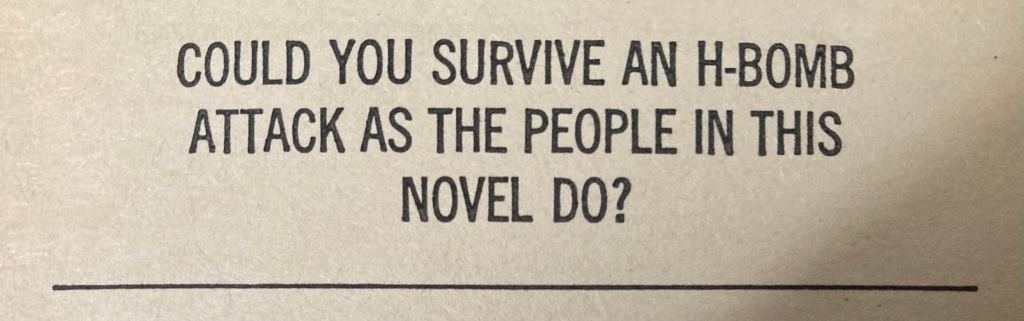
Do you have the inner strength to survive the panic of a nuclear attack? Take a test in the August 21st 1953 issue of Collier’s and find out! Sample question: “HOW DO YOU FEEL WHEN: […] You are alone in an automatic elevator when it stalls between floors?” Possible answers: “I’m not bothered,” “I become tense,” “It jars me badly,” and “I blow up.”
I ranked Alice Eleanor Jones’ apocalyptic slice-of-life nightmare “Created He Them” (1955) as my favorite SF short story of 2022. I also found Jones’ “The Happy Clown” (1955) a bleakly effective satire of television and consumerism. Unfortunately, Jones only published five short stories in 1955 before leaving science fiction altogether. It’s a shame she did not continue writing SF. With this post, I’ve covered her entire SF output.
Alice Eleanor Jones (1916-1981) received a PhD in English from University of Pennsylvania in 1944 on the seventeenth-century dramatist Shakerly Marmion. In the first year of her writing career, Jones “published five SF stories and two slick romance narratives.” Despite Anthony Boucher’s prediction that she’d be successful in both fields, Jones never returned to science fiction but continued to publish in the leading women’s magazines of the day and wrote a column for the trade magazine The Writer “well into the 1960s.”1 Lisa Yaszek argues that Jones’ “stories about housewife heroines and other domestic figures” do not reiterate conservative ideologues of the day but rather, through the construction of “offbeat” situations, examine how new scientific and social relations would impact women.2 Her two stories from the male perspective, “The Happy Clown” (1955) and “Life, Incorporated” (1955) are anti-consumerist satires.
What pre-1985 science fiction are you reading or planning to read this month? Here’s January’s installment of this column.
When I’m not reading science fiction, I’m more often than not devouring history that touches on my decades of focus: 1945-1985. Recently that’s meant lots and lots of monographs on Cold War culture: from fallout shelters, suburbia, to analysis of the drama of morality and terror that characterized nuclear deterrence. And in Guy Oakes’ transfixing The Imaginary War: Civil Defense and American Cold War Culture(1994), I came across a fascinating collision of science fictional thought and public policy.
A few months into Dwight D. Eisenhower’s presidency, the Public Affairs Office of the Federal Civil Defense Administration released a short pamphlet that analyzed the “relation between national will and nuclear terror” under the ridiculous title “Civil Defense Implications of the Psychological Impact and Morale Effect of Attacks on the People of the United States” (April 1953). In this pamphlet, the authors imagine the effects of nuclear war. They suggest that some survivors would “isolate themselves from the terrifying consequences of nuclear war by effecting a pseudo-escape into an interior psychological reality.” I thought immediately of Richard Matheson’s brilliant “Pattern for Survival” (1955), in which a SF author reenacts the process of writing and publishing a story to escape the reality in which he lives. The pamphleteers further imagine a political reality dominated by “mystical sects and cults, enthralled by the vision of an immeasurably happier future in an inner fantasy life of an extramundane kingdom of bliss that transcended the brutal empirical reality of nuclear destruction” (41). Early Cold War policy makers and consultants as science fiction authors!
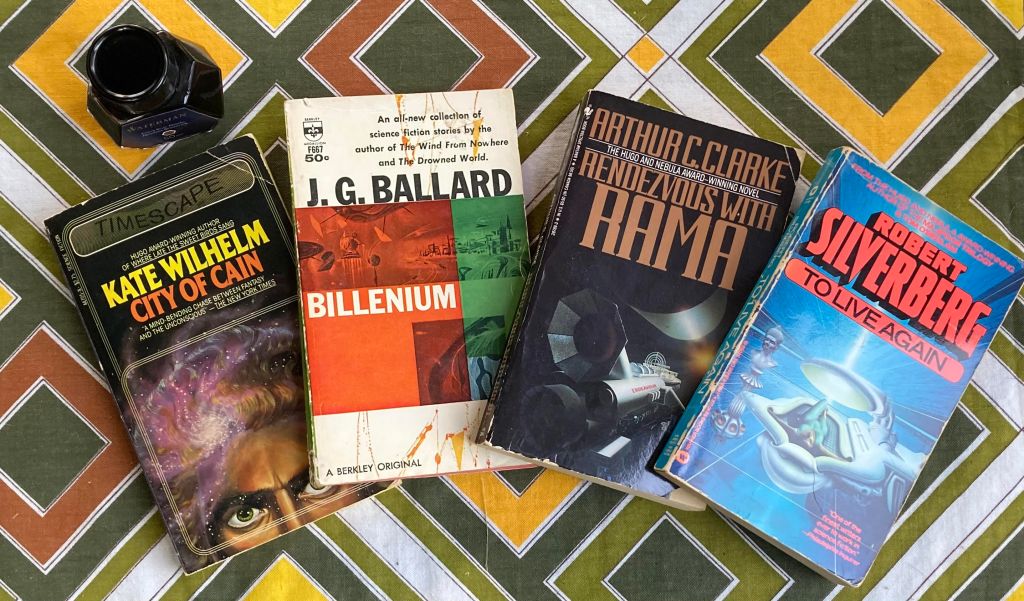
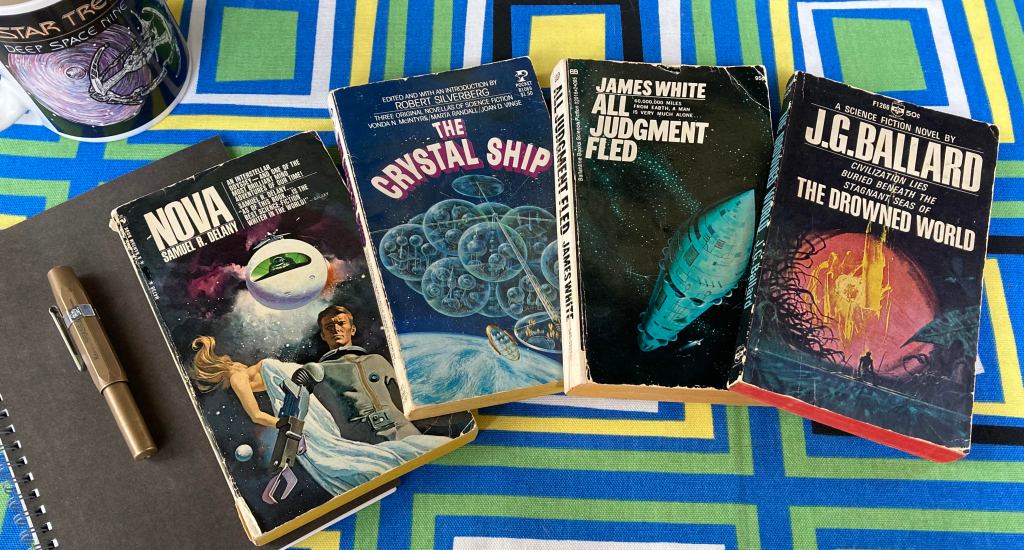
50s paranoid future visions aside, let’s turn to the books in the photo and what I’ve been reading and writing about.