Which books/covers/authors intrigue you? Which have you read? Disliked? Enjoyed?
1. The Escape Orbit (variant title: Open Prison), James White (1964)
Jack Gaughan’s cover for the 1965 edition
From the back cover: “STRANDED ON A PLANET OF MONSTERS. When the survivors of the his starship were taken prisoner by the insec-creatures against whom Earth had fought a bitter war for nearly a century, Sector Marshal Warren expected to be impounded in a prison camp like those the Earthmen maintained. But the “Bugs” had a simpler method of dealing with prisoners–they dumped them on an uninhabited planet, without weapons or tools, and left them to fend for themselves against the planet’s environment and strange monsters. A “Bug” spaceship orbited above, guarding them.
Which books/covers/authors intrigue you? Which have you read? Disliked? Enjoyed?
1. The Darfsteller and Other Stories, Walter M. Miller, Jr. (1982)
Peter Jones’ cover for the 1st edition
From the back cover: “Walter M. Miller, Jr., wrote A CANTICLE FOR LEIBOWITZ, and changed the nature of science fiction, forever. Now, collected together for the first time are some of his most gripping masterpieces, including the Hugo Award-winning ‘The Darfsteller’ and ‘Crucifixius Etiam.'”
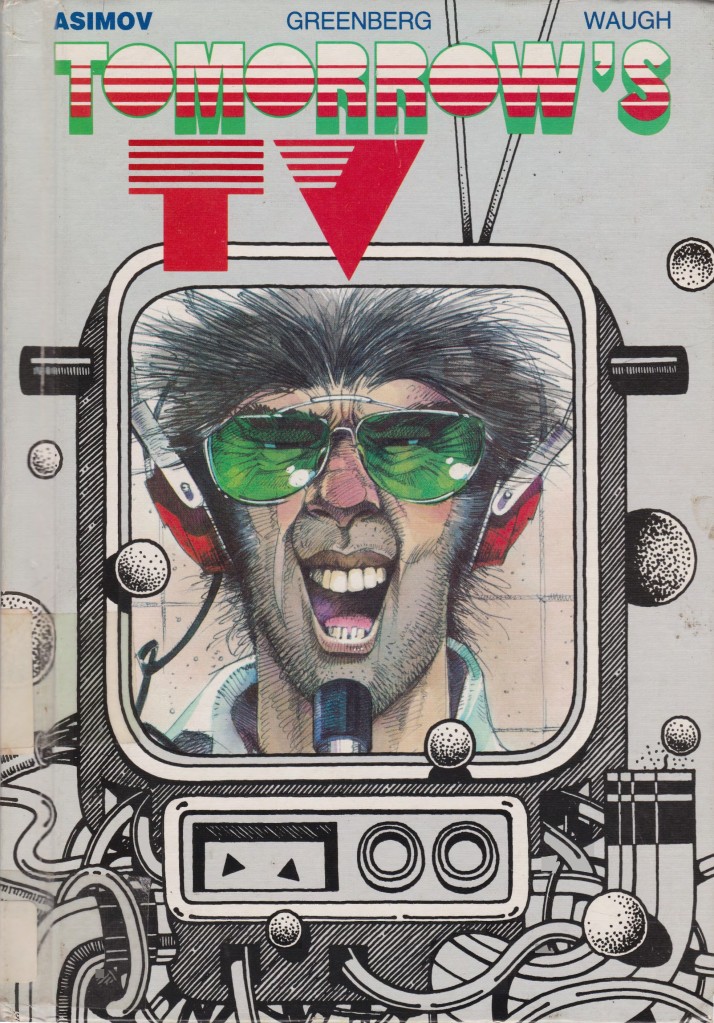
The seventh, eighth, ninth, and tenth stories in my series on the science fictional media landscape of the future appear in the anthology Tomorrow’s TV, ed. Isaac Asimov, Martin Harry Greenberg, and Charles Waugh (1982).
Tomorrow’s TV (1982) gathers together five short stories published between 1951 and 1979 on future speculations and disturbing manifestations of the tube of the future. The extensive number of TV-related science fiction from these decades (especially the 50s and early 60s) should not come as a surprise. According to Gary R. Edgerton’s magisterial monograph The Columbia History of American Television (2007), no “technology before TV every integrated faster into American life” (xi). Isaac Asimov speculates on the nature of education and the role of the “teacher” if every kid goes to school on their TV. Ray Bradbury imagines a frosty world where everyone turns inward towards the hypnotic glow of their TV sets. Robert Bloch explores the intersection of programming as escape and its collision with the real world. Ray Nelson narrates a hyperviolent expose of the alien entities behind subliminal messaging. And Jack Haldeman II imagines what will happen when the human mind reaches a moment of information overload.
The third story in my series on the science fictional media landscape of the future! In the wreckage of the 1950s Quiz Show scandals, Avram Davidson and Sidney Klein conjure a “secret history” of the real events.
Next up: Brian W. Aldiss’ “Panel Game” (December 1955).
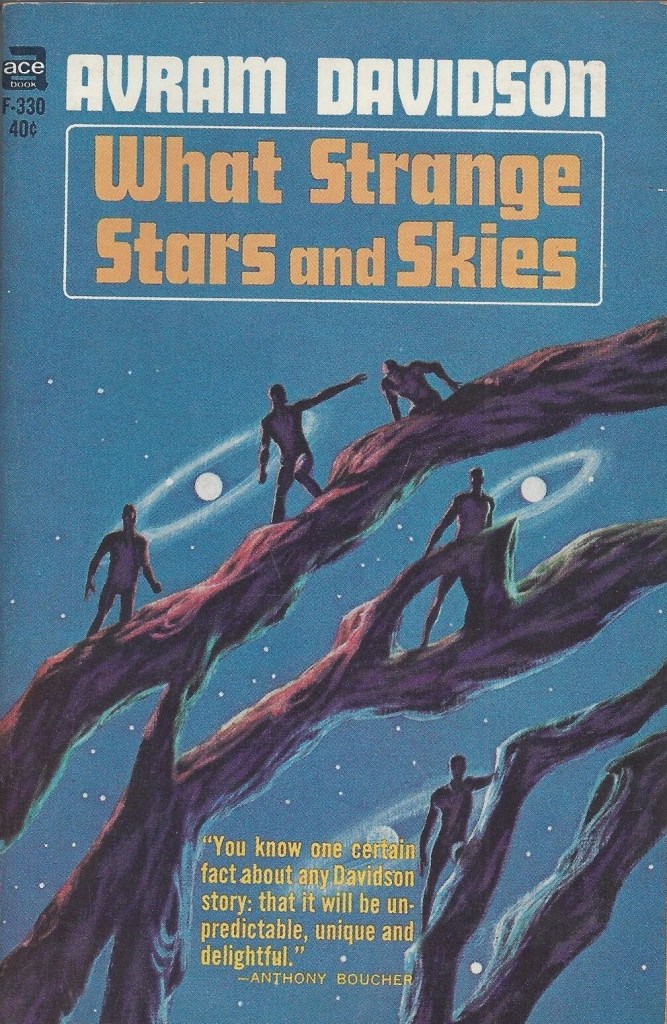
Jack Gaughan’s cover for the 1st edition of What Strange Stars and Skies (1965)
2/5 (Bad)
Avram Davidson and Sidney Klein’s “The Teeth of Despair” first appeared in The Magazine of Fantasy and Science Fiction, ed. Robert P. Mills (May 1961). I read it in Science Fiction Oddities, ed. Groff Conklin (1966). You can read it online here.
I suspect most of you have seen Robert Redford’s Quiz Show (1994), a dramatization of the 1950s Quiz Show scandals. In the film, John Turturro, as Herbie Stempel, turns whistleblower after a three-month run on NBC’s Twenty-One where he was compelled to allow his opponent, Ralph Fiennes as Charles Van Doren, to win. In the early weeks of Twenty-One, corporate sponsors of the program grew increasingly frustrated with the poor quality of the contestants. In response, the producers increasingly choreographed the rise and fall of America’s fact-regurgitating heroes.
Which books/covers/authors intrigue you? Which have you read? Disliked? Enjoyed?
1. The Dark Side of the Sun, Terry Pratchett (1976)
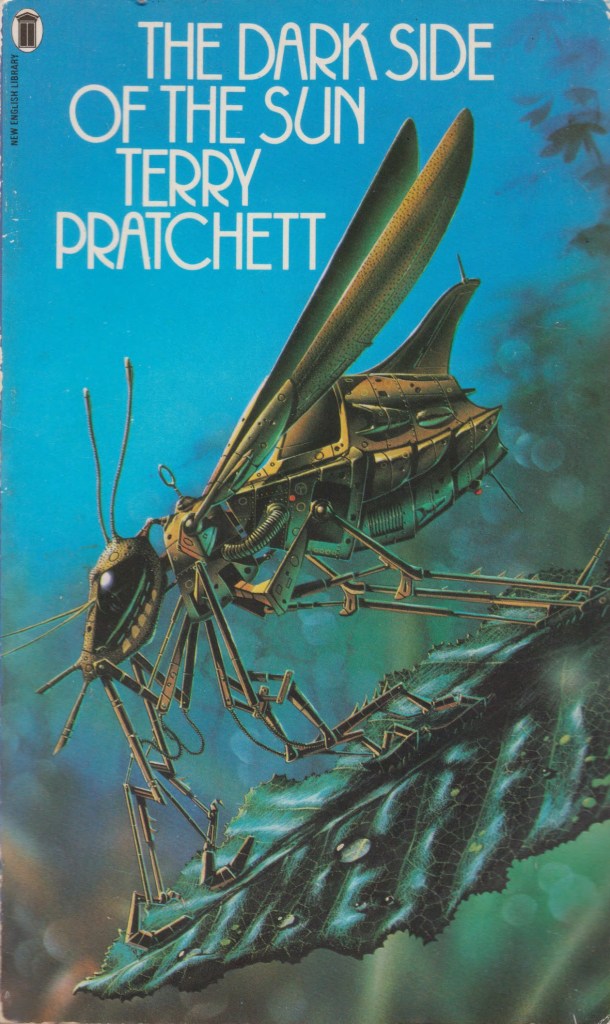
Tim White’s cover for the 1978 edition
From the back cover: “Dom Sabalos, the young heir to the Sabalos dynasty, has a strangely uncertain future. Probability math, the infallible science of foretelling the future, has predicted his assassination in twenty-four hours. But, by an extraordinary paradox, it has also predicted that he will go on to discover the fabulous, almost mythical world of the Jokers–the gods of the universe.
Uncredited cover art detail for the 1975 New English Library edition of Barry N. Malzberg’s The Destruction of the Temple (1974)
In the history of my website, I’ve reviewed and adored countless fictions that tackled future formations of the media landscape. Spurned in part by the explosion of television ownership in the 50s, pop art’s obsession with filmic iconography, and popular studies on advertising, science fiction compulsively explored futuristic formulations of media performance and manipulation, exploitation and paranoia (SF Encyclopedia). I’ve decided to put together a review series of short fiction that will continue my exploration of the theme.
It is devilishly difficult to organize all that I’ve reviewed so far but here are a few of the highlights that suggest different routes I might traverse. As I do not plan on rereading stories I’ve covered in the past, feel free to track down some of the gems below.
Kate Wilhelm’s “Baby, You Were Great” (1967), Carol Emshwiller’s “This Thing Called Love” (1955), and James Tiptree, Jr.’s “The Girl Who Was Plugged In” (1973) scrutinize the emotional bifurcation between the audience and their love of the starlet or influencer as presented and constructed. And the ways in which the audience controls the construction…. and by extension the performer.
Lloyd Biggle, Jr.’s “Well of the Deep Wish” (1961), Keith Roberts’ “Sub-Lim” (1965), and Kit Reed’s “At Central” (1967) speculate on the methods media can be used as social control. Of course, in the both the Biggle and Reed, the real world outside has utterly transformed since the audience has slipped into new worlds.
And, of course, I have to include Barry N. Malzberg’s extensive oeuvre–such as Revelations(1972) and Screen(1968). His work often demonstrates the pernicious addiction and desperation audiences and participants project into the media landscape hoping for truth and real experience. The media landscape is yet another mechanized artifice pandering to our obsession with dark spectacle.
I hope you enjoy this series. Feel free to join in (I include a link to the first story below)!
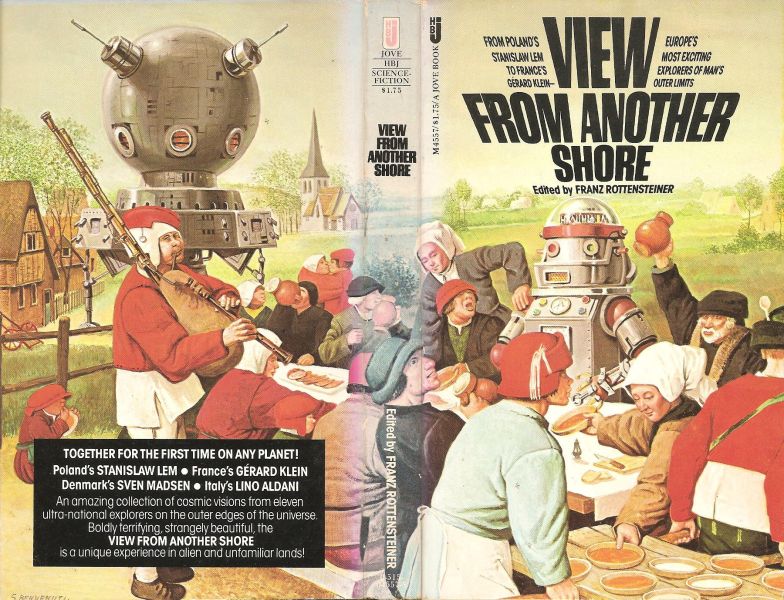
Gianni Benvenuti’s cover for the 1978 edition ofView from Another Shore (1973), ed. Franz Rottensteiner
4.75/5 (Near Masterpiece)
Lino Aldani’s short story “Good Night, Sophie” first appeared under the pseudonym N. L. Janda in Futuro, no. 1 (March/April 1963). Futuro, edited by Aldani along with Giulio Raiola and Massimo Lo Jacono, was the first entirely Italian science fiction magazine (it contained some translations of Polish SF) (contents). I read it in Franz Rottensteiner’s anthology of European science fiction in translation View from Another Shore (1973). You can read it online here.
Over the last year, I acquired three near-future SF novels exploring issues of race conflict in New York City written by authors of different racial backgrounds (White, African American, and Chicano): Warren Miller’s The Siege of Harlem (1964); John A. Williams’ Sons of Darkness, Sons of Light: A Novel of Some Probability (1969); and Enrique Hank Lopez’s Afro-6 (1969). I’ve decided to review them in chronological order.
Warren Miller (1921-1966), best known for The Cool World (1959) and Looking for The General (1964), wrote fiction that often dealt with issues of race. The Cool Worldattempted to “capture the argot of the streets of Harlem in the late 50s” and give a sympathetic look at the realities of black urban life. Considering his output, I was excited to track down a copy of The Siege of Harlem (1964), his final novel before his premature death.
Which books/covers/authors intrigue you? Which have you read? Disliked? Enjoyed?
1. Where is the Bird of Fire?, Thomas Burnett Swann (1970)
John Schoenherr’s cover for the 1st edition
From the back cover: “Were the mythical monsters our ancestors spoke of so often more than fantasy? Is it not probable that these semi-human races existed–and that only human vanity has blurred their memory?
2021 was the best year in the history of my site for visits and unique viewers! I suspect this increasingly has to do with my twitter account where I actively promote my site vs. a growing interest in vintage SF. I also hit my 1000th post–on Melisa Michaels’ first three published SF short stories–in December.
As I mention year after year, I find reading and writing for the site—and participating in all the SF discussions it’s generated over the year—a necessary and greatly appreciated salve. Thank you everyone!
I read very few novels this year. Instead, I devoted my attention to various science short story reviews series and anthologies. Without further ado, here are my favorite novels and short stories I read in 2021 (with bonus categories).
Tempted to track any of them down?
And feel free to list your favorite vintage (or non-vintage) SF reads of the year. I look forward to reading your comments.
My Top 7 Science Fiction Novels of 2021 (click titles for my review)
Uncredited cover for the 1988 edition
1. Where Time Winds Blow (1981), Robert Holdstock, 5/5 (Masterpiece): Holdstock’s vision is a well-wrought cavalcade of my favorite SF themes–the shifting sands of time, the pernicious maw of trauma that threatens to bite down, unreliable narrators trying to trek their own paths, a profoundly alien planet that compels humanity to construct an entirely distinct society… It’s a slow novel that initially masquerades as something entirely different. Just like the planet itself.





 Science Fiction and Other Suspect Ruminations