Which books/covers/authors intrigue you? Which have you read? Disliked? Enjoyed?
1. The Lovers, Philip José Farmer (1961)
Mati Klarwein’s cover for the 1972 edition
From the back cover: “In 1952, Philip José Farmer excited instant acclaim in the science fiction field with the publication of a short story, THE LOVERS.
In 1961, he wrote and published the full-length novel based on that short story.
And in 1972, Ballantine Books is proud to bring this classic work back into print.
Mr. Farmer, who is known for his explorations into the psychological byways of odd relationships, here postulates a love affair which might well have surprised even Haverlock Ellis. but words such as ‘normal’ or ‘abnormal’ simply have no application in the original concepts to which Mr. Farmer’s imagination gives rise. The book remains unique and fascinating.”
In the past year or so I’ve put together an informal series on the first three published short fictions by female authors who are new(ish) to me and/or whose most famous SF novels fall mostly outside the post-WWII to mid-1980s focus of my reading adventures. So far I’ve featured Carol Emshwiller (1921-2019), Nancy Kress (1948-), Melisa Michaels (1946-2019), Lee Killough (1942-), and Eleanor Arnason (1942). I do not expect transformative or brilliant things from first stories. Rather, it’s a way to get a sense of subject matter and concerns that first motivated authors to put pen to paper.
Today I’ve selected Josephine Saxton (1935-), an author whom I’ve long known about–I reviewed The Hieros Gamos of Sam and An Smith (1969) back in 2012–but never read any more of her work. Due to Rich Horton’s review of Saxton’s Vector for Seven (1970), my interest in an important voice of the English New Wave movement suddenly rekindled. Her 60s and 70s stories appeared in many of the influential New Wave (and adjacent) anthologies–including Judith Merril’s England Swings SF (1969), Harlan Ellison’s Again, Dangerous Visions (1972), Robert Silverberg’s New Dimensions 1 (1971), Samuel R. Delany and Marilyn Hacker’s Quark/3 (1971), and Damon Knight’s Orbit 9 (1971).
In her first three stories, Saxton deploys sculpted landscapes as metaphysical traps that allegorize the internal struggles of her characters. In the language of the New Wave, inner space manifests as a nightmarish landscape that one must try to traverse. Her prose, even in her weakest tales, is measured and poetic. See SF Encyclopedia for discussion of her later fiction.
Let me know which Josephine Saxton fictions–perhaps from much later in her career–resonate with you.
Keith Roberts’ cover for Science Fantasy, ed. Kyril Bonfiglioli (November 1965)
4/5 (Good)
“The Wall” first appeared Science Fantasy, ed. Kyril Bonfiglioli (November 1965). You can read it online here. It also appeared in Saxton’s collection The Power of Time (1985), which is where I read it.
Which books/covers/authors intrigue you? Which have you read? Disliked? Enjoyed?
1. Courtship Rite, Donald Kingsbury (1982)
Rowena Morrill’s cover art for the 1st edition
From the inside flap: “Gaet, Hoemei and Joesai are three clone brothers, survivors of the rigorous and deadly process of nurture and weeding that produces people of high kalothi, people worthy of surviving on the inhospitable planet of Geta. Geta was settled many thousands of years ago by human starships, but only legends of the people’s origins remain, memories that have become myths.
Ed Valigursky’s cover art for Amazing Science Fiction Stories (May 1958)
I appeared in my first ever podcast–Postcards from a Dying World with David Agranoff–last week. Organized around a series of interview questions, David and I ended up discussing vintage SF for a good hour. I cover how studying history has inspired my project, reasons for my focus on SF from post-WWII to the mid-1980s, favorite authors and themes, etc. Please check out his twitter and website as well. I have gathered together a list of the SF works I mention in the interview with links to my reviews when applicable.
I hate listening to myself as I am far too excited about vintage SF! (but is that a surprise?)
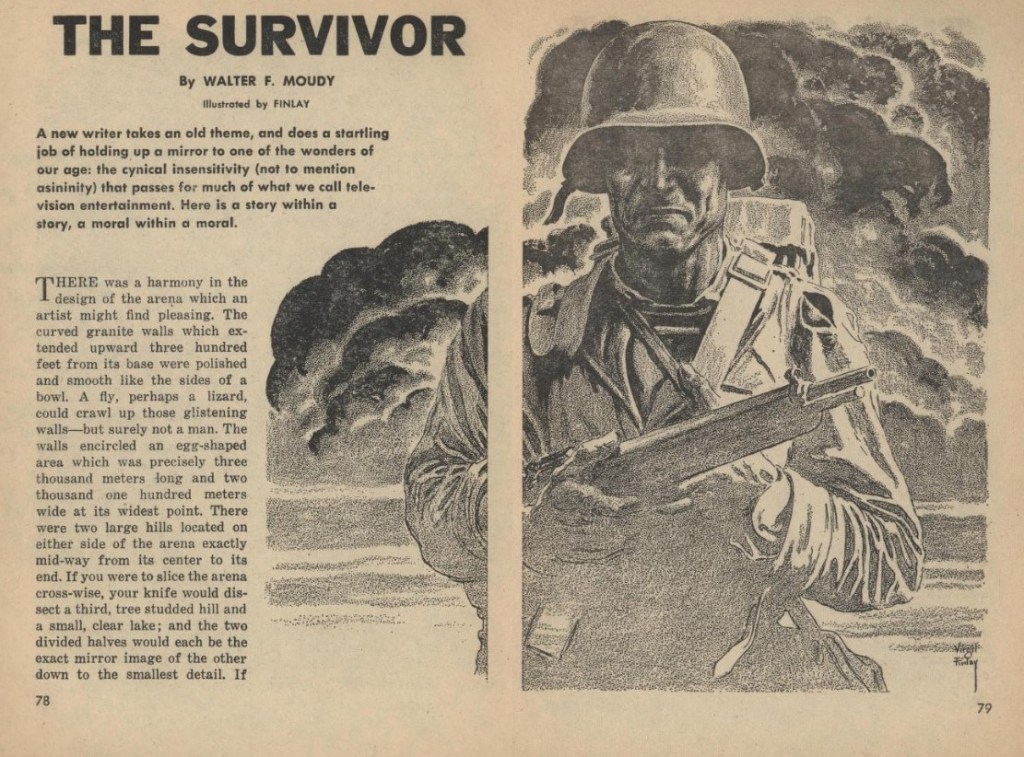
Today I’ve reviewed the fourteenth story in my series on the science fictional media landscape of the future. Walter F. Moudy relays the coverage of the 2050 Olympic War Games between the United States and Russia with harrowing effect.
Previously: Barry N. Malzberg’s “The Idea” (1971) (as K. M. O’Donnell).
Virgil Finlay’s interior art for Moudy’s “The Survivor” in the May 1965 issue of Amazing Stories
3.5/5 (Good)
Walter F. Moudy’s “The Survivor” first appeared in the May 1965 issue of Amazing Stories, ed. Cele Lalli (Goldsmith). You can read it online here.
Recently James Harris highlighted the truncated writing career of Walter F. Moudy (1929-1973) with a focus on No Man on Earth (1964), his only science fiction novel. Inspired by his comments on “The Survivor” (1965) and relentlessly intrigued by authors who have fallen from contemporary memory, I placed the slick future televised Cold War conflict tale at the top of my media landscapes of the future review list. For those expecting a masterful Henry Kuttner tale, stay tuned! In the meantime, let’s plunge into Moudy’s coverage of the 2050 Olympic War Games between the US and Russia.
Which books/covers/authors intrigue you? Which have you read? Disliked? Enjoyed?
Preliminary Note: As I’m currently on vacation, the images in this post are photographs of my volumes rather than my normal hi-res scans. I’ll replace them when I get home.
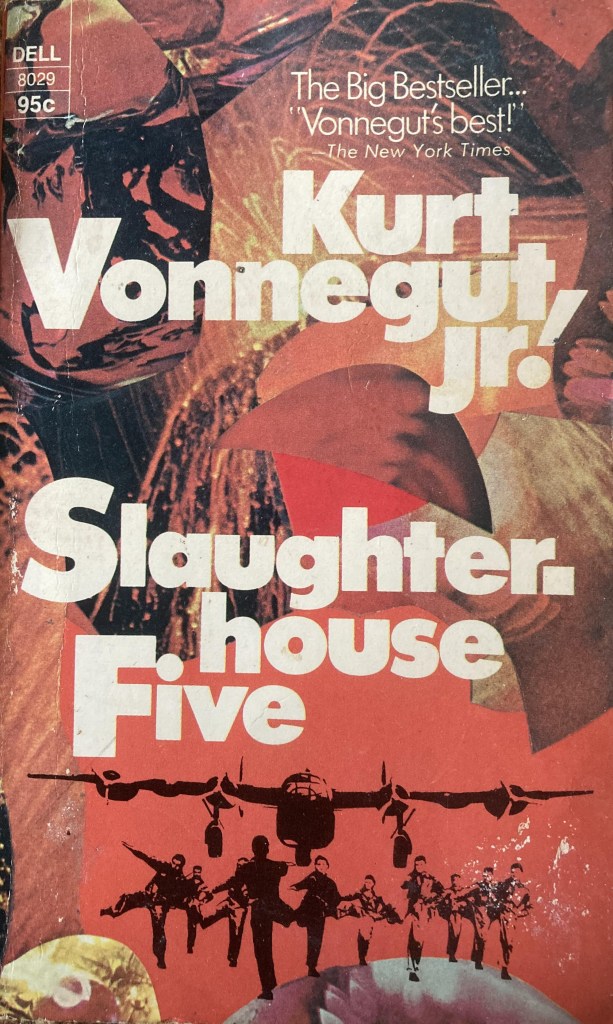
1. Slaughterhouse-Five or The Children’s Crusade: A Duty-Dance with Death, Kurt Vonnegut, Jr. (1969)
Uncredited cover for the 1971 edition
From the inside page: “TAKE A TRIP WITH BILLY PILGRIM
-To the cellar of a slaughterhouse in Dresden, a city about to be destroyed by the greatest man-made catastrophe of all time.
-To happy marriage and mating with the sweet and willing daughter of one of the finest citizens of Illium, New York.
-To a luxurious zoo on the planet Tralfamadore for the public exhibition of lovemaking with the famous Earthling blue-moviestar, Montana Wildhack.
All in an amazing novel that could only have been written by Kurt Vonnegut, Jr., a writer whose wildest flights take you straight to the hear and now.“
Which books/covers/authors intrigue you? Which have you read? Disliked? Enjoyed?
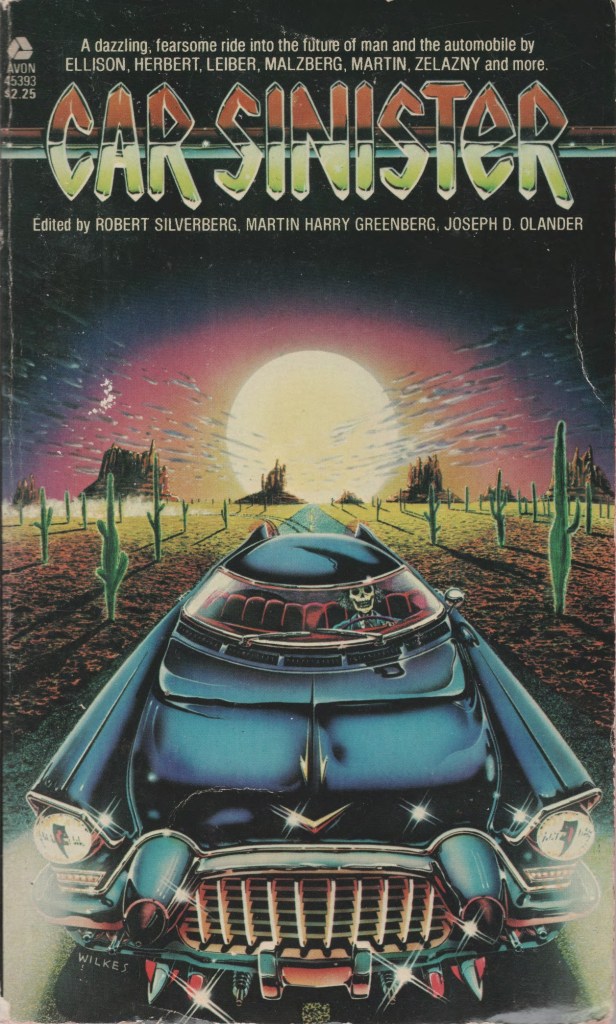
1. Car Sinister, ed. Robert Silverberg, Martin Harry Greenberg, and Joseph D. Olander (1979)
Mike Wilkes’ cover for the 1st edition
From the back cover: “MAN AND HIS MACHINE. The car is man’s most personalized machine; for teenagers it is a rite of passage and a statement of freedom; for adults it is a reflection of success, taste, and hopes; and for an entire culture it is a great and industrious mode of transportation–driving, perhaps, on the road of destruction. And the automobile–thrilling, honking, speeding, nerve-shattering–haunts us with the dark possibility that when our age of motoring innocence is over, we may no longer be the masters… CAR SINISTER–a splendid, imaginative vision of what lies down the road for all of us.”
Keith Roberts (1935-2000) was an influential, if underread and underappreciated, English author (and cover artist) best known for his alternate history fix-up novel Pavane (1968) and powerful short fictions evocative of the English countryside. He won four BSFA awards in various categories (novel, short story, and artist) yet did not achieve the same critical success in the United States. According to his obituary, his difficult personality, like his common male main characters unable to form steady professional or personal relationships, and propensity to refuse to deal with major publishers impacted his popularity.
Which books/covers/authors intrigue you? Which have you read? Disliked? Enjoyed?
1. Planet of the Damned, Harry Harrison (serialized 1961)
Uncredited cover for the 1962 edition
From the back cover: “Brion Brandd of the Galactic CRF had a problem. It was the planet Dis. Brion’s assignment was to salvage it.
Dis was a harsh, inhospitable, dangerous place and the Disans made it worse. They might have been a human once–but they were something else now.
The Disans had only one desire–kill! Kill everything, themselves, their planet, the universe if they could–
BRION HAD MINUTES TO STOP THEM–IF HE COULD FIND OUT HOW!”
Initial Thoughts: Smells like a variation of Harrison’s Deathworld (1960), which I never managed to review, from a year earlier. Which isn’t a good sign… Planet of the Damned was a finalist for the 1962 Hugo for Best Novel. It lost to Robert A. Heinlein’s Stranger in a Strange Land (1961).