Updates: Recent Science Fiction Acquisitions N. XL (Miller, Jr + Cogswell + Pohl/del Rey + Kornbluth/Merril)

A couple from my father + a few left over Marx Book purchases….

Three delightfully gorgeous Powers covers.  And one stunning John Schoenherr cover despite the unknown quality of the short stories within….

A short story collection and a three novella collection by Walter M. Miller, Jr., the author of A Canticle for Leibowitz (1959)…  A scathing, and hilarious satire by Frederik Pohl and Lester del Rey…  Among others.

1.  The View from the Stars, Walter M. Miller, Jr. (1965) (MY REVIEW)

(Richard Powers’ cover for the 1965 edition) Continue reading

Adventures in Science Fiction Cover Art: The Statue of Liberty on Pre-1968 Magazine and Novel Covers

pota-statue-of-liberty-2.jpeg

(Still from the 1968 film Planet of the Apes, dir. Franklin J. Schaffner)

For more covers on the same theme see Part II

I suspect that virtually all science fiction fans and film cineastes recall the vivid sequence near the end of the 1968 film Planet of the Apes where the Statue of Liberty lies half-buried in the sands.  Franklin J. Schaffner’s film draws on a rich tradition in pulp science fiction cover art.  I’ve included six cover from 1941-1965, all before the film was released, that depict the Statue of Liberty submerged by apocalyptical floods and excavated by future spacemen.  I have a large catalogue of covers that show various landmarks destroyed by mechanical monsters, ogled at by aliens, and wrecked by a variety of world ending disasters.  The Hollywood penchant for destroying as many national landmarks as possible in movies is deeply rooted in existing visual traditions.

My favorite is by far Blanchard’s (does anyone know his full name) cover for the 1959 edition of John Bowen’s After The Rain (1958).  The dark skies, the stormy waters reaching up to her nose, the survivors of the flood perched near the flame, the boats and roofs of houses floating about, perfectly evoke the extent of the disaster — and, “elements gone wild!”

Enjoy!

(if I’ve missed any pre-1968 covers please let me know.  I know that there are multiple later covers but they might be purposefully referencing Planet of the Apes)
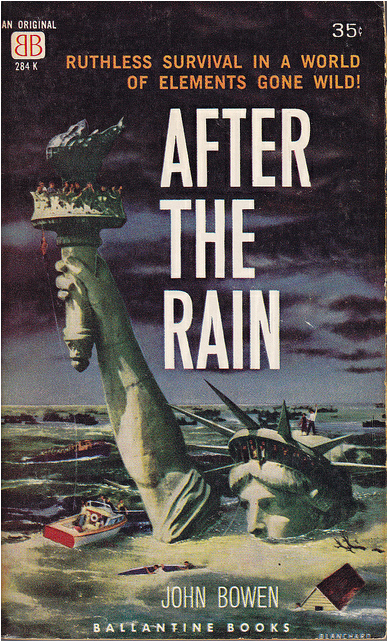
(Blanchard’s cover for the 1959 edition of After The Rain (1958), John Bowen) Continue reading

Book Review: The Joy Makers, James Gunn (1961, magazine publication 1955)

(William Hofmann’s cover for the 1961 edition)

4.25/5 (collated rating: Good)

The three parts of James Gunn’s fix-up novel The Joy Makers (1961) were originally published in magazine form in 1955 as ‘Name Your Pleasure,’ ‘The Naked Sky’, and ‘The Unhappy Man.’  I have not read the originals so I’m unsure of how much was added or subtracted or completely re-conceptualized.  Largely a satire — Gunn pushes his point to the logical, and terrifying extreme — each part is a further chronological progression of a society whose chief aim is to make people happy.  It is hard not to read Part I as a satirical take on some aspects of Scientology,  a movement that was gaining force in the early 1950s.

Because each part is only linked thematically to the others

Continue reading

Updates: Recent Science Fiction Acquisitions N. XXXVIII (Spinrad + Harrison + Kavan + Effinger)

Ah, when I have access to a massive inexpensive catalogue (Marx Books) the quality of my finds goes up and up…..  Finally a copy of Norman Spinrad’s metafictional The Iron Dream (1972) (if Hitler lived in America and wrote a sci-fi novel AND a commentary on said piece of science fiction).  Unfortunately, I own a later edition (with a hideous cover) than the one below.  Geo. Alec Effinger’s bizarre What Entropy Means to Me (1972) — again, about writing, and interpreting writing, and inventing interpretation…  Anna Kavan’s drug inspired underrated and underread sci-fi parable Ice (1976).  AND, a futuristic fantasy of the highest caliber, M. John Harrison’s The Pastel City (1971) — yes, I could have purchased the multi-novel sequence (and related short stories) in one volume but I like having the original paperbacks.

1. The Iron Dream, Norman Spinrad (1972)

(Uncredited cover for the 1972 edition) Continue reading

Book Review: Farewell, Earth’s Bliss, D. G. Compton (1966)

(Karel Thole’s cover for the 1971 edition)

4.5/5 (Very Good)

(*some spoilers due to the limited nature of the plot*)

Another D. G. Compton novel, another wonderful (and terrifying) experience…  The only one of his novels so far that has failed to hold my interest was The Missionaries (1971), a lackluster satire on religion.  The Continuous Katherine Mortenhoe (variant title: The Unsleeping Eye) (1973) is a masterpiece and Farewell, Earth’s Bliss (1966) and Synthajoy (1968) are close behind.

Farewell, Earth’s Bliss is best described as a character study of a group of convicts sent to Mars and their attempts to integrate into an incredibly repressive and conservative society (derived in part to to the extreme dangers of the Martian environment) — in short, a piece of race and religion themed social science fiction.  Be warned, there  is little to no action.  As with most of Compton’s works, near future environments are the perfect vehicle for societal ruminations Continue reading

Adventures in Science Fiction Cover Art: Spacewomen of the Future (fixing spaceships + fighting aliens + charging across barren landscapes)

(Don Sibley’s cover for the November 1950 issue of Galaxy)

When we conjure the image of a 40s/50s science fiction pulp heroine we often imagine a character who has to be rescued by men from aliens, shrieks and clings to any man nearby, and is always in a state of undress.  I’ve included one cover, for the sake of comparison, that I find to be an exemplar of this type of sexist (and racist) depiction below (Alex Schomburg’s cover for the January 1954 issue of Future Science Fiction): white woman wrapped in only a towel stalked by an evil alien obviously painted with African-American facial characteristics (heavy on the sexual predation vibe) — the reader is supposed to buy into the racial stereotypes and thus be titillated by the fear she must feel.

I’ve selected a wide range of mostly pulp magazine covers depicting spacewomen of the future (I’ve loosely decided that this means women in space, in spacesuits) that tend to buck the trend Continue reading

Updates: Recent Acquisitions N. XXXVII (del Rey + Geston + Saxton + Gunn)

A wonderful selection of Marx Book purchases….  All of them are high on my to read list!  I hadn’t heard of Josephine Saxton — she’s considered an inventive sf fabulist — until I read a review of her novel Vector for Seven (1970) on SF Mistressworks, a review collating blog which I highly recommend for any fan of science fiction.  There are so many great works by female sci-fi authors out there waiting to be rediscovered on dusty used bookstore shelves….

I enjoyed James Gunn’s Station in Space (1958), a thematically linked short story collection depicting mankind’s first steps into space, so I picked up a copy of one of his better known fix-up novels, The Joy Makers (1961).

I adore sci-fi novels on overpopulation so Lester del Rey’s The Eleventh Commandment (1962) was a given…

And, well, the incredibly alluring description on the back cover of Mark S. Geston’s Lords of the Starship (1967) speaks for itself…

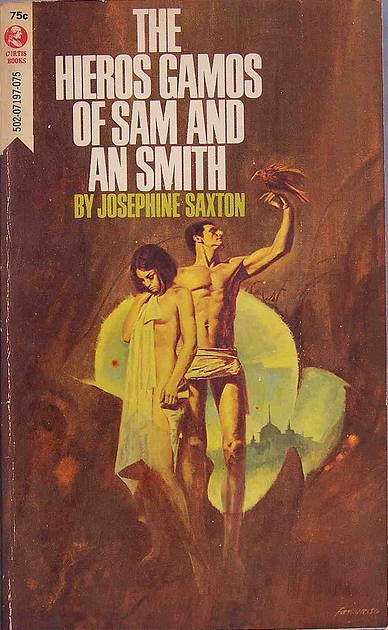
1. The Hieros Gamos of Sam And An Smith, Josephine Saxton (1969) (MY REVIEW)

(Jack Fargasso’s cover for the 1969 edition) Continue reading

Book Review: Eight Against Utopia (variant title: From Carthage Then I Came), Douglas R. Mason (1966)

(Dean Ellis’ cover for the 1970 edition)

2.25/5 (Bad) 

Eight Against Utopia (1966) is the second escape from a domed city novel published by Paperback Library I’ve read — the first, Rena Vale’s Beyond the Sealed World (1965) was a truly dismal “adventure.”  Mason’s take on the theme is only marginally better.  The first half, life and escape from the domed city of Carthage, is more intriguing and engaging than the second half, an endless unexciting chase sequence along the coast of North Africa.  Mason’s novel is painfully flawed in its social theory and mechanics of delivery.  Even on the level of a future adventure tale, most of Eight Against Continue reading

Updates: Recent Acquisitions XXXVI (Malzberg + Gallun + Harrison + Silverberg)

More Marx Book purchases along with some random 99 cent thrift store finds (Raymond Z. Gallun + M. John Harrison)  that seemed intriguing enough.  I will eventually get to M. John Harrison’s magnum opus series of novels, Virconium– beginning with The Pastel City (1971) — but, as always, I approach an author’s masterpieces through an often circuitous manner.  I suspect my Malzberg find will be of a lesser quality than either Beyond Apollo (1972) or Revelations (1972).

I reviews I’ve found online of Gallun’s The Eden Cycle (1974) proclaim it an underrated masterpiece — with layers of virtual reality, etc.  I’ll read it soon…

As always, have you read any of these?  If so, what did you think?

1. The Day of the Burning, Barry N. Malzberg (1974)

(Don Ivan Punchatz’s cover Continue reading