Book Review: Twilight Country, Knut Faldbakken (1974, trans. Joan Tate, 1993)

4.75/5 (Near Masterpiece)

In 1968, the moody Canadian psychedelic pop group The Poppy Family released “Of Cities and Escapes,” a haunting song of urban emptiness. The song’s narrator intones: “I live in a one-room apartment, with windows on one side / I stare through the glass ‘cross the water, to where the big, ugly city lies.” In the second verse, later sampled by Deltron 3030 on “Madness” (2000), the narrator cannot escape the death spiral: “I’m caught in the grip of the city, madness and smog.” Twilight City (1974, trans. Joan Tate, 1993), by Norwegian novelist Knut Faldbakken (1941-), delves into a similar dystopian urban gloom. The refugees of a decaying city dust off the entangling membranes of lost paths and the weight of melancholy souls and attempt to chart a new beginning in the city dump.

Brief Plot Summary/Analysis

In an unnamed country, the metropolis of Sweetwater–“an eruption of urban geography” (2) possessed by an “ever-growing urban sprawl” (23)–suffers under the effects of global warming, industrialization, and malignant societal decay.

Continue reading

Updates: Recent Science Fiction Purchases No. CCLXXIV (Suzette Haden Elgin, Paul Cook, Herbert W. Franke, Charles Eric Maine)

As always, which books/covers/authors intrigue you? Which have you read? Disliked? Enjoyed?

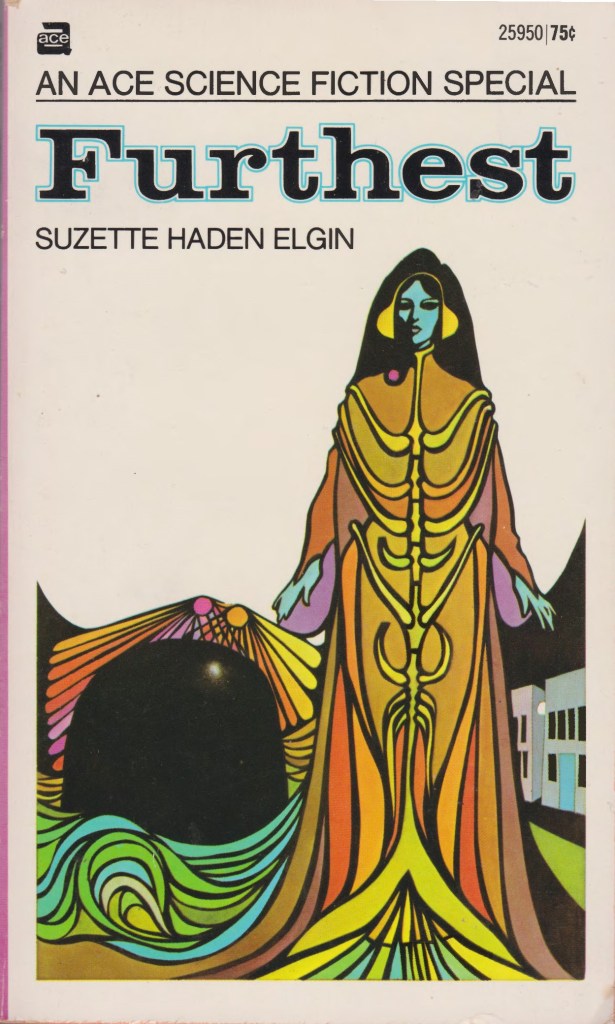
1. Furthest, Suzette Haden Elgin (1971) (MY REVIEW)

From the back cover: “Coyote Jones, agent for the Tri-Galactic Intelligence Service, had been sent to a planet so unimaginably distant from the rest of the Federation that it bore the descriptive name Furthest. His mission: to find out why the total body of data about Furthest showed the world’s inhabitants to be absolutely average down to the last decimal place. That data had to be false.

Jones was permitted to live on the planet, but the natives were so wary of him that he could uncover nothing—until he chanced into a personal crisis faced by his young Furthest assistant. The boy’s sister had been sentenced to Erasure, and he wanted Coyote Jones to take the fugitive girl in and hide her.

Continue reading

Short Book Reviews: John Wyndham’s The Chrysalids (variant title: Re-Birth) (1955), John A. Williams’ Captain Blackman (1972), and Gina Berriault’s The Descent (1960)

Note: My read but “waiting to be reviewed pile” is growing. Short rumination/tangents are a way to get through the stack before my memory and will fades. Stay tuned for more detailed and analytical reviews.


1. The Chrysalids (variant title: Re-Birth), John Wyndham (1955)

3/5 (Average)

John Wyndham’s The Chrysalids (1955), my first exposure to his science fiction, transpires in a standard post-apocalyptic cozy catastrophe scenario with a deeply emotional core. The narrative follows David’s childhood in the backwater territories of Labrador, Canada hundreds of years after a nuclear war. The Church, inspired by Nicholson’s Repentances—which along with the Bible are only surviving books–imposes a draconian theology that “only God produces perfection” (51). Mutations, a visual sign of diabolical influence, must be destroyed. David, the son of the local strongman and preacher, discovers a young girl with a terrifying secret–she has six toes. David starts to accumulate secrets including his own mysterious telepathic abilities and recurrent dreams of a city in a world without cities. He shares them with his sympathetic Uncle Axel, who attempts to protect him from the forces narrowing in.

There are some nice touches throughout. Uncle Axel recounts his travels and knowledge of the world as a seaman and the effects is that of a medieval map, filled with pseudo-legendary beings, historical fragments, and “real” flora and fauna that, at first glance, seems too fantastic to exist (54-57).

Continue reading

Updates: Recent Science Fiction Purchases No. CCLXXII (James Tiptree, Jr., Allen F. Wold, Nova Anthology, and non-fiction on Drugs, Esoterica, and Visionary Experience in the Seventies)

As always, which books/covers/authors intrigue you? Which have you read? Disliked? Enjoyed?

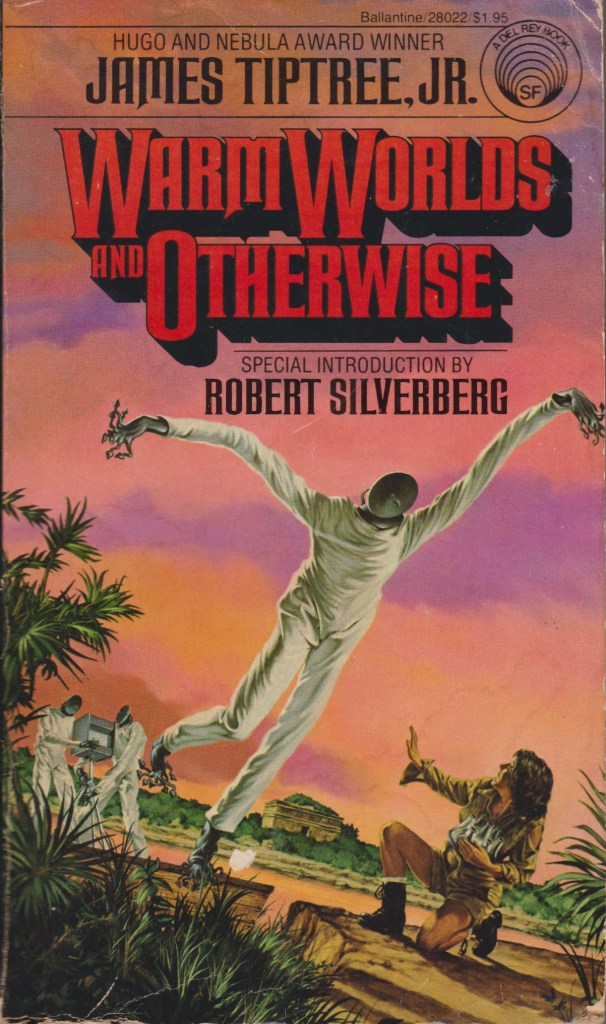
1. Warm Worlds and Otherwise, James Tiptree, Jr. (1975)

From the back cover: “A DOZEN FABULOUS TALES OF INNER VISIONS AND OUTER SPACE…

LOVE IS THE PLAN, THE PLAN IS DEATH (Nebula-Award Winner—Best Short Story 1973)

Courtship rites can easily run amok, especially when that’s what’s supposed to happen… especially when the creatures are color-coded for passion as well as for death!

THE GIRL WHO WAS PLUGGED IN

Continue reading

Adventures in Science Fiction Cover Art: Johann Peter Reuter’s Surreal Forms Arrayed Across the Plains

German painter and graphic designer Johann Peter Reuter (1949-) created fourteen credited covers for German SF presses between 1977-1984.  I have identified a potential fifteenth cover included below–the 1977 edition of Isaac Asimov’s Second Foundation (1953)–that I believe fits his style and date range. From the information gleaned from his homepage, Reuter’s SF output occurred in the first few years as a freelance artist after studying art in Dortmund. He started as a figurative painter before evolving to non-figurative forms (brief artist blurb).

If you’re interested in his non-SF art, check out his fascinating series of paintings from 2004 on the visualization of the mass.

Continue reading

Adventures in Science Fiction Interior Art: Monday Maps and Diagrams 2/22/21: Cordwainer Smith’s Instrumentality of Mankind Timeline

Detail from Darrel K. Sweet’s cover for the 1st paperback edition of The Best from Cordwainer Smith (1975)

Today’s installment of my occasional Monday Maps and Diagrams series is a self-reminder that I must get over the poor taste left in my mouth by two forgettable Cordwainer Smith short stories and dive into the meat of his Instrumentality of Mankind sequence. Which should I have read?

I’m a sucker for future history timelines (Olaf Stapledon, Robert A. Heinlein, and Isaac Asimov come to mind). They add a sense of time and scope to what, at first glance, might seem like disparate pieces. I often wonder how much an author plans out a timeline. This one, scanned from The Best of Cordwainer Smith (1975), places each of the Instrumentality of Mankind stories into a functional timeline. I’m assuming it adds to the series’ sense of historical development and societal evolution?

Let me know what you think of the series and the timeline in the comments!

John J. Pierce’s timeline (he wrote the intro article) in the 1975 Ballantine Paperback edition

Isfdb.org note on the timeline’s publication history: “There are (at least) 2 variants of this timeline. A table version titled The Instrumentality of Mankind appears in the original July 1975 Nelson Doubleday hardcover. A reformatted graphical version titled Timeline from THE INSTRUMENTALITY OF MANKIND appears in Continue reading

Recent Science Fiction and Fantasy Purchases No. CCLXVII (Daniel F. Galouye, Gordon Eklund, Lisa Tuttle, George R. R. Martin, and Andrew Sinclair)

As always, which books/covers/authors intrigue you? Which have you read? Disliked? Enjoyed?

1. Windhaven, George R. R. Martin and Lisa Tuttle (1981)

Vincent Di Fate’s cover for the 1st edition

From the inside flap: “The planet Windhaven was settled by humans after the crash of a colony starship. Survivors discovered that people could actually fly on this world, aided by the light gravity and dense atmosphere, and using wings made from a virtually indestructible metal fabric that had once been part of the starship. On this planet of small islands, monster-infected seas Continue reading

Updates: Recent Science Fiction Purchases No. CCLXVII (Ben Bova, Margaret O’Donnell, Dennis Schmidt, and a themed anthology on gentle invaders)

As always, which books/covers/authors intrigue you? Which have you read? Disliked? Enjoyed?

1. Millennium: A Novel About People and Politics in the Year 1999, Ben Bova (1976)

Fred Marcellino’s cover for the 1st edition

From the inside flap: “We are thrust into the terrifying world of the future in this chilling novel about people and politics in the year 1999. The Earth’s population has soared to eight billion. The two major powers are on the brink of nuclear war as they vie for control of the planet’s dwindling supply of natural resources.

Meanwhile, a few hundred kilometers above the Earth’s surface, on their respective Moon colonies, the United States Continue reading

Book Review: Infinity One, ed. Robert Hoskins (1970) (Poul Anderson, Anne McCaffrey, Gene Wolfe, Robert Silverberg, Miriam Allen deFord, et al.)

This anthology contains the 4th post in a loose series on SF short stories that are critical in some capacity of space agencies, astronauts, and the culture which produced them. I decided to review the entire anthology!

Previously: William Tenn’s “Down Among the Dead Men” (1954).

Up Next: Theodore Sturgeon’s “The Man Who Lost the Sea” (1959)

Jim Steranko’s cover for the 1st edition

3/5 (Collated rating: Average)

Robert Hoskins “resurrected” Infinity Science Fiction magazine (1955-1958) as a five volume anthologies series between 1970-1973. The first volume, Infinity One (1970), contains sixteen original stories and one reprint from the original magazine–Arthur C. Clarke’s “The Star” (1955). SF Encyclopedia describes the anthology series as “a competent but not outstanding series.”

Eight of the seventeen stories fall into the “good” category. While none are masterpieces, Robert Silverberg, Arthur C. Clarke, Barry N. Malzberg co-writing with Kris Neville, Katherine MacLean, Gene Wolfe, and Poul Anderson Continue reading