Updates: Recent Science Fiction Acquisitions No. CLXXXI (Harrison + Sturgeon + Moorcock + Buzzati)

1) Early Elric stories from Michael Moorcock’s pen. Confession: I bought it in Scotland due to the disquieting cover rather than any love of heroic fantasy—albeit M. John Harrison’s The Pastel City (1971) was pretty darn good.

The fantastic cover is uncredited: thoughts regarding the artist?

2) I adored Dino Buzzati’s magical realist novel The Tartar Steppe (1940). And the movie adaptation The Desert of the Tartars, dir. Valerio Zurlini (1976) inspired by the aesthetics of Giorgio de Chirico —I even wrote a half-baked and cursory review of the movie many years ago. While browsing I discovered that Buzzati wrote what is considered the first serious Italian SF novel—Larger than Life (1960). I can’t wait to read it!

3) More Theodore Sturgeon short stories….

Relevant reviews: A Way Home (1956), The Cosmic Rape (1958) and Venus Plus X (1960).

4) A while back I watched, and struggled to enjoy, the 1975 film adaptation of William Harrison’s short story “Roller Ball Murder” (1973). Time to read the source material. Copy snagged in Edinburgh, Scotland.

As always, I look forward to your thoughts.

1. The Stealer of Souls, Michael Moorcock (1963)

(Uncredited cover for the 1968 edition) Continue reading

Updates: Recent Science Fiction Acquisitions No. CLXXX (The Scotland Edition No. 2) (Ballard + Wyndham + Shaw + Aldiss)

Still abroad. Need my desk and familiar surroundings to write book reviews. Alas.

That said, more books from my Scotland travels. Here’s Part I in my Scotland series.

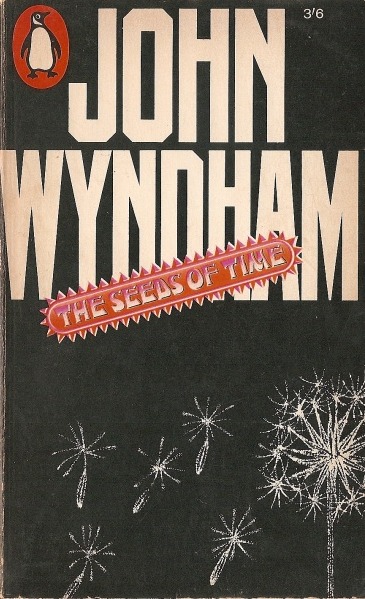
1) I need to read more John Wyndham. I often find short stories are the best place to start. And as I was journeying around the UK, Penguin editions are plentiful!

2) One of J.G. Ballard’s best known novels. The one Cronenberg got his hands on…. Relevant reviews: Billenium (1962), High-Rise (1975), and The Voice of Time and Other Stories (1962).

3) A late 70s Brian W. Aldiss collection. He’s long been a favorite on this site—especially his short fiction. I’ve reviewed the following collections: Starswarm (1964), No Time Like Tomorrow (1959), Galaxies Like Grains of Sand (1960), and Who Can Replace a Man? (variant title: Best Science Fiction Stories of Brian W. Aldiss) (1965).

4) And finally, another Bob Shaw novel. I’ve heard that The Palace of Eternity (1969) is one strange read.

Note: As I am still abroad and without my handy scanner, I’ve had to include cover images of two of the books which I do not own. At some later point I might replace the images with high-res scans.

As always, I look forward to your thoughts and comments!

1. The Seeds of Time, John Wyndham (1956)

(Uncredited cover for the 1966 edition) Continue reading

Updates: Recent Science Fiction Acquisitions No. CLXXIX (The Scotland Edition) (Moorcock + Cowper + Dozois + Raphael)

My perambulations through Scotland (Edinburgh–> castles–> castles–> Aberdeen–> Orkney Islands–> broch–> chambered cairn –> haggis meat pie) has not provided the most suitable opportunities to sit down and put in the hours necessary to review books. However it has given me the opportunity to acquire a range of UK editions.

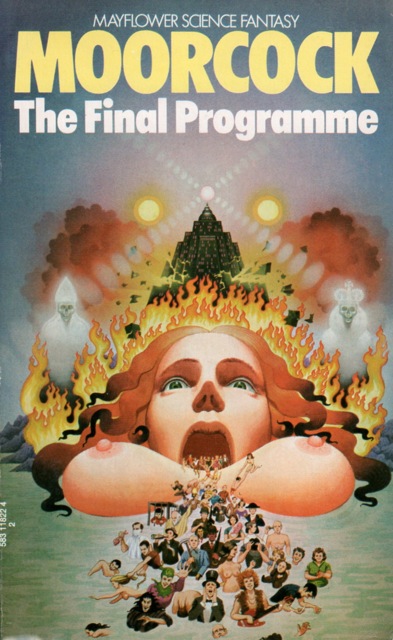
1) Michael Moorcock’s first Jerry Cornelius novel. Count me intrigued (but filled with trepidation)! I look forward to reading The Final Programme (1968) when I finally get home to the States.

A bizarre Bob Haberfield cover!

Relevant recent review: An Alien Heat (1972)

2) Gardner Dozois blew me away with his short story “Horse of Air” (1970) and I look forward to trying one of his novel length works. Strangers (1978) was nominated for the 1979 Nebula Award.

3) Rick Raphael’s slice of life fix-up novel–about life patrolling the streets of the future–Code Three (1967) was not without merits. I’m eager to read more of his short fiction.

4) Richard Cowper’s Profundis (1979) mixed humor and a wicked streak of satire to create a SF parable that made me want more. And the short stories in The Custodians (1976) were middling to good. Kuldesak (1972) takes on a far more standard theme…

Note: as I am not home with my handy scanner these are cover images I found online rather than high resolution images of my own copies.

I look forward to your thoughts! Any favorite covers?

1. The Final Programme, Michael Moorcock (1968)

(Bob Haberfield’s cover for the 1971 edition) Continue reading

Adventures in Science Fiction Cover Art: Body as Landscape

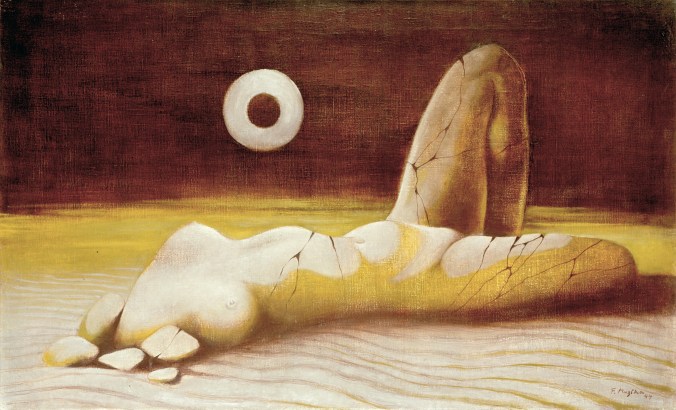
(František Muzika, Z Českého ráje V (Ležící torzo), 1944)

František Muzika (1900-1976), a key member of the Czech New Wave scene, created haunting paintings that blended human form with the surrounding landscapes. His painting that heads this post inspired me to collect various science fiction covers (from a mix of English and non-English language presses) that showcase the interlacing of human and landscape — the body (or body parts) as landscape. There are many many many more covers on this theme and perhaps I’ll gather them for a later post. I am torn over my favorite! Leigh Taylor’s cover for the 1967 edition of J.G. Ballard’s The Disaster Area (1967) Continue reading

Adventures in Science Fiction Cover Art: Three early David Pelham covers in honor of his birthday

(Cover for the 1971 edition of Fifth Planet (1963), Fred and Geoffrey Hoyle)

On twitter I occasionally post the birthdays of important figures in SF history (artists, authors, and editors). Every morning I scan The Internet Speculative Fiction Database’s birthday list on their main page and lo and behold a name immediately popped out for May 12th–the iconic 70s SF artist David Pelham (1938-present).  Enough has been written about his distinctive and surreal covers for Penguin that I won’t go into detail here. Instead I’ve included a few links if you wish to learn more below.

I invite my readers to link in the comments their favorite articles and tidbits about David Pelham and I’ll include any links I receive in my list as well.

I’ve chosen to include in this post his first three SF covers, which happen to be stylistically and thematically similar. Continue reading

Updates: Recent Science Fiction Acquisitions No. CLXXVIII (Carter + Boyd + Platonov + Anthology with Sturgeon, Bradbury, Budrys, et al.)

1) Can’t resist a beautiful Richard Powers cover even on a rather standard 60s anthology of short stories—includes Ray Bradbury, Fredric Brown, Theodore Sturgeon, Wyman Guin, Algis Budrys, etc.

Relevant reviews: Algis Budrys’ collection Budrys’ Inferno (1963) and Wyman Guin’s superb collection Living Way Out (variant title: Beyond Bedlam) (1967).

2) A SF novel by Angela Carter — enough said…

3) One of the great (and lesser read) Soviet dystopias! Can’t wait!

4) Another bargain bin find by John Boyd… with some incredibly hyperbolic cover blurbs on the back about his earlier (and lackluster) novel The Last Starship from Earth (1968).

As always, thoughts/comments are welcome!

1. Beyond, ed. Thomas A. Dardis (1963)

(Richard Powers’ cover for the 1963 edition) Continue reading

Article: Charts, Diagrams, Forms, and Tables in Science Fiction (John Brunner, Larry Niven, Christopher Priest, John Sladek, et al.)

(From Piers Anthony’s Macroscope (1969), 224)

First we must honor the book sacrificed in the making of this post: the spine of my Picador 1977 edition of Martin Bax’s The Hospital Ship (1976) needs some drastic surgery (glue) after I attempted to scan its dark interior….

As of late I’ve been fascinated by pseudo-knowledge in science fiction and speculative fiction–the scholarly afterward in The Iron Dream (1972), the real medical citations in The Hospital Ship (1976), the invented medical citations in Doctor Rat (1976), and “diagrammatic” SF covers filled with maps or anthropological diagrams.

Whatever form it takes, pseudo-knowledge—perhaps derived from our world or even “real” knowledge in our world modified and inserted into another imaginary one—adds, at the most basic level, a veneer of veracity. The most obvious category, and the one I am least interested in, is scientifically accurate Continue reading

Adventures in Science Fiction Cover Art: Pierre Faucheux’s 1970s covers for La grande anthologie de la Science-Fiction (robots, the end of the world, aliens, etc)

(Cover for the 1974 edition of Histoires de robot)

While researching the French SF author Gérard Klein, I discovered that he edited a themed anthology series La grande anthologie de la Science-Fiction with Jacques Goimard and Demètre Ioakimidis. This series covered SF stories on themes such as robots, aliens, machines, the galactic, the end of the world, time travel, etc. If you’re curious about the contents of any of the volumes in my post check out the handy Internet Speculative Fiction Database listing.

The famous French typographer, graphic artist, urbanist, and architect Pierre Faucheux—who worked primarily for the publishers Club Français du Livre and Le Livre de Poche—created the covers for Klein, Goimard, and Ioakimidis’ SF anthology series. And they are a varied and fascinating bunch…

I am not convinced I like all of them — but the 1974 edition of Histoires de machines, the 1974 edition of Histoires de fins du monde, and the 1975 edition of Histoires de voyages dans le temps certainly appeal to my artistic Continue reading

Updates: Recent Science Fiction Acquisitions No. CLXXVII (Piercy + Gotschalk + Bax + anthology edited by Haldeman)

1) Futuristic city? Yes! Is more needed? Okay, okay, I concede, more is needed. I hope Gotschalk’s novel with its fantastic Dean Ellis cover delivers. Among the least known of the Ace Science Fiction Special series…

Check out my older reviews of J. G. Ballard’s “Billennium” (1961)Future City, ed. Roger Elwood (1973), and The World Inside, Robert Silverberg (1971) for more SF on this theme of futuristic cities. If you delve through the archives you’ll find many more examples.

2) Ballard blurbs Martin Bax’s novel as “…the most exciting, stimulating and brilliantly conceived book I have read since Burroughs’ novels.” Hyperbole aside, the two reviews (here and here) I’ve read of Bax’s sole novel puts this at the top of my “to read” pile.

I have cheated a bit by including the cover for the first New Directions edition rather than the later Picador edition I own due to the cover quality.

3) Three acquisitions posts ago (here) I mentioned that the premise of Marge Piercy’s Dance the Eagle to Sleep (1970) did not inspire me to read it anytime soon. Thankfully I found a copy of what many consider her masterpiece Woman at the Edge of Time (1976) cheap at the local used book store.

4) I am not sure why I picked this collection up—I’ve heard good things about Joe Haldeman’s introduction which draws on his experience in the Vietnam War. As Isaac Asimov, Mack Reynolds, etc are not normally authors who intrigue me, I might do something I rarely do and read and review Effinger’s story only (and maybe Poul Anderson’s as he’s better in short form)…

As always thoughts and comments are welcome.

~

1. Growing up in Tier 3000, Felix C. Gotschalk (1976)

(Dean Ellis’ gorgeous cover for the 1976 edition) Continue reading