Updates: Recent Science Fiction Acquisitions No. LVIV (Laumer + del Rey + Stableford + Dickson)

An overpopulation themed novel (at least for part) by Gordon R. Dickson….

A supposedly underrated/dark novel by Brian M. Stableford (according to some, one of his best)…

An early novel in Keith Laumer’s famous Retief sequence…

And a fun juvenile by Lester del Rey….

1. The Outposter, Gordon R. Dickson (1971)

(Bruce Pennington’s cover for the 1976 edition)

From the back cover: “Destination: Oblivion.  The Lottery played no favorites — if a person’s number came up, he joined the rest of the losers marked for exile from the overcrowded Continue reading

Adventures in Science Fiction Cover Art: Nuclear Explosions + Mushroom Clouds!, Part III

10_galaxynovels_1951_ratrace_samsonpollen

(Richard Powers’ cover for the 1952 edition of Rat Race (1950), Jay Franklin)

Part III of my series on Nuclear Explosions + Mushroom Clouds…. Part I + Part II

As always, I’ve included a variety of novel and magazine covers on the theme from the 50s-70s.  My favorite is by far Richard Powers’ cover for the 1952 edition of Rat Race (1950) — his occasional less surreal visions from the 1950s are artistically adept and powerful (by the 60s the majority of his covers are surrealist).  I found that the uncredited cover for the 1961 edition of Dark December (1960) convincingly depicts the loneliness of the survivors in their new world…  J. F. Doeve’s cover for the 1966 Dutch edition of  The Crucified City (1962) displays the devastation Continue reading

Book Review: The Second Trip, Robert Silverberg (serialized: 1971)

(Uncredited cover for the 1973 edition)

4.5/5 (Very Good)

Robert Silverberg’s late 60s and early 70s science fiction novels were often well-wrought ruminations on acute social alienation.   For example, in Dying Inside (1972) a man slowly loses his telepathic abilities and thus, a core component of his identity.  In  The Man in the Maze (1969), a man rendered incapable of interacting with other humans, goes into self-imposed exile.  In Thorns (1967), two manipulated/modified souls (a man surgically altered by aliens and a young girl who’s the virgin mother of hundreds of children), find strange solace in each other’s company.  In The World Inside (1971), our heroes feel disconnected from the unusual world they’ve grown up in — and rebel in their own ways.

The Second Trip (1971) subverts this theme.  Instead, our hero desperately attempts to re-integrate himself into society (as his persona has been designed to do), to come to grips with his laboratory Continue reading

Updates: An Incomplete List of Worthwhile Classic Science Fiction Blogs/Resources

I love the idea of a community of science fiction reviewers — so I’ve put together a list of a handful of book review blogs focused on classic/slightly more esoteric science fiction.  Obviously there are plenty of great blogs I’ve omitted that have reviews of new releases or only occasional vintage science fiction….  Or, blogs that refrain from reviews of vintage science fiction unless participating in certain reading challenges….

Please visit them, comment on their reviews, and browse through their back catalogues.

1] Speculiction….: An under visited /commented on blog with quality book reviews of classic science fiction — however, the reviewer, Jesse, is limited by the lack of older science fiction available to him in Poland.  I especially enjoyed his reviews of Ballard’s “beautifully strange enigma” that is The Crystal World (1966) and of course, my favorite science fiction novel of all time, John Brunner’s magisterial Stand on Zanzibar (1968).  An index of his reviews can be found here.  He also has a good mix of newer science fiction reviews as well.

2] The PorPor Books Blog: SF and Fantasy Books 1968-1988: I find this blog Continue reading

Adventures in Science Fiction Cover Art: Look, I’m Actually a Robot (chest flaps, faux skin, mechanical brains)

1964_12_if_graymorrow

(Gray Morrow’s cover for the the December 1964 issue of If)

One of Philip K. Dick’s trademark narrative devices is a character’s realization that they are not human as they previously believed but rather a robot — for example in one of my favorite sci-fi short stories, ‘Impostor’.  Generally these bewildered robots float to the ceiling and explode, which has to be one of the more terrifying and cataclysmic revelations possible (the knowledge itself and the devastation caused).

Unfortunately, cover artists don’t attempt to depict that sort of “look, I’m a robot” type Continue reading

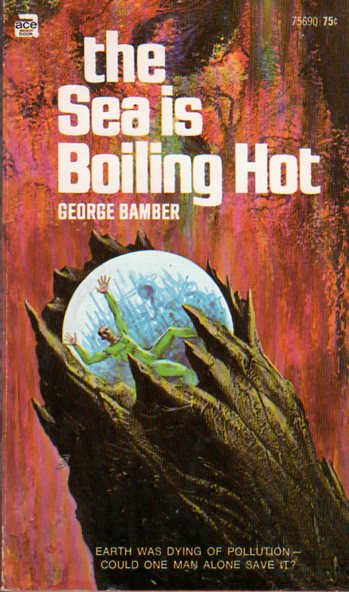
Book Review: The Sea is Boiling Hot, George Bamber (1971)

(Jack Gaughan’s cover for the 1971 edition)

2/5 (Bad)

The Sea is Boiling Hot (1971), George Bamber’s sole novel length contribution to the genre (thankfully), is the unabashedly pornographic version of the ecological disaster, humanity cooped-up in massive domed cities, let’s all get lobotomies to escape the horrors of the world science fiction.  As in, large portions of the narrative are endless sex scenes all gussied up with the accouterments of ecological “message” science fiction.

Unfortunately the sex scenes are there, in all their endless variation, simply to titillate to the reader rather than a necessary part of world building/character analysis — I’m thinking of Silverberg’s Continue reading

Adventures in Science Fiction Cover Art: The Composite Cover (illustrating a multiplicity of scenes, stories, thematic elements) Part II

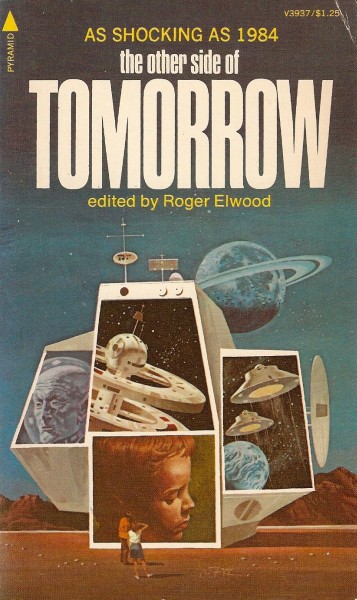
THTHRSDFTM1975

(Vincent di Fate’s cover for the 1975 edition of The Other Side of Tomorrow (1973), ed. Roger Elwood)

My second composite cover post — here’s a link to Part I if you missed it.  I’ve included a few covers by Vincent di Fate who has always been one of my favorite illustrators of the 1970s.  His cover for The Other Side of Tomorrow (1973) is top-notch.  A conglomerations of screens are placed on a barren stylized landscape where two figures gaze intently at them.  Each screen shows a different scene, a space station, spaceships, a boy’s contemplative face, an old man — and, a ringed planet looms in the background.  Whether or not the screens illustrate individual stories in the collection is unclear — regardless, the composite nature of the illustration is  Continue reading

Book Review: We Who Are About To…, Joanna Russ (1976)

(The hideous uncredited cover for the 1977 edition)

5/5 (Masterpiece: *caveats below*)

We Who Are About To… (1976) is the third of Joanna Russ’ science fiction novels I’ve read over the past few years. For some reason I was unable gather the courage to review The Female Man (1975) and might have been too enthusiastic about And Chaos Died (1970).  We Who Are About To… is superior to both (although, not as historically important for the genre as The Female Man).  This is in part because Russ refines her prose — it is vivid, scathing, and rather minimalist in comparison to her previous compositions — and creates the perfect hellish microcosm for her ruminations on the nature of history, societal expectation, memory,  and death.

Highly recommended for fans of feminist + literary Continue reading

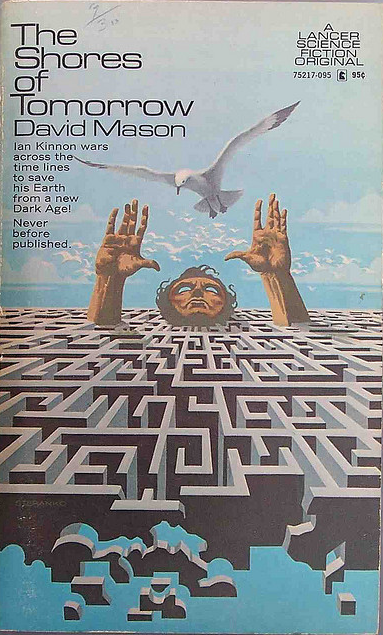
Adventures in Science Fiction Cover Art: The Maze (literal and metaphoric manifestations)

Screen shot 2012-01-09 at 12.48.26 AM

(Jim Steranko’s cover for the 1971 edition of The Shores of Tomorrow (1971), David Mason)

The covers for this post are both literal and metaphoric mazes.  Most come from two intriguing and highly recommended novels about mazes — no surprise there — Robert Silverberg’s brilliant The Man in the Maze (1968) and Philip K. Dick’s bizarre, hallucinatory, depressing as all hell A Maze of Death (1970).  The artist of the uncredited cover for the 1971 edition and Don Punchatz’s cover for the 1969 edition of Continue reading