Book Review: The Garments of Caean, Barrington J. Bayley (1976)

(H. R. Van Dongen’s cover for the 1980 edition)

3.75/5 (Good)

Barrington J. Bayley’s novels — I’ve reviewed Collision Course (1973), Empire of Two Worlds (1972), The Fall of Chronopolis (1974), The Pillars of Eternity (1982), and Star Winds (1978) — are characterized by extremely inventive concepts, generally poor characterization, and an uncanny lightness combined with a dose of visceral brutality.  In the works of his I’ve read so far he never leaves the galactic empire/space opera format and is utterly uninterested in extrapolating potential or possible future technology.

Along with Doris Piserchia’s The Billion Days of Earth (1976) and Lloyd Biggle, Jr.’s The Light That Never Was (1972), The Garments of Caean is one of the most off-the-wall strange space operas Continue reading

Updates: Recent Science Fiction Acquisitions N. XLIV (Anderson + Brunner + Bova + Budrys)

My Austin, TX haul….

Two classics I’ve yet to read: Budrys’ Who? (1958) and Poul Anderson’s Tau Zero (1970)…  The second in a trilogy by John Brunner, The Avengers of Carrig (1969) — the first, Polymath (first published in 1963 but expanded in 1974) was a readable Brunner pulp.

I’ve never enjoyed Bova’s novels, but I impulsively picked up As on a Darkling Plain (1972), perhaps influenced by the Ellis’ cover.

1. Who?, Algis Budrys (1958)

(Robert V. Engel’s cover for the 1958 edition) Continue reading

Adventures in Science Fiction Cover Art: Domed Cities of the Future, Part III

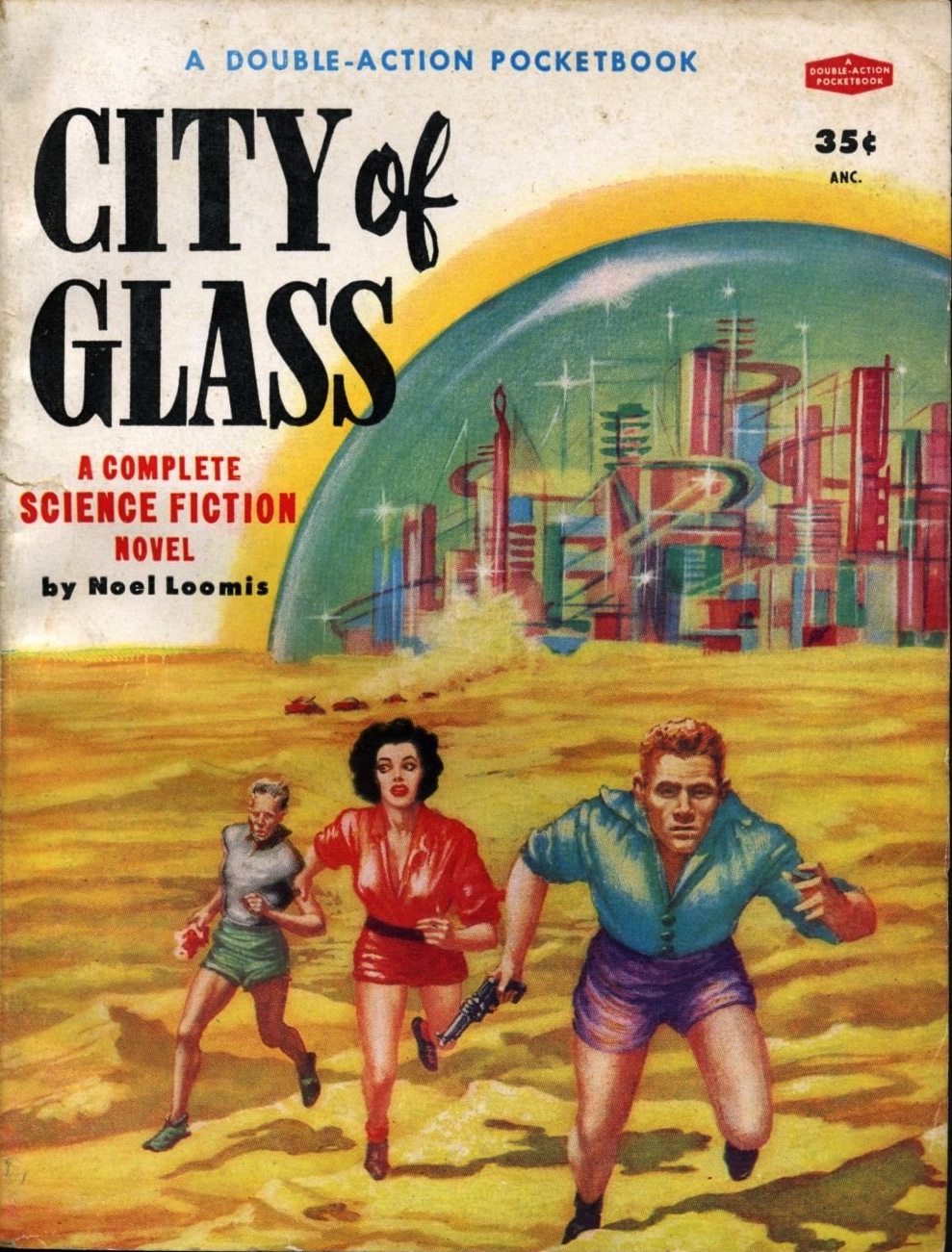
(Kelly Freas’ cover for the 1955 edition of City of Glass (1942 magazine), Noel Loomis)

Part I, Part II of my series on domed cities of the future.

Bob Watkin’s cover for the 1955 issue of If Magazine depicts an old man regaling stories of futuristic domed cities.  His fantastic visions are reduced to their key elements in sketch form — a translucent dome, buildings.  I’ve selected a variety of images from pulp 50s works until the late 70s depicting more fantastic/futuristic domed cities than the old man’s imagination conjures.  Ed Emshwiller’s cover for the  1953 edition of City at World’s End (1950) depicts two futuristic metropoli — a trend in future city development?  The first is a planned circular city spreading horizontally across the plain.  The other, an incredibly stylized “futuristic complex” Continue reading

Adventures in Science Fiction Cover Art: Nuclear Explosions + Mushroom Clouds, Part II

(Pattee’s cover for the November 1950 issue of Astounding Science Fiction)

In case you missed Part I.

Pattee’s cover for the Astounding Science Fiction November 1950 issue is visually stunning.  A transparent man (his arteries + brain showing) holds the atomic symbol aloft.  On the horizon a gigantic mushroom cloud is transposed with a spaceship.  Does man use atomic power for science and the good of mankind or evil and the destruction of mankind?  The message is made even more abundantly clear by the title of the piece of art — “Choice.”  Although this rhetoric might seem somewhat ham-fisted to modern post-Cold War readers, it produced some remarkable works of science fiction and science fiction art.  (If anyone knows the full name of the artist, I’d be grateful).

As with Part I, I’ve included some covers from the notorious hackwork spewing conveyor belt publisher Badger Books for giggles and Continue reading

Updates: Recent Science Fiction Acquisitions N. XLII (Malzberg + Roshwald + Clement + Moorcock)

A nice selection of books from my fellow book reviewer at Potpourri of Science Fiction Literature and a few from a recent trip to Indianapolis — the fried chicken and waffles at Maxine’s were far superior to their used book stores….

My trilogy of dark/brilliant/disturbed Malzberg novels dealing with the space program, The Falling Astronauts (1971), Revelations (1972), and Beyond Apollo (1972) is now complete!  When I get around to reading The Falling Astronauts I will put together a special post with a series of intriguing space program documents given to me by my fiancé — including a hilarious 1965 publication, The Astronauts & Their Families, where real life astronauts pose with their happy families, play with puppies, teach their children to shoot rifles, pose with their cars, pretend to play at the piano, etc — i.e. the oposite of Malzberg’s vision of the “manliest” of American heroes…

The Moorcock novel, The Ice Schooner (1969) was a rather impulsive buy — I’ve yet to read any of his works, but voyagers to cities wreathed in ice is always a fun trope.

Level 7 (1959) is generally considered a Cold War masterpiece…

Clement’s Through the Eye of the Needle (1978) is the sequel to Needle (magazine 1949) — I’ll probably want to find a copy of the first in the series before I give the sequel a shot….

1. The Falling Astronauts, Barry N. Malzberg (1971) (MY REVIEW)

(Davis Meltzer’s cover Continue reading

Book Review: The Eleventh Commandment, Lester del Rey (1962, revised: 1970)

(Dean Ellis’ cover for the 1970 edition)

3.5/5 (Good)

Lester del Rey’s The Eleventh Commandment, originally published in 1962, was revised by the author in 1970. I’ve reviewed the 1970 edition — I do not know to what extent the original was changed.

My first exposure to Lester del Rey’s sci-fi bucks the impression of general averageness conveyed by my fellow reviewers.  This work strikes me as a product of the more mature side of del Rey, a move away from his normal space opera YA fare.  In The Eleventh Commandment del Rey explores the religious ramification of overpopulation (see list) concerns of the 50s/60s.  Due to the fact that overpopulation fears gained a lot of currency after the publication of the 1968 bestselling non-fiction work The Population Bomb,  I suspect it provided the impulse for del Rey to rewrite the novel.  Despite the involving premise, the plot is often a Continue reading

Adventures in Science Fiction Cover Art: Visualizing Time

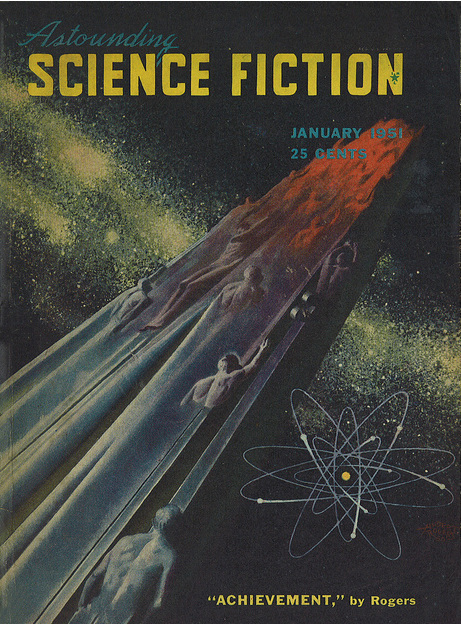
(Hubert Rogers’ cover for the January 1951 issue of Astounding Science Fiction)

In Hubert Rogers’ fascinating cover (titled ‘Achievement’) for the January 1951 issue of Astounding Science Fiction, mankind appears pulled upward, as if against their will, towards an undefined future goal.  Rogers’ cover encapsulates David Hume’s notion of historical time relentlessly moving towards improvement — improvement as something measurable and observable by the historian, and anyone who studies history.  Obviously, this historiographical framework has long been debunked (although it crops up in virtually all of my undergraduate students’ work in intro level courses) — it favors Western conceptions of progress, dismisses the achievements of non-European Continue reading

Book Review: Total Eclipse, John Brunner (1974)

(John Cayea’s cover for the 1974 edition)

3/5 (Average)

Over the years I’ve deluded myself into becoming a John Brunner completest — around twenty-five of his novels line my shelves and I’ve read most of them over the years.  At his best he’s without question one of the great masters of the genre — Stand on Zanzibar (1968), The Sheep Look Up (1972), etc. are evidence of this.  However, in-between his social science fiction masterpieces are a plethora of unsatisfying attempts at traditionalist space opera.  In these works Brunner never fully leaves his pulp roots although he occasionally tries to inject a dose of hard science, (pseudo) intellectualism, and social commentary.

Total Eclipse (1974) fits this mold.  A group of scientists attempt to figure out the mystery of a highly advanced race which has apparently, died out. Character interactions are painfully silly along the “Oh heroic main character, you’re a genius let me jump into your bed” sort of Continue reading

Updates: Recent Science Fiction Acquisitions N. XXXIX (Priest + Brunner + Crowley + Wallace + Duncan)

Ah, what a delightful group! A few from my father, a few from Marx books which I hadn’t posted yet….  Priest and Crowley’s novels involve fascinating worldscapes — a world winched across the horizon, a world at the top of a pillar…  Both are considered among the better stylists in science fiction and fantasy.

And, my 22nd (?) Brunner novel!  The Stone That Never Came Down (1973) — from his glory period of the late 60s-early 70s (this period produced Stand on Zanzibar, The Sheep Look Up, Shockwave Rider, The Jagged Orbit).

And two more impulsive finds — Ian Wallace’s Croyd (1967) — a reader claimed it was one of the best sci-fi novels of the 60s, and thus due to my intense curiosity, I had to find a copy.  And Dark Dominion (1954), I know little about David Duncan — he wrote only three sci-fi novels in the 50s.  His work is described by SF encyclopedia as “quietly eloquent, inherently memorable, worth remarking upon.”

And the covers!

1. The Inverted World, Christopher Priest (1974)

(Jack Fargasso’s cover for the 1975 edition) Continue reading