Book Review: In The Enclosure, Barry N. Malzberg (1973)

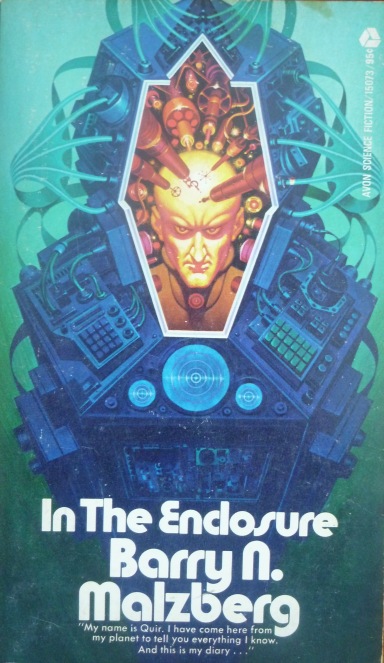
(Davis Meltzer’s cover for the 1973 edition)

4.5/5 (Very Good)

Fresh off Malzberg’s intriguing young adult novel, Conversations (1975), I picked up a copy of the altogether more disturbing, transfixing, unnervingly prescient, and at moments, brilliant In The Enclosure (1972).  As with many of Malzberg’s oeuvre, the work is infused with a steady dose of metafiction — our hero laments (and we writhe along with him in a malaise of unease), “I will never really know” (189).  Just as Quir is unsure of his own reality, his diaristic words — which the reader is desperate to hold on to — are admittedly, “an impression, a conception, nothing more” (190).

Combining the science fiction trope of implanted memories with the literary narrative mode of the unreliable narrator creates an overwhelmingly uncomfortable gulf between reality and constructed reality.  The result, the overpowering desire to pick up a piece of pulp science fiction where the future is rosy, technology = happiness, the kids smart, where rockets Continue reading

Adventures in Science Fiction Cover Art: Rocket, Field, Figure Part I

(Rod Dunham’s cover for the 1953 edition of Planet of the Dreamers (1953), John D. MacDonald)

First (archetypal) incarnation: rocket, field, figure.  Second incarnation: rocket with extra fins, field with unusual terrain, human staring at alien figure (s).  Repeat with virtually infinite variation.

By far one of my favorite science fiction cover tropes, rocket/field/figure evokes covers spanning the entire history of science fiction.  Rod Dunham’s cover for the 1953 edition of John D. MacDonald’s Planet of the Dreamers (above) perfectly evokes the archetype in its pure unadulterated form.  Emswiller’s cover for the 1960 issue of The Magazine of Fantasy and Science Fiction (below) uses a more traditional perspective but manipulates the field with a Continue reading

Book Review: Conversations, Barry N. Malzberg (1975)

(Uncredited cover for the 1975 edition)

3.25/5 (Average)

“Here I live.  Twenty up, twenty down, me in the middle with the Group.  Twenty up, broken gray and movement to the distance, twenty down to the landing, farther out the arena.  Gray up, landing down, me forever in the middle (1).”

Malzberg’s novella (89 pages), Conversations (1975), distills the common future dystopia tropes into an occasionally poignant but unremarkable young adult novel.  By young adult I mean completely suitable for young readers interested in science fiction (Malzberg fans know his usual relentlessly dark fare often verges on crass/risque).  I was unable to glean any information from the web on the work — only two or three of Malzberg’s extensive canon (late 60s-early 80s) receive any attention — so I had no idea that it was for younger readers.  A shot in the dark…

The main downfall of the work is the overly simplistic setting Continue reading

Updates: Recent Science Fiction Acquisitions N. XXI (Silverberg + Compton + Malzberg + Anderson)

A few more Christmas gift card purchases…

Dying Inside (1972) is often considered one of Silverberg’s best works and I can’t wait to read it (I will after my soon to be hellish weekend grading ~60 undergrad history papers).  Despite a painfully negative review on Amazon slamming Compton’s The Silent Multitude (1967) as a dull imitation of J. G. Ballard, it is high on my to read list — almost any experimental (allegorical) work exploring a crumbling city intrigues me.  Malzberg’s Conversations (1975) was a shot in the dark — it might be the least read of any of his novels — hence, my interest.

Pohl Anderson is almost always worth reading — even his middling short stories are fun.

Enjoy!

1. Dying Inside, Robert Silverberg (1972)

(Jerry Thorp’s cover for Continue reading

Updates: Visit + Submit to the BSFA Award Nominated Review Site SF Mistressworks


Hello all,  Ian Sales’ wonderful SF Mistressworks (link), a review collating blog, has recently been nominated for the BSFA award (British Science Fiction Association) in the non-fiction category (link for the list).  I’ve submitted nine of my reviews of sci-fi works written by women over the last few months.  It was created in direct response to the absence of sci-fi masterpieces by women on a list by The Guardian, a lack of general knowledge in the sci-fi community about early female pioneers in the genre, and general lack of readership for their many award-winning works.

If you’ve written reviews of science fiction works by women (the novels/short story collections need to be written before 2000) please submit them as well (500 words or so is preferred)!  So, gather up any Russ, Norton, Cherryh, C. L. Moore, Merril, Brackett, Piserchia, Le Guin, MacLean, Butler, etc etc etc reviews you might have on your blog or anywhere else.  It’s a great resource for finding seldom read works/authors which deserve a greater readership. Continue reading

Adventures in Science Fiction Art: Doomed Cities Part II (migrating icebergs, firestorms, the horsemen of the apocalypse)

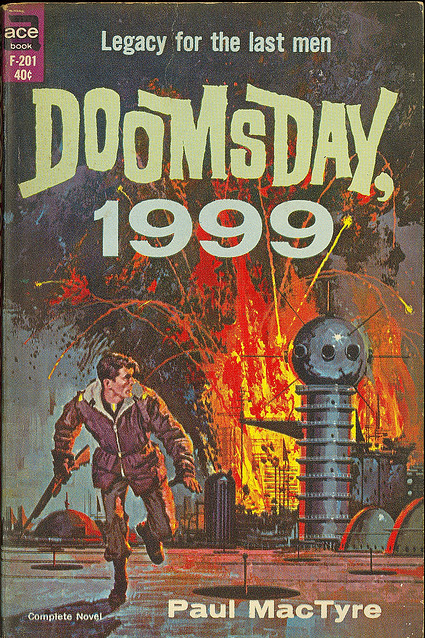
(Uncredited cover for the 1963 edition of Doomsday, 1999 (variant title: Midge), Paul MacTyre)

Behold Part II of my popular series on the doomed city in science fiction cover art (see Part I).  A doomsday that never happened, a tank and a skeletal reminder of a past battle — a ruined city, colliding stars, colliding planets…

Behold the august ruins of our people, our cities, our achievements.  If there’s anyone still left.

As always, are the books/authors worth reading? Continue reading

Updates: Recent Science Fiction Acquisitions N. XX (Clifton + Aldiss + et al.)

Christmas giftcard expenditures continue…

An interesting collection of acquisitions — Clifton’s Eight Keys to Eden (1960) is considered, at least by the reviews I’ve found online, to be a little read classic — i.e. my kind of sci-fi novel.  Aldiss always has wonderful ideas and The Long Afternoon of Earth (variant title: Hothouse) is generally proclaimed one of his best — I’m still waiting for work which garners the same magic as his masterpiece Non-stop (variant title: Starship) (1958).

After reading Kornbluth’s masterful short story collection The Explorers (1953) I felt obligated to pick up a copy of one of the more famous Pohl + Kornbluth collaborations, Gladiator-In-Law (1954).

A few intriguing Malzberg stories in Future City (1973) compelled me to snatch one of his lesser known novels off of the shelf — In The Enclosure (1973) tells the story of an alien tortured by his human captives.  I find Malzberg’s relentlessly dark visions very appealing…  He has a HUGE catalog I’ve yet to read.

1. The Long Afternoon of Earth (variant title: Hothouse), Brian Aldiss (1962)

(Uncredited cover for the 1962 edition) Continue reading

Adventures in Science Fiction Cover Art: On the Doctor’s Table

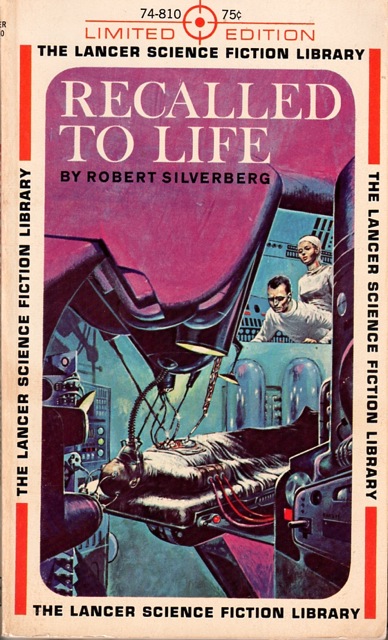
(Ed Emshwiller’s cover for the 1962 edition of Recalled to Life (magazine publication 1958), Robert Silverberg)

The science fiction doctor’s table — a place of healing, a place of inhuman manipulation, unusual prosthetic limbs are attached, immortality conferred, brains are transfered, descending mechanical arms wield their scalpels, vast arenas expose the spectacle, a mad scientist’s altar for ritualistic modification/sacrifice in the name of science or personal gain (legions of super men, alien/human hybrids, etc)…

I LOVE Ed Emshwiller’s cover for the 1962 edition of Silverberg’s Recalled to Life (1958).  The book itself is suposed to be one of Silverberg’s weaker ones.  I have read Silverberg’s To Live Again (1969) — a work filled with interesting concepts which are sadly not sustained Continue reading

Book Review: The City Machine, Louis Trimble (1972)

THCTMCHNGH1972

(Kelly Freas’ cover for the 1972 edition)

3.75/5 (Good)

First, a snarky comment about Kelly Freas’ unfortunate cover art — I can’t help but giggle at the imposing sci-fi behemoth cityscape which accidentally wandered onto a Thomas Kinkade, “Painter of Light” (or, as I call him, “The Painter of Kitsch”) Christmas tableau.  Kelly Freas’ fuzzy light, happy-budget-hotel-color-scheme art seldom impresses me.  Perhaps I’m too harsh….

On the other less caustic hand, Louis Trimble’s The City Machine is a surprisingly intriguing blend of allegory and sci-fi tale.  In line with my previous Continue reading