Guest Post: “The Quickening,” Michael Bishop (1981)

(Roger Zimmerman’s cover for Universe 11 (1981), first place of publication for “The Quickening”)

My ninth installment of my guest post series on The Science Fiction of Michael Bishop comes via Max (twitter: @MaxCarnduff) at the fiction (and occasionally SF/F) review site Pechorin’s Journal.  His incredibly erudite review of  Anna Kavan’s Ice (1967) is the reason I have not tried to review the work myself….  Follow him on twitter and check out his site!

For this series he selected the novelette “The Quickening” (1981) which won the Nebula for Best Novelette (1982) (one of the two Nebula wins Bishop has under his belt) and was nominated for the Hugo for best novelette that same year.  The novelette appears in Bishop’s most recent retrospective collection put out by Subterranean Press, The Door Gunner and Other Flights of Fancy (2012) that desperately needs an eBook/Kindle version!

Enjoy!

~
Screen shot 2014-04-19 at 7.30.08 PM

“The Quickening” (1981)

When Joachim approached me about participating in his series of guest reviews of works by Michael Bishop I was delighted, but worried I wouldn’t be able to get a review to him on time (work, life, that sort of thing).

Well, I was right on both counts. I was right to be delighted because Michael Bishop’s a writer with real talent Continue reading
Guest Post: Blooded on Arachne (selections), Michael Bishop (1982)

P1050043

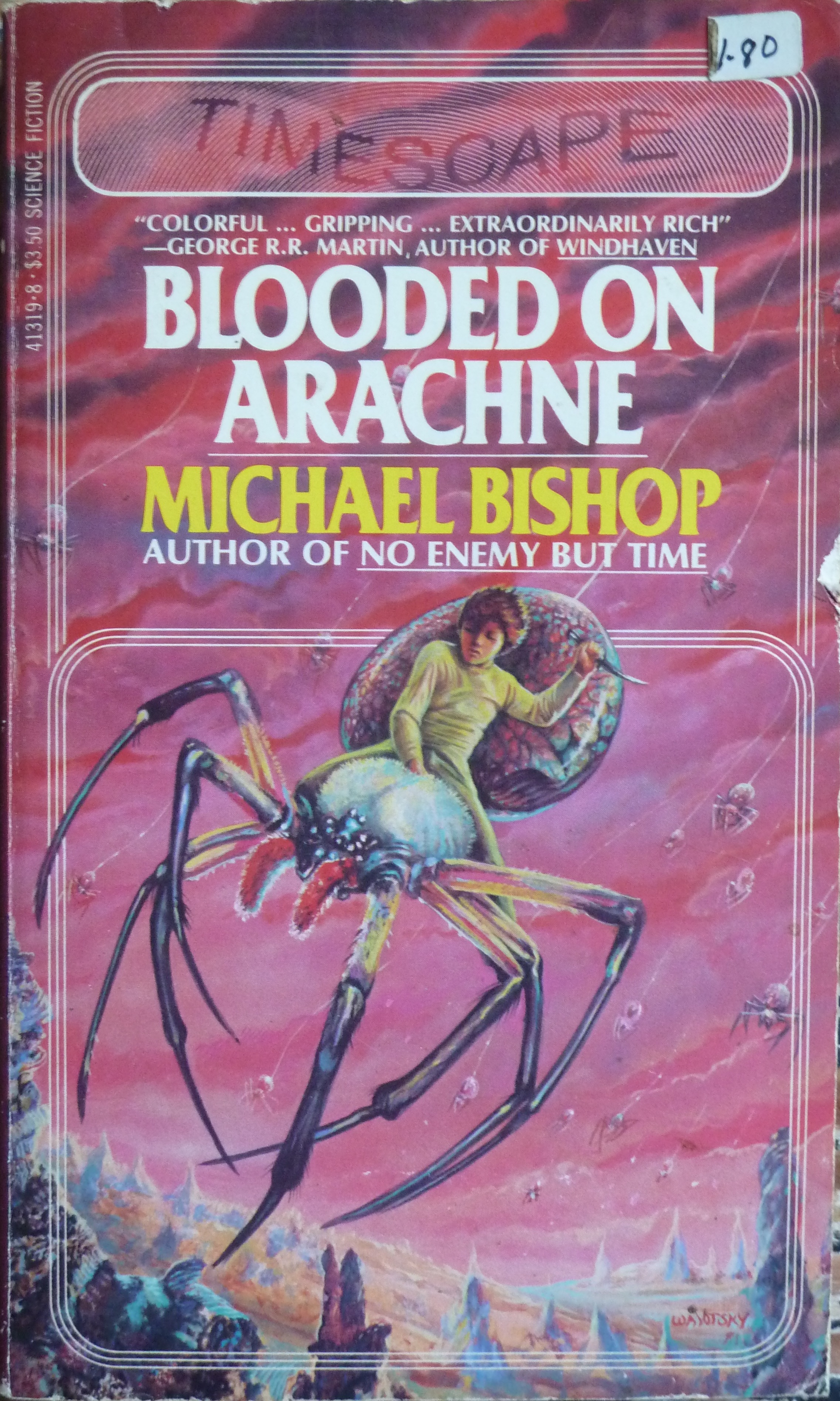
(Ron Walotsky’s cover for the 1982 edition)

The seventh installment of my guest post series on the SF of Michael Bishop comes via Carl V. Anderson (twitter: @SteelDroppings) over at the SF/F site Stainless Steel Droppings.  Although he does not often review older SF he was excited to participate in my project.  We decided to split Bishop’s first collection of short stories, Blooded on Arachne (1982).  Although he found a few of the stories rather hit or miss, he was blown away by “In Chinistrex Fortronza the People are Machines” 5/5 among others.  Check out Carl’s worthwhile site (for example, posts on the new Hugo art nominees, Andre Norton reviews etc. etc. etc.)

Screen shot 2014-04-19 at 7.30.08 PM

Blooded on Arachne (1982)–Michael Bishop

When Joachim Boaz asked me to join a group to guest post about author Michael Bishop, I jumped at the opportunity despite my overwhelming schedule. I had not been doing much short story reading, and the proposition of exploring work from an author I had not read…admittedly don’t recall ever having heard of…excited me. Of course there was more to it than that. Having followed Joachim’s site for several years and knowing his passion Continue reading

Guest Post: Brighten to Incandescence (selections), Michael Bishop (2003)

(Jamie Bishop’s cover for the 2003 edition)

The fourth installment of my The Science Fiction of Michael Bishop guest post series was written by MPorcius (twitter: @hankbukowsi) at MPorcius Fiction Log—a valued and longtime commentator on my site.  I have procured quite a few books due to his quality reviews which I highly recommend perusing.  Check out his site (especially if you like classic SF)!

Over the course of this series we moved from Michael Bishop’s most well known novella (“Death and Designation Among the Asadi“) to his novels (Brittle Innings, No Enemy but Time) and now to an intriguing collection of lesser known short SF and non-genre stories.

MPorcius decided to only focus on the SF in Brighten to Incandescence but points out that all the stories in the collection are worth reading!

Enjoy!

~~~

michael bishop,header,02

Brighten to Incandescence (2003) — Michael Bishop

Brighten to Incandescence, published by Golden Gryphon Press in 2003, is Michael Bishop’s seventh collection of stories. In the final chapter of the book, a series of notes on the stories, Bishop explains that he and the people at Golden Gryphon initially were thinking of putting out a Best Of volume, then decided to publish a collection of previously uncollected pieces instead. What we have in Brighten to Incandescence, then, are 17 stories, many of which were passed over for inclusion in previous collections for years or even decades; these stories probably do not represent Bishop’s best or most salable work.

Happily, the stories are all worth Continue reading

Guest Post: No Enemy But Time, Michael Bishop (1982)

NENMYTM1983

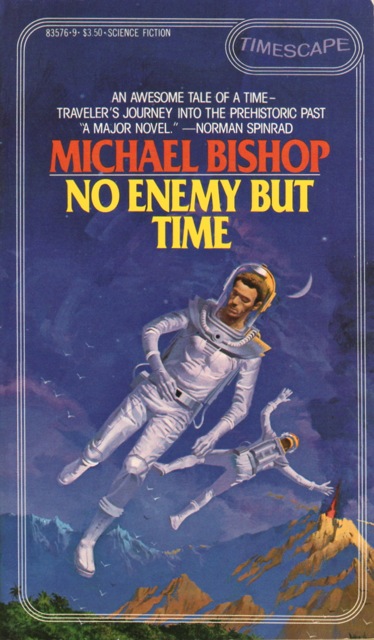
(Vincent Di Fate’s cover for the 1983 edition)

The third installment of my Guest Post Series on Michael Bishop’s SF was written by Megan (twitter: @couchtomoon) over at the relatively new but completely worthwhile SF review site From Couch to the Moon.  She’s already put together a substantial list of delightful reviews.  Megan selected Bishop’s single most famous and Nebula award-winning novel, No Enemy But Time (1982)—and sadly, one of few books of his still in print.  Along with Transfigurations (1979), it was republished and selected for the Gollancz Masterwork [list].

michael bishop,header,02

No Enemy But Time (1982) — Michael Bishop

Coming out of Bishop’s 1982 Nebula award winning novel, No Enemy But Time, is like coming out of a time travel trance: the experience is jarring, hazy, and unwelcome. Bishop sweeps the reader into his world—humanity’s distant past—and paints a primitive African landscape dappled with hippos, hyenas, and volcanoes, but lush Continue reading

Updates: Recent Science Fiction Acquisitions No. CII (Disch 2xs + Anderson + Pollack)

My fiancé picked these up for me as she perambulated through Dallas, TX—the birthplace of Half Price Books.  And, easily the best one in the country.

Two more Disch novels to add to my collection (I only owned Camp Concentration).  The cover and cover blurb for On Wings of Song (1979) is terrifyingly bad—the contents are supposedly magisterial.

I have no idea if Rachel Pollack’s Golden Vanity (1980) will be any good—looks like average space opera.

And, who can resist Poul Anderson?

Thoughts?

1. Echo Round His Bones, Thomas M. Disch (1966)

ECHORB1967

(Uncredited cover for the 1967 edition) Continue reading

Update: Guest Post Series Announcement, The Science Fiction of Michael Bishop

michael bishop,header,02

Collage of Bishop’s SF covers created by my father

“[Michael Bishop’s] early stories and novels display considerable intellectual complexity, and do not shirk the downbeat implications of their anthropological treatment of aliens and alienating milieux” — John Clute, SF Encyclopedia

Michael Bishop (b. 1945) [official website] is no stranger to critical success for both his novels and short SF: he has won the Nebula Award twice (“The Quickening” and No Enemy But Time) and picked up nine Hugo nominations and an additional thirteen Nebula Nominations.  Two of his more famous novels, No Enemy But Time (1982) and Transfigurations (1979), were selected for inclusion and republication in the Gollancz Masterwork List. Although Bishop has not published a novel since the Hugo-nominated Brittle Innings in 1994, he received a Nebula nomination for his novelette “Vinegar Peace, or, The Wrong-Way Used-Adult Orphanage” (2008) as recently as 2010!

With this in mind it is surprising that his extraordinary talent is not better known within the SF community.  John Clute in his article for SF Encyclopedia argues that “the earnest ardour and rigorousness of Bishop’s fiction has made Continue reading

Updates: Recent Acquisitions No. CI (Clarke + Bishop + Varley + Maclennan)

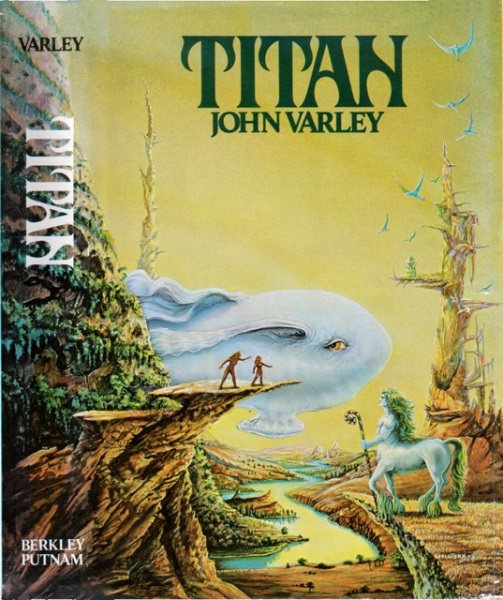
A nice range of SF authors/works!  A Michael Bishop collection containing many of his most famous 70s short stories for my upcoming guest post series….  And a SF juvenile written by Phyllis Maclennan with an intriguing premise (although, as always, I’m very dubious about juveniles in general).  John Varley’s famous novel Titan (1979) seems like a fascinating take on the Big Dumb Object trope. And finally a 50s adventure by the indomitable Arthur C. Clarke.

I am most intrigued by the Varley’s Titan and Bishop’s Blooded on Arachne.

Some of the covers are cringe inducing.

Thoughts?

1. Titan, John Varley (1979)

TTNRPPCRKF1979

(Ron Waltosky’s cover for the 1979 edition) Continue reading

Updates: Recent Science Fiction Acquisitions No. XCVII (Asimov + Malzberg + Randall + Schmidt)

Some goodies (finally reaching the bottom of my large pile of unreported SF—holiday leftovers, one or two Half Price/Thrift store visits, birthday gifts).

My second collection (need more!) of Malzberg short stories eagerly wants to be read!

An Asimov collection, Buy Jupiter and Other Short Stories (1975), that was inexpensive and also low on my list of books to read.  As readers know, one of my first SF novels I ever read was The Currents of Space (1952)… That said, Asimov has nostalgic allure but none of the many subsequent novels of his I have read have proved, in my opinion, his supposed “genius talent” and cult of “hero worship.”

Both the Malzberg and Asimov collections have brief intro essays to each story and random autobiographical fragments—smacks of filler.  But, perhaps there will be some intriguing observations (although, I rather not know that Malzberg wrote a particular short story in only an hour, or that Asimov took a bet from a pretty female editor, blah, blah, blah).

Marta Randall’s Islands (1976) was a solid read so it was only a matter of time before I acquired her superior (according to Ian Sales) A City in the North (1976).  You have to feel for her, her books received some of the most horrid Vincent Di Fate covers possible….

 I suspect that The Sins of the Fathers (1973) by Stanley Schmidt is a forgettable 70s space opera but I am willing to give it a try.

Thoughts?

1.  The Man Who Loved the Midnight Lady, Barry N. Malzberg (1980)

(Michael Flanagan’s cover for the 1980 edition) Continue reading

Adventures in Science Fiction Art: Visualizing Time, Part II (time travel + sundials + the decay of eternity + time portals)

11_1953_07_fantasticsty_walterpopp

(Walter Popp’s cover for the 1953 issue of Fantastic Story Magazine, ed. Samuel Mines)

It has been along time since I cobbled together a cover art post…

…but it’s a good one!

This is Part II of my Visualizing Time sequence—if you haven’t seen it already check out Part I.  And in Part II we have a standoff across time with your primitive ancestors, decay and the hourglass, rewriting America’s racist past, the sundial as an arena for an epic showdown with an alien, jumping through cave paintings (a metaphor Continue reading