Updates: Recent Science Fiction Acquisitions No. CII (Disch 2xs + Anderson + Pollack)

My fiancé picked these up for me as she perambulated through Dallas, TX—the birthplace of Half Price Books.  And, easily the best one in the country.

Two more Disch novels to add to my collection (I only owned Camp Concentration).  The cover and cover blurb for On Wings of Song (1979) is terrifyingly bad—the contents are supposedly magisterial.

I have no idea if Rachel Pollack’s Golden Vanity (1980) will be any good—looks like average space opera.

And, who can resist Poul Anderson?

Thoughts?

1. Echo Round His Bones, Thomas M. Disch (1966)

ECHORB1967

(Uncredited cover for the 1967 edition) Continue reading

Update: Guest Post Series Announcement, The Science Fiction of Michael Bishop

michael bishop,header,02

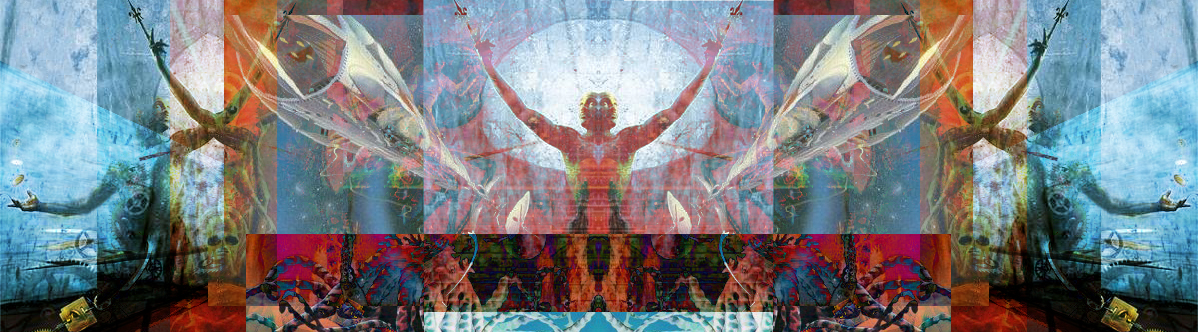
Collage of Bishop’s SF covers created by my father

“[Michael Bishop’s] early stories and novels display considerable intellectual complexity, and do not shirk the downbeat implications of their anthropological treatment of aliens and alienating milieux” — John Clute, SF Encyclopedia

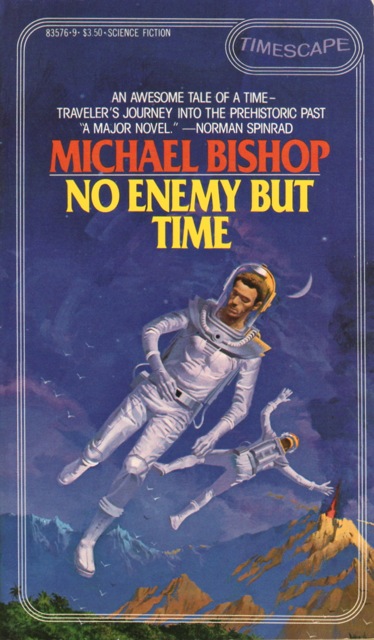
Michael Bishop (b. 1945) [official website] is no stranger to critical success for both his novels and short SF: he has won the Nebula Award twice (“The Quickening” and No Enemy But Time) and picked up nine Hugo nominations and an additional thirteen Nebula Nominations.  Two of his more famous novels, No Enemy But Time (1982) and Transfigurations (1979), were selected for inclusion and republication in the Gollancz Masterwork List. Although Bishop has not published a novel since the Hugo-nominated Brittle Innings in 1994, he received a Nebula nomination for his novelette “Vinegar Peace, or, The Wrong-Way Used-Adult Orphanage” (2008) as recently as 2010!

With this in mind it is surprising that his extraordinary talent is not better known within the SF community.  John Clute in his article for SF Encyclopedia argues that “the earnest ardour and rigorousness of Bishop’s fiction has made Continue reading

Updates: Recent Acquisitions No. CI (Clarke + Bishop + Varley + Maclennan)

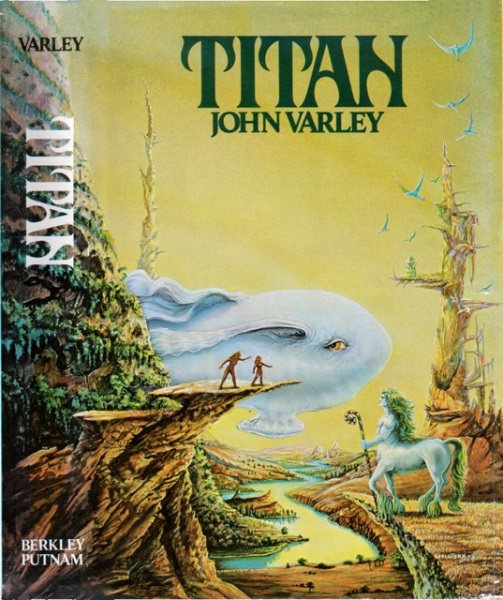
A nice range of SF authors/works!  A Michael Bishop collection containing many of his most famous 70s short stories for my upcoming guest post series….  And a SF juvenile written by Phyllis Maclennan with an intriguing premise (although, as always, I’m very dubious about juveniles in general).  John Varley’s famous novel Titan (1979) seems like a fascinating take on the Big Dumb Object trope. And finally a 50s adventure by the indomitable Arthur C. Clarke.

I am most intrigued by the Varley’s Titan and Bishop’s Blooded on Arachne.

Some of the covers are cringe inducing.

Thoughts?

1. Titan, John Varley (1979)

TTNRPPCRKF1979

(Ron Waltosky’s cover for the 1979 edition) Continue reading

Updates: Recent Science Fiction Acquisitions No. XCVII (Asimov + Malzberg + Randall + Schmidt)

Some goodies (finally reaching the bottom of my large pile of unreported SF—holiday leftovers, one or two Half Price/Thrift store visits, birthday gifts).

My second collection (need more!) of Malzberg short stories eagerly wants to be read!

An Asimov collection, Buy Jupiter and Other Short Stories (1975), that was inexpensive and also low on my list of books to read.  As readers know, one of my first SF novels I ever read was The Currents of Space (1952)… That said, Asimov has nostalgic allure but none of the many subsequent novels of his I have read have proved, in my opinion, his supposed “genius talent” and cult of “hero worship.”

Both the Malzberg and Asimov collections have brief intro essays to each story and random autobiographical fragments—smacks of filler.  But, perhaps there will be some intriguing observations (although, I rather not know that Malzberg wrote a particular short story in only an hour, or that Asimov took a bet from a pretty female editor, blah, blah, blah).

Marta Randall’s Islands (1976) was a solid read so it was only a matter of time before I acquired her superior (according to Ian Sales) A City in the North (1976).  You have to feel for her, her books received some of the most horrid Vincent Di Fate covers possible….

 I suspect that The Sins of the Fathers (1973) by Stanley Schmidt is a forgettable 70s space opera but I am willing to give it a try.

Thoughts?

1.  The Man Who Loved the Midnight Lady, Barry N. Malzberg (1980)

(Michael Flanagan’s cover for the 1980 edition) Continue reading

Adventures in Science Fiction Art: Visualizing Time, Part II (time travel + sundials + the decay of eternity + time portals)

11_1953_07_fantasticsty_walterpopp

(Walter Popp’s cover for the 1953 issue of Fantastic Story Magazine, ed. Samuel Mines)

It has been along time since I cobbled together a cover art post…

…but it’s a good one!

This is Part II of my Visualizing Time sequence—if you haven’t seen it already check out Part I.  And in Part II we have a standoff across time with your primitive ancestors, decay and the hourglass, rewriting America’s racist past, the sundial as an arena for an epic showdown with an alien, jumping through cave paintings (a metaphor Continue reading

Updates: Immortality Themed SF Novels/Short Stories Resource Posted


I while back I put out a call for SF novels/short works on immortality to add to a preliminary list I put together.  Due to my lack of knowledge of newer SF and uncanny ability to forget relevant previously read works I eagerly added your suggestions.  And Marta Randall’s Islands (1976) motivated me to finally post  it…

Here’s the LIST!

If you can think of any that I might be missing be sure to Continue reading

Adventures in Science Fiction Cover Art: The Space Station, Part IV

192dc8791f8ad474dd5bfcf367a3fe82

(Uncredited cover for the 1963 edition of The Changeling Worlds (1959), Kenneth Bulmer)

Part IV of my space station themed sequence (Part IPart IIPart III)–if you have not yet checked them out I recommend you do.

Vincent Di Fate is the master of space station art.  They are hyper realistic and detailed.  Although I definitely prefer his earlier surrealist work (for example, here) there is a certain appeal to more technical depictions of future space technology.  However, my favorite of the handful Di Fate pieces I cobbled together is his for the 1975 edition of The Other Side of Tomorrow (1973)—the screens are windows into the future, and a space station is featured prominently.  I sort of enjoy Bob Eggleton’s cover for the 1993 Italian edition of To Open the Sky (1967) as well—although I suspect the cover was published on an English language book earlier, Continue reading

Updates: Recent Science Fiction Acquisitions No. LXXXV (Fowler + Bishop + Brunner + Blish)

Dallas Part V (and some older finds) (Part IV, Part III, Part II, Part I)!

Love Brunner, want his short stories, enough said….

Also, I have a love hate relationship with Blish (love his “hard” SF and dislike his juveniles of which he wrote a many and often in a “hard” SF series)—The Frozen Year (1957) supposedly is his attempt at a “realistic” SF novel.  I’ll just have to see…  I feel weirdly compelled to read it.

As for the Karen Joy Fowler collection—yes, she wrote in the 80s!—the book sorters at the Half Price Books failed to realized that it was a signed copy!  So for a mere dollar I now have only my second signed SF work after D. G. Compton’s Scudder’s Game (1988).  As people have probably realized, I completely eschew conventions and have little connection with fandom and thus do not go out of my way to procure signed editions…

Michael Bishp=one of my new favorite authors (after reading Beneath the Shattered Moons and A Funeral for the Eyes of Fire).  Hence, Catacomb Years (1979) is a welcome addition to my collection.

Thoughts?

1. No Future in It, John Brunner (1962)

(Uncredited cover for the 1965 edition) Continue reading

Updates (New Resource): List of Immortality Themed SF (a call to contribute!)

This post is a call for readers to submit their favorite immortality themed science fiction NOT included on my list below (and even examples they did not care for so I can make this a more substantial resource).  I’ll make a page with all the information I receive for easy consultation soon (INDEX of similar pages/articles).

A while back I started gathering a list of titles — via SF Encyclopedia, other online resources, and my own shelves — on immortality themed SF.  I have always been intrigued by the social space (one plagued by violence and despair or buoyed by the hope of a better future) that the possibility of immortality might generate.

I would argue that the single best example of social effects that the possibility of immortality might create is Clifford D. Simak’s Why Call Them Back From Heaven? (1967).  In similar fashion, James Gunn’s The Immortals (1962) takes place in a world where immortals do exist, they skirt Continue reading