Adventures in Science Fiction Cover Art: Future Archaeology and Mysterious Artifacts (Alien + Human)

SPCSCNCFCC1953

(Hannes Bok’s cover for the  Space Science Fiction [UK], Volume 1 No. 4 (1953), ed. unlisted)

A spaceship arrives on Mars…  After a cursory initial exploration, the human astronauts conclude that the planet has always been barren and uninhabited.  But in some chasm or scattered in desolate plain, a column is found, and rows of mysterious buildings, and a pulsating crystal…  An abandoned outpost of an alien society?  Or, Earth’s mysterious forebearers…  Summaries such as this one proliferate the dusty SF paperbacks on back shelves of used book stores and the closets of SF fans — the variations are countless.

Queue my cover art theme: The future discovery of mysterious ruins/artifacts Continue reading

Book Review: Brain Wave, Poul Anderson (magazine publication 1953)

(Richard Powers’ cover for the 1954 edition)

3.25/5 (Vaguely Good)

I have long been a fan of Poul Anderson’s functionalist yet engaging SF adventures.  He is one of the masters at integrating social commentary (often on the impact of future technology) into the framework of the early Cold War influenced SF story without unduly weighing it down.  Brain Wave (1954) is  a good example of both his virtues and faults.

Brain Wave in a nutshell: a fascinating premise,  a somewhat frustrating ending, dubious social commentary, while the incredibly brief length (even for the 50s)  and uneven pacing suggest heavy cuts by editor…  That said, I suspect other famous works — such as the Daniel Keyes’ Flowers of Algernon (novelette: 1959, novel: 1966) and perhaps even Continue reading

Book Review: Mortals and Monsters, Lester del Rey (1965)

(Richard Powers’ cover for the 1965 edition)

3.25/5 (collated rating: Average)

Lester del Rey’s collection Mortals and Monsters (1965) — first editions are adorned with a gorgeous collage by the superb Richard Powers — is comprised of eight short stories from the 50s and four from the early 60s.  The collection, as with all but the best collections, is a mixed bag.  ‘The Years Draw Nigh’ (1951) is almost a masterpiece while ‘Recessional’ (1965) is an upsetting exercise in 60s sexism despite the fascinating premise.

I found that a few of the del Rey’s shorts are some of the more blatantly sexist 50s works Continue reading

Book Review: Mission of Gravity, Hal Clement (serialized, 1953)

(Joe Mugnaini’s cover for the 1954 edition)

3.5/5 (Good)

Hal Clement’s Mission of Gravity (1953) is generally considered one of the early classic (and most influential) novels of the hard science fiction subgenre.  The care in which Clement lavishes on the fascinating world of Mesklin is manifest on virtually every page.  The inherent logic of the unusual scientific properties of the planet Mesklin provides the superstructure for Clement’s development of the intelligent species that inhabits it and generates the majority of the plot.  Clement, a Harvard educated astronomer, applies the (remorseless) logic of the world to almost every situation and every paragraph creating a convincing, if rather laborious Continue reading

Book Review: Croyd, Ian Wallace (1967)

(Paul Lehr’s cover for the 1968 edition)

2.5/5 (Bad)

The esteemed science fiction critic John Clute claimed quite adamantly that Ian Wallace’s Croyd (1967) and its sequel Dr. Orpheus (1968) “are among the most exhilarating space-opera exercises of the post-World War Two genre” (SF Encyclopedia entry for Ian Wallace).  With this endorsement in mind I picked up a copy with high expectations.  But Clute’s assessment leaves me utterly flummoxed.

Wallace attempts to channel A. E. Van Vogt’s 1940s at a time (the 60s) when a large percentage of the writers were eschewing this form for social science fiction and the literary aspirations Continue reading

Adventures in Science Fiction Cover Art: The Hand of God?

194-1

(William Timmins’ cover for the January 1947 issue of Astounding Science Fiction)

A hand from a body off canvas enters the fray….  An alien’s hands wrap around the Earth, amused or disturbed by its creations?  A hand rises from a variety of desolate landscapes…  Is it the remnant of a robotic construct or a relics from some age old creator?

This particular theme — a powerful force depicted via an often disembodied hand — has yielded some fantastic covers.  Brian Lewis’ cover for the 1958 issue of Science Fantasy is one of my favorites.  I find the scene — a group of people discovering a robotic hand reaching from the f Continue reading

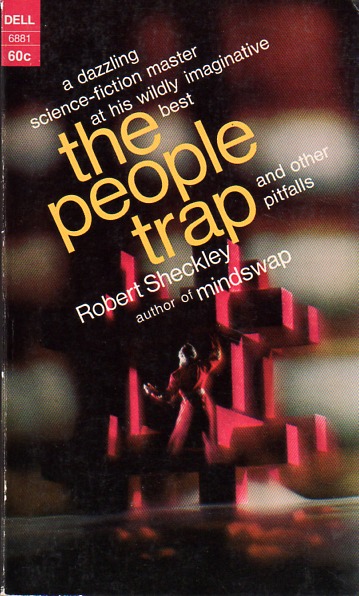
Book Review: The People Trap (full title: The People Trap and other Pitfalls, Snares, Devices, Delusions, as Well as Two Sniggles and a Contrivance), Robert Sheckley (1968)

TPPLTRP19XX

(Photo Media’s cover for the 1968 edition)

4/5 (collated rating: Good)

Although Robert Sheckley’s collection The People Trap (1968) does not approach the heights of Store of Infinity (1960), there are plenty of gems and the overall quality should compel any fan of satirical 50s/60s science fiction to find a copy.   Sheckley’s stories are characterized by delightful wit (despite serious themes such as the effects of colonization, technology, and nuclear disaster), surprising twist-endings, a penchant for intellectual mind-games (especially his 60s stories), and often hilariously hapless Continue reading

Book Review: A Scourge of Screamers (variant title: The Lost Perception), Daniel F. Galouye (1966)

SCRGSCRM1968

(Paul Lehr’s cover for the 1968 edition)

2.75/5 (Vaguely Average)

Recently I procured a handful of Daniel F. Galouye’s novels (here) for a few dollars on ebay because I enjoyed his first novel Dark Universe (1961), which is an underread/underrated classic of the early 60s.  In an effort to rekindle public interest in Galouye’s small ouvre (he died at 54 due to war injuries and was unable to write much in the last ten years of his life), he received the Cordwainer Smith Rediscovery Award in 2007.  Unfortunately, Galouye’s fast-paced sci-fi thriller A Scourge of Screamers (variant title: The Lost Perception) does not measure up to the claustrophobic and well-plotted social rumination (with a good dose of action) that is Dark Universe.

The most redeeming feature is Paul Lehr’s harrowing depiction of mental anguish Continue reading

Adventures in Science Fiction Cover Art: The Space Station, Part II

Screen shot 2013-03-31 at 12.09.55 PM

(Arthur Hawkins’ cover for the 1959 edition of Skyport (1959), Curt Siodmak)

Part II of my series on cover art depicting space stations (Part I).  Here are vast assortment of primarily Alex Schomburg and Vincent Di Fate’s artwork — they did love their space stations.  But, I think my favorite is by far Arthur Hawkins’ cover for the 1959 edition of Curt Siodmak’s Skyport (1959) — the author is of course famous for the novel Donovan’s Brain (1942).  The delightful color scheme, the 50s aesthetic, the vague indication of continents below, the cluster of Continue reading