Adventures in Science Fiction Cover Art: Rocket, Field, Figure Part I

(Rod Dunham’s cover for the 1953 edition of Planet of the Dreamers (1953), John D. MacDonald)

First (archetypal) incarnation: rocket, field, figure.  Second incarnation: rocket with extra fins, field with unusual terrain, human staring at alien figure (s).  Repeat with virtually infinite variation.

By far one of my favorite science fiction cover tropes, rocket/field/figure evokes covers spanning the entire history of science fiction.  Rod Dunham’s cover for the 1953 edition of John D. MacDonald’s Planet of the Dreamers (above) perfectly evokes the archetype in its pure unadulterated form.  Emswiller’s cover for the 1960 issue of The Magazine of Fantasy and Science Fiction (below) uses a more traditional perspective but manipulates the field with a Continue reading

Book Review: The Man in the Maze, Robert Silverberg (1969)

(Ron Walotsky’s cover for the 1978 edition)

4.5/5 (Very Good)

The Man in the Maze (1969) is yet another glorious novel from Silverberg’s best period (1967-1975).  Silverberg adeptly recasts Sophocles’ play Philoctetes (perhaps more of a loose inspiration) in an inventive and fully realized science fiction future where man has newly come into contact with interstellar beings.  As with some of his more serious works (The World Inside, Downward to the EarthHawksbill Station, etc.) the tone is that of a dark and brooding rumination.  The setting, a massive and unexplained ancient maze/city on the planet of Lemnos, is the perfect backdrop for the thought-provoking human drama that unfolds.

Plot Summary

Our hero, Richard Muller, is a one-time diplomat famous Continue reading

Updates: Recent Science Fiction Acquisitions N. XXI (Silverberg + Compton + Malzberg + Anderson)

A few more Christmas gift card purchases…

Dying Inside (1972) is often considered one of Silverberg’s best works and I can’t wait to read it (I will after my soon to be hellish weekend grading ~60 undergrad history papers).  Despite a painfully negative review on Amazon slamming Compton’s The Silent Multitude (1967) as a dull imitation of J. G. Ballard, it is high on my to read list — almost any experimental (allegorical) work exploring a crumbling city intrigues me.  Malzberg’s Conversations (1975) was a shot in the dark — it might be the least read of any of his novels — hence, my interest.

Pohl Anderson is almost always worth reading — even his middling short stories are fun.

Enjoy!

1. Dying Inside, Robert Silverberg (1972)

(Jerry Thorp’s cover for Continue reading

Adventures in (Bad) Science Fiction Cover Art: Miserable Monday No. III (Through the Purple Haze)

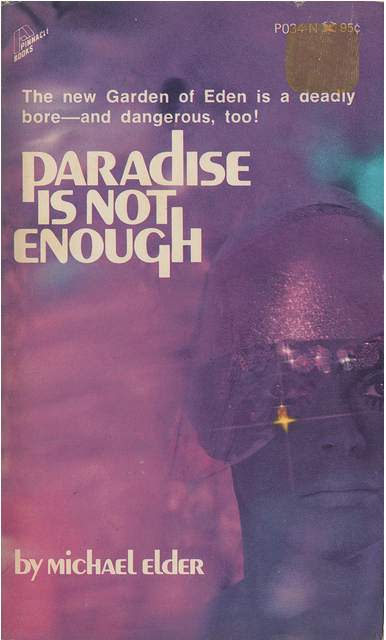
(Uncredited cover for the 1971 edition of Paradise is Not Enough (1970), Michael Elder)

My third Miserable Monday installment! (part I, part II)

Evil lurks behind purple clouds — a mascara-eyed man be-speckled with sparkling stars leers from the purple haze (the aphrodisiacal gases of paradise?), a goggled hero clutches his chest due to the horrific color palette sheeting towards them (a purple god’s purple tears?)(“O no! Run! Shall we run from the purple and green atomic rays?”), and real humans aren’t purple, so, the androids must be — to blend in with the real humans? or, are all humans purple but only androids see the purple spectrum?  Serious questions.

No wonder the cover artists aren’t credited!

Enjoy, and try not to Continue reading

Updates: Recent Science Fiction Acquisitions N. XX (Clifton + Aldiss + et al.)

Christmas giftcard expenditures continue…

An interesting collection of acquisitions — Clifton’s Eight Keys to Eden (1960) is considered, at least by the reviews I’ve found online, to be a little read classic — i.e. my kind of sci-fi novel.  Aldiss always has wonderful ideas and The Long Afternoon of Earth (variant title: Hothouse) is generally proclaimed one of his best — I’m still waiting for work which garners the same magic as his masterpiece Non-stop (variant title: Starship) (1958).

After reading Kornbluth’s masterful short story collection The Explorers (1953) I felt obligated to pick up a copy of one of the more famous Pohl + Kornbluth collaborations, Gladiator-In-Law (1954).

A few intriguing Malzberg stories in Future City (1973) compelled me to snatch one of his lesser known novels off of the shelf — In The Enclosure (1973) tells the story of an alien tortured by his human captives.  I find Malzberg’s relentlessly dark visions very appealing…  He has a HUGE catalog I’ve yet to read.

1. The Long Afternoon of Earth (variant title: Hothouse), Brian Aldiss (1962)

(Uncredited cover for the 1962 edition) Continue reading

Adventures in Science Fiction Cover Art: On the Doctor’s Table

(Ed Emshwiller’s cover for the 1962 edition of Recalled to Life (magazine publication 1958), Robert Silverberg)

The science fiction doctor’s table — a place of healing, a place of inhuman manipulation, unusual prosthetic limbs are attached, immortality conferred, brains are transfered, descending mechanical arms wield their scalpels, vast arenas expose the spectacle, a mad scientist’s altar for ritualistic modification/sacrifice in the name of science or personal gain (legions of super men, alien/human hybrids, etc)…

I LOVE Ed Emshwiller’s cover for the 1962 edition of Silverberg’s Recalled to Life (1958).  The book itself is suposed to be one of Silverberg’s weaker ones.  I have read Silverberg’s To Live Again (1969) — a work filled with interesting concepts which are sadly not sustained Continue reading

Adventures in (Bad) Science Fiction Cover Art: Miserable Monday No. 1, (pink/yellow striped cat aliens)

Inspired by C. M. Kornbluth’s dark/satirical tales in The Explorer (1954) that uncover the underbelly of the normally glamorous 50s portrayals of space travel and alien contact, I seek to expose (well, re-expose) the darker side of science fiction cover art.  I’ll try to post every monday, one bad science fiction cover — if possible, I’ll pair it with a much better cover of the same book from another edition if one exists.

My reasons:

1). The hilarious website ‘Good Day Sir’ doesn’t post the images I come across fast enough despite getting routine ratings from 7.5-9.5…    This is probably due to the fact that I don’t own the books and don’t follow the submission rules — i.e. posting an image of me physically holding a book in hand — alas, too bad.

2).  If a reader came across certain editions (posted below) the true nature of a book would be hopelessly confused (a great cover on a terrible book does the same thing) — Yes, there really are cat-like aliens in this book.  But, the  work’s overarching theme is much more mature (societal reaction to natural disaster, etc). Continue reading

Book Review: The Explorers, C. M. Kornbluth (1954)

(Richard Powers’ cover for the 1954 edition)

collated rating: 4/5 (Good)

I’ve stayed away from C. M. Kornbluth for far too long.  I read Kornbluth and Pohl’s The Space Merchants (1953) when I was quite young and was put off for some unexplainable reason.  What a shame!  This collection of short stories and novelettes contains some of the best short works I’ve ever read from the 50s (a few of Philip K. Dick’s early works are just as good).  As with The Space Merchants, Kornbluth exposes (in an often satirical manner) the dark underbelly of the usually glamourous 50s accounts of space travel, interplanetary trade, and the devastating social ramifications of technology on astronauts, new cultures, etc.  Kornbluth is equally adept at infusing his work with devastating commentary on American society.

This collection is brilliant throughout — only the annoying silly Continue reading

Updates: Recent Science Fiction Acquisitions N. XIX (Herbert + Aldiss + et al.)

Christmas = gift cards = more science fiction books, and a few my dad had procured for himself appeared miraculously in my pile — I’ve decided to break down the clump into manageable four book posts.

And of course, I wish you all a good sci-fi book hunting/reading year!

Enjoy!

1. The Santaroga Barrier, Frank Herbert (1968)

(Paul Lehr’s cover for the 1968 edition)

I’ve read a substantial number of Frank Herbert’s non-Dune Continue reading