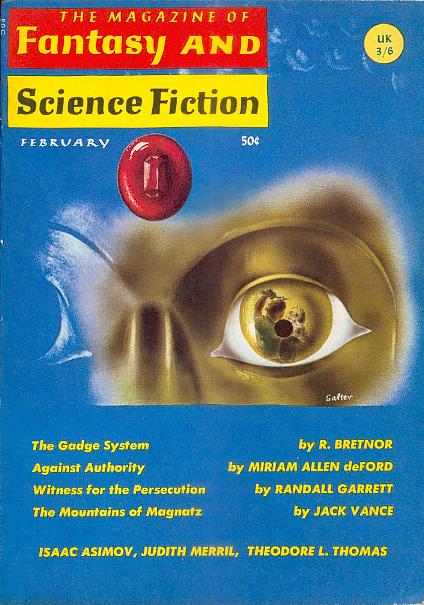
Updates: New Type of Post (grouped reviews of uncollected short stories published in magazines)


I do not own many SF magazines from the 40s-70s.  The reasons are as follows: 1) Novels tended to be serialized which means I have to track down multiple magazines to read an entire novel.  2) The novels were often radically altered for their first book form publication (think, Herbert’s “Dune World” (1963) that later became Dune (1965).  Thus, I rather own the later novel form that wasn’t as constrained by the strictures of magazine form. 3) I love short story collections and would rather own the entire collection than read a singleton story.

Continue reading

Book Review: Citizen in Space, Robert Sheckley (1955)

(Richard Powers’ cover for the 1955 edition

4/5 (collated rating: Good)

Robert Sheckley’s easily one of the best SF satirists in the short story form.  The collection Citizen in Space (1955), although not as uniformly brilliant as the collection Store of Infinity (1960), is chock full of gems including “The Luckiest Man in the World” (1955), “Something for Nothing” (1954), “Ask a Foolish Question” (1953), and “Skulking Permit” (1954).  Sheckley exposes in all their glory the vast variety of humankind’s follies and utopic delusions.

Later in the 50s and in the span of 6os his visions would become increasingly searing and metafictional.  This early collection Continue reading

Updates: Immortality Themed SF Novels/Short Stories Resource Posted


I while back I put out a call for SF novels/short works on immortality to add to a preliminary list I put together.  Due to my lack of knowledge of newer SF and uncanny ability to forget relevant previously read works I eagerly added your suggestions.  And Marta Randall’s Islands (1976) motivated me to finally post  it…

Here’s the LIST!

If you can think of any that I might be missing be sure to Continue reading

Updates: Recent Science Fiction Acquisitions No. XCIII (McCaffrey + Gunn + Spinrad + Sellings)

My first collection (and a big one at that) of Norman Spinrad short stories!  I loved The Iron Dream (1972).  I’ve also wanted to give Anne McCaffrey’s non-Pern SF a shot (loved Pern as a kid).  Although, it does look rather silly, catlike aliens are generally not my idea of fun.  Another novel by James Gunn, one he claims is his best…. And, one of those impulsive type acquisitions of unknown quality, The Power of X (1968) by Arthur Sellings.

Thoughts?

1. Kampus, James E. Gunn (1977)

(Bob Larkin’s cover for the 1977 edition) Continue reading

Book Review: Islands, Marta Randall (1976)

Screen shot 2014-02-02 at 9.35.15 AM

(Vincent Di Fate’s cover for the 1976 edition)

3.5/5 (Good)

Nominated for the 1977 Nebula Award for Best Novel

*Note: I read the 1980 Pocket edition which, according to Locus, was modified (to what extent I do not know) from the original 1976 first edition.

Marta Randall, the first female president of SFWA, is one of numerous female science fiction writers from the 70s that are seldom read today.  A while back Ian Sales alerted me to Randall’s work in his very positive review of A City in the North (1976) on SF Mistressworks.  Recently, while looking for unread works on my immortality-themed SF list (here), I came across the Nebula-nominated Islands (1976).

One of the more effective ways to write about the ennui Continue reading

Updates: Recent Science Fiction Acquisitions No. LXXXIII (Randall + Brunner + Shaw + Jones)

Dallas Half Price Book Store Part III (Part I, Part II)!

A short story collection by an author I have termed Mr. Perpetually Average But Readable, Bob Shaw.  I am interested in whether or not his visions are more concise/poignant in short story form.  I suspect a book like One Million Tomorrows (1971) would have been amazing in short form, especially the disturbing portions that take place in Africa (the UN forcefully administering immortality treatment on people who do not want them)….

A Nebula award nominated novel by Marta Randall, Islands (1976)—immortality themed, seems (at first glance) to be on the allegorical side = I have high hopes.

More Brunner! (Despite his warning, I was influenced by a review over at Speculiction…. here)  But then again, I am a Brunner completest…. And finally, a relatively unknown British SF novel, Implosion (1967) about a decreasing population.  Despite words of warning from reviews like Ian Sales’ (here) I couldn’t resist the Vincent Di Fate cover.

Thoughts?

1. Tomorrow Lies in Ambush, Bob Shaw (1973)

(Uncredited cover for the 1975 edition) Continue reading

Book Review: Fireship (variant title: Fireship / Mother and Child), Joan D. Vinge (1978)

(Stephen Hickman’s cover for the 1978 edition)

3.5/5 (collated rating: Good)

Like so many SF fans, my first exposure to Joan D. Vinge’s work was via her wonderful Hugo-winning novel The Snow Queen (1980).  Eventually I found a copy of her first published novel, The Outcasts of Heaven Belt (1978), which had an intriguing premise but a less than satisfactory delivery (poor characterizations, pacing, etc).  The collection Fireship (1978) is comprised of two novellas: the Hugo- and Nebula-nominated “Fireship” (1978) and one of her earlier works, “Mother and Child” (1975).

The title story is the lesser of the two despite its (dare I say dubious) award nominations.  It’s a light-hearted and unchallenging proto-cyperpunk Continue reading

Book Review: Xenogenesis, Miriam Allen deFord (1969)

(Richard Powers’ cover for the 1969 edition — there is some speculation that it might be a collaboration with Leo and Diane Dillon)

3.5/5 (Collated rating: Good)

Miriam Allen deFord—one of the more prolific SF short story authors of the 50s-70s whose works appeared in The Magazine of Fantasy and Science Fiction, If, Fantastic Universe, Galaxy, Worlds of Tomorrow, etc—deserves a Gollancz Masterworks volume.  But, as Ian Sales has pointed out so forcefully in his recent article (here), despite the number of prolific women SF authors in the 50s-70s they were rarely republished and are perhaps the least read group of SF authors for modern audiences.  There are some exceptions but few readers can name a women author pre-Ursula Le Guin.  deFord’s shorts were collected in only two volumes, Xenogenesis (1969) and Elsewhere, Elsewhen, Elsehow (1971) and both print runs were limited to the first year of publication.

Informed by her feminist activism (she was an important campaigner for birth control) and her earlier career in the newspapers, deFord’s stories tackle themes such as overpopulation, racism, colonialism, gender issues, sexism, and alienation.  Her works range from deceptively simple allegories to future histories vast in scope and complexity (for short stories).  Her female characters are almost all individualistic, resourceful, and highly educated–they often struggle against increasingly regimented/mechanized/homogenized societies in order to raise families in addition to their careers.  In short, deFord advocates forcefully the right to self-determination Continue reading

Book Review: A Way Home, Theodore Sturgeon (1956)

(Mel Hunter’s cover for the 1956 edition)

3/5 (collated rating: Average)

Although Theodore Sturgeon is generally considered a master of the SF short form, his collection A Way Home (1956) contains only two worthwhile stories — “Thunder and Roses” (1947) and “Bulkhead” (1955).  The rest I was either unable to finish or struggled to muddle through over the course of the last two or so weeks.  Fortunately,  the near masterpiece “Bulkhead” was almost worth the pain induced by the intelligent dog related subgenre of SF manifest in “Tiny and the Monster” (1947) or the cute accidentally destructive hurkle kittens of “The Hurkle Is a Happy Beast” (1949).

At this stage in my recent endeavor to brush up on the best of the 50s short story wordsmiths, I place Sturgeon below Robert Sheckley, Brian Aldiss, Philip K. Dick, Fritz Leiber, Miriam Allen deFord, Lester del Rey, Walter M. Miller, Jr., C. M. Kornbluth, and Frederik Pohl. (shocking to some, I know!).

However, before I make a more definitive conclusion I call on my readers to list what you consider his best short work Continue reading