Guest Post: The Last Video Store on Earth

And now for something completely different… While an undergrad at The University of Texas (Austin) (2005-2009), my saved dollars went to Vulcan Video—a purveyor of cult films (science fictional, foreign, unusual). Between Vulcan Video and the university audio visual library, I spent the majority of my free time transported to unusual worlds. I asked a friend, Christopher Giles, who returned to Austin after college to work at the store to write a guest post on the intersection of science fiction cinema/fiction and Vulcan’s last days, a victim (at least partly) of Covid-19.

Enjoy!

And as always, I look forward to your thoughts.

~~~~~~~~~~~~~~~~~~~~~~~~~~~~~~~~~~~~~~~~~~~~~~~~~~~

The Last Video Store on Earth

Christopher Giles

Vulcan Video was an independently owned video rental store located in Austin, Texas. Enjoying a stock of literally thousands of titles, with a focus on classic, foreign, and rare genre oddities, Vulcan stood as a beloved cinematic hub in a town uniquely suited for such a space, one of the few remaining businesses of its kind left standing. Unfortunately, recent years dealt Vulcan with the twin blows of increased rent prices and decreased customer traffic in the age of digital streaming, and the unavoidable realities of COVID-19 forced the store to permanently shut its doors in early April 2020.

Working at a video store, one grows accustomed to seasonal rushes on particular genres: lots of romcom rentals in February; the Horror section picked dry by the end of October; frantic, last-minute requests for It’s A Wonderful Life (1946) the week before Christmas. It’s to be expected, and can often lead to opportunities for customers to discover overlooked gems. When all copies of John Carpenter’s Halloween (1978) are predictably checked out weeks prior to the titular holiday, a slasher-starved customer might instead leave the store with Mario Bava’s Bay of Blood (1971) in hand, none less the richer for the alternative. As video store clerks, we looked forward to these days on the calendar and prepared for them accordingly.

Even the occasional curveball of unexpected news could be met with quick action, like, say, the untimely death of a beloved actor; when Burt Reynolds passed in 2018, the Vulcan Video staff quickly put together a tribute section for the mustachioed icon. This allowed for grieving customers to easily locate and snatch up copies of tried and true favorites like White Lightning (1973) and Continue reading

Book Review: Candy Man, Vincent King (1971)

(Patrick Woodroffe’s cover art for the 1973 edition)

3.5/5 (Good)

The Candy Man wanders from place to place in a crumbling mega-city with his sole companion, a mechanical dog named Wolf who comes with a handy handle. Candy Man instigates the lobotomized, with primal speeches and drugged sugar floss tinted with pulverized beetles, to revolution. His reward for turning in those he encouraged deviate from the will of the Deep Machine and their Teachers? Vials of drugs. Enter the hypnagogic world of Vincent King’s Candy Man (1971), an unsettled landscape inhabited by the degenerate remnants of humankind and the arcane workings of a computer program that cannot escape its original perimeters.

Fresh off Vincent King’s short story “Defense Mechanism” (1966), I tracked down a copy of his second novel. Occupying a similar space as “Defense Mechanism” (conceptual breakthrough in a decaying world city), King pushes the narrative Continue reading

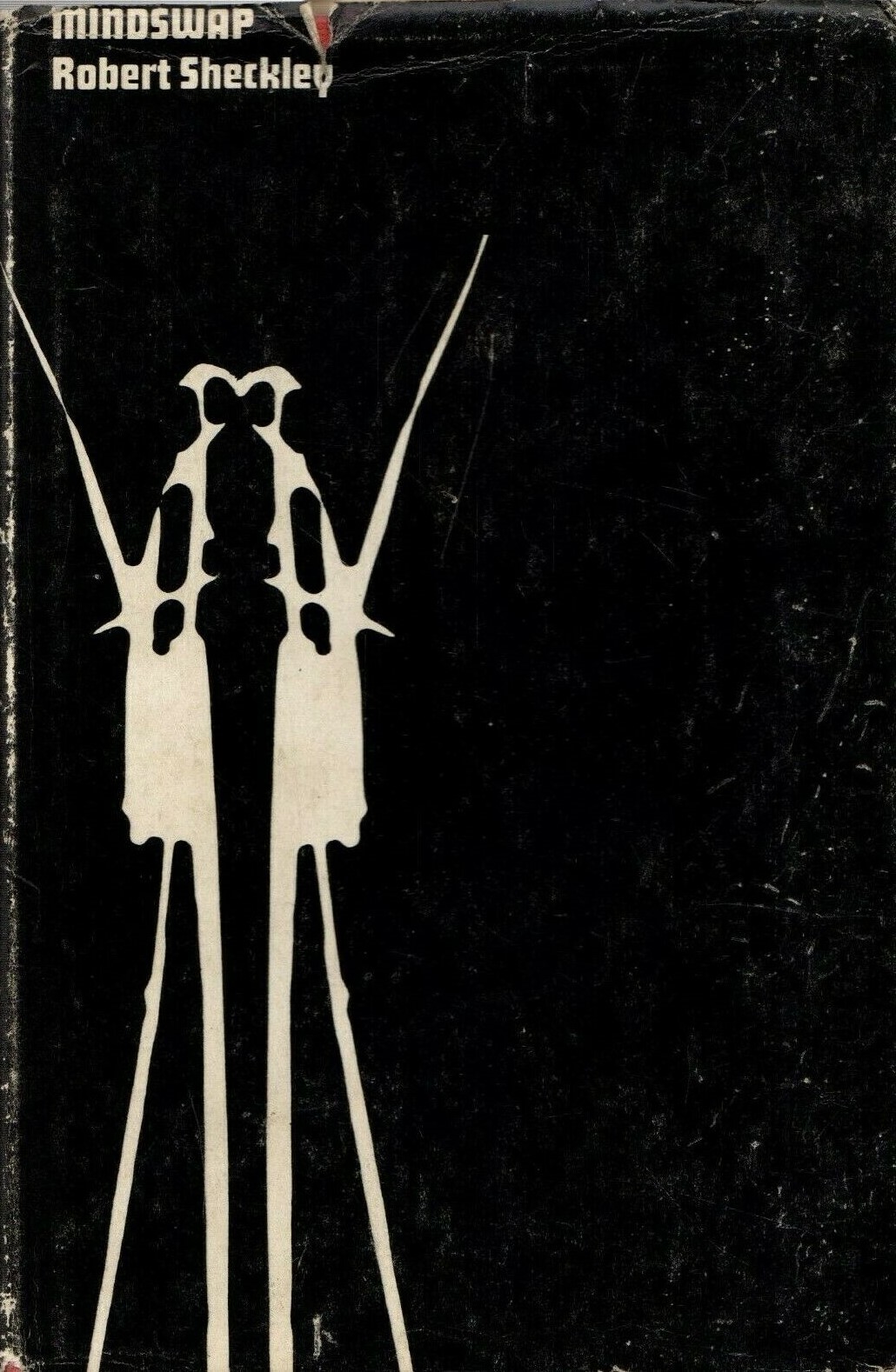
Adventures in Science Fiction Cover Art: The Spectral Visions of Terry James, Part I

(The 1967 edition of Mindswap (1966), Robert Sheckley)

A few weeks ago I reviewed Clifford D. Simak’s The Werewolf Principle (1967) and came across Terry James’ cover (below) for the 1969 Science Fiction Book Club (UK) edition. The spectral shedding/transforming of the human figure matched the uncanny vibe of the novel. And I headed immediately to isfdb.org to browse his ouvre (note: a few volumes in the pub. series are clearly his but remain uncredited)! And I decided to put together a series of posts showcasing his work.

His art, the entire catalog of SFBC editions between 1968 and the mid-way point of 1971, works with little Continue reading

Book Review: The Texts of Festival, Mick Farren (1973)

(Peter Jones’ cover for the 1975 edition)

2.5/5 (Bad)

Mick Farren (1943-2013)—science fiction author, counterculture musician, underground newspaper journalist—spins a wild drug-tinged adventure, replete with innumerable musical references, across a devastated, decadent, and depopulated future United Kingdom. The Texts of Festival (1973), dolled up with half-baked attempts at philosophy (counterculture becomes mainstream and loses its radical and society-transforming meaning), careens forth  with extensive sequences of action-packed exploitative sleaze. A sword-and-fantasy plot unfolds Continue reading

Updates: Recent Mostly Apocalyptic Science Fiction Acquisitions No. CCXXIX (Nevil Shute, Walter Tevis, Philip McCutchan, and Lawrence Watt-Evans)

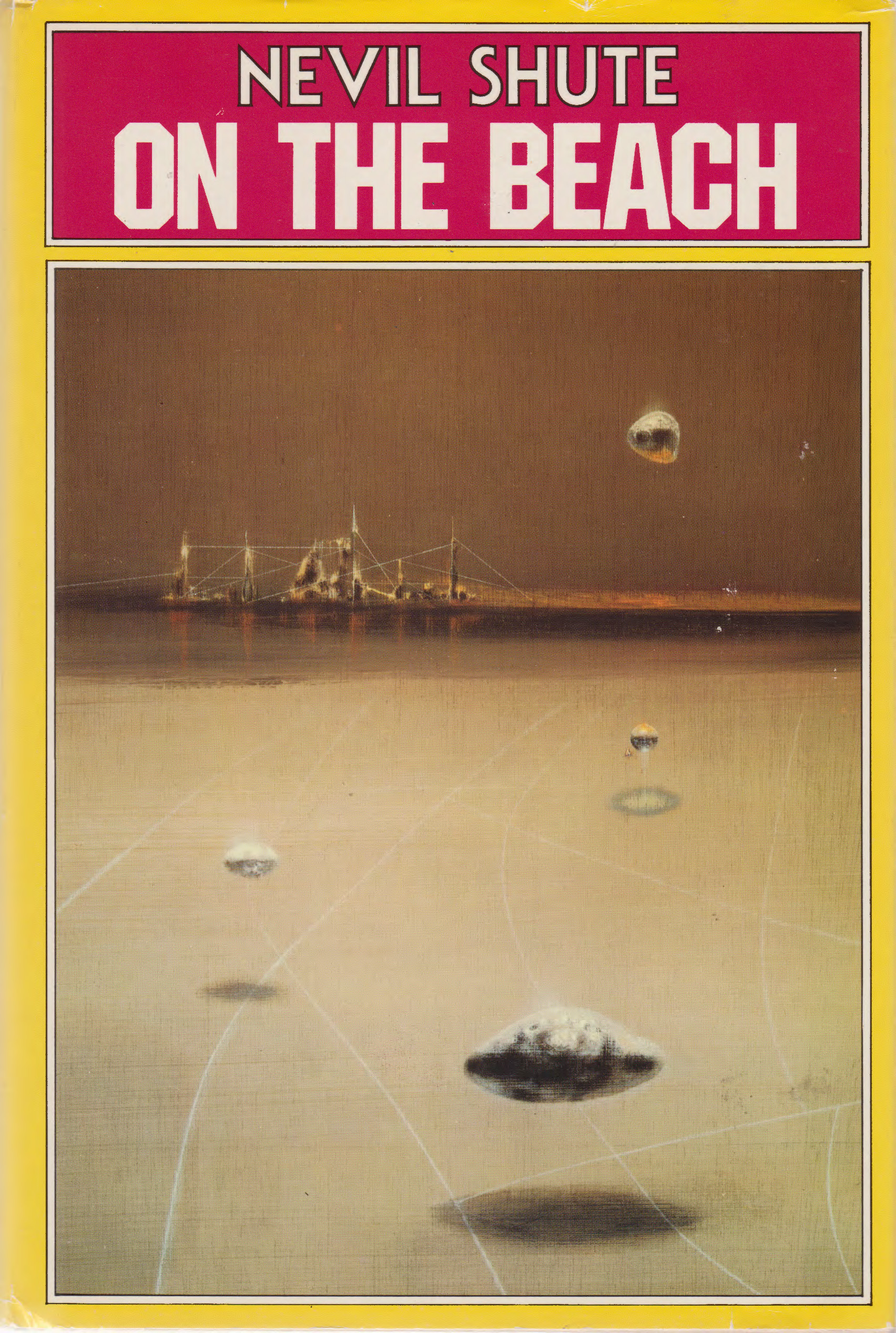
1. I’m finally the owner of one of the 50s/60s post-apocalyptic novels…. I suspect the 1959 film adaptation of Nevil Shute’s On the Beach (1957), which I did not enjoy, was the reason I’ve taken so long to acquire a copy.

It’ll fit neatly into my recent themed review sequence:

2. A far lesser known UK post-apocalyptic novel–SF Encyclopedia compares Philip McCutchan’s A Time for Survival (1965) to the relentless despair of Cormac McCarthy’s The Road (2006

3. I’ve yet to read any of Walter Tevis’ SF–I’ve acquired his post-apocalyptic novel Mockingbird (1980).

4. And finally, the least-known quantity of this post…. an impulse buy (SF and noir is a fun combo) at my local Half Price.

Let me know what books/covers intrigue you. Which have you read? Disliked? Enjoyed?

~

1. On the Beach, Nevil Shute (1957)

(Richard Powers’ cover for the 1986 edition) Continue reading

Book Review: A Wrinkle in the Skin (variant title: The Ragged Edge), John Christopher (1965)

(Steve Crisp’s cover for the 1985 edition)

3.75/5 (Good)

John Christopher’s A Wrinkle in the Skin (variant title: The Ragged Edge) (1965) is the second in my informal reading series on 50s/60s post-apocalyptic visions.  Fresh off Alfred Coppel’s moody and reflective Dark December (1960), I chose one of Christopher’s works long overshadowed by his popular Tripods trilogy (1967-68)* and more famous earlier catastrophe novel The Death of Grass (1956).* Continue reading

Adventures in Science Fiction Cover Art: Crashed Spaceships, Part III

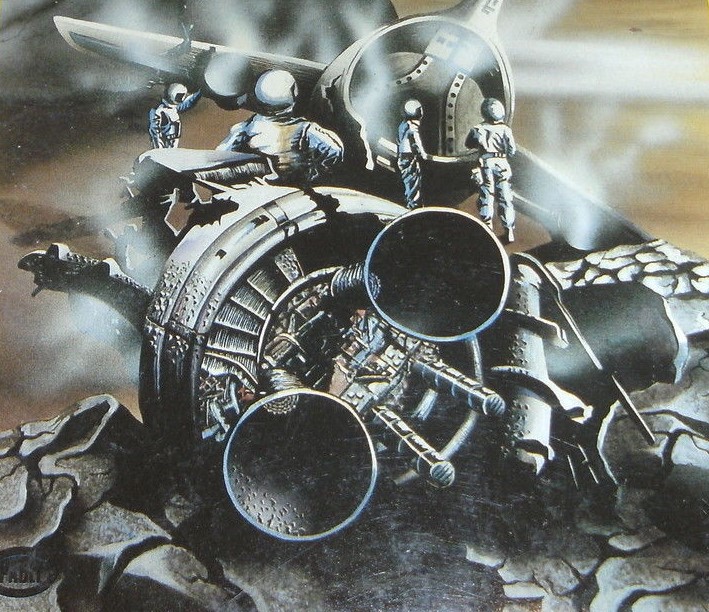
(Detail from Alan Daniels’ cover for the 1980 German edition of Open Prison (1964), James White)

The crashed spaceship — a wrecked hulk spinning in the emptiness of space, shattered metal struts strewn across an alien landscape…. I find few SF scenarios more nostalgic than this one as a younger me was obsessed with books about the societies formed from the survivors of such cataclysms (Anne McCaffrey’s Acorna Universe sequence, of dubious quality now, was a cornerstone of my youth).

I have selected a range of fascinating covers which add to a series I made in 2012 (Part I) and 2013 (Part II). My favorite of the bunch is Tibor Csernus’ cover for the 1973 French edition of Clifford D. Simak’s Time and Again (1951) due to the verdant and wet landscape the spaceship finds itself in. My second favorite is Dean Ellis’ “descriptive” cover for the 1974 edition of Alan Dean Foster Icerigger (1974). It doesn’t try to be surreal but rather depicts a scene straight from novel. I usually prefer when the artist takes a more unusual approach but in this case Ellis narrows in on the wonder of the premise. Continue reading

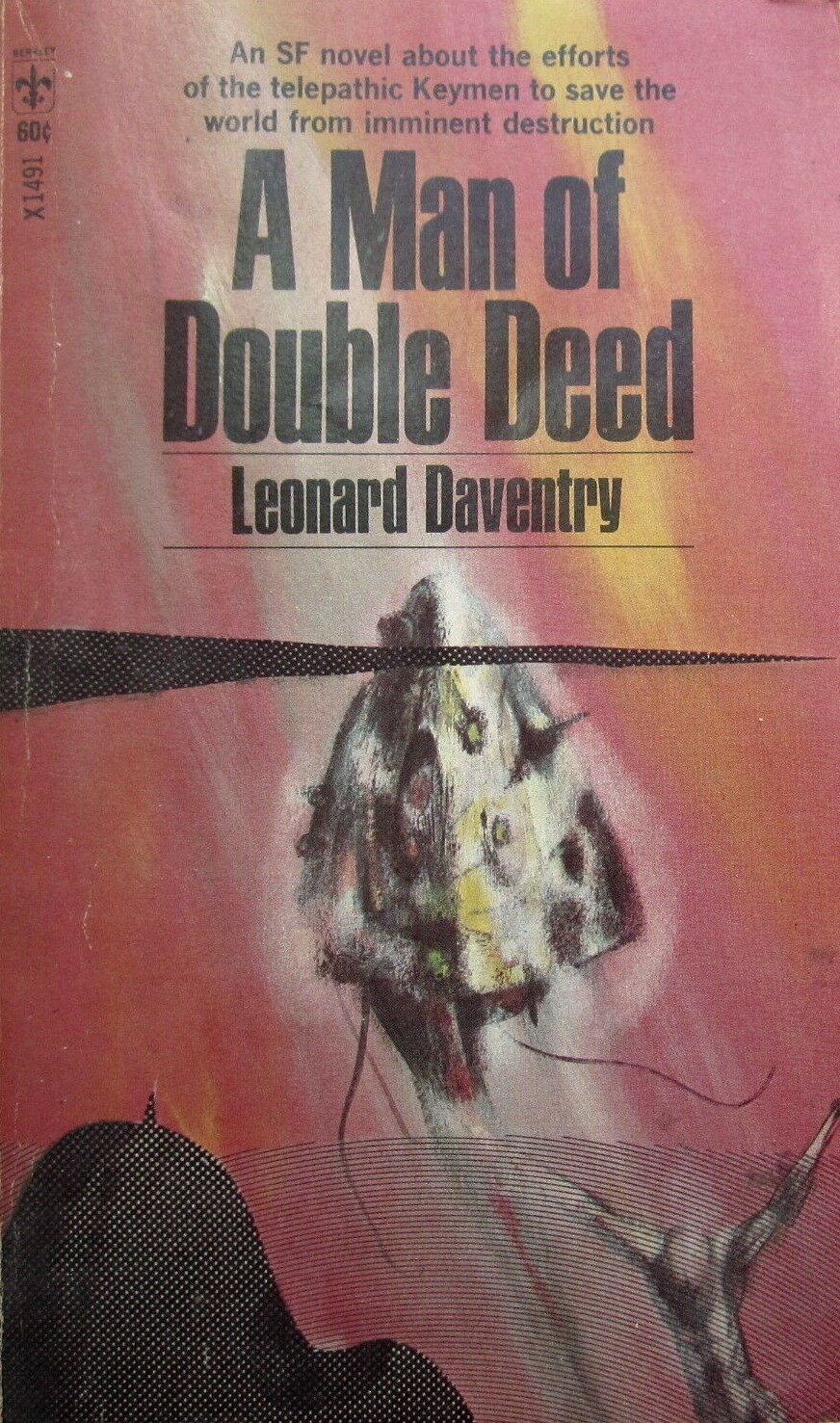
Book Review: A Man of Double Deed, Leonard Daventry (1965)

(Richard Powers’ cover for the 1967 edition)

3/5 (Average)

Leonard Daventry’s A Man of Double Deed (1965) is a dark and grungy tale of polyamory, telepathy, and apocalyptical violence. Swinging between philosophical and emotional introspection and awkwardly explained action sequences based on the flimsiest of plots, Daventry’s novel succeeds as a noirish character study but fails as a compelling unity of parts. Continue reading

Updates: Recent Science Fiction Acquisitions No. CXCIX (Ursula K. Le Guin + Cordwainer Smith + M. P. Shiel + John Varley)

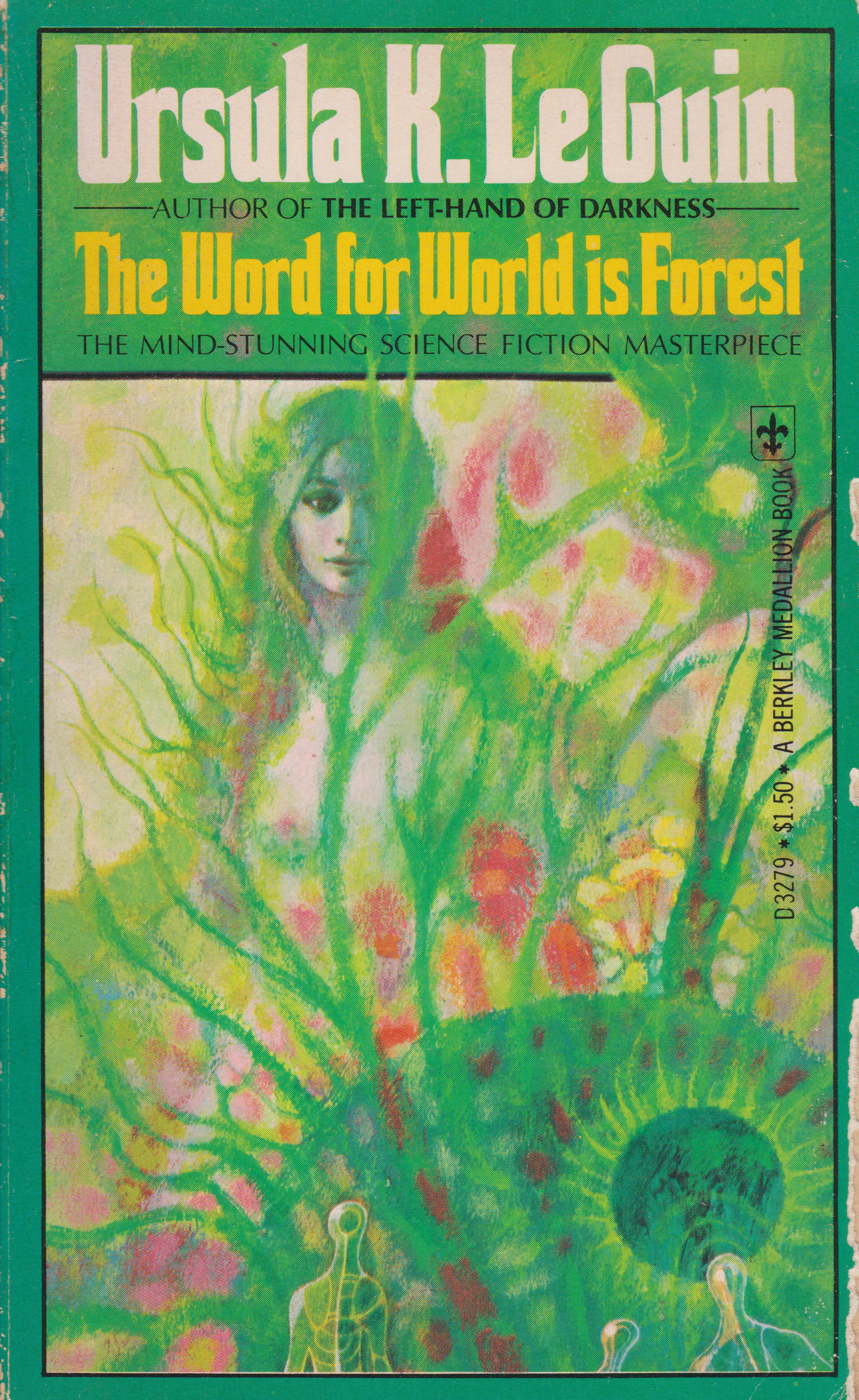
1. Ursula K. Le Guin’s novella, The Word for World is Forest, first appeared in Harlan Ellison’s Again, Dangerous Visions (1972) anthology before a stand-alone publication. I seem to remember reading it as a kid…. But…. the memories are vague.

2. Cordwainer Smith and I have never really seen eye to eye (I wanted to rhyme). I’m all for acquiring more of his collections just in case!

3. From Wikipedia:  “H. G. Wells lauded [M. P. Shiel’s] The Purple Cloud as ‘brilliant’ and H. P. Lovecraft later praised the novel as exemplary weird fiction, ‘delivered with a skill and artistry falling little short of actual majesty.'”

The Richard Powers cover is one of his best of the 60s.

4. John Varley, another author whom I’ve yet to read despite owning numerous of his collections and novels…. Millennium (1983) seems, well, suspicious? Time travel, airplanes, dystopic futures, love affairs across time. We shall see!

…and it was turned into a film in 1989.

Note: the images are hi-res scans. Click to enlarge.

As always, comments and tangents are welcome!

Enjoy.

1. The Word for World is Forest, Ursula K. Le Guin (anthology publication 1972) (MY REVIEW)

(Richard Powers’ cover for the 1976 edition) Continue reading