Adventures in Science Fiction Cover Art: The Composite Cover (illustrating a multiplicity of scenes, stories, thematic elements) Part II

THTHRSDFTM1975

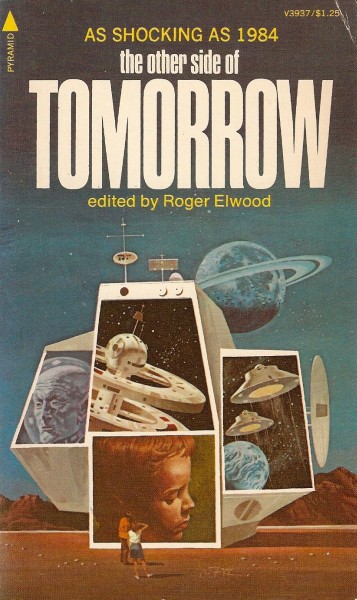
(Vincent di Fate’s cover for the 1975 edition of The Other Side of Tomorrow (1973), ed. Roger Elwood)

My second composite cover post — here’s a link to Part I if you missed it.  I’ve included a few covers by Vincent di Fate who has always been one of my favorite illustrators of the 1970s.  His cover for The Other Side of Tomorrow (1973) is top-notch.  A conglomerations of screens are placed on a barren stylized landscape where two figures gaze intently at them.  Each screen shows a different scene, a space station, spaceships, a boy’s contemplative face, an old man — and, a ringed planet looms in the background.  Whether or not the screens illustrate individual stories in the collection is unclear — regardless, the composite nature of the illustration is  Continue reading
Adventures in Science Fiction Cover Art: The Maze (literal and metaphoric manifestations)

Screen shot 2012-01-09 at 12.48.26 AM

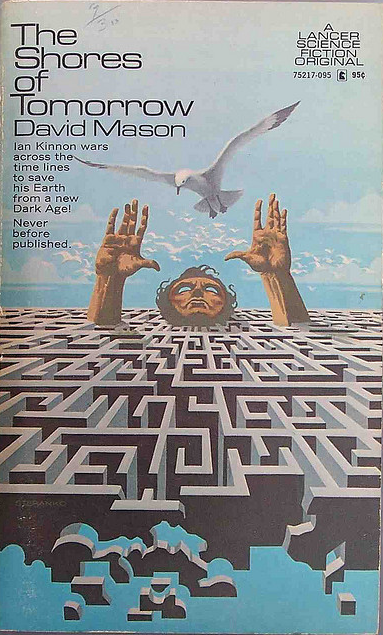
(Jim Steranko’s cover for the 1971 edition of The Shores of Tomorrow (1971), David Mason)

The covers for this post are both literal and metaphoric mazes.  Most come from two intriguing and highly recommended novels about mazes — no surprise there — Robert Silverberg’s brilliant The Man in the Maze (1968) and Philip K. Dick’s bizarre, hallucinatory, depressing as all hell A Maze of Death (1970).  The artist of the uncredited cover for the 1971 edition and Don Punchatz’s cover for the 1969 edition of Continue reading

Adventures in Science Fiction Cover Art: Planetary Rovers + Exploration Craft + Transport Vehicles of the Future

AMAZNOV1964

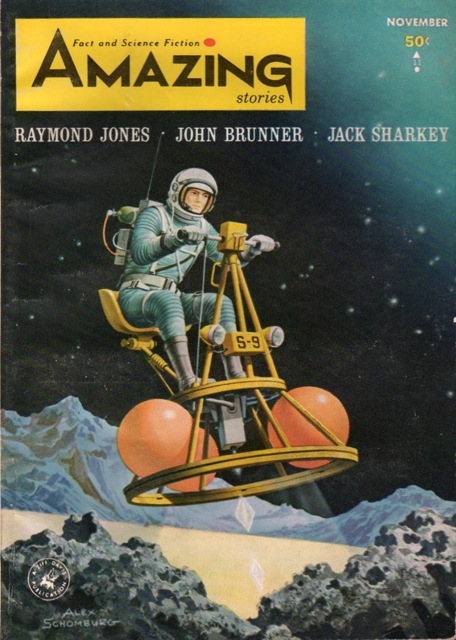
(Alex Schomburg’s cover for the November 1964 issue of Amazing Science Fiction and Fact)

I’ve put together a vast assortment of futuristic planetary transport vehicles — high tech lunar rovers, personal levitating (by mysterious forces) transport craft  glorified cargo tractors, self-propelling robotic brains, large exploration vehicles trekking across vast alien landscapes… Due to the subject matter the art tends to be in the more realistic vein — à la the classic art of Chelsey Bonestell, Alex Schomburg, and other greats.  The Paul Lehr’s cover for Robert Heinlein’s Farmer in the Sky (1950) adds a nice fantastical take on the subject.

I found that Chelsey Bonestell’s cover for the April 1955 issue of  Continue reading

Adventures in Science Fiction Cover Art: The Composite Cover (illustrating a multiplicity of scenes, stories, thematic elements)

Screen shot 2013-01-27 at 5.27.06 PM

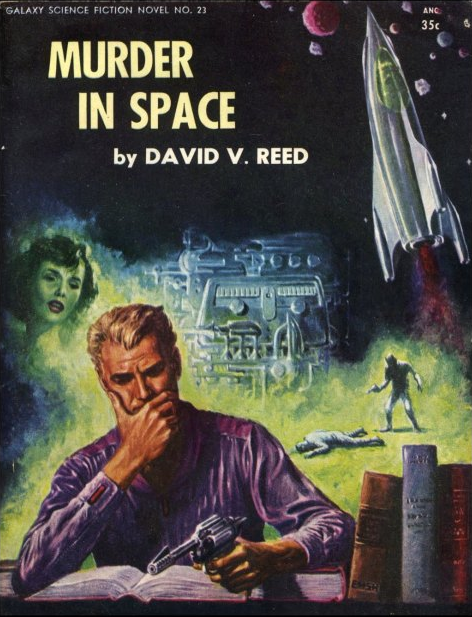
(Ed Emshwiller’s cover for the 1954 edition of Murder in Space (1944), David V. Reed)

Ed Emshwiller’s cover for the 1954 edition of Murder in Space (1944) perfectly embodies the composite cover comprised of sequences from the narrative.  Our hero (or villain) plots the murder in the foreground (guns, books, furrowed brow), commits the murder in the background, his love interest looks over his left shoulder (she’s constantly on his mind), and some random astroids/planets (let’s call them space rocks), a spaceship, and a strange piece of technology alert us to the science fiction aspect of the narrative…  The uncredited cover for the 1955 edition of The Altered Continue reading

Adventures in Science Fiction Cover Art: An Assortment of Mysterious Spheres, Part II

(David Bergen’s cover for the 1978 edition of Sea-Horse in the Sky (1969), Edmund Cooper)

Here’s Part II of my cover art series on the delightfully nebulous theme of mysterious spheres (Part I).  I’ve selected a variety of spheres: including spheres elevated in the air (balloon representations of the sun? planets? large scale planetary orbit models?), spherical eggs hatching men?, alien warships, alien (and human) transportation devices, strange atomic technology, obvious Death Star ripoffs, fields littered with the perplexing shapes….

… and even the simple unadorned sphere held aloft to indicate the pure delight of Continue reading

Book Review: The Eyes of Heisenberg, Frank Herbert (1966)

(Paul Lehr’s cover for the 1970 edition)

4/5 (Good)

Frank Herbert, known to most science fiction fans for his classic six book Dune sequence, published an extensive catalogue of other novels and short story collections.  A trademark of so many works of Herbert’s corpus is his near immaculate world-building skills.  As in Dune, the true extent of the world and all its hidden powerplays are slowly uncovered over the course of the narrative.  Although the basic premise is standard for the genre, Herbert’s multi-faceted world combined with his ability to develop characters and the pure hysteria/sheer hopelessness that permeates every page makes Continue reading

Updates: Recent Science Fiction Acquisitions No. XLVIV (Crowley + Strete + McAllister + Bond)

Christmas presents!

Intriguing literary sci-fi by Craig Strete and John Crowley…

Works of unknown quality, Bruce McAllister’s Humanity Prime (1971) and Nelson Bond’s collection No Time Like the Future (1954)…

And one of my favorite Powers’ covers.

1. Humanity Prime, Bruce McAllister (1971)

(David Meltzer’s cover for the 1971 edition) Continue reading

Updates: Recent Science Fiction Acquisitions, Magazine Edition No. I (Galaxy 2x, Worlds of If 3x, The Magazine of Fantasy and Science Fiction 1x)

My first science fiction magazines!

Although I’m not sure that I want to collect the entire catalogues of either Worlds of If or The Magazine of Fantasy and Science Fiction, I wouldn’t mind starting a collection of Galaxy (one of the more famous magazines).  I’ve been tentative in the past about purchasing magazines for one simple reason: a large percentage of their contents, especially if by well-known authors, are rewritten/expanded/re-conceptualized for later short story collections or novel publication form.  Thus, what version you read in the magazine is rarely the more polished version found in later editions.  For example, in the August 1965 issue of Galaxy Frank Herbert’s Do I Wake or Dream? was expanded for the 1966 novel publication under the title Destination: Void (which was revised again for the much later 1978 edition).  Novels like Dune (1965) are themselves fix-up novels from shorter novels previously serialized in magazines — Dune World (1963) and The Prophet of Dune (1965).  However, six magazines for one dollar each was too good of a deal to pass up….

The only magazine I desperately want to collect is New Worlds due to the quantity of experimental New Wave material which was published during Moorcock’s editorship.

(Gray Morrow’s cover for the August 1965 issue) Continue reading

Book Review: Lords of the Starship, Mark S. Geston (1967)

(John Shoenherr’s cover for the 1967 edition)

3.75/5 (Good)

Mark S. Geston’s first novel Lords of the Starship (1967), written at the age of 21 while he was an undergraduate history student, revolves around a fascinating premise: The construction of a massive (fake) spaceship intended to lift a society out of a crippling malaise.  The narrative covers hundreds of years and seemingly innumerable characters.  The lack of distinct characters is the most frustrating aspect of the work.  However, the extremely dark tone and satirical underpinnings lift the novel above the endless morass of earlier pulp sci-fi.

For fans of 50s/60s space opera and more traditionalist 60s Continue reading