What pre-1985 science fiction are you reading? + Update No. XXIV

What pre-1985 science fiction are you reading or planning to read next month? Here’s the June installment of this column.

I adore teaching American History for college credit. Every summer I ponder what to change and improve. And this year, I want to integrate a few science fiction stories!

My 1950s unit in the spring semester could be modified with a few science fiction short stories. Considering my ongoing fascination with media landscapes of the future, I want to integrate one story on fears over television and one on nuclear horror (which would fit nicely with a group of assignments I have using song lyrics about atomic panic). Feel free to suggest a story that you would include or wish was included in your own US college course (or advanced high school course). No novels unfortunately. I have access to a range of syllabi and a TON of ideas but I always love to hear your selections.

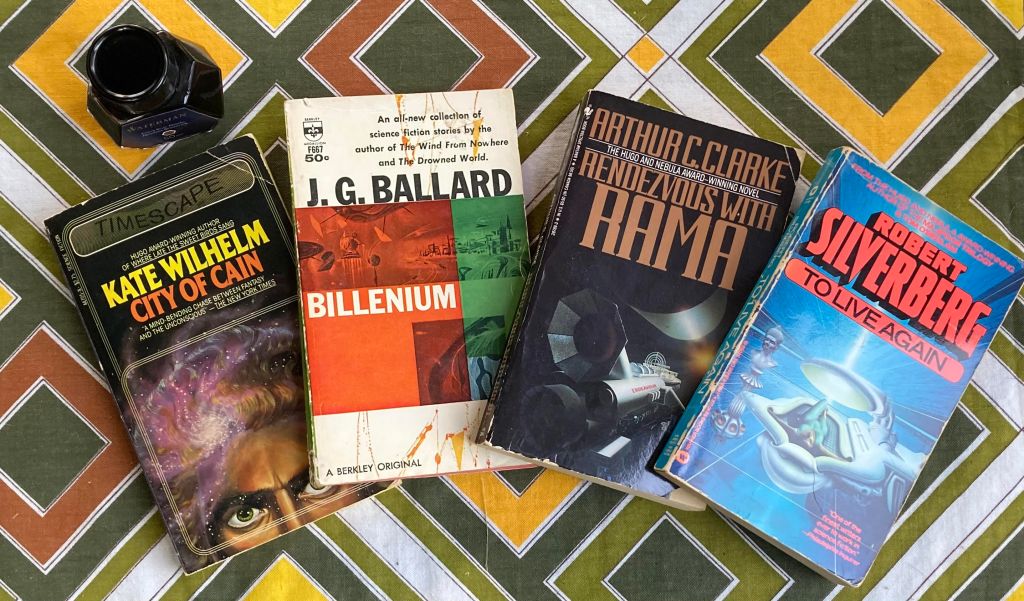
Before we get to the photograph above and the curated birthdays, let me know what pre-1985 SF you’re currently reading or planning to read! 

Continue reading
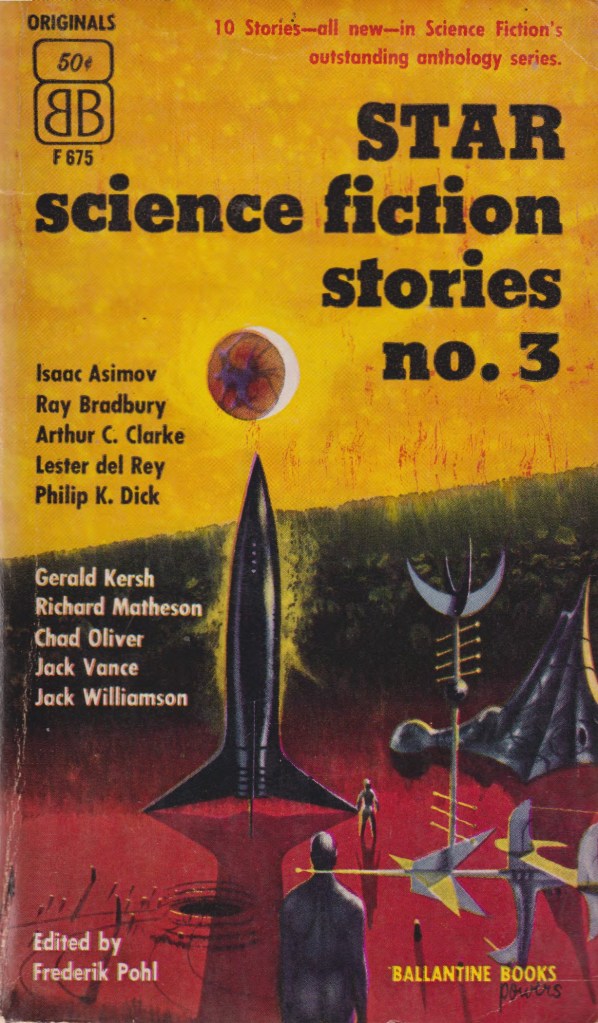
Book Review: Star Science Fiction Stories No. 3, ed. Frederik Pohl (1955)

3.5/5 (collated rating: Good)

Ballantine Books’ illustrious science fictional program started with a bang–Star Science Fiction Stories. According to Mike Ashley’s Transformations: The Story of Science-Fiction Magazines from 1950 to 1970 Frederik Pohl’s anthology series of original (mostly) stories was “intended as both a showcase of Ballantine’s authors and a lure to new writers.” Paying better rates than magazines, the Star series foreshadowed the explosion of original anthologies that would provide a sustained challenge to the eminence held in the 50s by the magazine.

I’ve selected the third volume of the six-volume series.1 It contains an illustrative cross-section of 50s science fiction. Philip K. Dick’s “Foster, You’re Dead” (1955), Richard Matheson’s “Dance of the Dead” (1955), and Jack Williamson’s “Guinevere for Everybody” (1955) are not to be missed.

Continue reading

What pre-1985 science fiction are you reading? + Update No. XIII

What pre-1985 science fiction are you reading or planning to read this month?

Here’s May’s installment of this column.

As I am currently exploring the north-of-the-Arctic Circle reaches of Norway, why not segue way into this post by re-ruminating on the only Norwegian SF novel I’ve read: Knut Faldbakken’s spectacular Twilight Country (1974, trans. Joan Tate, 1993). I wish I’d thought to bring the sequel — Sweetwater (1976, trans. Joan Tate, 1994). Twilight Country, my second favorite SF novel read of 2021, contains one of the great depictions of a decaying metropolis. It is a densely metaphoric story of survival within its crumbling edifices. The masterstroke of Faldbakken’s novel is the portrayal of the Dump, a border zone containing the cast off fragments of human existence, as a place of recreation. Our characters run to the Dump to escape, to make their lives anew. They’re deeply flawed figures. There’s a tangible sense of organic transformation within the transients who inhabit this liminal zone. Sweetwater and The Dump act as a closed system. One decays into the other. One creates the other. Not recommended unless you like your SF dark and moody like me!

Continue reading

Exploration Log 3: Interview with Adam Rowe, author of Worlds Beyond Time: Sci-Fi Art of the 1970s (2023)

Today I have the third post in my Exploration Log series.

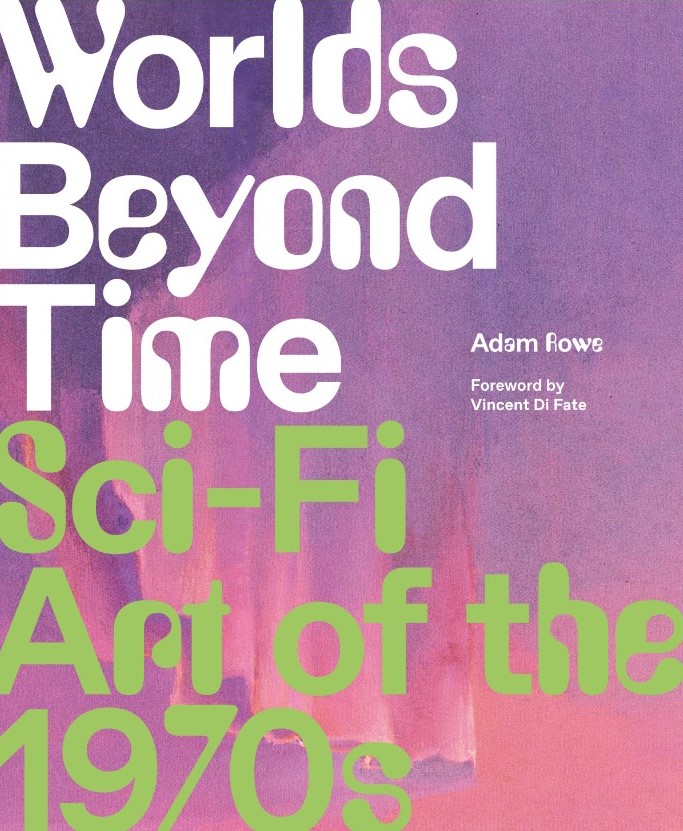
I would like to welcome Adam Rowe to Science Fiction and Other Suspect Ruminations. He is the author of a brand new book–Worlds Beyond Time: Sci-Fi Art of the 1970s (2023)–on 70s science fiction cover art with a foreword by artist Vincent Di Fate. You can follow Adam’s art account on Twitter and Tumblr. I also recommend subscribing to his free 70s SF art newsletter. You can buy Worlds Beyond Time on Amazon and Barnes and Noble

Adam Rowe is a writer who has been collecting retro science fiction art online since 2013. He covers technology at Tech.co and has been a Forbes contributor on publishing and the business of storytelling. He has also written for iO9, Popular Mechanics, Tor.com, and the Barnes & Noble Sci-Fi & Fantasy Blog. Worlds Beyond Time: Sci-Fi Art of the 1970s (2023) is his first book.

Continue reading

Recent Science Fiction Purchases No. CCXCIX (Henry Kuttner, C. L. Moore, Jack Williamson, Jacob Transure, Star Anthology)

Which books/covers/authors intrigue you? Which have you read? Disliked? Enjoyed?

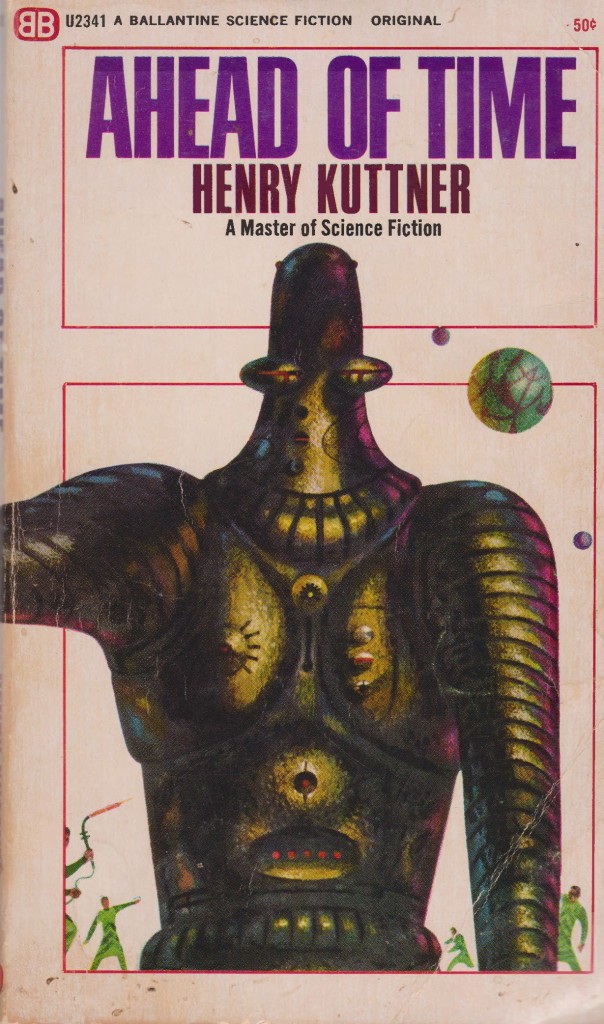
1. Ahead of Time, Henry Kuttner and C. L. Moore (1953)

From the inside page: “A brain in a box fights a criminal plot

A visitor from the future turns out to be peculiar even for his society

An eternal hillbilly family survives the centuries and gets into political trouble

A sick electronic calculator catches a psychosis from its operator

…these are some of the highly original and vividly written stories you will find in this selection of a master’s work.

Science fiction and fantasy grow constantly in popularity. Writing of this quality and imagination is the reason. Henry Kuttner demonstrates again in his book why more and more readers are becoming devotees of that intriguing fiction which is not content to stay in the world as we see it and know it, which takes us to the farthest reaches of space and time, to the farthest reaches of the human mind.”

Continue reading

Book Review: The Dead Astronaut, ed. uncredited (1971) (J. G. Ballard, Ursula K. Le Guin, Arthur C. Clarke, et al.)

(Pompeo Posar’s cover for the 1st edition)

3/5 (collated rating: Average)

“The dead astronaut: The phrase is filled with anxiety, the words themselves evoking the tension and anguish that gripped the whole world in that fateful month of April 1970, when a technical malfunction came close to costing the lives of astronauts Lovell, Swigert and Haise” (5).

The Dead Astronaut (1971) contains a range of 50s and 60s SF stories—from Ursula K. Le Guin to J. G. Ballard—on the broad theme of astronauts, that appeared in Playboy Magazine. For a  reader of genre for only the last decade (and a bit), it’s shocking to consider that Playboy, at one point, contained top-notch science fiction! That aside, The Dead Astronaut contains a range of soft and hard science fictional accounts of astronauts Continue reading

Book Review: The 1972 Annual World’s Best SF, ed. Donald A. Wollheim (1972)

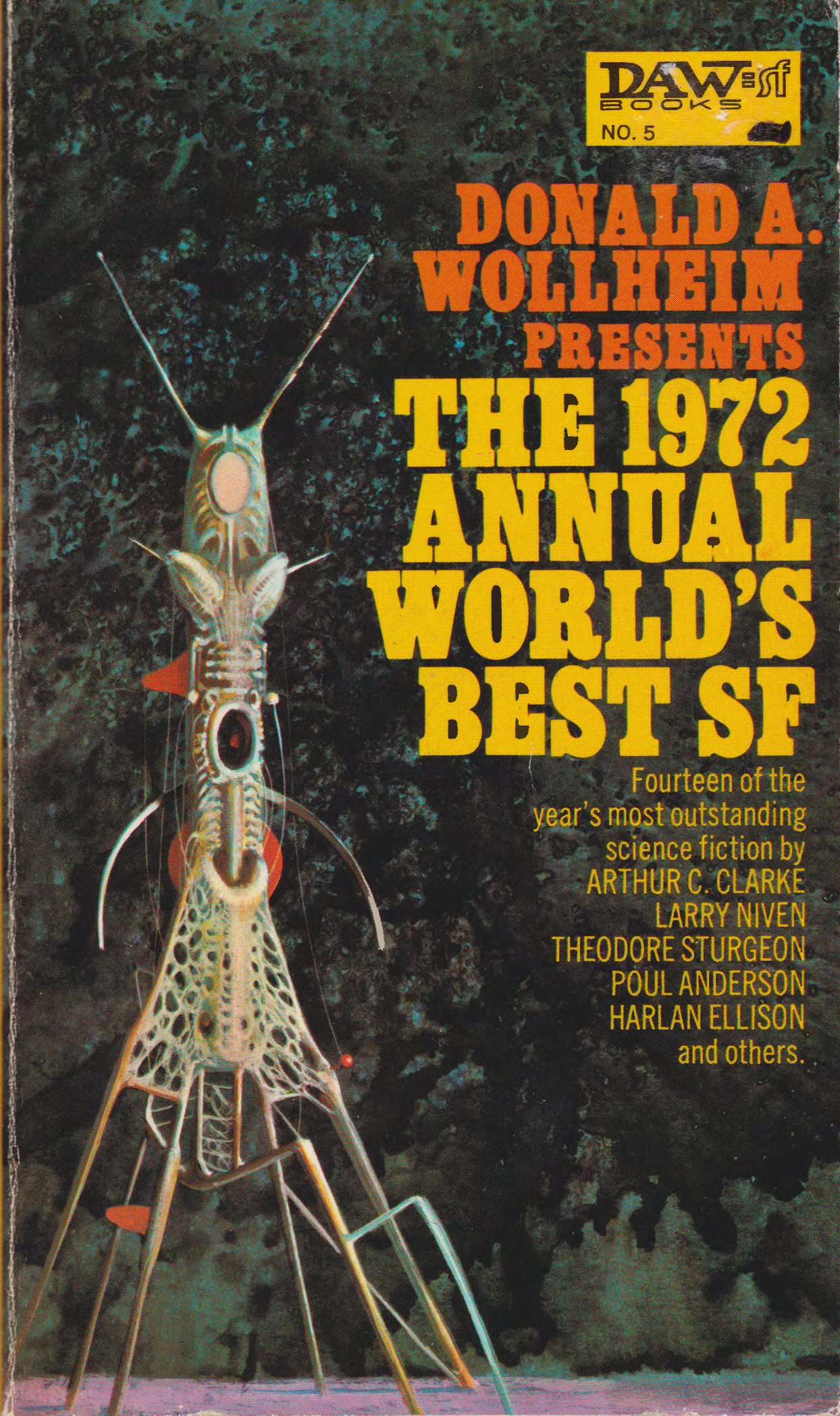
(John Schoenherr’s cover for the 1972 edition)

3.5/5 (collated rating: Good)

The 1972 Annual World’s Best SF, ed. Donald A. Wollheim (1972) doesn’t feel like a “best of” collection. The majority of the contents are unspectacular space operas and hard SF in the Analog vein. Amongst the chaff, a few more inventive visions shined through—in particular, Joanna Russ’ mysteriously gauzy and stylized experiment replete with twins and dream machines; Michael G. Coney’s evocative overpopulation story about tourist robots; Christopher Priest’s “factual” recounting of human experimental subjects that isn’t factual at all; and Barry Malzberg’s brief almost flash piece about differing perspectives all tied together by the New York metro.

On the whole, I give it a solid recommendation although the best can be found in single-author collections.

Brief Analysis/Summary

“The Fourth Profession” (1971), novelette by Larry Niven, 3/5 (Average): Nominated for the 1972 Continue reading

Updates: Recent Science Fiction Acquisitions No. CLXXXII (The Anthology Edition) (Best SF Stories from New Worlds 5, Orbit 6, Alpha 3, Best SF 1972)

Little pleases me more than reading the fascinating cross-section of the genre presented by anthologies from my favorite era of SF (1960s/70s). After the success that was World’s Best Science Fiction: 1967 (variant title: World’s Best Science Fiction: Third Series) (1967), ed. Donald A. Wollheim and Terry Carr, I decided to browse my “to post” pile of recent acquisitions and share a handful with you all. As is often the case, the collections are peppered with stories I’ve already read—I’ve linked the relevant reviews.

Filled with authors I haven’t read yet—Stephen Tall, Robin Scott, Roderick Thorp, Jean Cox, Christopher Finch, etc.

…and of course, many of my favorites including Gene Wolfe, Ursula Le Guin, Barry N. Malzberg, and Kate Wilhelm (among many many others).

Scans are from my collection.

1. The 1972 Annual World’s Best SF, ed. Donald A. Wollheim (1972)

(John Schoenherr’s cover for the 1972 edition) Continue reading

Updates: Recent Science Fiction Acquisitions No. CXXV (Pangborn + Janifer + Anthology + Biggle, Jr.)

A very odd selection today…  Some Christmas gift card holdovers and one volume I purchased online.  Including Edgar Pangborn’s most famous novel, a bizarre anthology of future artistic visions (with stories by Ellison, Clarke, Effinger, Zelazny, Dickson, Kornbluth, et al.), a collection of Lloyd Biggle, Jr.’s SF stories on music, and a most likely horrible pulp slave planet rebellion type novel by Laurence M. Janifer.

Thoughts?

1. Davy, Edgar Pangborn (1964)

(Robert Foster’s cover for the 1965 edition) Continue reading