Book Review: The Empty People, Barry N. Malzberg (as K. M. O’Donnell) (1969)

P1050045

(Howard Winters’ cover for the 1969 edition)

3.5/5 (Good)

“Inspecting a few she found that they were about what she had expected: the science-fiction books seemed to be full of nonsense about extraterrestrials or flights into space, the damnedest silliest stuff imaginable, and the sex part was sheer filth.  There was no question about it; there was no other way to describe those books” (12).

Science fiction as delusion.  More specifically, chapters replete with SF plots with evil aliens with interchangeable names and megalomaniacal claims to power culled straight from the pulps are delusions.  Imagined (perhaps?) by an average American man with “metastases” (14) growing in his brain while a concerned, albeit cheating, normal American housewife waits at his bedside.  The Empty People (1969) is considered Barry N. Malzberg’s (writing at K. M. O’Donnell) first SF novel.  However in the vein of his more famous Herovit’s World (1973), the most convincing interpretation of the novel suggests that the SF elements (purposefully clichéd and vaguely explained) are mere manifestations and torments of a diseased mind.

Originally Malzberg had aspirations to become a playwright and was even awarded multiple university playwright fellowships but was unable to break into the literary market.  Thus, he tried his hand at science fiction in the late 60s with some success (his most famous work would be published in the early 70s).  I would suggest that Malzberg’s palpable frustration writing SF can be found throughout the novel.  In The Empty People pulp science fiction plots, in their most general formulations, serve as instruments of repression Continue reading


Guest Post: A Little Knowledge, Michael Bishop (1977)

(Dean Ellis’ cover for the 1978 edition)

The sixth installment of my The Science Fiction of Michael Bishop guest post series was graciously provided by Heloise over at Heloise Merlin’s Weblog.  She is a long time fan of Michael Bishop’s work and we have engaged in numerous (fruitful) discussions of his work—including whether or not the first version of A Funeral for the Eyes of Fire (1975) is superior to his complete rewrite Eyes of Fire (1980).

Heloise purposefully chose one of Bishop’s lesser known novels.  But, from the review, A Little Knowledge (1977) has been wrongly ignored: “even though [A Little Knowledge] never leaves this single place on Earth, in the end Bishop’s novel manages to give more of a sense of what it means for humans to live in a vast, largely unexplored universe than most novels that are filled with large spaceships and far-future technologies.”

I plan acquiring a copy ASAP.

Visit Heloise’s site! Enjoy!  Comment!

michael bishop,header,02

A Little Knowledge (1977)—Michael Bishop

Michael Bishop’s Urban Nucleus sequence (consisting of the novel A Little Knowledge and the stories collected in Catacomb Years) is unusual among his early works in that it is not an anthropological Science Fiction novel; unlike books like A Funeral for the Eyes of Fire or And Strange at Ecteban the Trees, while reading A Little Knowledge, one is not so much reminded of Ursula K. LeGuin but it rather seems influenced by Philip K. Dick – and not by his largely consensual novels like Ubik or The Man in the High Castle, but his Continue reading

Updates: Recent Science Fiction Acquisitions No. CIII (Wilhelm + Clarke + Tucker + Malzberg)

Another Wilhelm to add to my growing stack of her novels and collections—I’ve read and reviewed quite a few recently: Margaret and I (1971), The Downstairs Room and Other Speculative Fiction (1968), and Juniper Time (1979)

More Malzberg (Ace Double story collection + discursive SF novel about fandom)—early stuff from his K. M. O’Donnell pseudonym days.

Clarke’s first novel—although my edition does not have the amazing cover I placed in the post (sorry!).

And, the perhaps OK novel, Ice & Iron (1974) by Wilson Tucker.  I really should read his more famous time travel novels first, I have at least two on the shelf….

Enjoy!

1. The Infinity Box, Kate Wilhelm (1975)

(Ed Soyka’s cover for the 1977 edition) Continue reading

Book Review: The Dream Master, Roger Zelazny (1966)

THDRMMSTR1966

(Kelly Freas’ cover for the 1966 edition)

4/5 (Good)

Roger Zelazny’s The Dream Master (1966)—expanded from the Nebula Award winning novella “He Who Shapes” (1965)—revolves around the Freudian notion of the centrality of dreams and importance of decoding dreams for psychoanalytical treatment.  Susan Parman, in Dream and Culture (1990), points out that Freud was initially focused on “treating ‘abnormal’ patients” but soon “expanded his theory of psychoanalysis to explain puzzling events in ‘normal’ behavior” including dreams.  Freud’s influential work The Interpretation of Dreams (1899) argued that the “dream expresses the secret wishes of the soul” where the dreamscape is the “arena” in which good and bad forces are engaged in a struggle.  Thus, the dream is a message that must be deciphered by an “allegorical Continue reading

Updates: Recent Acquisitions No. CI (Clarke + Bishop + Varley + Maclennan)

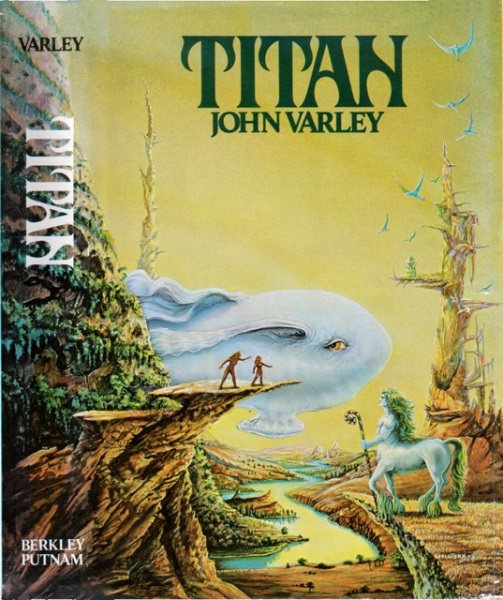
A nice range of SF authors/works!  A Michael Bishop collection containing many of his most famous 70s short stories for my upcoming guest post series….  And a SF juvenile written by Phyllis Maclennan with an intriguing premise (although, as always, I’m very dubious about juveniles in general).  John Varley’s famous novel Titan (1979) seems like a fascinating take on the Big Dumb Object trope. And finally a 50s adventure by the indomitable Arthur C. Clarke.

I am most intrigued by the Varley’s Titan and Bishop’s Blooded on Arachne.

Some of the covers are cringe inducing.

Thoughts?

1. Titan, John Varley (1979)

TTNRPPCRKF1979

(Ron Waltosky’s cover for the 1979 edition) Continue reading

Updates: Recent Science Fiction Acquisitions No. C (Bishop + A. E. Van Vogt + Pangborn + Pratt)

Another Michael Bishop novel for my upcoming guest post series (announcement coming soon)!  Irresistible after the brilliant Stolen Faces (1977) and his masterpiece A Funeral for the Eyes of Fire (1975)….

The rest are fun but not high on my list of must reads.  I’ve never been a fan of A. E. Van Vogt (could not tolerate the inarticulate labyrinth of a novel The World of Null-A) but the Powers cover on The War Against the Rull (1959) was fun.

I’ve heard good things about Edgar Pangborn, although people seldom discuss West of Eden (1953), perhaps with good reason.

Fletcher Pratt’s Invaders from Rigel (1932) is one of those AMAZING covers but incredibly dubious reads.  Even the back cover is rather non-sensical.

Thoughts?

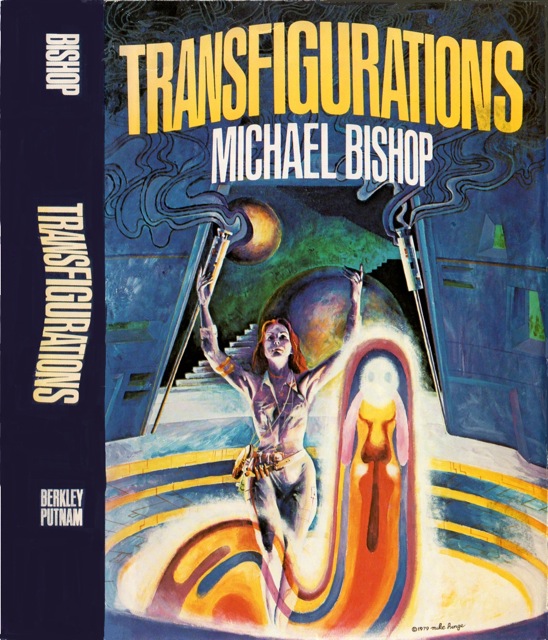
1. Transfigurations, Michael Bishop (1979) (MY REVIEW)

TRNSFGRTND1980

(Mike Hinge’s cover for the 1979 edition) Continue reading

Book Review: Stolen Faces, Michael Bishop (1977)

(Steve Hickman’s cover for the 1978 edition)

4.75/5 (Near Masterpiece)

“The growths beside her mouth moved like living tumors when she spoke.” (19)

There is nothing superfluous in Michael Bishop’s Stolen Faces (1977).  Like some nightmarish condensate that gathers into waiting cups, it induces hellish visions.  Metaphors and images of bodily decay, societal decadence, and strange rituals abound.  I suspect that Bishop’s profoundly uncomfortable themes, deliberate plotting, and metaphorical/literary way of telling have prevented the novel from gaining a wider audience.

Continue reading

Adventures in Science Fiction Cover Art: Existential Crisis

PRTNTRRRRM1968

(Uncredited cover for the 1968 edition of Operation Terror (1962), Murray Leinster)

Barry N. Malzberg’s depressed/depraved astronauts have inspired me to make a post! (unfortunately, the covers for his books do not really fit the bill).

Guy Billot’s cover for the 1975 edition of Brian Stableford’s Man in a Cage (1975) perfectly embodies the feel of existential crisis—man, hemmed in by a single red line, raises his arms against the star-studded sky in anguish.  The nature of the crisis is left oblique.  I have selected a variety of covers that convey—with varying degrees of success/precision—this same mental state.

I admit that some might not fit the bill exactly—for example, in the uncredited Continue reading