Book Review: The Gamesman, Barry N. Malzberg (1975)

(Ed Soyka’s cover for the 1975 edition)

4.5/5 (Very Good)

“The Game is not a metaphor. The Game is not a closed system which represents something larger; but the choices made within its pathways are exactly that, choices which have to do with the immediate outcome. It would be a mistake to think of the success or failure in the Game having anything to do with the world. There are not metaphors. There are no outer significances. There is merely the Game itself and what it accomplishes upon its participants” (37).

In Jorge Luis Borges’ 1941 short story, “The Library of Babel” the universe is conceived of as a vast library stretching in all directions.  In this spectacular environment—an endless series of hexagonal rooms, each one with the same number of shelves with the same number of books with the same number of letters inscribed on each page, etc. Borges brings into sharp, and unsettling relief, complex metaphysical speculations.

In The Gamesman (1975) Barry N. Malzberg creates a similarly sculpted world with two bifurcated Continue reading

Updates: Recent Science Fiction Acquisitions No. CIX (Holland + Snyder + Malzberg 2x)

A grab bag of risk (Cecelia Holland + Guy Snyder) and great reward (Barry N. Malzberg)!  I would love to know what you think.  I know Holland’s Floating Worlds (1976) was picked up by the SF Masterwork series put out by Gollancz but I know next to nothing about the novel.

And, well, Malzberg is my favorite SF author (metafiction + experimentation + Freud + recursive elements) so I know what I’m getting with his stuff!

Thoughts?

1. Floating Worlds, Cecelia Holland (1976)

(Melvyn Grant’s cover for the 1978 edition) Continue reading

Book Review: Indoctrinaire, Christopher Priest (1970)

(Bruce Pennington’s cover for the 1971 edition)

3.25/5 (Slightly Above Average)

“There is an element of terror in any natural object that does not exist in its proper place. Wentik experienced the full force of this as he stood in the dark. A hand grows from a table, and an ear from a wall. A maze is constructed to sophisticated mathematical formula, yet is housed in a tumbledown shack. A minor official terrorizes me, and a man tries to fly a helicopter without vanes. Land exist in future time, through I feel and believe instinctively that I am in the present. What else will this place do to me? (83)”

Christopher Priest’s first novel Indoctrinaire (1970) explores the mystery of a vast perfectly round plain with a series of strange buildings that appears in the middle of the Amazonian jungle.  Seemingly displaced in time, the transformed landscape is not only a visible sign of the ecological transformation the world will undergo but also, less visibly, the unseen but pernicious scars Continue reading

Updates: Recent Science Fiction Acquisitions No. CVIII (Malzberg + Bishop + Sheckley + White)

What a haul!  Three are from numerous previous expeditions to choice used book havens….  And I caved in and bought Malzberg’s The Destruction of the Temple (1974) on abebooks because his seldom reprinted works are hard to find.

Sheckley’s Journey Beyond Tomorrow (1962) is near the top of my reading list.  Supposedly one of his best.

And, who can resist Michael Bishop’s magnum opus, No Enemy But Time (1982)?!?

And James White is always solid…

Thoughts?  Anything particularly worth reading?

1. The Destruction of the Temple, Barry N. Malzberg (1974)

(Uncredited cover for the 1974 edition) Continue reading

Book Review: The Centauri Device, M. John Harrison (1974)

(Paul Lehr’s cover for the 1980 edition)

4/5 (Good)

I can only imagine the shock that readers received and still receive (according to amazon reviews) after diving into M. John Harrison’s The Centauri Device (1974) expecting a standard space opera.  This is a subgenre where the anti-hero still has not found a firm place to roost…  You know the rubric: Empathizing with the hero.  Positivism.  Saving the world.  The good guys win.

I suspect the shock to the system that Stephen R. Donaldson’s leprous and bitter (and reluctant) savior Thomas Covenant in Lord Foul’s Bane (1977) and subsequent novels had on high fantasy was something akin to impact The Centauri Device‘s drug-addled, inarticulate, and passive spacer Continue reading

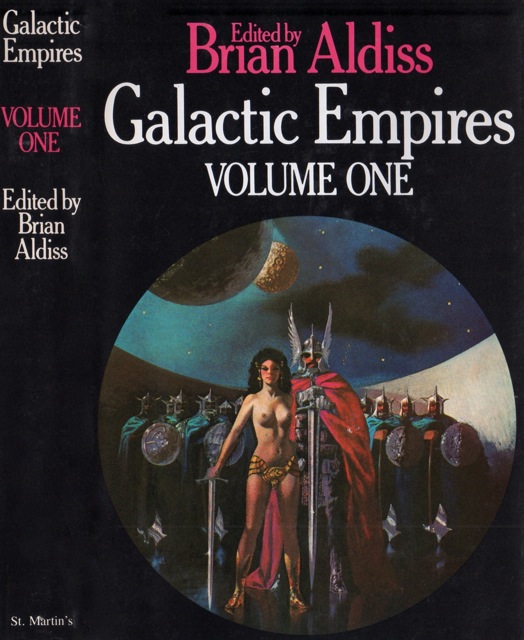
Updates: Recent Science Fiction Acquisitions No. CVII (Anthology: Galactic Empires, vol 1 and 2 + Holdstock + Watson)

Snatched all but one of these up at a 1$ SF hardback clearance sale at my local bookstore.  The other, Watson’s The Jonah Kit (1976) came via The Dawn Treader Bookstore in Ann Arbor, MI.

I am not usually interested in Galactic Empires but the collection seems to have some intriguing short authors—for example, Lafferty, Davidson, Shaara, etc whose works I have no been that exposed to.  I look forward to slowly working my way through both volumes.

I also acquired my first Robert Holdstock novel, Where Time Winds Blow (1981).  Seems intriguing.

My schedule has finally calmed down a little so expect a slew of book reviews in the coming days/weeks…

Thoughts?

1. Galactic Empires, Volume I, ed. Brian Aldiss (1976)

GLCTCMPRSV1978

(Karel Thole’s cover for the 1978 edition) Continue reading

Updates: Recent Science Fiction Acquisitions No. CVI (Malzberg + Laumer + Sargent + Russell)

A few more wonderful acquisitions from my pilgrimage to Dawn Treader Books in Ann Arbor, MI from month or so ago.

More Malzberg!  And thankfully, one of the few really solid covers to grace his extensive oeuvre.  I read Sargent’s novel Cloned Lives (1976) recently and was disappointed.  Hopefully her short story collection Starshadows (1977) is more my cup of tea.

A 50s “classic” by Erin Frank Russell…

And a collection of short works on time travel by Keith Laumer….  Could not resist the early Di Fate cover which I have featured in art posts before.

Thoughts?

1. Timetracks, Keith Laumer (1972)

(Vincent Di Fate’s cover for the 1972 edition) Continue reading

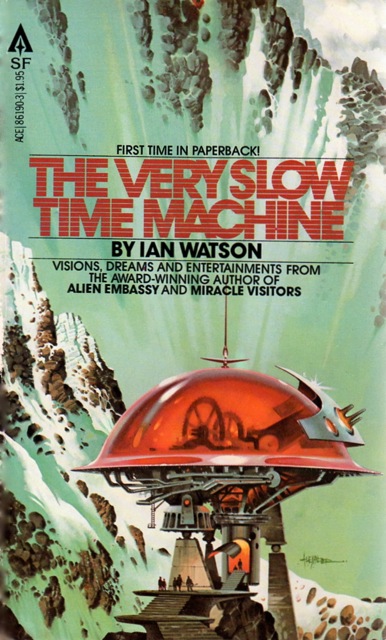
Book Review: The Very Slow Time Machine, Ian Watson (1979)

VRYSLWTM19XX

(Paul Alexander’s cover for the 1979 edition)

4.5/5 (Very Good)

My first exposure to Ian Watson’s extensive SF catalog could not have been more impressive.  The Very Slow Time Machine (1979) is up there with Robert Sheckley’s Store of Infinity (1960) and J. G. Ballard’s Billenium (1962) as the best overall collection of stories that I have encountered in the history of this site.

The collection is filled with narrative experimentation (“Programmed Loved Story,” “Agoraphobia, A.D. 2000,” etc), some awe inspiring ideas (“The Very Slow Time Machine,” “The Girl Who Was Art” etc.), a few delightful allegories (“Our Loves So Truly Meridional,” “My Soul Swims in a Goldfish Bowl”), and a handful of more traditional SF stories that hint at anthropological Continue reading

Adventures in Science Fiction Cover Art: Josh Kirby’s Astronauts (1957-1976)

THRPRDCTVS1970

(Josh Kirby’s cover for the 1970 edition of The Reproductive System (variant title: Mechasm) (1968), John Sladek)

It has been too long since I collated a cover art post…  I have a love hate relationship with Josh Kirby’s work.  He tends to be on the comedic side, for example, he provided covers for a large percentage of Ron Goulart’s DAW titles (The Wicked Cyborg, etc) and Prachett’s Discworld novels.

However, for a brief window of time in the 60s and 70s he produced some gorgeously surreal depictions of astronauts and and astronaut transformations.  His cover for the 1970 edition of The Reproductive System (variant Continue reading