Updates: Recent Science Fiction Acquisitions No. CIV (Yarbro + Priest + Farmer + Malzberg)

Ann Arbor’s Dawn Treader Book Store contains the best used SF collection I have encountered in my perambulations (fortunately, I live far away or else I would empty my bank account).  Prepare for its manifold and manifest joys (multiple parts over the next month or so)!

What a haul!  I have yet to read a Chelsea Quinn Yarbro novel—this one is her most famous work so I look forward to it despite the creepy wolf/man with blood on the cover.  Also, Farmer has somewhat redeemed himself in my eyes with Strange Relations (1960)—thus, the metafictional account of a man who recreates the Burrough’s Tarzan tales sounds like an experimental New Wave SF novel right up my alley.

As does Christopher Priest’s Indoctrinaire (1970)…  I think I will read this one before I tackle Inverted World (1974) that I acquired a while back but never felt like reading.

And, I bought FOUR novels by one of my favorite authors, Barry N. Malzberg—the first is On a Planet Alien (1974).  Will read this one soon.

Thoughts?  Have you read any of the novels?

1. False Dawn, Chelsea Quinn Yarbro (1978) (MY REVIEW)

(Gary Friedman’s cover for the 1978 edition) Continue reading

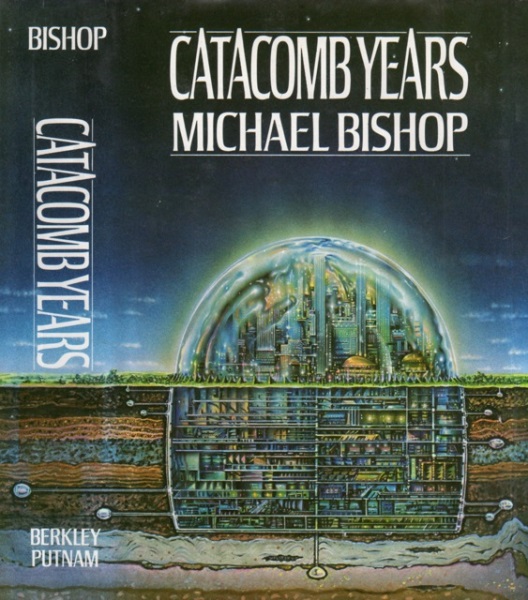
Guest Post: Catacomb Years, Michael Bishop (1979)

CTCMBYRS5E1979

(Ron Walotsky’s cover for the 1979 edition)

The eighth (!) installment in my Michael Bishop Guest post series comes via my longtime fellow SF blogger/friend (well, multiple years) 2theD (twitter:@SFPotPourri) at PotPourri of Science Fiction Literature.  And this is a darn good linked collection of Bishop stories.

I highly recommend you check out 2theD’s blog, follow him on twitter, peruse his large collection of reviews…

michael bishop,header,02

All cities are built on voiceless narratives

Collated rating: 5/5

Buying Michael Bishop’s Catacomb Years was a wise investment, albeit an impulse buy at the second-hand bookstore. This is the only Bishop novel, or collection, I own. Originally, it was going to stay stacked in my to-be-read pile for 3-4 years in the future (hey, I have a lot of catching up to do in my library) but the alluring cover proved  too much… that and Joachim Boaz manhandled me from 8,700 miles away into reading it for his collection of guest posts on the work of Michael Bishop.

You’d be a dullard if you weren’t initially struck by either the premise or the cover art: As history barrels forward in a the manner of a drunkard, American cities like Atlanta eventually cap themselves in domes under the idea of Preemptive Isolation, only to suffer the pangs of dying from its onset Continue reading

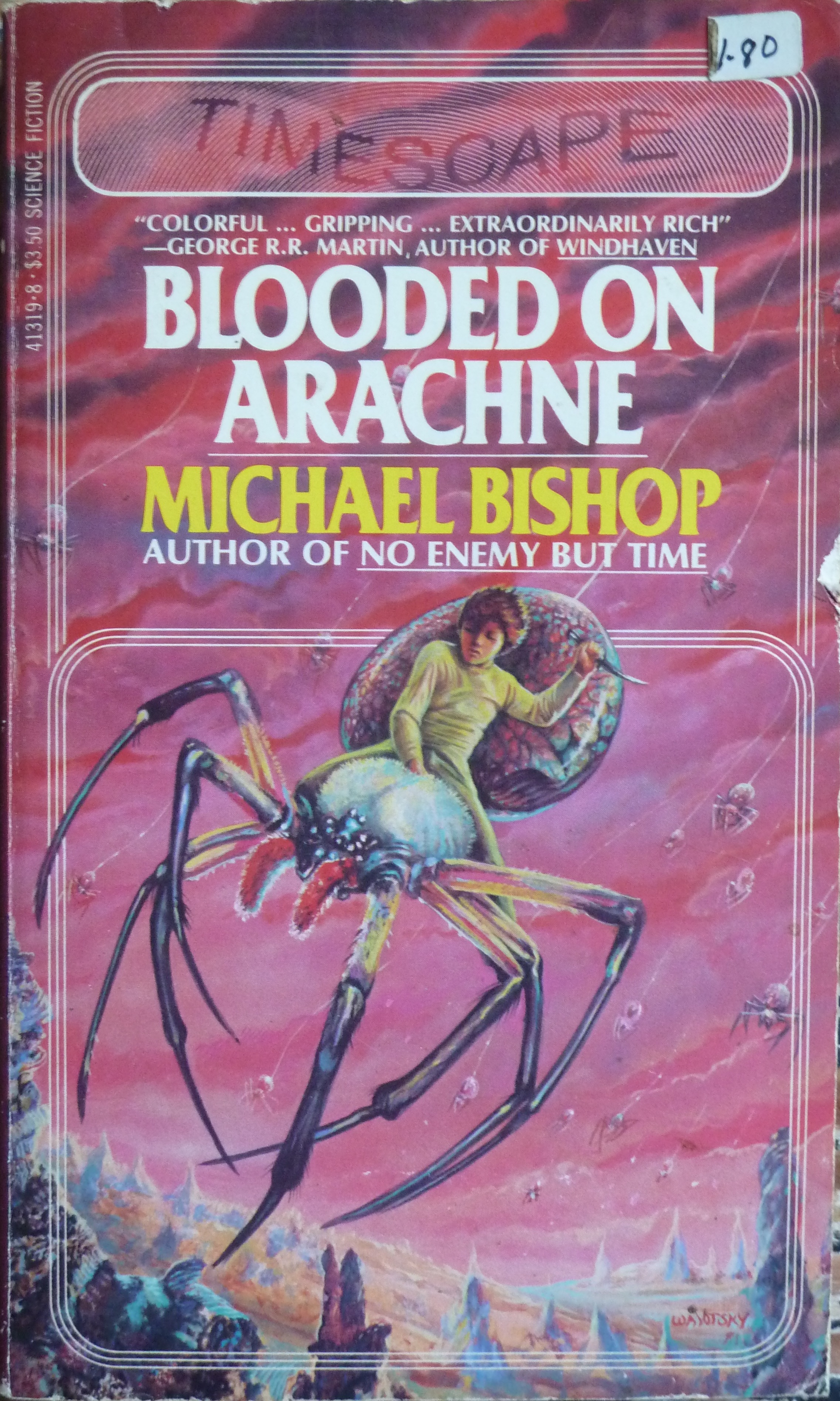
Guest Post: Blooded on Arachne (selections), Michael Bishop (1982)

P1050043

(Ron Walotsky’s cover for the 1982 edition)

The seventh installment of my guest post series on the SF of Michael Bishop comes via Carl V. Anderson (twitter: @SteelDroppings) over at the SF/F site Stainless Steel Droppings.  Although he does not often review older SF he was excited to participate in my project.  We decided to split Bishop’s first collection of short stories, Blooded on Arachne (1982).  Although he found a few of the stories rather hit or miss, he was blown away by “In Chinistrex Fortronza the People are Machines” 5/5 among others.  Check out Carl’s worthwhile site (for example, posts on the new Hugo art nominees, Andre Norton reviews etc. etc. etc.)

Screen shot 2014-04-19 at 7.30.08 PM

Blooded on Arachne (1982)–Michael Bishop

When Joachim Boaz asked me to join a group to guest post about author Michael Bishop, I jumped at the opportunity despite my overwhelming schedule. I had not been doing much short story reading, and the proposition of exploring work from an author I had not read…admittedly don’t recall ever having heard of…excited me. Of course there was more to it than that. Having followed Joachim’s site for several years and knowing his passion Continue reading

Book Review: The Empty People, Barry N. Malzberg (as K. M. O’Donnell) (1969)

P1050045

(Howard Winters’ cover for the 1969 edition)

3.5/5 (Good)

“Inspecting a few she found that they were about what she had expected: the science-fiction books seemed to be full of nonsense about extraterrestrials or flights into space, the damnedest silliest stuff imaginable, and the sex part was sheer filth.  There was no question about it; there was no other way to describe those books” (12).

Science fiction as delusion.  More specifically, chapters replete with SF plots with evil aliens with interchangeable names and megalomaniacal claims to power culled straight from the pulps are delusions.  Imagined (perhaps?) by an average American man with “metastases” (14) growing in his brain while a concerned, albeit cheating, normal American housewife waits at his bedside.  The Empty People (1969) is considered Barry N. Malzberg’s (writing at K. M. O’Donnell) first SF novel.  However in the vein of his more famous Herovit’s World (1973), the most convincing interpretation of the novel suggests that the SF elements (purposefully clichéd and vaguely explained) are mere manifestations and torments of a diseased mind.

Originally Malzberg had aspirations to become a playwright and was even awarded multiple university playwright fellowships but was unable to break into the literary market.  Thus, he tried his hand at science fiction in the late 60s with some success (his most famous work would be published in the early 70s).  I would suggest that Malzberg’s palpable frustration writing SF can be found throughout the novel.  In The Empty People pulp science fiction plots, in their most general formulations, serve as instruments of repression Continue reading

Guest Post: A Little Knowledge, Michael Bishop (1977)

(Dean Ellis’ cover for the 1978 edition)

The sixth installment of my The Science Fiction of Michael Bishop guest post series was graciously provided by Heloise over at Heloise Merlin’s Weblog.  She is a long time fan of Michael Bishop’s work and we have engaged in numerous (fruitful) discussions of his work—including whether or not the first version of A Funeral for the Eyes of Fire (1975) is superior to his complete rewrite Eyes of Fire (1980).

Heloise purposefully chose one of Bishop’s lesser known novels.  But, from the review, A Little Knowledge (1977) has been wrongly ignored: “even though [A Little Knowledge] never leaves this single place on Earth, in the end Bishop’s novel manages to give more of a sense of what it means for humans to live in a vast, largely unexplored universe than most novels that are filled with large spaceships and far-future technologies.”

I plan acquiring a copy ASAP.

Visit Heloise’s site! Enjoy!  Comment!

michael bishop,header,02

A Little Knowledge (1977)—Michael Bishop

Michael Bishop’s Urban Nucleus sequence (consisting of the novel A Little Knowledge and the stories collected in Catacomb Years) is unusual among his early works in that it is not an anthropological Science Fiction novel; unlike books like A Funeral for the Eyes of Fire or And Strange at Ecteban the Trees, while reading A Little Knowledge, one is not so much reminded of Ursula K. LeGuin but it rather seems influenced by Philip K. Dick – and not by his largely consensual novels like Ubik or The Man in the High Castle, but his Continue reading

Updates: Recent Science Fiction Acquisitions No. CIII (Wilhelm + Clarke + Tucker + Malzberg)

Another Wilhelm to add to my growing stack of her novels and collections—I’ve read and reviewed quite a few recently: Margaret and I (1971), The Downstairs Room and Other Speculative Fiction (1968), and Juniper Time (1979)

More Malzberg (Ace Double story collection + discursive SF novel about fandom)—early stuff from his K. M. O’Donnell pseudonym days.

Clarke’s first novel—although my edition does not have the amazing cover I placed in the post (sorry!).

And, the perhaps OK novel, Ice & Iron (1974) by Wilson Tucker.  I really should read his more famous time travel novels first, I have at least two on the shelf….

Enjoy!

1. The Infinity Box, Kate Wilhelm (1975)

(Ed Soyka’s cover for the 1977 edition) Continue reading

Book Review: The Dream Master, Roger Zelazny (1966)

THDRMMSTR1966

(Kelly Freas’ cover for the 1966 edition)

4/5 (Good)

Roger Zelazny’s The Dream Master (1966)—expanded from the Nebula Award winning novella “He Who Shapes” (1965)—revolves around the Freudian notion of the centrality of dreams and importance of decoding dreams for psychoanalytical treatment.  Susan Parman, in Dream and Culture (1990), points out that Freud was initially focused on “treating ‘abnormal’ patients” but soon “expanded his theory of psychoanalysis to explain puzzling events in ‘normal’ behavior” including dreams.  Freud’s influential work The Interpretation of Dreams (1899) argued that the “dream expresses the secret wishes of the soul” where the dreamscape is the “arena” in which good and bad forces are engaged in a struggle.  Thus, the dream is a message that must be deciphered by an “allegorical Continue reading

Updates: Recent Acquisitions No. CI (Clarke + Bishop + Varley + Maclennan)

A nice range of SF authors/works!  A Michael Bishop collection containing many of his most famous 70s short stories for my upcoming guest post series….  And a SF juvenile written by Phyllis Maclennan with an intriguing premise (although, as always, I’m very dubious about juveniles in general).  John Varley’s famous novel Titan (1979) seems like a fascinating take on the Big Dumb Object trope. And finally a 50s adventure by the indomitable Arthur C. Clarke.

I am most intrigued by the Varley’s Titan and Bishop’s Blooded on Arachne.

Some of the covers are cringe inducing.

Thoughts?

1. Titan, John Varley (1979)

TTNRPPCRKF1979

(Ron Waltosky’s cover for the 1979 edition) Continue reading

Updates: Recent Science Fiction Acquisitions No. C (Bishop + A. E. Van Vogt + Pangborn + Pratt)

Another Michael Bishop novel for my upcoming guest post series (announcement coming soon)!  Irresistible after the brilliant Stolen Faces (1977) and his masterpiece A Funeral for the Eyes of Fire (1975)….

The rest are fun but not high on my list of must reads.  I’ve never been a fan of A. E. Van Vogt (could not tolerate the inarticulate labyrinth of a novel The World of Null-A) but the Powers cover on The War Against the Rull (1959) was fun.

I’ve heard good things about Edgar Pangborn, although people seldom discuss West of Eden (1953), perhaps with good reason.

Fletcher Pratt’s Invaders from Rigel (1932) is one of those AMAZING covers but incredibly dubious reads.  Even the back cover is rather non-sensical.

Thoughts?

1. Transfigurations, Michael Bishop (1979) (MY REVIEW)

TRNSFGRTND1980

(Mike Hinge’s cover for the 1979 edition) Continue reading