Book Review: A Pail of Air, Fritz Leiber (1964)

(Richard Powers’ cover for the 1964 edition)

4/5 (Collated rating: Good)

My only previous exposure to Fritz Leiber was his enjoyable and highly experimental Hugo-winning novel The Big Time (1958) — an unusual story (evoking a one-act play) whose characters are soldiers recruited from all eras of history relaxing in between missions during a vast temporal war.  The same sort of invention and incisive wit abounds in the collection A Pail of Air (1964).  Against a post-apocalyptical backdrop that runs throughout most of the stories, Leiber’s stories are chimeric (and satirical) parables on a vast spectrum of themes — the mechanization of the future, gender relations, endless war, media saturation…  The stories shift between whimsical delight and gut-wrenching despair.

This collection of eleven stories from the early 50s to the early 60s is highly recommended for all SF fans — especially the title story  “A Pail of Air” (1951),  “The Foxholes of Mars” (1952), Continue reading

Book Review: Armed Camps, Kit Reed (1969)

Screen shot 2013-08-29 at 9.24.15 AM(Bob Haberfield’s cover for the 1969 edition)

4.5/5 (Very Good)

“[…] and the men were on the way to the bar, they were talking about the performance, they had to compare it to every other performance, they had to link them all and form them into something continuous, something to keep away the dark” (19).

Kit Reed’s first SF novel Armed Camps (1969) is all about characters constructing narratives and conjuring visions in order to keep the aphotic tides of societal disintegration at bay.  The two paralleled narratives — a woman (Anne) running from her past and a man (Danny March) slowly recounting what led to his own downfall — are two different ways of fighting off what is bound to come.  An oppressive melancholy that never lifts soaks the passages, presaging the motions of the characters as if they are trapped in some Thucydidean manifestation of the cyclicality Continue reading

Book Review: The Deep, John Crowley (1975)

(Richard Powers’ cover for the 1976 edition)

4.5/5 (Very Good)

The Deep (1975) was John Crowley’s first published novel and his first of three SF works from the 70s (The Deep, Beasts, Engine Summer).  He is best known for Engine Summer (1979) and his complex/literary fantasy — Little, Big (1981) and the Ægypt sequence (1987-2007).  In the two novels of his I’ve read (the other is Beasts), Crowley’s prose is characterized by an almost icy detachment, an adept construction of unusual images, and dialogue that says only what is needed.

The Deep deploys, in minimalistic fashion, the standard tropes of the fantasy genre mixed with distinctly SF elements: namely, an android visitor whose blood “was alive — it flowed  Continue reading

Updates: Recent Science Fiction Acquisitions N. LXIX (Sladek + Reed + McIntyre + Anthony)

Unlike other acquisition posts where I post the most palatable finds from the shelves of a local used book store, this one contains books that I have wanted to own for a long time and finally gave in and bought online — more Kit Reed (after her wonderful collection 1967 Mister Da V. which I recently reviewed), a novel by one of the great (and underread and probably underrated) SF satirists — John T. Sladek — of the 60s/70s, Piers Anthony’s early New Wave experimental work, and Vondra N. McIntrye’s first novel.

A quick non-scientific poll of my fellow reviewers on twitter (if you are so inclined, follow me!) showed that few had read Sladek’s work recently…  Is it time for a mini-Renaissance of his works?

Some fun covers, great authors — these will be read soon….  Unlike the other 300+ works in my too read pile.

1. The Reproductive System (variant title: Mechasm), John T. Sladek (1968)

(Leo and Diane Dillon’s cover for the Continue reading

Book Review: Approaching Oblivion, Harlan Ellison (1974)

(Leo and Diane Dillon’s cover for the 1974 edition)

4.25/5 (collated rating: Good)

Ellison’s stories punch where it hurts.  Approaching Oblivion (1974) is filled with transfixing tales about violent future racism (“Knox”), humanity’s last moments (“Kiss of Fire”), the desperate desire to change one’s own past (“One Life, Furnished in Early Poverty”), a last rebel against the militarizing system (“Silent in Gehanna”), and familial rivalry within a vast arcology (“Catman”), etc…

They are terrifying and vicious, immersive and gut-wrenching, and span from baroque far future speculations to near future warnings.  Above all, they are well-written and intelligent.  Many are infused with (pseudo) autobiographical content and lament the societal ills Continue reading

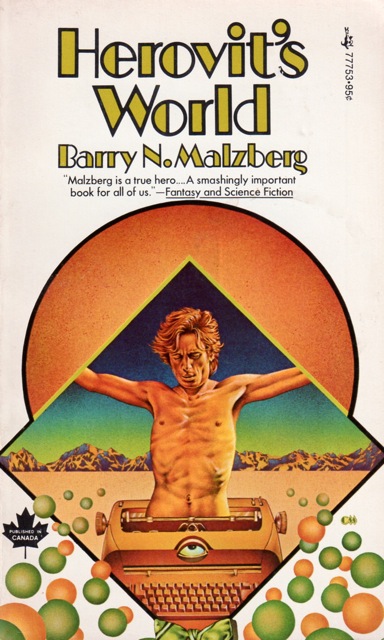
Book Review: Herovit’s World, Barry N. Malzberg (1973)

(Charles Moll’s cover for the 1974 edition)

3.5/5 (Good)

Note: Today is Barry N. Malzberg’s birthday!

Upon reading In the Enclosure (1973) I was immediately seduced by Barry N. Malzberg’s metafictional brand of science fiction — best illustrated by his masterpieces Beyond Apollo (1972) and Revelations (1972).  Although Herovit’s World (1973) contains many of the same metafictional trademarks of Malzberg’s best work, it should be noted that the novel is not science fiction and more a work about writing (pulp) science fiction.  In this case, the mental collapse of a pulp writer whose life may or may not contain “true” autobiographical kernels from Malzberg’s own experience Continue reading

Adventures in Science Fiction Cover Art: Domed Cities (and Outposts) of the Future, Part IV

Screen shot 2013-01-25 at 9.47.21 PM

(Ley Kenyon’s cover for the 1953 edition of Adventures in Tomorrow (1951), ed. Kendell F. Crossen)

Since the release of the TV series Under the Dome (2013-), based on Stephen King’s 2009 novel by the same name, there has been a resurgence of interest in domed cities.  And for good reason — the trope is one of the most popular of science fiction artists and authors since the 30s (and probably earlier).  Not only do the societal implications and visual allure of the trope of a domed outpost on a harsh planet or a domed city amidst the ruins of Earth arouse the creative authorial juices but also generate some fantastically Continue reading

Book Review: Why Call Them Back From Heaven?, Clifford D. Simak (1967)

(Leo and Diane Dillon’s cover for the 1970 edition)

4.5/5 (Very Good)

I have found that the most successful science fiction novels on the theme of immortality are not about the immortals themselves or the state of “being immortal.”  Novels like Raymond Z. Gallun’s The Eden Cycle (1974) might attempt to convey, at moments effectively, the ennui of an endless existence with endless possibilities but, as with mind of the immortal in question, the reader too feels the effects of endless, repetitive inundation.  Rather, the most successful and evocative novels — for example James Gunn’s The Immortals (1962) — explore the social space that is created by the presence of immortals although they might be only peripheral characters.  Simak’s Why Call Them Back From Heaven? (1967) takes Gunn’s premise a step further: What would happen to our society if almost everyone bought into the idea that immortality would be a real possibility sometime in the future? Continue reading

Book Review: Mister Da V. and Other Stories, Kit Reed (1967)

Screen shot 2013-07-16 at 10.06.04 AM

(Uncredited cover for the 1967 edition)

4.25/5 (collated rating: Good)

Kit Reed has been publishing literary, thought-provoking, and darkly satirical sci-fi + speculative fiction + non-genre fiction since the late 50s… And she is still going strong — her most recent novel Son of Destruction (2012) came out last year.  Reed’s collection Mister Da V. and Other Stories (1967) contains three stories from the late 50s including her first published work, ‘The Wait’ (variant title: ‘To be Taken to a Strange Country’) (1958) and ten others from the 60s.  A few of the stories in the collection are not overtly science fiction — regardless, one could argue that all but ‘I am Through with Bus Trips’ (1967) contain speculative and/or sci-fi elements.

There are superficial differences between the 1967 Faber and Faber edition and the 1973 Berkley Medallion edition.  Because I own the Berkley paperback I’ve gone ahead and followed its chronological story order and page numbers.

A few of the themes/topics of the volume:  Paranoia.  Post-apocalyptic Landscapes.  Youth  Continue reading