Today I’ve reviewed the twenty-first story in my series on the science fictional media landscape of the future. Ray Bradbury conjures a strange new world without television.
Adrian Chesterman’s cover for the 1980 edition of The Day It Rained Forever (1959)
3.5/5 (Good)
Ray Bradbury’s “Almost the End of the World” first appeared in The Reporter (December 26, 1957). It later appeared in his short story collection The Day It Rained Forever (1959). If you have an Internet Archive account, you can read it online here.
In multiple earlier reviews in this series, I’ve laid out television’s transformative and speedy infiltration of the American consciousness and daily activities over the course of the 1950s. Multiple Bradbury stories critique this new world. The lovely and crystalline “The Pedestrian” (1951) imagined a future night city in which its denizens are transfixed by their TV scenes. The city, observed by the solitary one-time writer Leonard Mead, is as silent as “a wintry, windless Arizona country” (90). “Almost the End of the World” (1957) ruminates on the effects on American society if a cosmic event severs the viewer from the succor of the screen.
Wallace Wood’s interior art for Frederik Pohl’s “The Wizards of Pung’s Corners” in Galaxy Magazine, ed. H. L. Gold (October 1958).
Today I’ve reviewed the twentieth story in my series on the science fictional media landscape of the future. Frederik Pohl satirizes a post-apocalyptic world where advertising gets right to work after the bomb!
Dember’s cover for Galaxy Magazine, ed. H. L. Gold (October 1958)
3/5 (Average)
Frederik Pohl’s “The Wizards of Pung’s Corners” first appeared in Galaxy Magazine, ed. H. L. Gold (October 1958). You can read it online here.
The year 1957 flashed subliminal messaging directly into the popular imagination. Vance Packard published The Hidden Persuaders (1957), that quickly became a best seller, and articlesincluding “The Growing Power of Admen” in the Atlantic [1]. In addition, research findings were released and publicized demonstrations occurred over the course of the year appeared to substantiate Packard’s primary claims. In September 1957 James Vicary, a pioneer in subliminal advertising, conducted his infamous “breakthrough media event” to gathered reporters [2]–he intermixed a nature documentary with the subliminal message “Drink Coca-Cola” 169 times! –that built on his earlier studies [3].
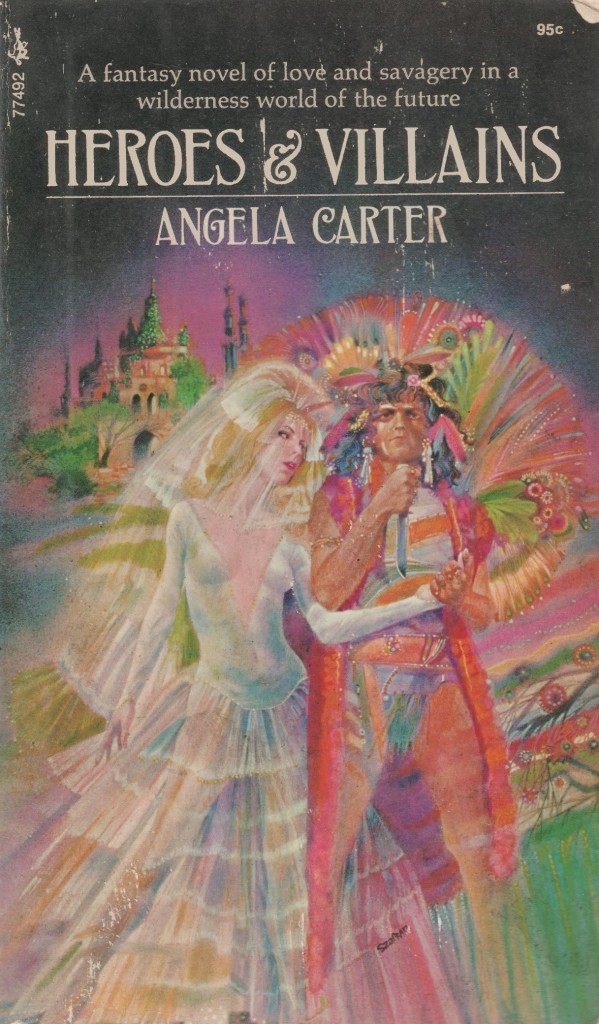
English author Angela Carter (1940-1992) spun postmodern fabulations of decadent futures and decaying urban expanses replete with incisive deconstruction of genre conventions [1]. Her dark, Freudian, and erotic masterpiece The Infernal Desire Machines of Doctor Hoffman (1972) ranks amongst my favorite SF 70s visions. From a young age Carter read John Wyndham and, like so many others in the 60s, felt the relentless pull of Michael Moorcock’s New Worlds magazine and the larger New Wave movement: “this lode, this seam of intensely imaginative and exciting fiction” [2]. And, as with her contemporary Emma Tennant, the work of J. G. Ballard–and/or his ability to fill the air with his entropic sadness–spurred her to write post-apocalyptic SF [3]. Heroes & Villains (1969) is the product of her inspiration and “her first tale to engage in a recognizably sf displacement of reality” [4].
Rob Latham in his article “Sextrapolation in New Wave Science Fiction” (2008) argues that in the early 1950s “a handful of stories were published in the magazines that dealt explicitly with sexual topics” long absent from genre. Latham suggests that some of the notable New Wave takes on science fictional sex read as reconceptualized versions of these stories [2]. With few exceptions, the 50s trailblazing tales were ignored by the major digests of the day and instead appeared in the failing pulps–Startling Stories and Thrilling Wonder Stories–or in “second- and third-tier digests just struggling to establish themselves” such as Howard Browne’s Fantastic Adventures. For example, my two previous posts in this series covered Sherwood Springer’s “No Land of Nod” (1952), which appeared in Thrilling Wonder Stories, and Philip José Farmer’s “The Lovers” (1952) in Startling Stories. The later was rejected by H. L. Gold, according to John Brunner, at Galaxy with the note: “I’ll publish this if you can get rid of the sex–I run a family magazine” [3].
Let’s get to the stories! Both Fritz Leiber’s “The Ship Sails at Midnight” (1950) and Theodore Sturgeon’s “The Sex Opposite” (1952) explore polyamorous relationships between humans and aliens. In Leiber’s case, a group of bohemians fall in love with a bisexual alien. In Sturgeon’s tale, a heterosexual couple both fall for a parthenogenetically female “alien” symbiote that appears male to women and female to men.
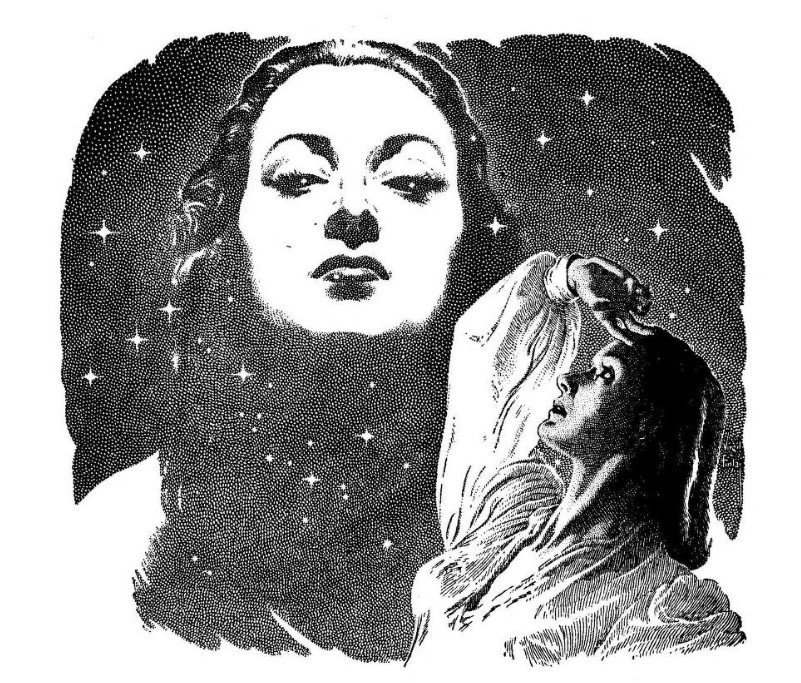
Henry Sharp’s interior art for Fritz Leiber’s “The Ship Sails at Midnight” in Fantastic Adventures, ed. Howard Browne (September 1950)
3/5 (Average)
Fritz Leiber’s “The Ship Sails at Midnight” first appeared in Fantastic Adventures, ed. Howard Browne (September 1950). You can read it online here.
Four self-proclaimed “‘wild’-young people, bohemians” (61), fresh out of college but still “sponging” off their parents “doing academic odd-jobs” (57), encounter the enigmatic and stunningly gorgeous Helen serving food at Benny’s, an all-night diner. Soon after meeting Helen, Es, “something of an artist,” starts to push the boundaries of her previously staid art (56). The narrator, Larry, who calls himself a writer but spends more time “reading magazines and detective stories, lazing around, getting drunk, and conducting […] endless intellectual palavers” (58) suddenly has something to actually write about–a carnal and intellectual love for Helen that they keep hidden from the rest. Louis, a philosopher, slowly encounters new avenues to explore rather than “merely cultivat[ing] a series of intellectual enthusiasms [..] and fruitless-excitement over the thoughts of other men” (57). And the gruff exterior of Gene, an atomic scientist, begins to mellow. All four view Helen as a “Great Books discussion leader” who serves as an intellectual midwife–who fosters, encourages, and inspires the expansion of their minds.
Virgil Finlay’s interior art for Sherwood Springer’s “No Land of Nod” in Thrilling Wonder Stories, ed. Samuel Mines (December 1952)
In the March 1955 issue of John Brunner’s fanzine Noise Level, the young author listed a handful of “thematically edgy stories”–including Sherwood Springer’s “No Land of Nod” (1952), Theodore Sturgeon’s “The World Well Lost” (1953), and Lester del Rey’s “For I am A Jealous People (1954)–that he considered a “step forward” in the field [1]. The previous year he had praised elements of Philip José Farmer’s “The Lovers” (1952) in a fan letter to Startling Stories. According to Jad Smith, the stories feature “lived-in, morally ambiguous backgrounds much noisier and dynamic than the two-dimensional backdrops of more conventional fare” that appealed to Brunner’s embryonic views on genre [2]. Brunner viewed social change as a “messy and unpredictable process riddled with moral complexities” [3].
Today I’ve reviewed the seventeenth story in my series on the science fictional media landscape of the future. John Brunner explores how total immersion media, one organ in a vast futuristic fair designed to satiate the masses, can transform fear within the broken.
Terry Maloney’s cover for New Worlds Science Fiction, ed. John Carnell (March 1956)
4.5/5 (Very Good)
John Brunner’s “Fair” first appeared in New Worlds Science Fiction, ed. John Carnell (March 1956) under the pseudonym Keith Woodcott. You can read it online here. It also appeared in his first collection No Future In It (1962).
I recently devoured Jad Smith’s short monograph John Brunner(2012) in the Modern Masters of Science Fiction series for Illinois University Press. Not only did the book rekindle my desire to tackle more of Brunner’s short fiction but I also bought copies of The Squares of the City (1965) and Quicksand (1967). I might even reread The Shockwave Rider (1975) in the near future. If you are at all interested in John Brunner’s science fiction I recommend acquiring a copy.
Smith identifies “Fair” (1956) as Brunner’s “finest achievement during this [early] period” (Smith 28). I’d rank it right under his spectacular generation ship short story “Lungfish” (1957). As with many of Brunner’s best works, “Fair” had a contested publication history–in this instance John Carnell only accepted it under the pseudonym “Keith Woodcott” to “fill out an issue” (Smith 29). The identity of the consummate wordsmith didn’t last long as Carnell accidentally revealed his identity in next issue when the story came in second in the reader’s poll!
Today I’ve reviewed the sixteenth story in my series on the science fictional media landscape of the future. John D. MacDonald tortures a time-traveler with an immersive TV experience!
Thank you “Friend of the Site” John Boston for suggesting I track this one down for my media series. “Friend of the Site” Antyphayes also brought up the story in a discussion way back in 2018…
Up Next: John Brunner’s “Fair” (March 1956) (as Keith Woodcutt).
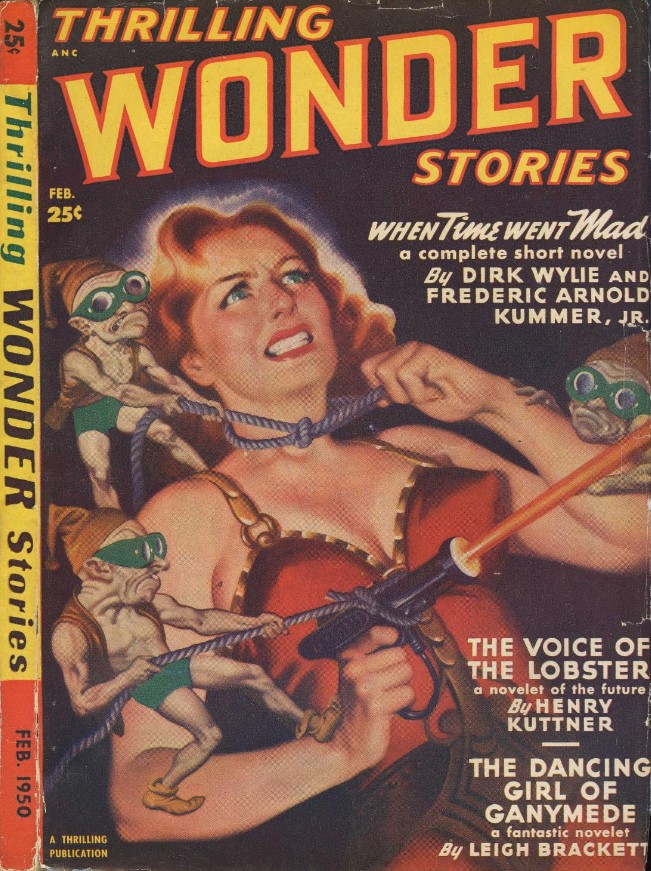
Earle Bergey’s cover for Thrilling Wonder Stories, ed. Sam Merwin, Jr. (February 1950)
4/5 (Good)
John D. MacDonald’s “Spectator Sport” first appeared in the February 1950 issue of Thrilling Wonder Stories, ed. Sam Merwin, Jr. You can read it online here. Note: this is a very short story and my review will contain unavoidable spoilers.
John D. MacDonald (1916-1986), best known for his massive Travis McGee series (1964-1985) and the twice-adapted psychological thriller The Executioners (1957), wrote three SF novels and was a regular in SF magazines in the 40s and 50s (with a handful appearing later). SF Encyclopedia claims erroneously that none of his later “ebullient pessimism” is present in his early SF. “Spectator Sport” embodies “ebullient pessimism” by creating a future where everyone is excited about slipping into delusion.
Today I’ve reviewed the fourteenth story in my series on the science fictional media landscape of the future. Walter F. Moudy relays the coverage of the 2050 Olympic War Games between the United States and Russia with harrowing effect.
Previously: Barry N. Malzberg’s “The Idea” (1971) (as K. M. O’Donnell).
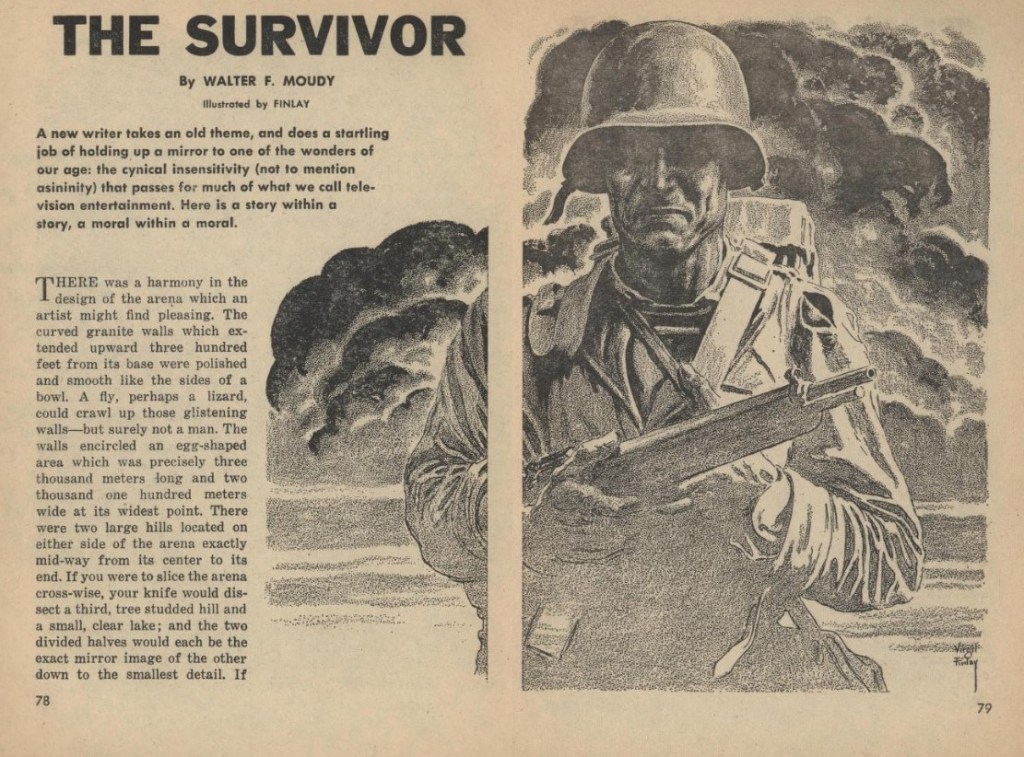
Virgil Finlay’s interior art for Moudy’s “The Survivor” in the May 1965 issue of Amazing Stories
3.5/5 (Good)
Walter F. Moudy’s “The Survivor” first appeared in the May 1965 issue of Amazing Stories, ed. Cele Lalli (Goldsmith). You can read it online here.
Recently James Harris highlighted the truncated writing career of Walter F. Moudy (1929-1973) with a focus on No Man on Earth (1964), his only science fiction novel. Inspired by his comments on “The Survivor” (1965) and relentlessly intrigued by authors who have fallen from contemporary memory, I placed the slick future televised Cold War conflict tale at the top of my media landscapes of the future review list. For those expecting a masterful Henry Kuttner tale, stay tuned! In the meantime, let’s plunge into Moudy’s coverage of the 2050 Olympic War Games between the US and Russia.
Which books/covers/authors intrigue you? Which have you read? Disliked? Enjoyed?
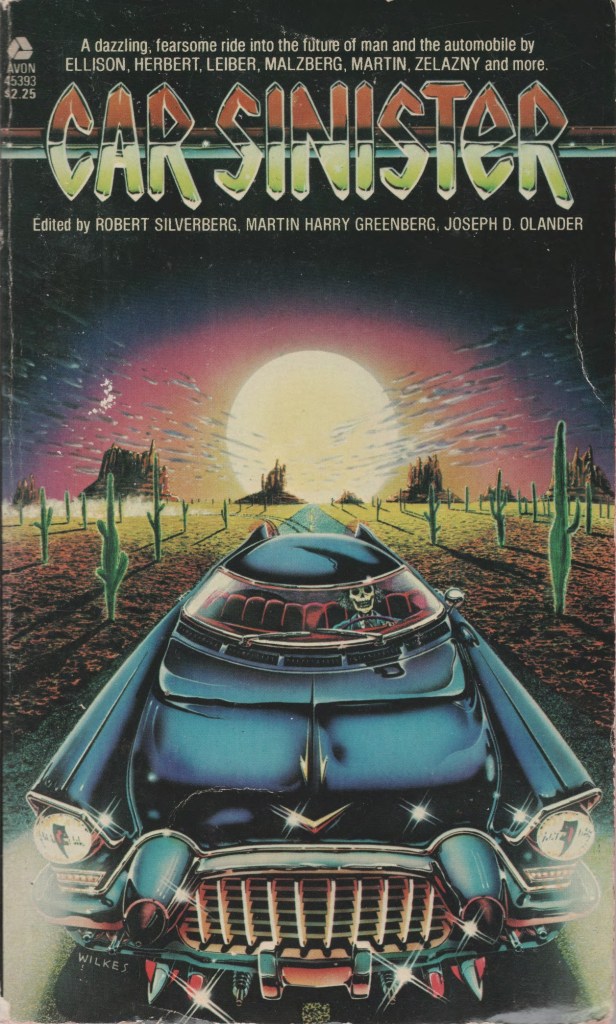
1. Car Sinister, ed. Robert Silverberg, Martin Harry Greenberg, and Joseph D. Olander (1979)
Mike Wilkes’ cover for the 1st edition
From the back cover: “MAN AND HIS MACHINE. The car is man’s most personalized machine; for teenagers it is a rite of passage and a statement of freedom; for adults it is a reflection of success, taste, and hopes; and for an entire culture it is a great and industrious mode of transportation–driving, perhaps, on the road of destruction. And the automobile–thrilling, honking, speeding, nerve-shattering–haunts us with the dark possibility that when our age of motoring innocence is over, we may no longer be the masters… CAR SINISTER–a splendid, imaginative vision of what lies down the road for all of us.”